
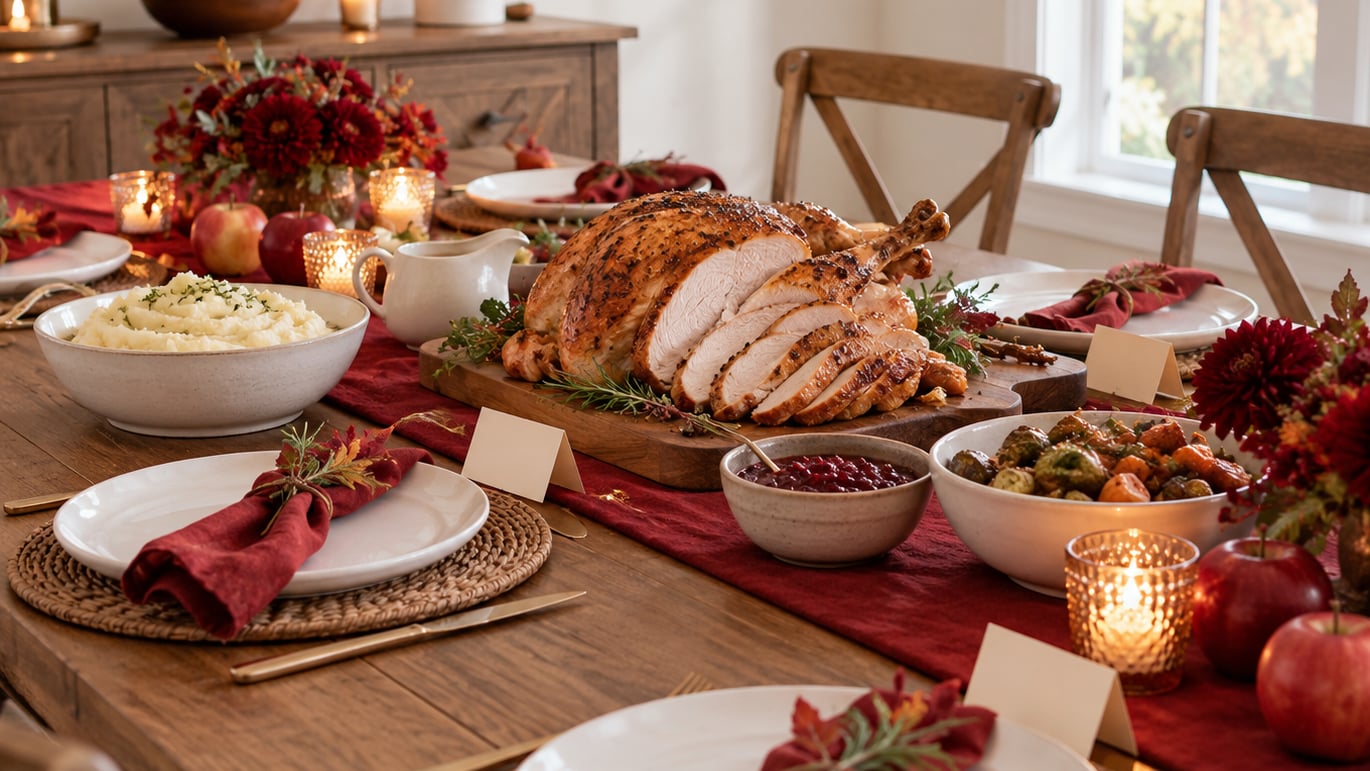
The calm way to learn how to host Thanksgiving for the first time comes down to one idea: plan backwards from the hour you want to sit down. Lock the guest count, pick one main and two or three sides, do nearly everything the day before, then cook a calm morning and let the turkey rest before you carve it. Most first-timers are not short on effort, they are short on a timeline.
The good news is that a first Thanksgiving does not have to be ambitious. It has to be organized. Plenty of people host a table of ten to fifteen with one oven, two burners, and a grocery list that fits on an index card, and they finish the day having actually sat down.
Table of Contents
- What You Need
- Step-by-Step: How to Host Thanksgiving for the First Time
- Common Mistakes
- Frequently Asked Questions
- Should I let Thanksgiving guests bring dishes, or does that look bad?
- How much food should I cook for 10 people?
- What time should Thanksgiving dinner be served?
- How do I host Thanksgiving in a small apartment kitchen?
- How do I cook a turkey for the first time without ruining it?
- What should I serve as Thanksgiving appetizers and drinks?
- How to Host Thanksgiving for the First Time: A Simple Conclusion
What You Need
Before you think about recipes, gather the handful of things that make the day run itself. Most first-time hosts have the cookware but are missing one or two serving pieces, and borrowing them late is the wrong time to discover it.
Paper and planning tools. A notebook or a printed checklist you can mark off in the kitchen. A guest list with names and phone numbers. A menu card or note so you remember what you promised to bring. A grocery list broken out by store aisle, not by what you happen to remember at 9pm on Tuesday.
Kitchen equipment. A reliable instant-read thermometer, without one you are guessing at the turkey and that is where the panic comes from. A carving board with a groove, a sharp knife, a large pot for potatoes, and a roasting pan. If you own a slow cooker, this is the week it earns its counter space: it holds a side dish and keeps your oven free.
Serving supplies. Enough large bowls and platters that every dish has a home, plus a spoon or tongs for each one. Serving spoons are the item people always forget. Disposable containers for leftovers, a roll of paper towels, and a trash bag within reach of the serving area so you are not crossing the room mid-conversation.
Guest details. A final headcount, including children. Any dietary restrictions, allergies included, written down. Arrival times. Who needs a chair with a higher seat, who needs the nearest bathroom, and whether anyone is bringing a dish. If you host in an apartment, count your chairs now and buy a folding table this week rather than next.
Step-by-Step: How to Host Thanksgiving for the First Time
Six steps, in order. Each one has a clear signal that tells you it is finished, so you always know what comes next.
Step 1: Set the Guest List and Headcount
Count adults and children separately. A child under about eight eats roughly half an adult portion, and that difference decides your turkey size and your potato quantity. Write the number down and treat it as final, because every quantity on your list hangs off it.
Ask about dietary needs in the invitation itself rather than a week beforehand, so nobody answers under pressure from a sidebar conversation. Allergies get treated like allergies. Preferences, like vegetarian or no pork, get a swap at the table.
Set one arrival window, something like “anytime from 3 to 4,” and state your dinner time plainly. Hosts in r/etiquette and r/partyplanning threads keep landing on the same advice: ambiguity about timing is what produces the awkward two-hour gap where everyone is hungry and nobody is sitting down.
Decide the plus-one rule now and put it in the invite. “Please let me know by the 1st if someone is coming with you” handles it without anyone getting awkward at your door.
Finally, decide whether this is a potluck or a hosted meal, and tell people either way. Assigning dishes is not a failure of hosting, it is the single most repeated piece of advice across Thanksgiving advice threads. When the assignments are unclear you get three green bean casseroles and no bread.
You are done when the number is written down, every dietary note is recorded, the invite carries a time and a plus-one deadline, and each guest bringing food knows exactly what they are bringing.
Step 2: Choose a Manageable Menu Your Kitchen Can Handle
One main, two or three sides, rolls, one dessert. That is the whole menu. A table of twelve eats far more food than twelve people can finish in one sitting, and every extra dish is another oven slot, another pot to wash, and another thing that can go wrong while you are carving.
Pick the size that matches your oven. A roasting pan needs clearance on both sides, and a bird that touches the walls will not cook evenly. Cookbooks and butchers both suggest about a pound of raw turkey per person for a first hosting attempt, which lands between a half pound for a crowded table and three quarters of a pound if you want generous leftovers.
- 4 to 6 guests: an 8 to 10 pound raw bird, 2 1/2 to 3 hours at 325°F, then a 30 minute rest.
- 8 to 10 guests: a 12 pound raw bird, 3 1/2 to 4 hours at 325°F, then a 30 to 40 minute rest.
- 12 to 14 guests: a 14 to 16 pound raw bird, 4 to 4 1/2 hours at 325°F, then a 40 minute rest.
- 16 to 20 guests: an 18 to 20 pound raw bird, 4 1/2 to 5 hours at 325°F, then a 45 minute rest.
Treat those roast times as a starting point, not a schedule. Thaw in the refrigerator at roughly 24 hours per pound, or in cold water on a running tap at about 30 minutes per pound. A frozen turkey still in the center at noon is the single most common first-hosting disaster, and buying it a week early and thawing it slowly removes the risk entirely.
Now write down what you are not cooking. Your first time is not the time for a stuffed turkey, since the stuffing has to reach 165°F on its own and pushes your cooking time up. Skip from-scratch gravy, which is unforgiving, and pick up a jar if you want it on the table. Skip a second protein. Skip a raw salad as your only vegetable, since it will wilt while everything else waits.
Buying one or two things is allowed. A store-bought pie, a jarred cranberry sauce, a bag of rolls: veterans on hosting threads describe this as a feature rather than a failure. You are not trying to prove anything to people you invited to eat with you.
You are done when your menu fits on one page, your turkey fits in your oven, and your shopping list has a dish attached to every line.
Step 3: Make a Shopping and Prep Timeline
Three shopping waves keep the holiday-week crowds from setting your budget. Wave one, a week or more out: the turkey, shelf-stable pantry items, spices, wine, and anything you can freeze. Wave two, three to four days out: produce that keeps well, potatoes, onions, butter, and dairy. Wave three, the morning of or the day before: fresh herbs, rolls if you are buying them, and anything that wilts.
Avoid the Wednesday and Thursday before if you can. Those are the days the store is a wall of people and the aisles are hard to navigate with a cart.
Know what keeps. A cranberry sauce made three days ahead is better on Thursday than it is on Wednesday. Mashed potatoes reheat fine with a splash of milk. Gravy thickens overnight and just needs heat. Stuffing can be assembled Wednesday and baked Thursday. Roast vegetables hold up. What does not keep is anything crisp, and what cannot be made ahead is the turkey, the rolls if they are yeast-based, and a salad dressed with oil.
You are done when your list has a day attached to each purchase, your fridge and freezer hold every make-ahead dish, and nothing on the list requires a store trip on Thursday morning except fresh herbs and rolls.
Step 4: Set Up the Dining Area and Serving Station
Serving congestion is the failure nobody plans for. Two people carrying hot platters through a doorway is how a gravy boat ends up on the floor. Pick one spot as the serving station, usually a sideboard, the end of a counter, or a folding table in another room, and put everything there. Guests walk to the food. Nothing travels through the dining space.
Set the table the night before if you can. Plates and flatware can go down Wednesday without anyone noticing, and it removes twenty minutes from the most frantic part of the day. Keep the center low: low arrangements, a bowl of apples, a couple of votives. Tall tapers and big floral centerpieces block conversation across the table, which is a shared complaint from veteran hosts and it is worth taking seriously for a table that has to fit ten people in a normal-sized dining room.
If your place settings run out, two end-of-table settings on an extension table beat cramming everyone in. In a small apartment, set the serving table in the kitchen and eat wherever you have floor space. A living room coffee table covered with a tablecloth works. Nobody notices, everybody eats.
You are done when every dish has a spot on the serving station, the dining table is set, and a child or a guest with mobility needs has a seat that is not at the far end of a crowded room.
Step 5: Cook, Serve, and Keep Food Safe
Work backwards from the time you want to sit down. Most hosts aim for 1pm, which means the turkey goes into a 325°F oven by 8am for a 14-pound bird. Build your own schedule from that number: everything else on the timeline shifts with the turkey, since it is the longest item and the only one you cannot speed up.
Here is a workable Thursday for a 1pm serve with a 14-pound turkey. At 7am, preheat the oven and put the turkey in. At 8am, put a slow cooker side on low so it cooks untouched. At 9:30am, start potatoes boiling and put rolls in the oven if they are store-bought. At 11am, finish the vegetables and get them into serving dishes. At noon, pull the turkey and check the temperature in the thickest part of the thigh, avoiding the bone. Rest it 40 minutes. At 12:40, carve, plate the sides, and take everything to the table.
Temperatures matter more than clock time. Use the thermometer, and keep cooking until you hit the number. Poultry, including turkey, must reach 165°F in the thickest part of the thigh and wing and the center of the stuffing. Ground meat needs 160°F. Whole cuts of beef, pork, and lamb, and fish, need 145°F with a three-minute rest. Check the sides too: casseroles and stuffed dishes are ground-meat temperature, so 160°F, which surprises people who assume 165°F applies to everything.
Keep hot food at 140°F or above and cold food at 40°F or below. The two-hour rule covers both ends: perishables should not sit out longer than two hours at room temperature, and one hour if the room is above 90°F. When guests are late, put the platters back in the oven with the door shut and turn it down, rather than leaving everything out on the counter waiting.
To carve without panic, let the bird rest where it does not slide, cut the leg and thigh sections off first, then slice the breast across the grain with the knife edge toward you. Put the carving board on a folded towel so it does not walk across the table.
You are done when the thermometer reads the safe temperature, the turkey has rested, the sides are hot, and everyone is sitting down within fifteen minutes of your target hour.
Step 6: Close the Meal Without Stress
The meal is not over when the plates are cleared, and the host who disappears into the kitchen right after dessert misses their own holiday. Bring boxes out before dessert and box leftovers at the table with whoever is closest. Five minutes of food into containers while the table is still talking is far easier than it sounds later.
Refrigerate perishables within two hours. Turkey and sides go into shallow containers rather than one deep bowl, because a deep mass stays in the danger zone long after the edges cool. Ask every guest to take something, and pack it in a container they brought, which removes both the guilt and the container problem.
Then stop. Set the dishes to soak, put on music, and sit with your guests for an hour. Washing up at midnight versus 10pm changes nothing about the food and everything about your evening. Leave the rest for Friday, and start that day with coffee and nothing urgent.
You are done when the perishables are in the fridge, every guest left with food, and the kitchen is parked rather than half-clean.
Common Mistakes
These are the problems that show up again and again in first-time hosting threads, and each one has a simple fix you can make this week.
Planning to Cook Every Classic Side
Fix it: one main, two or three sides, one dessert. Delegate the rest. A first host with one oven who attempts five from-scratch sides is choosing a guaranteed collision in the kitchen.
Shopping on Thanksgiving Eve
Fix it: buy in three waves and keep the last one tiny. The holiday-week crowd is the reason your total cost climbs and the reason you walk out missing two things you need at noon.
Guessing at the Turkey
Fix it: buy a thermometer, thaw it a week ahead, and check the thigh temperature rather than the clock. Nobody has ever ruined a turkey by overcooking it slightly, and plenty have served one that was pink in the middle.
Carving Before Everyone Is Served
Fix it: rest the turkey 30 to 45 minutes after it leaves the oven. Carving hot meat releases the juice onto the board and makes dry slices, and it is the reason an otherwise good bird disappoints.
Forgetting Dietary Needs
Fix it: put the question in the invitation, and build at least one side that anyone can eat without asking. Being the host who already has something for the vegetarian, the nut allergy, and the person who cannot eat dairy is the job.
Trying to Host and Clean at the Same Time
Fix it: soak dishes, park the cleanup, and be present for the meal. You set the menu, the room, and the schedule; guests will notice you sitting down, and they will not notice the pans soaking until Saturday.
Two more habits are worth picking up from experienced hosts. Have snacks and drinks out the moment guests arrive, because people arrive hungry and a hungry room is a tense room. And pick a serve time you can defend. Late dinner is fine, unplanned dinner is not.
Frequently Asked Questions
Should I let Thanksgiving guests bring dishes, or does that look bad?
Letting guests bring dishes is normal, not a shortcut. Most Thanksgiving meals are a potluck in practice, and first-time hosts in advice threads say assigning dishes is what made the day feel manageable. Put the request in the invitation, list two or three slots such as a vegetable side, a salad, and rolls, and claim the turkey and one side for yourself so the table has an anchor. Tell people what you already have so you do not end up with three green bean casseroles.
How much food should I cook for 10 people?
For ten adults, plan on roughly a 12-pound raw turkey, which lands about a pound per person. Count children as half portions, and add a pound to the turkey if several guests are big eaters. On the side-dish side, three quarts of potatoes, two pans of vegetables, and two dozen rolls covers a table of ten with room for seconds. Cook slightly more than you think you need: a sandwich box on Friday is worth more than a plate of food you threw out on Thursday night.
What time should Thanksgiving dinner be served?
Pick a time and state it in the invitation. Most hosts choose between 12:30pm and 1pm, which works for grandparents, young children, and anyone who plans to travel that day. Say when people should arrive, roughly an hour before dinner, and build the cooking schedule backwards from the serve time. If your turkey needs four hours plus a 40-minute rest, a 1pm serve means it goes into the oven by 8am. A stated time also solves the late-arrival problem before it starts.
How do I host Thanksgiving in a small apartment kitchen?
Shift the food out of your kitchen, not the guests. Cook in batches and use the slow cooker as a second appliance so the oven and the stovetop are never both blocked. Set up a folding table in another room as the serving station so people never queue through the kitchen doorway, and eat at whatever surface fits your group, even a coffee table with a cloth over it. Count your chairs early and borrow or buy a folding table so nobody ends up sitting on a counter.
How do I cook a turkey for the first time without ruining it?
Thaw it slowly in the refrigerator, about 24 hours per pound, which is why you buy the bird a week ahead. Roast at 325°F uncovered on a rack in a pan, without stuffing or wrapping it in foil, and start checking the temperature an hour before you think it is done. It is ready when a thermometer in the thickest thigh reaches 165°F without touching bone. Then rest it 30 to 45 minutes before carving, and a slightly higher roast temperature with a basting tin nearby keeps the breast from drying out.
What should I serve as Thanksgiving appetizers and drinks?
Put something out the moment guests arrive. A cheese board with crackers, spiced nuts, and sliced fruit needs no cooking, which is the point. For drinks, plan one batched cocktail or a pitcher punch made the night before so you are not mixing behind your ear all evening, and expect roughly one to one and a half bottles of wine per drinking guest. Put water and a nonalcoholic option on the table too, and set out a small bin or bag near the door for the coats before the coats become the problem.
How to Host Thanksgiving for the First Time: A Simple Conclusion
Start with five things and the rest of the day arranges itself around them. Confirm your headcount and write it down. Choose one main and two or three sides your kitchen can actually finish. Build a written timeline that works backwards from your serve time. Do everything the day before that can be done the day before. And keep the plan loose enough that a late guest or a broken oven does not undo the evening.
You are allowed to buy the pie. You are allowed to ask for help with the dishes. You are allowed to sit down before the dishes are done. The holiday is the table, not the cooking, and once you know how to host Thanksgiving for the first time, you will be the one answering this question for somebody else.