
Dinner party etiquette for guests comes down to four things: reply when asked, arrive inside a reasonable window, be easy to feed, and thank the host before you go. Everything else is detail. A host who invited you to their home is not looking for perfect posture or a memorized place setting diagram — they want you to show up, be pleasant company, and notice that they cooked.
That said, most dinner party mishaps come from small misunderstandings rather than bad intentions. Arriving at the exact minute dinner is supposed to start. Bringing a bottle of wine back home unopened. Asking the host to send something back the way you would at a restaurant. None of these are disasters, but each one creates a little awkwardness the host has to absorb.
This guide walks through the whole evening in order: what to do in the days before, how to time your arrival, how to behave at the table, how to enter and exit a conversation, when to offer help, what to bring, and how to leave. If you only read one section, read the one that matches whatever part of the evening feels awkward to you.
Table of Contents
- What Dinner Party Etiquette for Guests Actually Covers
- How to Prepare Before a Dinner Party
- How to Arrive Without Being Early or Late
- What to Do During Dinner Party Etiquette for Guests
- How to Be Considerate at the Dinner Table
- How to Join and End the Conversation
- When Should a Guest Offer to Help?
- How to Bring a Gift or Host Contribution
- How to Leave a Dinner Party Gracefully
- Dinner Party Etiquette for Guests When You Do Not Know the Hosts Well
- Frequently Asked Questions
- Should you bring a gift when invited to someone’s home for dinner?
- Is it rude to arrive early or exactly on time to a dinner party?
- How long should you stay at a dinner party after dinner is served?
- What are the three things you should not talk about at the dinner table?
- When should you send a thank you note after a dinner party?
- Conclusion
What Dinner Party Etiquette for Guests Actually Covers
Dinner party etiquette for guests covers six windows of time: what you do before you arrive, how you arrive, how you behave during the meal, how you handle conversation, whether and how you help, and how you leave. Each window has its own small set of expectations, and none of them are complicated.
The useful framing is consideration rather than performance. Ask yourself what the host would have to do if you did not do this, and you usually get the right answer on your own. If the host does not have leftovers packed for you, do not ask. If the host is carrying a heavy casserole, do not stand there with empty hands asking whether you can do anything.
A few rules that come up constantly are not about manners at all. They are about pacing and reading the room. Hosts worry most about timing — food sitting out, guests stuck in the kitchen, a table that stays half empty. Guests who notice the timing without being told tend to be the ones who get invited back soonest.
How to Prepare Before a Dinner Party
Reply to the invitation within a few days, and always before the RSVP date printed on it. A prompt answer saves the host from having to chase a headcount for a table they are already planning. If you cannot attend, decline quickly rather than letting the date slip past.
Say something about food early
Tell the host about allergies the moment you know, not the night of. There is a real difference between a medical allergy, where cross-contact genuinely matters, and a preference, where you are simply not eating the beef. Hosts handle the first one carefully and the second one easily, and mixing them up creates awkwardness for everyone.
A short message works fine: “I’m looking forward to Thursday. I have a shellfish allergy, so nothing that touches the grill, and I’m otherwise happy with anything.” That gives the host the information they need without asking them to redesign the menu around you.
Check the dress code by asking
If the invitation says nothing, look at the invitation itself — the paper weight, the formality of the wording, the time of day. A Saturday evening cocktail invite and a Thursday soup-and-salad invite are not the same event. If you are still unsure, one quick text to the host or another guest settles it, and nobody minds being asked.
Ask before bringing anyone
A plus-one is the host’s decision, not yours. If the invitation offers one, treat it as an offer for that evening. If it does not, ask first, and be genuinely willing to hear no. Showing up with an extra guest the host has not planned for seating, food, or conversation is one of the fastest ways to make an evening feel crowded.
Decide what to bring
Casual weeknight dinners rarely need anything. Formals, birthdays, new homes, and first-time-visit dinners usually call for a small token. More on that later in the guide.
How to Arrive Without Being Early or Late
Aim for ten to fifteen minutes after the stated start time for a casual evening, and on the dot for anything formal. Arriving at the exact minute the food is meant to be served is the one timing that is almost always wrong, because the host is usually still finishing up in the kitchen.
Arriving twenty or thirty minutes early is also a problem. It puts the host in the awkward position of hosting someone who cannot be seated yet. A wide-open invitation with no time on it is different, though — in that case, early is fine, since the host has told you the evening is loose.
When the door opens and the host is not ready
Put your phone on silent, smile, and say something that gives them an out: “No rush at all — I can wait in the kitchen or wherever is easiest.” If they look frazzled, compliment the smell, ask a quick question, or offer to hang your coat. Do not stand in the doorway surveying the room while they apologize.
Coats, shoes, and joining a group already gathered
Follow the host’s lead. If they take coats, hand yours over. If guests are already settled in the living room, you are allowed to join them without waiting to be presented to each person one at a time. A quick round of names, a drink, and a seat somewhere comfortable is a perfectly normal way to start an evening.
If you are running late
Send a short text with a real estimate. Hosts plan courses and seating around a headcount and a clock, so a five-minute heads-up is genuinely useful. Turning up twenty minutes after the main course has been served, unannounced, is the version that creates work.
What to Do During Dinner Party Etiquette for Guests
The first ten minutes after you arrive set the tone. Accept a drink, but do not fix one and hold it for two hours while the food is sitting in the kitchen. Sit where the host indicates, or ask, rather than claiming the seat you wanted.
Wait when the host waits
Food at a home dinner is almost always served hot, so the host will generally wait for everyone before bringing it out. If you arrive after the main course has begun, do not ask for a separate plate later in the evening unless you ask quietly and the host offers — it puts them on the spot with the oven.
Pass dishes and portion correctly
When a dish goes around the table, take what you can realistically eat and pass it on. Serving yourself a large portion before anyone else has taken any reads as either enthusiasm or a claim on the leftovers. If the host serves family-style and you do not know a dish, ask: “What is this one?” is a normal question to ask.
Take care of your own dietary needs
Do not interrogate the host about every dish. Glance at the table, identify what works for you, and if the situation is genuinely unclear, ask the person next to you rather than calling across the table. If you bring a restriction up at the last minute, keep it short and unbothered: “Oh, this is great — I just do not eat shellfish, but I am having everything else.”
Offer to help with the dishes, once
After the meal, clear plates or start the dishwasher if it is right there. One offer, accepted or declined, is enough. Being the guest who insists on helping is its own kind of awkward.
How to Be Considerate at the Dinner Table
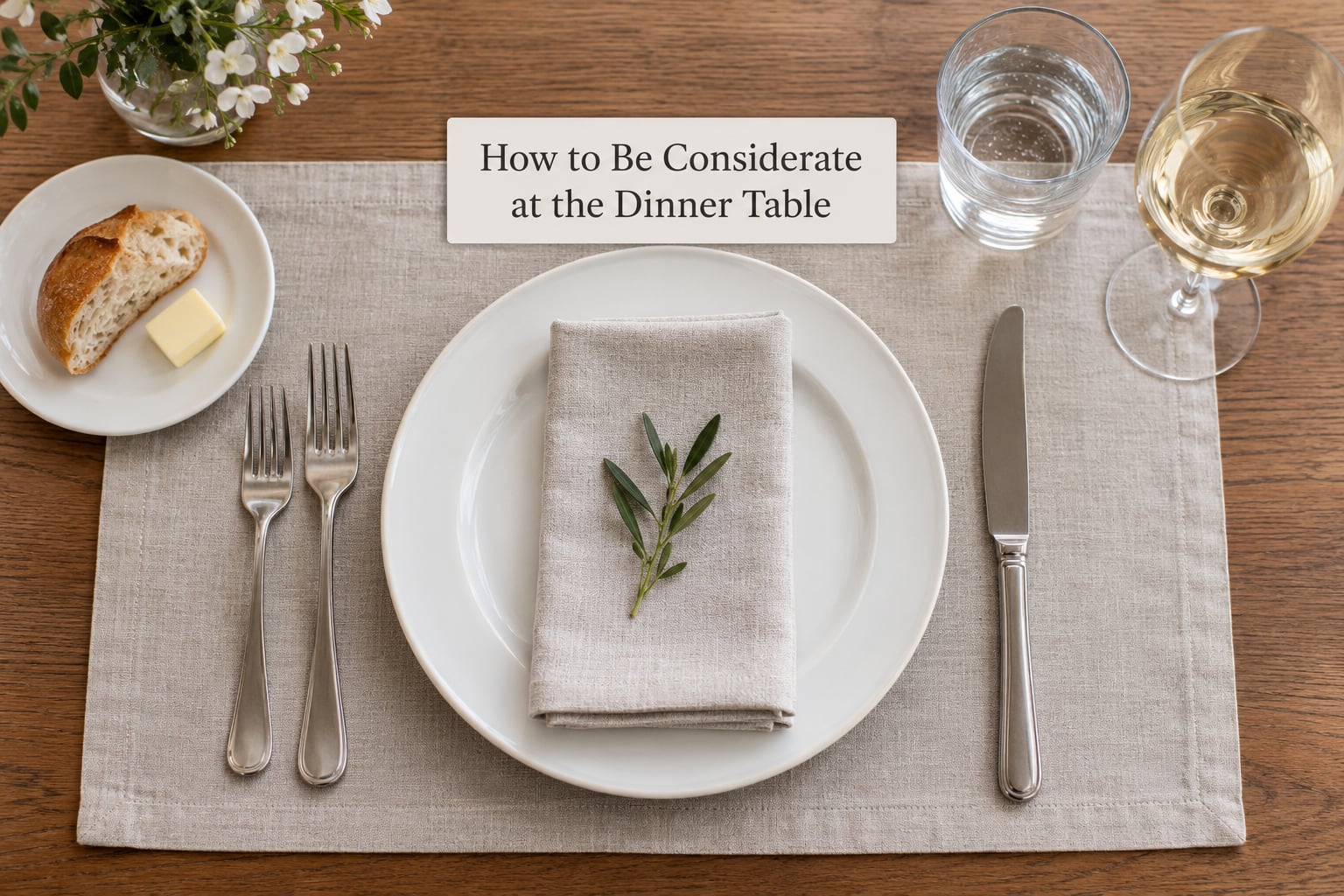
Table manners exist so that the person across from you is not required to watch you eat. That is the whole reason for every rule below.
Utensils work from the outside inward
Start with the utensil furthest from your plate and move inward with each course. Fork and knife beside the plate are for the main course; anything above them is for an earlier one. Take glasses in order of use too, working from the outermost glass inward.
Napkin on your lap, plate on the table
Unfold the napkin into your lap when you sit down. Leave it there for the whole meal. If you need to step away, place it lightly on your chair rather than the table, and do not use it to wipe your hands — that is what the small folded napkin or the restroom is for.
Phones face down and away
Put the phone in your pocket or a bag, or at minimum face down and out of sight. Phones on the table, screen up, pull the eye and change the tone of the room. If you genuinely need it, one glance is fine: “Sorry, I need to check this — one minute.” Photos of other guests need a quick yes first, especially anyone you do not know well.
Rest elbows, pace your eating, and wait to talk
Keep elbows off the table and hands visible. Eat at the pace of the table rather than the pace of your hunger, and do not spear food or pick up a sandwich before everyone has been served. Conversation happens between courses more than during them; you cannot debate politics and chew at the same time, and trying is what people notice.
Decline without making the host twist
Take a small amount and say you would love some more, or simply say “I’ll pass for now, thank you.” Compliment the dish regardless, even if you only like part of it. Sending a plate back, or asking the host to change a dish the way you would at a restaurant, is the one guest behavior hosts complain about most often.
For a larger group, a self-serve spread removes almost all of this pressure, since nobody is serving anybody.
Drink thoughtfully
Refill your own water glass. If the host opened a bottle of wine for the table, you are welcome to pour from it once it reaches you, but do not assume a bottle is there for your table alone. And if you do not drink, say so early and simply: “I’ll stick with water and enjoy watching everyone else’s evening unfold.”
How to Join and End the Conversation
Dinner conversation is the part of the evening guests worry about most, and it is the easiest to get right. People are not waiting for you to perform. They are hoping the table does not go quiet.
Joining a conversation already in progress
Stand near the group for a few seconds and listen. Joining a conversation between two people who are deep into a story can feel like an interruption; joining a table-wide topic does not. A simple “Can I jump in here?” or “What are you all arguing about?” works almost anywhere.
Asking better questions
People remember the question, not the answer. Ask about something they did rather than something they own, and follow the answer with another question before changing the subject. Hosts notice who asks questions, and they also notice when someone talks only to the person next to them for two hours.
Three topics to steer away from
The classic advice is politics, religion, and money. It is dated but not wrong — not because those subjects are forbidden, but because they pull people into positions they cannot back out of gracefully over a shared meal. Uninvited criticism of other guests, weight, and personal appearance are the more reliable offenders at real dinner tables.
Bringing quieter guests in
If someone has said almost nothing all evening, ask them a direct, easy question rather than waiting for them to volunteer. Turning your head toward them and saying “Alex, you work in healthcare, right — how do you see the staffing situation?” gives them a clear opening that does not feel like being put on the spot.
Winding a conversation down
When you are ready to go, start with the host rather than the room. A quiet “I should get moving — I have an early start tomorrow” is a complete exit. Do not announce that you are leaving to the table at large, and do not stand up while someone is mid-sentence.
When Should a Guest Offer to Help?
Offer once, at a moment that actually helps, and accept a no without arguing.
- Before dinner begins: offer to help with drinks, plates, or getting the table set. This is useful and low-pressure.
- During cooking: if the host is clearly stressed, ask a specific question instead — “Can I chop those vegetables while you finish the sauce?”
- During the meal: stay seated. Getting up to help while the food is on the table usually adds a trip and an extra place setting for the host to handle.
- After dinner: clearing plates and loading the dishwasher is the single most useful thing a guest can do at the end of an evening.
- Not at all: if the host says they have help, or waves you toward a chair, sit down. Hovering while someone else cooks is work with extra steps.
How to Bring a Gift or Host Contribution
Bring something for a birthday, a formal dinner, a new home, or the first time you visit someone’s table. Skip it for a casual weeknight the host describes as nothing special, where a bottle of wine can actually add pressure to a budget and to the fridge.
When you do bring something, keep it modest. A thoughtful choice beats an expensive one, and hosts tend to remember the gesture rather than the object.
- Flowers: safe and lovely, but ask first if you know there is a cat, or go with a potted plant instead.
- Wine or sparkling: standard, but check whether the host has a drink they love before assuming. A non-alcoholic bottle is a kind choice at a table where not everyone drinks.
- Dessert or a coffee: works well when the host has said the meal is the whole plan. If you want to bring the main event yourself, how much a platter actually costs per person is worth checking before you commit.
- Something from your own kitchen: bread, jam, sauce. Popular partly because it arrives with nothing to be returned.
What to do with the rest of it
This trips people up more than anything else. If you bring a bottle and the host opens it, it is being shared with everyone and stays. If you bring a bottle, it goes unopened, and the evening winds down, you may ask whether you should take it: “Do you want me to take this back, or would you like to save it?” Asking like that makes it easy to say yes either way.
Guests who quietly repack unopened drinks and desserts without a word tend to be the ones hosts notice, and not kindly. A one-line question fixes it entirely.
How to Leave a Dinner Party Gracefully
Leave when you have been useful and before you have outstayed the evening. For most dinners, an hour or so after the main course is plenty unless the host moves everyone to the living room, which is its own signal that the evening is continuing.
Before you go, find the host alone for a moment. Say something specific — the dish you actually liked, not just that it was great — and thank them for the evening. Specific thanks land; generic thanks sounds like an exit line.
Take food home when the host offers. Say yes even if you are full; a small container of leftovers is a compliment to the cooking, not a rejection of it. If they do not offer, do not ask for seconds in the host kitchen.
Send a short message the next day. Two or three lines is plenty: a thank you, one specific detail about the evening, and an offer to return the favor. That message does more for the next invitation than any table manner at this one.
Dinner Party Etiquette for Guests When You Do Not Know the Hosts Well
When you do not know the hosts well, uncertainty is normal. Every question you would ask a close friend — about gifts, alcohol, arrival gifts, or helping — is better asked than guessed at.
Watch how they run the evening. If they refill drinks without being asked, they would probably rather you did the same. If everything is pre-plated and served on a schedule, stay seated and let the timing unfold. Hosts signal what they need almost constantly; most of the time they just need you to notice.
If you are visiting from another country and the customs do not match what you know, follow the host’s lead every time and ask a small question when you are unsure. “Do we serve ourselves here, or do you serve us?” is not an embarrassing question to ask once. Guests who ask and adapt are described as charming; guests who guess wrong and insist are not.
One last piece of advice for new hosts in your circle: skip the elaborate entrance, the long prepared toast, and the immediate effort to clear the table. Show up on time, eat well, say thank you, and let the evening be ordinary. Ordinary is what people remember.
Frequently Asked Questions
Should you bring a gift when invited to someone’s home for dinner?
Bring something for a birthday, a formal evening, a new home, or your first visit. Skip it for a casual weeknight the host describes as nothing special. A modest bottle of wine, a small bouquet, dessert, or something from your own kitchen all work. The point is the gesture, not the price, and an elaborate gift can actually make a host feel obligated to match it.
Is it rude to arrive early or exactly on time to a dinner party?
Both can be awkward. For a casual evening, ten to fifteen minutes after the stated time is right. For anything formal, on the dot works. Arriving early forces the host to host someone they cannot seat yet, and arriving exactly when food is meant to be served means dinner waits for you. If an invitation gives no time at all, earlier is fine.
How long should you stay at a dinner party after dinner is served?
About an hour after the main course is a solid default for a dinner party. Staying noticeably longer usually means someone is being polite rather than engaged, and leaving during the meal looks worse than either. Watch for the signal: if the host moves everyone to the living room, the evening is clearly continuing, and it is fine to settle in.
What are the three things you should not talk about at the dinner table?
Politics, religion, and money are the traditional three, and the reason is practical rather than moral. These topics pull people into opinions they cannot back out of gracefully over a shared meal, especially with people they only partly know. Also avoid critiquing other guests, commenting on anyone’s appearance or weight, and bringing up business that nobody at the table is part of.
When should you send a thank you note after a dinner party?
The next day is ideal, and a short message is enough. Name something specific about the evening rather than writing only that it was lovely, offer to return the favor, and send it before the host has to wonder whether you enjoyed yourself. If the host gave you something to take home or you stayed late helping, that is the moment a short note matters most.
Conclusion
Most of dinner party etiquette for guests comes down to five moves. Reply before the RSVP date, mention any allergy or restriction early, arrive ten to fifteen minutes after the stated start, pay attention to what the host needs rather than what you assume they need, and thank them warmly before you go.
Bring a modest gift when the occasion calls for one, ask before adding a plus-one, and send a short message the next day. That is genuinely the whole list. The rest is just noticing that you are a guest in someone’s home and treating the evening accordingly.