
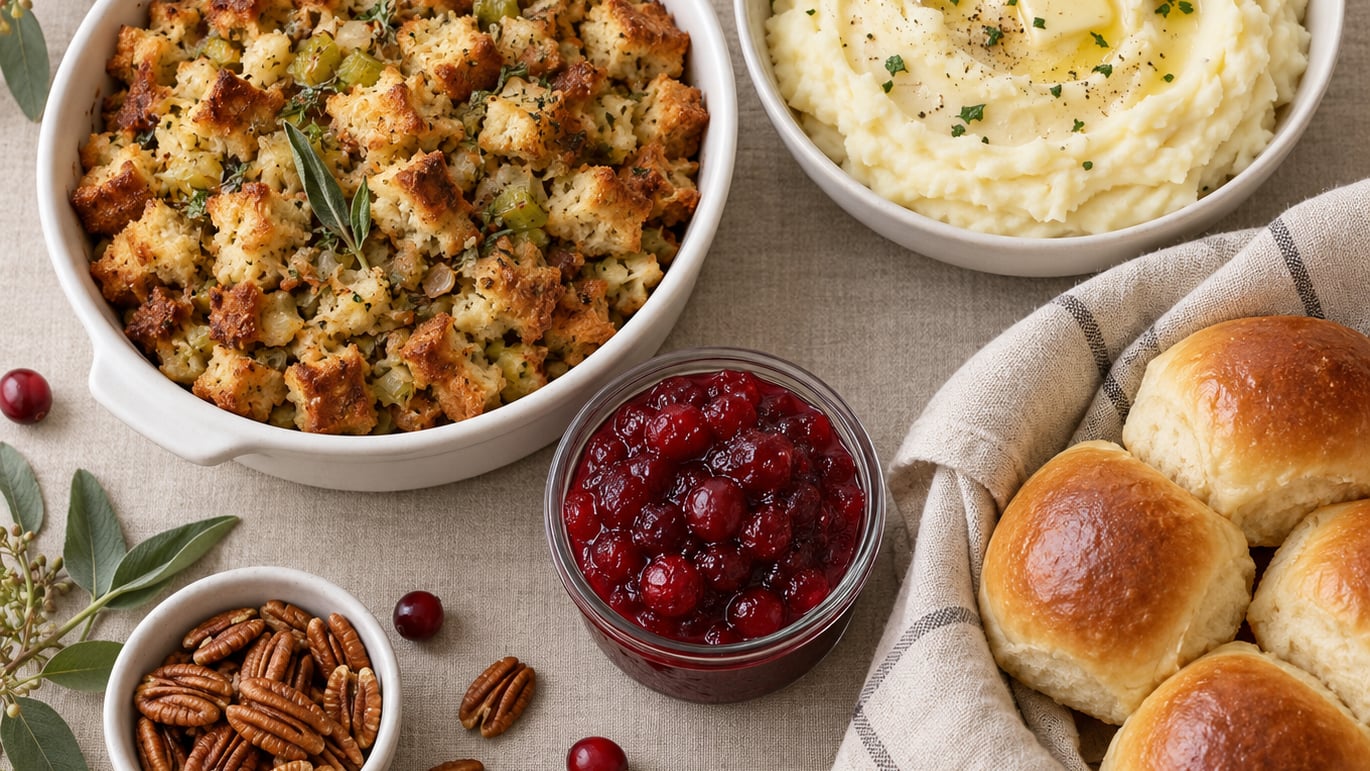
The best Thanksgiving side dishes to make ahead are the ones that reheat without turning to glue: stuffing, mashed potatoes, casseroles, cranberry sauce, gravy and anything you can serve at room temperature. Most starches and casseroles hold their texture for three to four days in the refrigerator, so the real work happens the weekend before, and Thursday is reduced to warming dishes while the turkey rests.
That matters because the oven and the stovetop are the bottleneck on Thanksgiving Day. Cook three sides at once and something sits until it dries out or gets soggy on the bottom. Cook most of them earlier and the oven belongs to the turkey, the 4 p.m. crunch mostly disappears, and you can feed fifteen people from a kitchen that has one oven. The same logic pays off all week if you want a head start on other meals, which is why I lean on a batch of sandwiches made ahead for the whole week whenever I am prepping food in one long session.
I cook for a crowd of twelve every year and I have stopped pretending the day is manageable. What I do now is spread the work across a Saturday, a Tuesday and a Wednesday, then keep Thanksgiving itself to reheating and one dish cooked fresh. This list covers the ten sides I actually make ahead, with the number of days that worked, how each one stores, and how to bring it back to life.
Table of Contents
- Thanksgiving Side Dishes to Make Ahead at a Glance
- 1. Make-Ahead Thanksgiving Stuffing
- 2. Creamy Make-Ahead Mashed Potatoes
- 3. Make-Ahead Green Bean Casserole
- 4. Roasted Brussels Sprouts with Maple and Walnuts
- 5. Make-Ahead Cranberry Sauce
- 6. Southern-Style Make-Ahead Sweet Potato Casserole
- 7. Make-Ahead Dinner Rolls or Biscuits
- 8. Make-Ahead Wild Rice Pilaf
- 9. Make-Ahead Thanksgiving Salad
- 10. Easy Make-Ahead Apple Crumble
- What Not to Make Ahead, Even If You Think You Can
- Frequently Asked Questions
- Which Thanksgiving side dishes are best to make ahead?
- How long can make-ahead Thanksgiving sides stay in the refrigerator?
- Can I freeze Thanksgiving side dishes such as stuffing, mashed potatoes, and sweet potato casserole?
- How do I reheat mashed potatoes without making them dry?
- Should green bean casserole be assembled before Thanksgiving?
- Which Thanksgiving sides can be made the day before and served cold?
- Conclusion
Thanksgiving Side Dishes to Make Ahead at a Glance
Here is the whole plan on one page. The make-ahead window is how far in advance I have gotten good results, the storage column is what I use, and the final column is how the dish goes back on the table. A dash in the travels column means the dish does not survive a long drive well enough to recommend it.
| Dish | Prep method | Make ahead | Storage | Reheat or serve | Travels well |
|---|---|---|---|---|---|
| Stuffing | Assemble unbaked, or bake and cover | 1 day (baked), 5 days (unbaked, refrigerated) | Covered baking dish | Covered, 350F, 25-35 min with a splash of stock | Yes |
| Mashed potatoes | Boil and mash, hold the dairy back | 1-2 days | Shallow container, plastic pressed to the surface | Low and covered, 250F, 45-60 min, stirring in reserved liquid | No |
| Green bean casserole | Assemble without the onions | 2 days assembled, unopened onion can sit 2 weeks in the pantry | Covered casserole dish | Bake 20 min at 325F, scatter onions, 10-15 min more | Yes, warm |
| Maple Brussels sprouts and walnuts | Par-roast the sprouts | 2 days | Airtight container | Roast or skillet 12-15 min; dressing and nuts added at the table | Moderate |
| Cranberry sauce | Cook whole | 5 days refrigerated, 3 months frozen | Airtight container or freezer bag | Served chilled or at room temperature, no reheating | Yes |
| Sweet potato casserole | Bake the casserole, keep the topping separate | 2 days | Covered dish, pecan topping in a separate bag | Covered at 325F for 25 min, then topped and reheated 10 min | Yes, warm |
| Dinner rolls or biscuits | Chill the dough overnight or bake and freeze | Dough 1-2 days, baked rolls up to 1 month frozen | Airtight bag or freezer bag | Bake from chilled at 400F, or foil and 350F for 10 min from frozen | Yes, frozen |
| Wild rice pilaf | Cook, drain, chill | 3 days | Shallow container | Covered with a splash of broth, 350F, 25-30 min | Yes |
| Holiday salad | Prep components, hold the dressing back | 2 days for sturdy greens, same day for delicate leaves | Dressing in a jar, vegetables in a lined bowl | Tossed cold at the table, no reheating | Yes, dressing carried separately |
| Apple crumble | Prep fruit and topping separately, assemble unbaked | 2 days assembled, 3 months frozen unbaked | Covered baking dish | Bake cold, 375F, 45-55 min, until bubbling in the center | Yes, unbaked |
Two rules sit underneath every row. Cool food fully before you cover it, because a lid on a steaming casserole traps condensation and softens the crust. And keep perishable sides out at room temperature for no more than two hours, which usually means putting them out in waves rather than all at once.
1. Make-Ahead Thanksgiving Stuffing
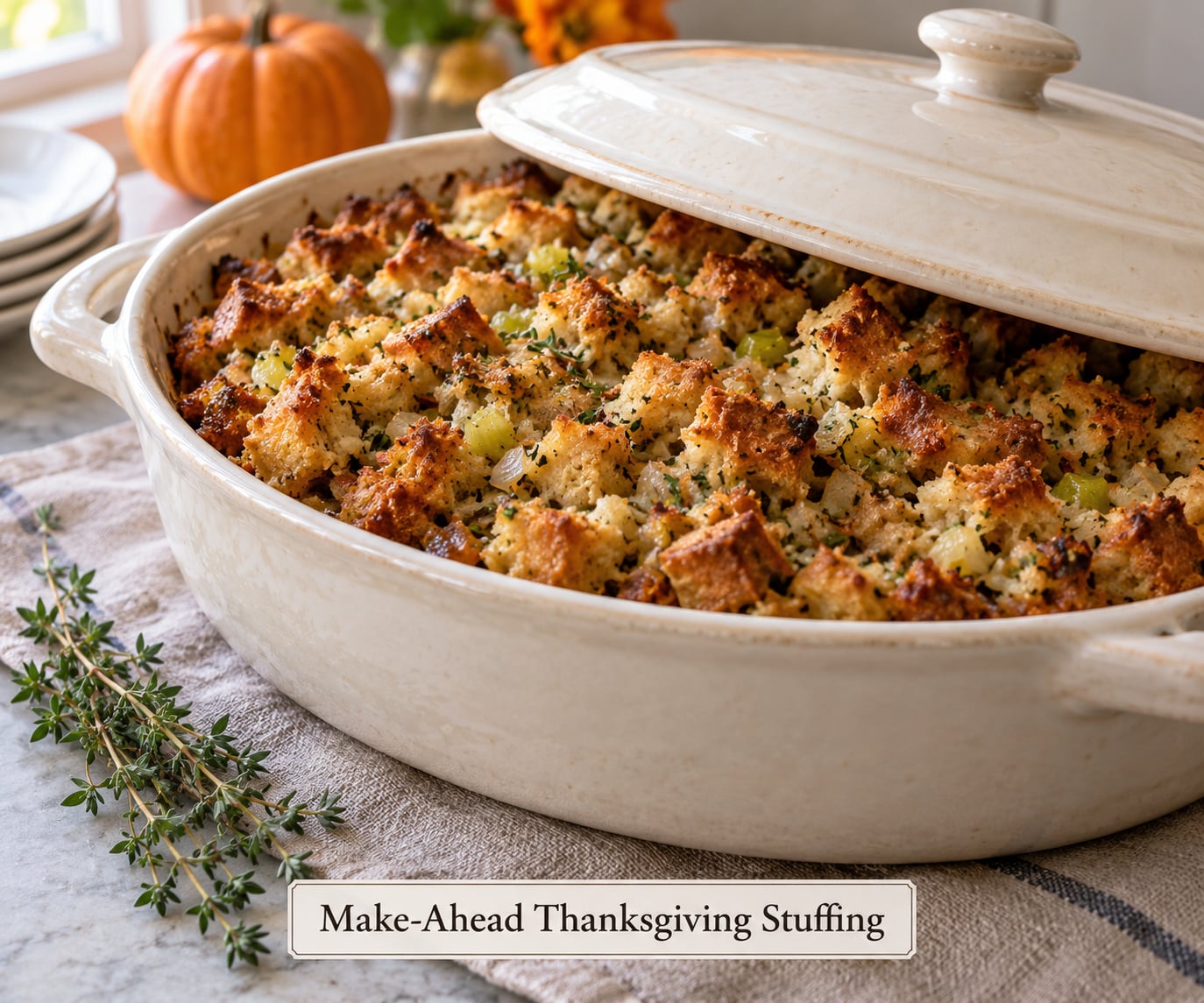
Stuffing is the side most people are told not to make ahead, and the reason is always the same: it turns to mush. That happens when the bread sits wet in a covered dish overnight without any liquid being able to escape. You can get around it, but you cannot skip the covered-then-uncovered finish.
Two methods work. The first is to assemble the bread, onions, herbs and stock in the baking dish, cover it, and refrigerate. Bring it out of the fridge while the turkey is in the oven, add a fresh splash of stock right before it goes in, and bake covered at 350F for about 30 minutes, then uncover for 15 minutes so the top dries out and browns. Unbaked stuffed bread keeps about five days refrigerated in a covered dish, so a Wednesday assembly works fine.
The second method is to bake the stuffing covered on Wednesday, cool it fully, cover it, and refrigerate it whole. On the day, reheat it covered at 350F for 25 to 35 minutes with a little stock poured over the top. That is what I do when I am cooking for a big group, because it means only one baking dish hits the oven on Thursday and the top gets its browning then. Bread cubes reheated dry are why so many people dislike leftover stuffing. Stock is the fix.
Stuffing is also the one Thanksgiving side worth freezing. Cool it completely, wrap the dish in foil plus a freezer bag, and it holds three months. Thaw in the fridge overnight with the foil still on, add stock, and bake as if it were fresh.
2. Creamy Make-Ahead Mashed Potatoes
Yes, you can make mashed potatoes the day before, and for a big table it is the difference between a relaxed holiday morning and a standing-at-the-stove one. The trick is holding the dairy back. Cream, butter and milk are what go gluey and grey overnight, so you mash the potatoes with just a little of the butter and save the rest.
Boil the potatoes whole, drain them well, and mash them while they are still hot and dry. Salt generously at this point, since a lot of it is still in the water. Spread the mash in a shallow container rather than a deep bowl, press plastic wrap directly onto the surface to stop a skin forming, and refrigerate. Two days is the limit; three days is where the texture starts going mealy.
When make-ahead Thanksgiving side dishes go wrong in the fridge
The three failures I see most often are all storage problems. Potatoes go gluey because the dairy went in too soon. Green bean casserole goes watery because it was assembled uncovered and the condensation had nowhere to go. Salad wilts because it was dressed in the morning and sat for six hours before anyone ate it.
For the potatoes, whisk the butter and cream together while they are still cold, then stir that mixture into the mash in small additions. Add the reserved cooking liquid a splash at a time until the potatoes loosen back to the texture you want. Reheat covered at 250F rather than 350F, and give it a stir halfway through. The oven will take the chill out evenly without driving off moisture.
Do not reheat mashed potatoes in a microwave if you have another option. The edges get hot and rubbery long before the middle is warm, and you end up with two textures in one bowl. If a microwave is all you have, use 50 percent power in three- or four-minute bursts with a stir between each.
3. Make-Ahead Green Bean Casserole
The question I get most often is whether green bean casserole should be assembled before Thanksgiving, and the honest answer is yes with one exception: leave the onions out.
The canned fried onions are what go soft first. They are also the easiest part to buy and the part you most want crisp, so the entire dish should be built around keeping them dry. Assemble the green beans, cream of mushroom soup, milk and butter in the casserole dish, cover it, and refrigerate for up to two days. The onions stay in the pantry until Thursday, and you can use them straight from the can because they keep for months.
Bake it at 325F for about 20 minutes until the sauce bubbles at the edges, then scatter the onions over the top and give it another 10 to 15 minutes. That two-step finish costs you nothing but a little attention, and it is the difference between a crisp top and a pale soft one.
Green bean casserole travels well warm, which makes it one of the better choices for a potluck, since it can go straight into someone else’s oven. Freeze it unbaked with the onions on top if you want to be safe; cream soup casseroles freeze for up to three months and thaw cleanly in the fridge overnight. Do not freeze a baked green bean casserole, because the topping never recovers its crunch.
4. Roasted Brussels Sprouts with Maple and Walnuts
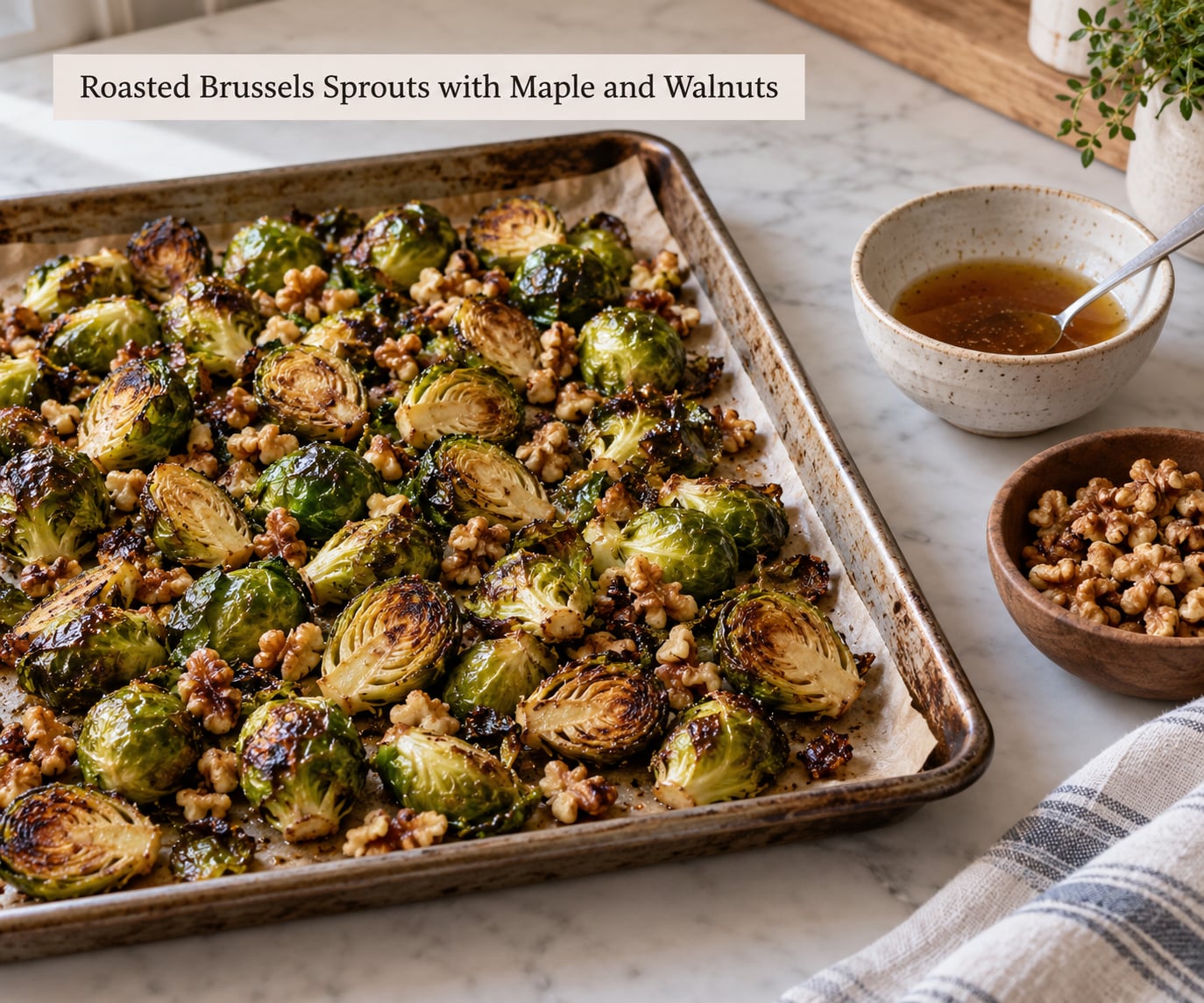
Roasted vegetables get a bad name for reheating, mostly because nobody separates the parts. A maple dressing soaking into hot sprouts and walnuts going soft in a sealed container is not a reheating failure, it is a storage failure.
Blanch or roast the sprouts a day or two ahead. Blanching takes three minutes in salted boiling water, then an immediate ice bath, and it keeps the color bright. Roast them at 425F for 15 minutes and cool them before you cover the container, because any trapped steam softens the outer leaves.
Keep three things separate until the table. The dressing goes in a jar in the fridge. The walnuts go in a separate container, ideally with a paper towel, because damp nuts turn to paste. The sprouts stay on their own. On the day, either roast them at 425F for 12 minutes or throw them in a hot skillet with a little oil, and they come back with their bite intact.
This is also the easiest side to cook outside the oven, which matters when the turkey has claimed the whole cavity of yours. A skillet or an air fryer gets the same result and frees the rack.
5. Make-Ahead Cranberry Sauce
Cranberry sauce is the easiest win on the list. There is no reheating, no texture to protect and no oven space involved. It also travels better than anything else here, because a jar of sauce survives a 90-minute drive without a fuss.
Most recipes improve after a night or two in the fridge, so making it two or three days ahead is an upgrade rather than a compromise. Use the frozen berries if you like a brighter, sharper sauce; canned berries cook down faster and sweeter. Season as usual with sugar, orange juice and cinnamon, and stop adding sweetener once the berries pop and the liquid coats a spoon.
Refrigerated in an airtight container, homemade sauce holds about five days. Portion it into small jars if you serve a big table, so nobody is passing one heavy dish around and dripping on the tablecloth. If your holiday runs long, freeze half in a bag with the air squeezed out and thaw it in the fridge the morning of.
Take it out of the fridge 20 to 30 minutes before dinner. Cranberry sauce served cold straight from a cold container is far too tart to taste anything, and letting it lose its chill makes it taste more like the holiday than a straight-from-the-fridge version.
6. Southern-Style Make-Ahead Sweet Potato Casserole
A pecan-topped sweet potato casserole is easy to make two days ahead because the topping and the filling fail in different ways. The filling gets dry. The topping goes soft. Split them and both problems disappear.
Bake the casserole on Wednesday with the eggs, sugar, butter and milk, but leave the pecans off. Let it cool uncovered before you cover it, or the top steams itself soft. Two days in the fridge is fine, and it freezes well up to three months if you assemble it unbaked and add the pecans later.
On Thanksgiving, cover the dish and warm it at 325F for about 25 minutes, since it starts cold. Scatter the toasted pecans on top, then put it back in for 10 minutes so the nuts brown and crisp. If you toast the pecans separately and store them airtight, you can skip that last step entirely and scatter them at the table.
Watch the dairy. Sweet potato casserole reheated to a hard boil goes curdled, and reheating at a hard boil is what the microwave does by default. A covered oven reheat at 325F keeps it creamy.
7. Make-Ahead Dinner Rolls or Biscuits
Bread is the side people assume has to happen on the morning, and it doesn’t. There are two routes, and the right one depends on how you feel about a rise schedule.
The dough route: mix the dough, knead it, cover it tightly, and refrigerate overnight. That overnight chill is actually a flavor advantage, since a slow cold rise develops more tang than a room-temperature rise on the morning. Pull the dough out about two hours before you plan to bake, let it come to room temperature, shape it, and let the second rise run a little longer since the dough starts colder. A common adjustment is to skip the second rise entirely for rolls, which means you can bake straight from the fridge after a short 30-minute rest.
The freeze route is simpler. Bake the rolls completely, cool them, and freeze them in a single layer first so they do not fuse together, then bag them. Frozen baked rolls reheat at 350F wrapped in foil for about 10 minutes, and they come out genuinely good rather than merely acceptable.
Whatever route you take, do not refrigerate baked rolls uncovered. The crust goes soft in a few hours and never comes back. Wrap the whole batch in a clean towel and then a plastic bag if they are sitting out for more than an hour.
8. Make-Ahead Wild Rice Pilaf
Wild rice is one of the best make-ahead sides for a large gathering, because a batch covers a lot of plates and it does not mind sitting in a slow cooker while everyone eats the first round of turkey.
Cook the rice, let it steam dry in the pan for a few minutes, then spread it into a shallow container to chill fast. Three days refrigerated is comfortable. Keep any nuts, herbs or dried fruit separate, for the same reason as the Brussels sprouts: they get caught in steam and lose their texture. A spoonful of butter folded into the rice before chilling keeps it from drying out in the fridge.
Reheat covered at 350F for 25 to 30 minutes with a splash of broth. It will drink more liquid than you expect, which surprises people who ate leftover wild rice at school and assume that was the plan. Add the liquid gradually and keep testing, because too much turns the pilaf into soup.
For a buffet, put the pilaf in a slow cooker on warm rather than a serving dish on the table. It will sit at temperature for hours without drying the way it does on a bare platter. If it travels, take the broth in a separate jar and add it on the far end. Assembling the night before so nothing has to be plated cold is the same idea behind building a deli platter at home that looks catered: you do the work in a calm kitchen, then set the table out ready to eat.
9. Make-Ahead Thanksgiving Salad
A salad is the one side nobody expects to be make-ahead, but it is the one that benefits most, because assembling a salad at 4 p.m. is exactly the kind of last-minute chopping that wrecks a host’s schedule.
The rule is components. Wash and dry the sturdy greens a day ahead and store them in a bowl lined with paper towels. Cut the vegetables, cook the eggs or roast the squash, and make the dressing a day ahead in a jar, all refrigerated separately. Keep the nuts, croutons and cheese out until the last five minutes, because that is the one part of a salad that goes soft overnight.
Drying matters more than anything else here. Water trapped in lettuce is what makes a salad limp by the time it is served, so spin it properly after washing and store it dry. If you are using delicate leaves like arugula or baby spinach, hold those until the morning. Good sturdy greens tolerate two days; fragile ones do not.
Dressings made two days ahead, especially vinaigrettes, are often better than day-old ones, since the sugar and acid have time to settle. Keep creamy dressings in a separate jar rather than pouring them into the greens, and thin mayonnaise-based ones with a splash of water or milk before serving.
10. Easy Make-Ahead Apple Crumble
Apple crumble is the best-value side on the list for a different reason than the others: it feeds a crowd for almost no effort, and it is one of the few dishes nobody at the table expects you to be an expert.
Prep the fruit and the topping separately a day or two ahead. Toss the sliced apples with sugar, lemon juice and spices, and hold them in the fridge. Keep the flour, butter and sugar crumble in a separate sealed container so it stays dry. You can assemble the whole dish unbaked up to two days before, or freeze it unbaked for three months.
The important detail is that it bakes from cold. If you bake it from room temperature or straight from the fridge without adjusting, the topping melts into the fruit before it can crisp. Start it at 375F and give it 45 to 55 minutes for a deep dish, until the fruit is bubbling thickly in the center, not just at the edges.
Assembled and unbaked, it travels perfectly. Take it frozen or chilled, let whoever is hosting put it in the oven while the turkey is resting, and it finishes right on time. This is the dish I bring when I know the kitchen I am walking into has one oven and no idea what I am bringing.
What Not to Make Ahead, Even If You Think You Can
Some sides fail at the fridge, and knowing which ones saves a lot of wasted effort. Anything fried or breaded is the biggest one. Pre-crisping fried chicken or breaded onions and storing them overnight is a reliable way to end up with a soft, pale version of what was supposed to be the crispest thing on the table. Crisp elements get their texture in the last few minutes of a hot oven or in fresh oil, not from a night in plastic.
Dressings and raw salads are the second group. Vinegar and salt pull water out of leaves, and every hour makes the salad less like a salad. Prep the components, not the finished plate.
Delicate roasted vegetables like asparagus and thin-sliced squash fall into the same trap as the sprouts. Reheated a second time, they go soft and watery rather than crisp. If you must prepare them ahead, roast them raw and finish them on the day in the oven you already have running for something else.
And skip anything you will serve cold and want to serve crisp, like a fruit salad with bananas or a salad with croutons. Cold temperature plus waiting time is one-way.
Frequently Asked Questions
Which Thanksgiving side dishes are best to make ahead?
Casserole-style dishes, stuffing, mashed potatoes, wild rice, gravy and anything served at room temperature are the best make-ahead sides. They reheat well, they hold their flavor for three to four days refrigerated, and they free your oven for the turkey. Skip fried or breaded sides, raw salads, and anything crisp that you plan to reheat.
How long can make-ahead Thanksgiving sides stay in the refrigerator?
Cooked sides keep three to four days in the refrigerator, which is the USDA guideline for most leftovers. Cool them completely before covering them, store them in shallow containers so heat escapes quickly, and label what is inside and the date. Anything older than four days should be frozen or discarded rather than served.
Can I freeze Thanksgiving side dishes such as stuffing, mashed potatoes, and sweet potato casserole?
Stuffing freezes well unbaked or baked for up to three months, and sweet potato casserole freezes unbaked with the pecan topping added later. Mashed potatoes do poorly as a mash, so freeze them as a shaped casserole with eggs and cream instead. Thaw everything in the refrigerator overnight, never on the counter.
How do I reheat mashed potatoes without making them dry?
Reheat covered at a low temperature, around 250F, so steam cannot escape and pull moisture out of the mash. Stir in a splash of the cooking liquid you reserved, and add the butter and cream you held back, a little at a time until the potatoes are loose again. A microwave reheats the edges long before the center, which is why it produces two textures at once.
Should green bean casserole be assembled before Thanksgiving?
Yes, assemble the green beans, soup, milk and butter up to two days ahead in the covered casserole dish. Keep the canned fried onions out of it and scatter them on before the final bake, since they are the part that turns soft. Bake at 325F for about 20 minutes, add the onions, then another 10 to 15 minutes for a crisp top.
Which Thanksgiving sides can be made the day before and served cold?
Cranberry sauce, pickled vegetables, roast beef or ham sliced cold, potato salad, coleslaw, pickled beets and chilled soups all work well made the day before and served without reheating. Take refrigerated items out around 20 to 30 minutes before dinner so they are not shockingly cold, and never leave perishable sides at room temperature for longer than two hours.
Conclusion
Start with the dishes that reheat well and improve overnight: stuffing, cranberry sauce, gravy, wild rice and a casserole or two. Those five take most of the work out of your Thursday without you touching the food twice.
Then keep the rest of your plan boring and consistent. Cool everything fully before you cover it, use shallow containers, label each one with the date, and remember that refrigerated make-ahead Thanksgiving sides have a four-day ceiling rather than an unlimited one. Reheat casseroles and other perishable sides to 165F, put cold items out in waves so nothing sits out past two hours, and let your oven do what it does best while you are not standing in front of it.
One last suggestion: choose your dishes based on the size of your oven and your guest list, not on what sounds impressive. A single crowded oven plus one casserole and a warm salad will feed a table better than four dishes fighting for the same rack.