
Learning how to split the bill at a restaurant without awkwardness comes down to one thing: timing. Ask your server when you place your order, not when the check lands on the table. Splitting a bill is a normal request that servers handle several times a night. The tension people feel usually has nothing to do with the request itself.
The fear is almost always the same. Someone is worried about looking cheap, petty, or difficult in front of friends or family. That fear is what creates the silence, and the silence is what makes it feel rude. Break the silence early and the rest of the meal gets easier, not harder.
Most of the discomfort also comes from not having words ready. You do not need a speech. You need one sentence per scenario, and you need to say it early enough that the server can still act on it.
While you are here, you might enjoy how to meal prep sandwiches for the week without soggy bread, since good planning at home tends to make anything after dinner feel easier.
Table of Contents
- What You Need to Split the Bill at a Restaurant Without Awkwardness
- Step-by-Step
- Common Mistakes
- Tips
- Frequently Asked Questions
- Should I split the restaurant bill evenly or by what each person ordered?
- How do I split a restaurant bill when several people shared one dish?
- Who should pay the tip when the check is split several ways?
- Can a restaurant split one check into separate payments?
- How do I ask the server to divide a check fairly?
- What should I do if my friends want to split the bill differently from me?
- Conclusion
What You Need to Split the Bill at a Restaurant Without Awkwardness
Very little. The awkwardness comes from doing this with nothing prepared, not from missing equipment.
- The itemized check. Ask for it printed with every line separated. If a drink or appetizer was added and not requested, you cannot question it later.
- A rough sense of each share. You do not need exact math in your head. Knowing roughly what each person ordered is enough to catch a real mistake.
- An agreed tip amount. Settle on a percentage or a number before dividing, so the tip does not become a second argument.
- A calculator or a payment app. Phone calculators handle the cents. Splitwise, Settle Up, Venmo, and Cash App all handle the later transfer without anyone tracking who paid what.
- One person willing to do the math. Volunteers make this dramatically calmer. Elect them out loud so nobody is appointed by surprise.
Step-by-Step
Step 1: Decide How to Split the Bill Without Awkwardness
Pick the method before the food arrives, and say it to the table so nobody is guessing later.
Even split. Everyone pays the same amount. Say: “Let’s just split it evenly tonight, it’s simpler.” It works best with small groups where the totals are close.
Separate checks. Everyone pays for exactly what they ordered. Say: “Can we get separate checks when you get a chance?” Best for dates, coworker meals, and tables with very different orders.
Shared items only. Each person pays for their own food, and shared appetizers or bottles get split among the people who actually had some. This is the fairest method and takes the most math. One clean line covers it: “I’ll cover my plate and we can split the apps and the bottle between us.”
Pay for what you ordered, no negotiation. Pay your own share and settle the rest later. Say: “I’ll just send you my half after dinner so we’re not doing math here.”
One more option worth knowing: food on one check, drinks on another, then split each evenly. On a table with two people drinking and four who are not, it produces a fair result with almost no mental arithmetic.
Step 2: Review the Itemized Bill
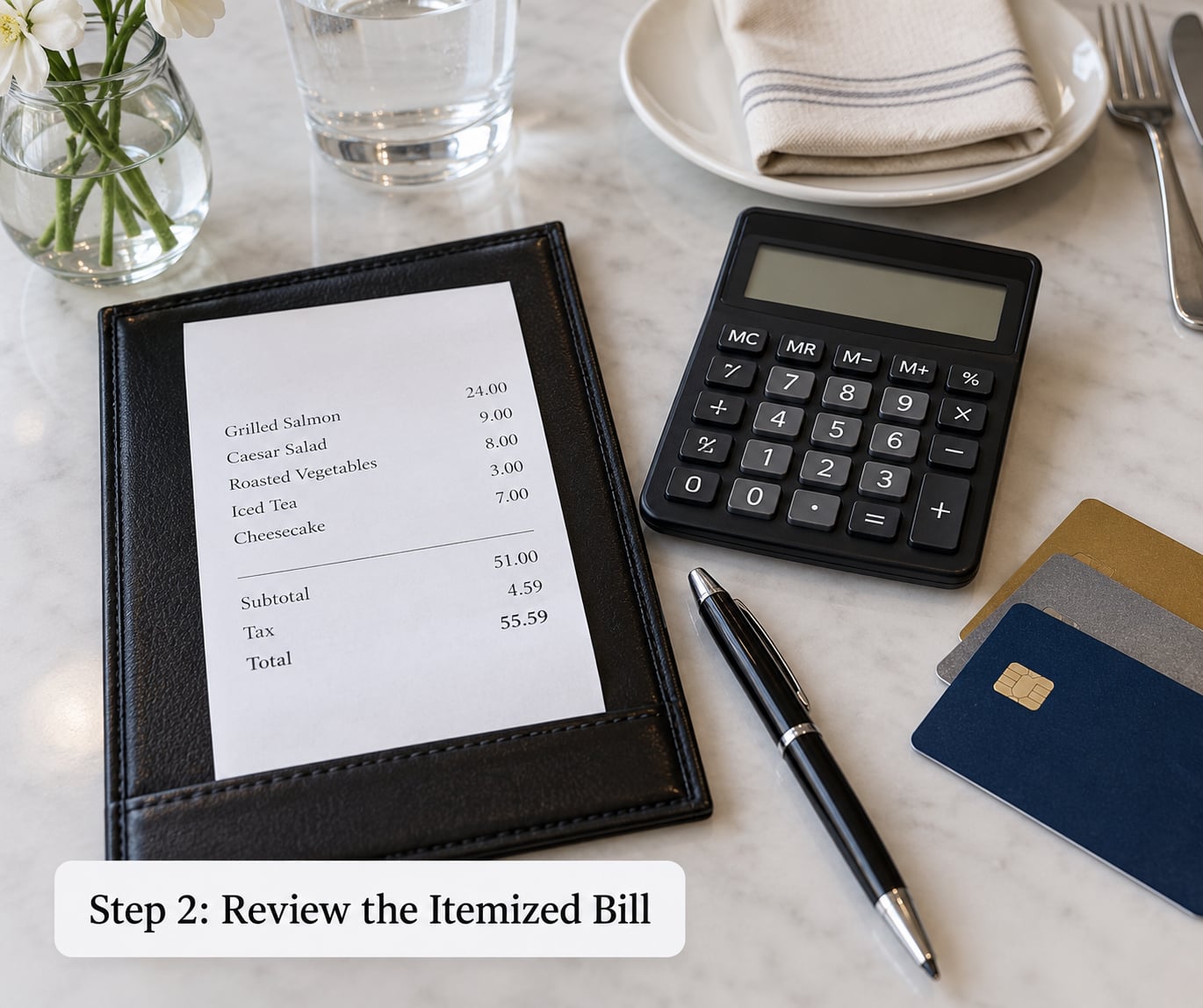
Read the check before anyone says a number out loud. Confirm the entrees, the drinks, and the appetizers match what was ordered.
If something looks wrong, handle it the same way you would handle any mistake. Point at the line and ask the server calmly. “Did we get two of the flatbread? I only see one on the order.” Vague accusation feels worse than a specific question.
Also check tax and any added fees before dividing, since those usually get split evenly even when food does not.
Step 3: Agree on the Total and Tip
Decide the tip before dividing the food. People rarely argue about a percentage out loud, but they do argue about whether drinks are included in the tip base.
A short sentence covers most cases: “Let’s tip on the whole bill, including the drinks.” Then nobody has to guess what base you used.
Do not skip or shrink the tip to protest a split you dislike. The server did not cause the problem, and reduced tips land on people who had no part in it.
Step 4: Calculate Each Person’s Share
Work the numbers in a specific order so nobody watches you fumble. Take the food total first, subtract tax and any fees, and split that figure by the chosen method.
For an even split, divide the pre-tip total by the number of people, then round to the nearest cent. For a food total of 96.40 across four people, each share is 24.10. For 93.60 across four, each share is 23.40.
For a shared appetizer, divide that line item only among the people who ate it. A 22.00 appetizer shared by three people adds 7.33 each, and the rounding difference of a cent or two usually settles itself.
For a bottle of wine ordered by two people on a six-person table, divide the bottle line by two rather than six. That one adjustment is usually the whole disagreement.
If the numbers will not divide cleanly, round your own share up and let the difference sit. Trying to make every line end in zero is a good way to lose ten minutes.
Step 5: Collect and Confirm Payment
Choose the payment path that produces the least public counting. Four options work well.
- One person pays, everyone sends their share. Common and fast. Use a shared payment link, a group text, or a bill-splitting app so nobody has to announce a number.
- Everyone pays at the register with separate checks. Cleanest, and it avoids the group counting money in the middle of a dining room.
- Pay at the table with a QR code. More restaurants now use QR or app-based ordering with seat-level tabs. Each person enters their own card and pays for their own items. This quietly removes most of the problem.
- Card handed around at the table. Fine for two or three people. Not great for eight.
Whatever the method, have one person state the final figure quietly and confirm it once: “So that is 27.40 each, all in.” A single clear confirmation prevents the second-guessing that follows silence.
Step 6: Close the Interaction Politely
Money exchanges stay comfortable when they end on a normal social note. A short thank-you does most of the work.
Something like “Thanks for sorting that out” or “Thanks for dinner, that was great” signals that the transaction is finished and nobody needs to keep tracking it. Then stop discussing it.
If you are still settling up later, one line is enough: “Just sent it, thanks for covering in the meantime.”
Common Mistakes
Almost every awkward bill split traces back to one of these six.
- Bringing it up when the check arrives. By then everyone has committed money and the room has an audience. Fix: ask your server when you order.
- Ignoring shared items. Dividing only entrees looks precise but quietly makes whoever skipped the appetizers pay for it. Fix: split shared lines separately.
- Letting one person order for the table without checking. Extra drinks and desserts that nobody agreed to usually land on whoever is splitting evenly. Fix: order your own additions yourself.
- Calculating the tip twice. Once on the bill and again in the app. Fix: decide the final amount in one place and write it down.
- Assuming the bill is fair. Nobody wants to be the one who raises it, so everyone assumes everyone else checked. Fix: appoint a reader.
- Leaving without confirming the final total. Uncertainty after the fact is worse than any conversation at the table. Fix: verify once, in one sentence.
Two habits also cause real damage. Reopening who ordered what from six months ago has no payoff. And freeloading on a shared app that was never offered to you is noticed every time.
Tips
Different groups want different things. A date usually wants separate checks. Family dinners usually go even. A group of eight friends often cannot track itemized math at all, so an even split or a rotating-payer system serves better.
Rotate payment across repeat dinners. If you eat out with the same people regularly, alternate who covers the bill. It removes the fairness question entirely because everyone pays the same total over time.
Ask the server how they prefer to handle it. Servers know their own point of sale system. Asking “what is easiest on your end?” takes the pressure off them and often gets you a better answer than a specific demand.
Know when a restaurant will say no. The two reasons are server time and the point of sale system. A busy table in the middle of a rush makes a complex split genuinely hard, and some systems cannot separate a check after the fact.
Fine dining is the exception. At a formal or high-end venue, asking to divide checks can read as unusual. Everywhere else, it is ordinary.
Watch the cultural tell. The expectation of an even split is largely American. Other dining cultures often separate checks without any social charge at all, which is worth knowing before you read too much into the moment.
Have a recovery line ready. If you already agreed to an even split and it is landing badly, say this early: “I would rather just pay for what I ordered, if that is okay with everyone.” Stating your preference plainly takes the weight off the person who was dreading bringing it up.
Whichever method you choose, saying it early is what removes the awkwardness. A server who hears it at ordering time treats it as routine. The same request at the check arrives as a public negotiation, and no amount of good phrasing fully hides that.
Frequently Asked Questions
Should I split the restaurant bill evenly or by what each person ordered?
Split evenly when the orders are close in price or the group is large enough that itemized math would be tedious. Split by item when one person ordered noticeably more, when there is a clear drinker and non-drinker split, or when anyone is on a tight budget. Say which method you prefer out loud before the check arrives, so nobody is left guessing later.
How do I split a restaurant bill when several people shared one dish?
Put shared items on their own line and divide just that line among the people who had some. An appetizer of 22.00 shared by three people adds about 7.33 each. A bottle of wine ordered by two people on a six-person table is split two ways, not six. Non-drinkers are not usually counted for the wine unless they drank some.
Who should pay the tip when the check is split several ways?
The easiest approach is to agree on one tip on the whole bill, including drinks, then divide it with everything else. If someone wants to tip more on their own share, let them. What to avoid is withholding or reducing a tip to express displeasure with a split, since the server had no part in the disagreement and absorbs the cost of it.
Can a restaurant split one check into separate payments?
Usually yes, but it depends on the restaurant and its point of sale system. Separate checks are easiest when requested at ordering time, since the order can be entered that way from the start. After the fact, a busy table or an older system may make it impractical. Ask the server what works in your specific situation.
How do I ask the server to divide a check fairly?
Say it while ordering and keep it short: “Can we get separate checks, and could you include the tax with each one?” Servers see this request often and prefer a specific, calm request over a vague one. Asking what is easiest on their end often gets a workable answer and takes pressure off the server during a rush.
What should I do if my friends want to split the bill differently from me?
Say so early rather than paying an amount you resent all night. A line like “I would rather just pay for what I ordered, if that is okay” is honest and neutral. If the group still prefers an even split, accepting it is fine, and you can quietly send the difference afterward instead of arguing at the table.
Conclusion
Here is the whole approach in five beats: choose the split method before the food arrives, ask your server while ordering, read the itemized check once, agree on the tip before dividing, and confirm the final figure in a single calm sentence. That sequence is what makes learning how to split the bill at a restaurant without awkwardness feel ordinary rather than loaded. The request is routine. Only the timing feels unusual.
If you are splitting a bill after hosting, keep the meal simple so the arithmetic stays simple too. Our guide to how to toast a sub at home without a commercial oven is a good example of the same idea in a different room.