
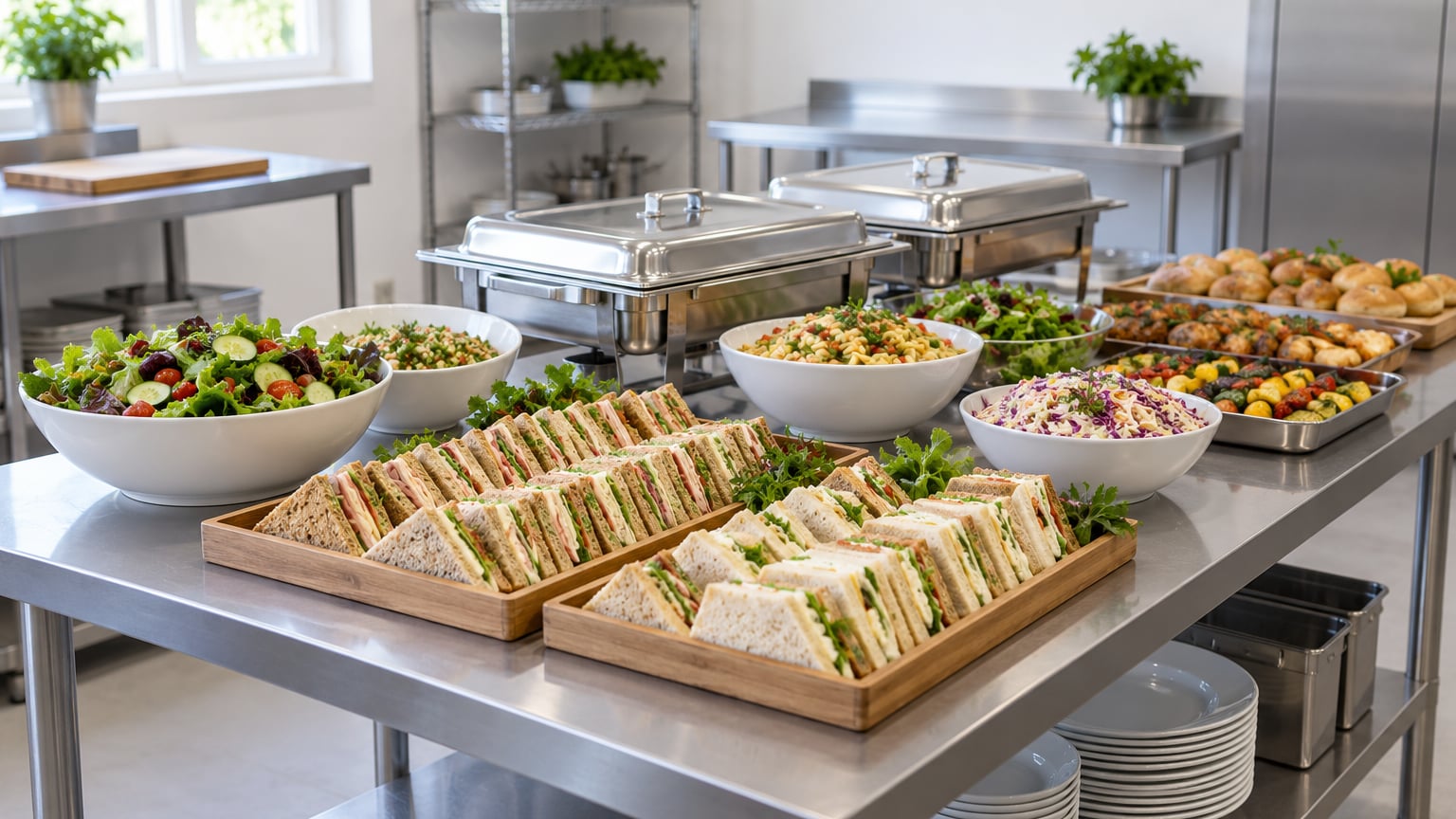
Learning how to cater your own wedding comes down to four things: a final guest count, a menu your helpers can actually cook, a venue that allows it, and a written timeline everyone shares. Get those four right and a self catered wedding runs like any other day with extra food. Skip them and you find out at 5 p.m. that the venue has no kitchen, your helpers left for the ceremony, and the main dish is still frozen.
Budget couples usually manage it in 40 to 60 hours of spread-out prep over a few weeks, plus 4 to 6 people on the wedding day. The work is real but it is not a full-time job, provided you choose food that holds well and cook it ahead rather than trying to plate a hot meal for 80 people in a borrowed kitchen.
This guide walks through the whole process in order: what to gather, how to pick a menu, how to calculate quantities, how to stay inside food safety rules, how to set a service line, and how to run the day without letting catering take over the celebration. Read the whole thing before you book anything, because the venue conversation constrains nearly every other decision.
Table of Contents
- What You Need
- Step-by-Step
- How to cater your own wedding by setting the scope
- Choose a menu your team can execute
- Create the guest count and quantities plan
- Confirm the venue kitchen and service rules
- Assemble the right people and jobs
- Buy, prepare, and store food safely
- Set up a simple service line
- Run the day and finish the cleanup
- Common Mistakes
- Frequently Asked Questions
- How many hours before a wedding should the food be prepared?
- Can I cater my own wedding if the venue has no kitchen?
- How much food should I cater for each wedding guest?
- Do I need a licensed caterer or food permit for a private wedding?
- What is the easiest food to serve at a wedding without professional help?
- Conclusion: Start With the Headcount and Venue
What You Need
Self catering works when the groundwork is done weeks ahead. Before you compare menu ideas or start pricing equipment, line up these eight pieces. If any one of them is unresolved, stop and solve it first, because each one can change the others.
The final guest count
Your RSVP list minus the guests who will not be eating. A rough “about 60” is the number that gets couples in trouble. Get a near-final number, then add a buffer. Plan for 10 percent more than your final count for mains, and round that up to the next easy batch size.
Children and heavy drinkers change the math in different directions, so count them separately. Send yourself the final list two weeks out and treat that as the number you buy for.
Written venue rules
Ask the venue in writing whether outside food is allowed, whether there is an exclusive caterer requirement, and whether a food handler certificate is needed for anyone preparing food on site. Get answers on kitchen access hours, refrigeration space, electrical outlets, hot water, and where trash goes. A backyard rental or a community hall with a small kitchen changes the whole plan, and some properties forbid home-prepared food outright.
A service level you can staff
Decide how food reaches guests before you decide what food it is. A buffet needs two to four people refilling and clearing. A plated dinner needs six or more trained servers. Sticky dessert and a grazing table need almost nobody. Couples who pick the hardest format usually pick it because it looks elegant in a photograph, not because it is manageable on a Saturday.
| Service style | Helpers needed | How it works | Worth it for DIY? |
|---|---|---|---|
| Buffet line | 2 to 4 | Guests walk a table and serve themselves from covered pans | Yes, the safest option |
| Stations | 3 to 5 | Two or three small tables, each staffed by one person | Yes, if stations are simple |
| Family style | 2 to 3 | Platters land on the table, guests pass dishes | Yes, but it needs a wide table |
| Grazing table | 1 to 2 | A cold board of cheeses, fruit, crackers, spreads | Yes, low risk, no heat |
| Cocktail reception | 2 | Small plates passed or set on high tables | Only if guests are already fed later |
| Plated dinner | 6 or more | Servers carry timed courses to seated guests | No, not without a caterer |
A menu that survives transport
Pick two to four dishes, not nine. One protein, one or two sides, one salad or bread, one dessert. Everything should be edible at room temperature for a short window or hold well when reheated, because anything that must be served exactly hot at exactly the right minute will not happen on a day you are also getting married in.
Equipment you cannot borrow
List what you need and where each item comes from: your kitchen, a rental company, a friend, or the venue. For most couples the short list is serving pans with lids, a food thermometer, insulated carriers, fuel for chafing dishes, a folding table or two, trash cans, and a handwashing setup. Rent the items you will use once and buy the items you will genuinely reuse.
| Item | Rent | Buy | Borrow |
|---|---|---|---|
| Chafing dishes and fuel | Yes, one-day use | No | Rarely available |
| Insulated carriers and Cambro boxes | Yes, if you have no storage | Yes, if you will use them again | Good from a restaurant coworker |
| Serving utensils and tongs | Possible in a full rental package | Cheap and reusable | Yes |
| Folding tables | Often cheaper than delivery | Awkward to store | Ask the venue first |
| Food thermometer | No | Yes, keep it | Acceptable but awkward |
| Disposable or compostable serveware | No | Yes, for cleanup simplicity | No |
Serving supplies
Plates, forks, cups, napkins, water pitchers, drinking straws, tablecloths that hide stains, trash and recycling bins with liners, and a chalkboard or printed cards for labels. Order plates and flatware for every guest plus 10 percent, and add a stack of sturdy paper plates for dessert if the plan involves cake and frosting near formal clothing.
Named helpers
List the actual people by name, with a job attached to each one, before the wedding date gets firm. Ask each helper for a two-hour window in writing, not a vague “afternoon”. A couple who planned a 45-guest taco bar with three slow cookers found their helpers abandoned the buffet for cocktail hour, which is the most common failure reported on wedding planning forums.
Storage and transport
Decide where food lives before it is cooked and how it gets there. That means fridge and freezer space at both ends, a car or van that can carry trays flat, and a plan for hot food that stays above 140°F and cold food that stays at or below 40°F during the drive. The couple who attempted a 140-guest self catered wedding described nearly losing the entire deposit over a disagreement about serving trays, and transport logistics were the underlying issue.
Step-by-Step
How to cater your own wedding by setting the scope
Write one page that answers four questions: how many people, what kind of service, what kind of food, and who does what. Everything else in this plan hangs off that page. It takes twenty minutes and it prevents the expensive mid-planning changes that come from a relative promising to “bring a side dish” after the menu is already built.
Set a service level you can staff. A family of 60 with a buffet and three make-ahead dishes is a realistic self catered wedding. A family of 60 wanting a three-course plated dinner with a meat carving station is not, at any budget, unless you are paying professionals for the service part.
How you will know the scope is set: you can say out loud, in one sentence, what the food will be and who is cooking it, and nobody has a different answer. If two people describe two different menus, you are not finished scoping.
Choose a menu your team can execute
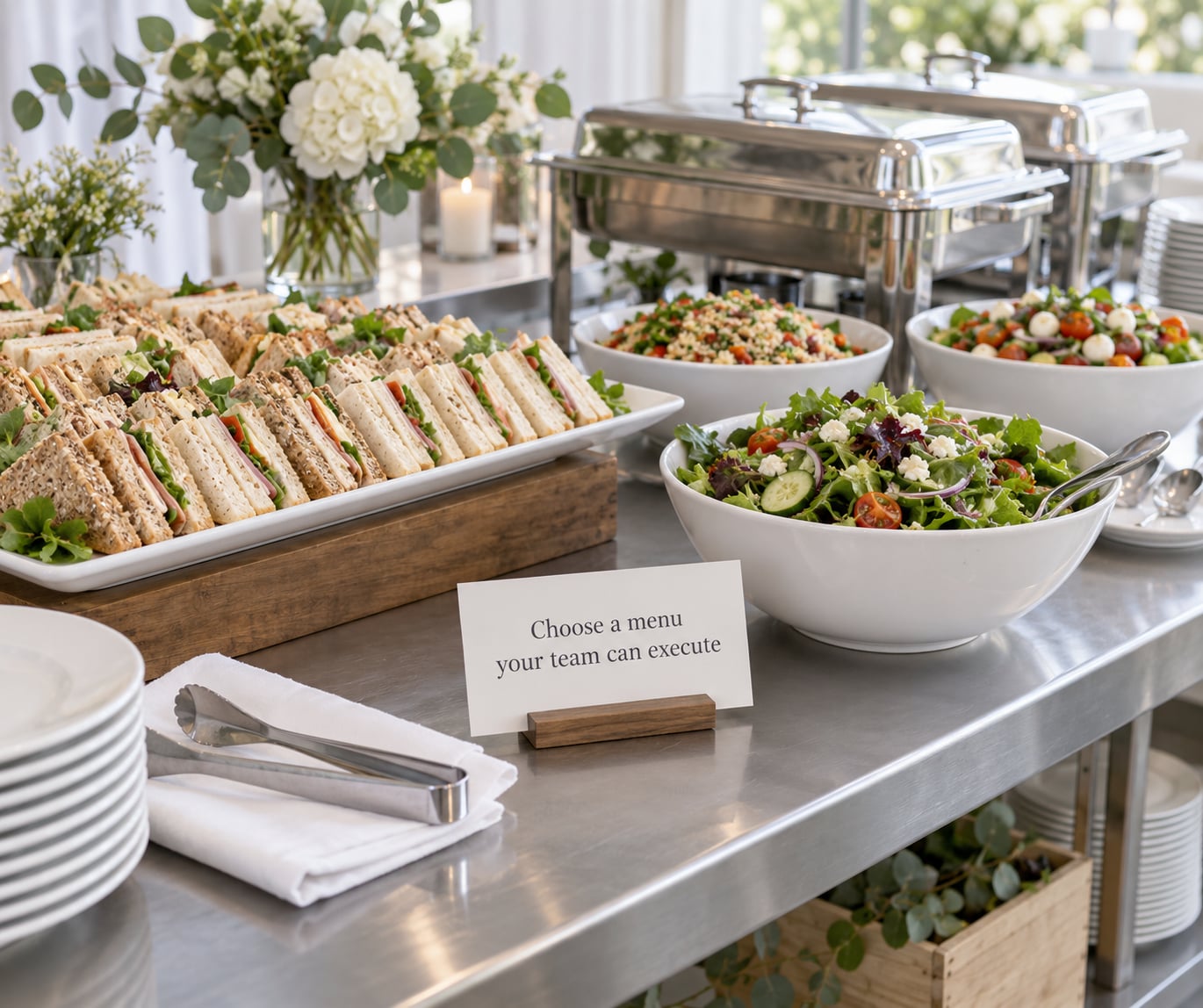
Pick dishes that can be made a day or two ahead, travel without falling apart, and hold for an hour either hot or cold without turning into a food safety question. Shredded pork shoulder, braised beef, baked pasta, rice or grain salads, and sheet-pan vegetables all meet that test. Roast chicken and seafood salads are riskier because they need refrigeration the whole time.
Sandwiches and sliced meats are the most forgiving category of all. Nothing needs to be hot, nothing needs plating, and a tray made hours ahead still looks intentional. If you want to see whether slicing your own meat at home is realistic before committing to it for 60 guests, the breakdown in is it cheaper to cook and slice your own lunch meat walks through the time and equipment honestly.
Menu rules that save people:
- One protein, not three. Two proteins doubles your shopping, your equipment, and your holding problems.
- One dish that can be served at room temperature, so a delay in the hot food is not a crisis.
- Nothing that needs last-minute assembly beyond opening a lid and putting on a spoon.
- One vegetarian or plant-forward main that is genuinely a meal, not a side dish with a label.
- One dessert that does not require a tiered structure or refrigeration.
Test every recipe at full scale, or at least at half scale, in the month before. Scaling a recipe written for four to sixty changes salt, liquid, and cooking time, and it is the single most common way a self catered wedding runs short on time.
Create the guest count and quantities plan
Work from a spreadsheet with one row per dish. Multiply, then add your buffer, then round up to something you can buy or batch. Guessing by feel is where couples end up with forty sandwiches for sixty people.
Useful planning numbers for buffet and station service:
- Entrées: 1 generous portion per adult, 1.5 for large appetites, half for most children aged 4 to 12.
- Sides: 1 small portion per adult, or two tablespoons per guest for a buffet pan.
- Salad or bread: 1 to 1.5 pieces per guest so the entrée is not the only thing on the plate.
- Sandwiches: 1.5 to 2 per guest for a reception where dinner is the only meal, 3 to 4 for a grazing table that stands in for dinner.
- Dessert: 1 piece per guest, plus 10 percent. Cut cake smaller than the bakery suggests.
- Drinks: 1 drink per guest for a reception under two hours, 2 for longer, and always more water than looks necessary.
Then account for dietary needs. Ask about allergies on the RSVP, and ask specifically about nuts, dairy, gluten, and shellfish rather than “any restrictions”. One couple serving 130 guests with passed canapés learned that five to six pieces per person was not enough and guests were still hungry by 8:30, which is the argument for making a real meal available later in the night.
Buy ten percent extra of the main and nothing extra of everything else. Overages on salad and bread are the usual source of waste and leftover tossing; a modest protein overage is what rescues a hungry guest at 9 p.m.
How you will know quantities are right: your total food, divided by your guest count, lands slightly above one full portion per person, and the spreadsheet row for each dish has a specific number in it, not the word “plenty”.
Confirm the venue kitchen and service rules
Call the venue coordinator and get specifics in writing. This conversation decides whether you can finish food on site or must cook everything at home, and it is the step most often skipped and most regretted.
Ask these questions:
- Is outside food permitted, and is there an exclusive or required caterer clause in the contract?
- What hours can we have kitchen access, and is there a fee?
- How much refrigerator and freezer space is available, and is it working and sanitized before we arrive?
- How many electrical circuits can we use, and are they grounded? Water, hot water, and handwashing access?
- How early can we arrive to set up, and how late can we stay to clean up?
- Does the venue require a certificate of insurance, a food handler permit, or a licensed kitchen for anything prepared on site?
- Where does waste and recycling go, and what happens to food we cannot use?
If the answer to kitchen access is no, plan every dish to be finished at home and transported. That is workable for a buffet and painful for anything that must be finished in the oven. Insulated carriers with frozen gel packs handle cold dishes, and a small number of chafing dishes fueled at the venue handle hot ones. Test both with a load of water before the day; a leaky carrier over your car seat is a bad omen.
Assemble the right people and jobs
Write a one-line job for each person and give it to them before the wedding, not on the morning. Roles worth naming: shopping lead, prep lead, transport driver, setup lead, buffet attendant, replenisher, drink monitor, allergen steward, and cleanup crew.
Rule of thumb for a buffet: one trained server per 25 to 30 guests, plus one person whose only job is replenishing the line so serving never stops. Pair every helper with a backup. A single no-show on a small team is a service collapse, not an inconvenience, and the cure costs nothing but a phone call in April.
Protect the ceremony and cocktail hour. Helpers should be told explicitly that the food is not their job during the ceremony, and that someone specific owns the line the moment guests are released. Couples on planning forums describe the exact same failure repeatedly: helpers who are managing the buffet while the couple walks down the aisle.
One more person often pays for themselves: a day-of coordinator who is not a guest and not a family member. For 80-plus guests, or for any wedding where a parent is also in the wedding party, this is the cheapest stress you can buy.
Buy, prepare, and store food safely
Order shelf-stable and frozen goods several weeks out, buy produce and meat closer to the date, and never buy proteins on the wedding day unless the store is minutes away. Keep a printed list with quantities and the row totals from your spreadsheet, and check items off as they land.
Follow the USDA minimum internal temperatures, and check with a thermometer rather than appearance:
- Poultry: 165°F / 74°C
- Ground meat: 160°F / 71°C
- Whole cuts of meat and fish: 145°F / 63°C
Keep cold food at or below 40°F and hot food at or above 140°F. The danger zone between 40°F and 140°F is where bacteria multiply quickly, so time sitting in that range matters: refrigerate within two hours, or one hour if it is above 90°F outside.
A workable prep rhythm: two or three days out, buy and portion proteins and make sauces; one to two days out, cook the mains and assemble casseroles and sheet-pan vegetables; the day before, make the grain and pasta salads, chop toppings, and set up the transport; wedding morning, load coolers and keep cold food refrigerated until the last possible moment.
Transport cold food in insulated carriers with frozen packs and hot food in carriers that preheat. Reheat to 165°F before it goes into a chafing dish, then check again every 30 minutes and add fuel before it runs out rather than after. For allergens, use separate utensils, separate pans, and a dedicated station. The one guest who reacts to a stray spoon is the one story the whole wedding remembers.
Set up a simple service line
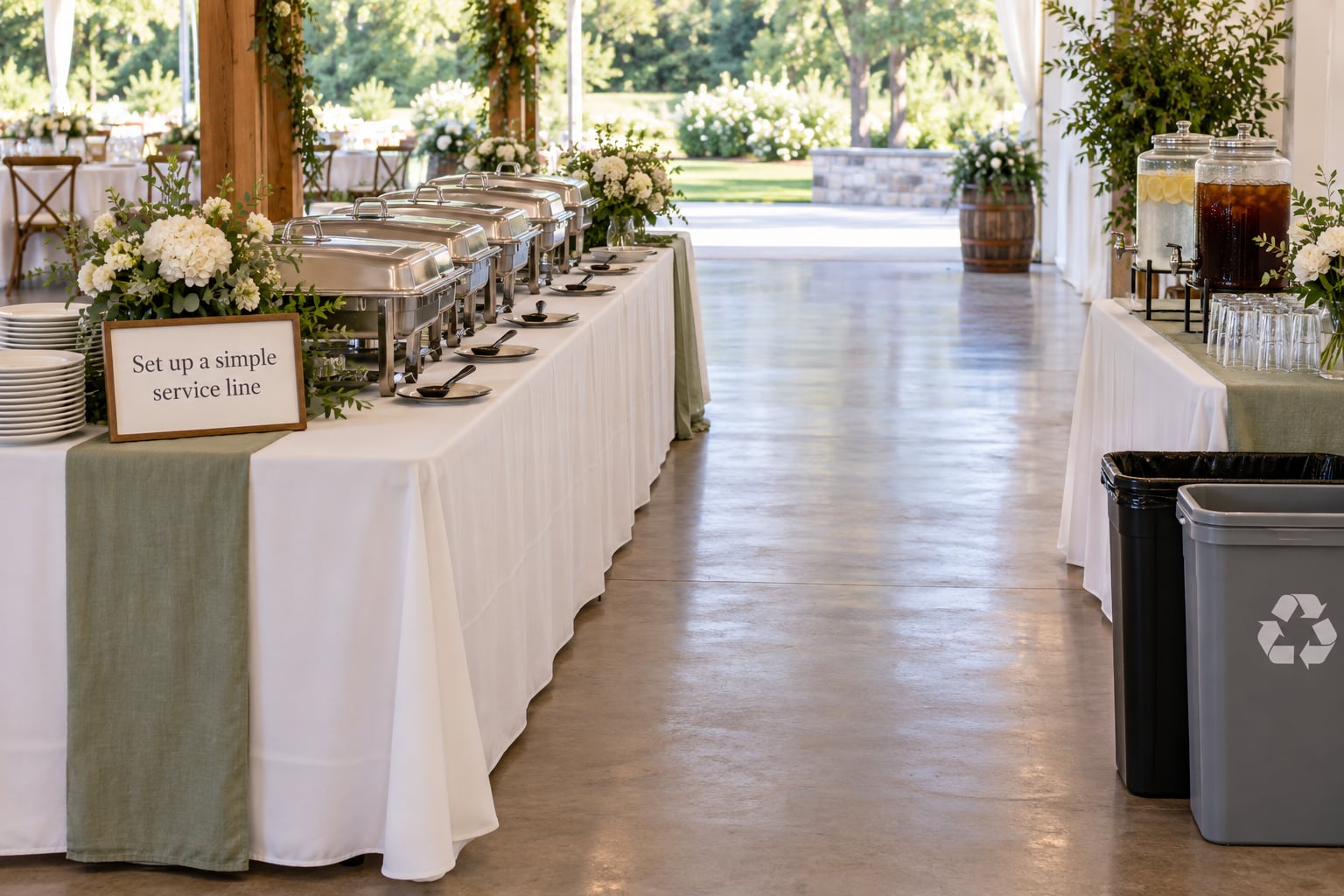
Layout decides how fast the line moves. Put the plates and napkins first, then the salads and sides, then the main at the end of the line, then drinks and utensils on a separate table so the main path never backs up. Keep at least three feet of walking space in front of the table and put the trash bins at the exit, not in the middle of the queue.
Cover every pan until its turn. Light labels in plain language help more than fancy ones, and include allergen callouts such as “contains dairy” or “gluten free” so guests can self-select without interrogating your servers. Provide one pair of serving utensils per pan, plus a backup set, and put a small spoon or tongs for each allergen-free dish so nobody has to guess.
Put the chafing dishes on fuel, not electric units, unless the venue has confirmed circuits. Start the fuel about 20 minutes before doors open, and light the second set of pans as the first runs low. Place water, and only water, near the line; a self-serve drink station elsewhere keeps the traffic thinner.
How you will know the setup is right: you can stand at the end of the line and watch the flow at 6:45 p.m. without anyone reaching across a guest.
Run the day and finish the cleanup
Work backwards from the moment guests are served. Example shape for a 5 p.m. buffet at a 4:30 p.m. ceremony:
- 8:00 a.m. — Final cold prep at home, coolers loaded, thermometers packed.
- 11:30 a.m. — Depart with hot food just finished cooking, cold food in carriers.
- 12:30 p.m. — Arrive, unload, set the line, fill water pitchers, verify the venue kitchen.
- 2:00 p.m. — Reheat mains to 165°F, light chafing fuel, cover and label everything.
- 4:15 p.m. — Line walk with the coordinator, temperature check, count the pans against your list.
- 4:30 p.m. — Ceremony. Crew takes a break, not a shift change.
- 5:15 p.m. — Open the line. Replenisher stays on the line continuously.
- 8:00 p.m. — Leftover sweep, decide what is kept and where it goes, start cleanup.
- 9:00 p.m. — Venue walkthrough, trash out to the correct bin, rentals stacked, kitchen wiped.
Have a backup for the three things that actually go wrong: the ceremony running late, a helper calling in sick, and a chafing dish dying mid-service. Keep a tray of cold food in reserve, keep one helper’s contact list in your phone, and keep spare fuel and matches in the same bin as the pans.
Cleanup is where deposits get lost. Ask the venue in advance what condition they expect the kitchen in, set a fixed end time, and give the cleanup crew a written list. Many venues accept unopened, properly handled surplus, and several local food banks and shelters take prepared food if it arrives the same day; a quick call to your local group ahead of time beats a hopeful pile of leftovers on a counter.
How you will know the day worked: every pan was accounted for, the venue signed off on the space, and you were a guest at your own wedding for a few hours.
Common Mistakes
Almost every failed self catered wedding comes down to one of the same nine problems. Each has a fix you can make weeks ahead, which is the only time a fix is worth anything.
Choosing a menu nobody can hold
Dishes that must be plated hot, or that collapse after twenty minutes, turn a wedding day into a restaurant shift. Cut the menu to two to four items, make sure each one travels and holds, and test them at scale before the week of the wedding.
Underestimating the equipment
The most common surprise is oven and fridge capacity. Two families each with a full-size oven cannot produce a roast for 60 people in a morning. Count your batch capacity, count your fridge shelves, and count your transport volume in trays, not in pans. If the numbers do not work, rent a trailer cooler, borrow a second refrigerator, or cut the guest count of dishes per person.
Under-buying food
Guests who go hungry at 8 p.m. undo an entire reception. Plan the full portion plus ten percent on the main, keep a tray of sandwiches or rolls in reserve for late arrivals and second helpings, and remember that the dessert table does not count as dinner. Sweet carts and frozen treats are a snack, not a meal.
Ignoring the guest count timeline
Guests who never ate before the reception, or who drank through the afternoon, need a real main course. Consider a late snack for weddings that run past three hours, and plan the timing so it lands before people start leaving.
Hiring helpers you never confirmed
Write down who is coming and when, and confirm each person two weeks out. Assign each person one job, one start time, and one backup. A team that has never worked together needs a walkthrough at 4:15 p.m., not an introduction during dinner.
Trusting the venue’s verbal yes
Outside catering allowed “usually” is not allowed. Get the rules, fees, and access hours in writing, including insurance and permit requirements. Some venues require a licensed caterer, some require food to be prepared in an inspected kitchen, and finding that out in the final week is the most expensive possible time to find it.
Letting cold food sit out
Guests do not know which pan is which, and neither will your servers at hour two. Label everything, keep a thermometer in your hand, and put the cold dishes out last and take them in first. Assume nothing about the temperature of a pan that sat on the table for an hour.
Abandoning the cleanup
Assign the cleanup crew before the wedding, not after. Give them a start time, a checklist, and permission to say no to new requests. Leave the kitchen in the condition the venue specified, or expect a cleaning fee to come out of your deposit.
Simplifying the plan instead of adding people
If the schedule looks impossible, the answer is almost always fewer dishes, not more hands. Drop a side, keep the dessert simple, choose a single station, or make the salad a bagged salad. Every dish you remove buys back shopping time, equipment, holding, and cleanup.
And test everything once. A dry run of the menu at your own kitchen table two weeks out tells you more than any checklist, because it exposes the dish that does not travel and the step that takes twice as long as the recipe claims.
Frequently Asked Questions
How many hours before a wedding should the food be prepared?
Most of the cooking happens one to three days ahead: sauces and proteins earlier, casseroles and sheet-pan vegetables the day before, and grain and pasta salads the day before. On the wedding morning, finish only cold items and reheat the mains. Hot food is cooked as late as practical and travels in insulated carriers. Refrigerate anything perishable within two hours of taking it out.
Can I cater my own wedding if the venue has no kitchen?
Yes, and plenty of couples do. Cook everything at home, then transport cold dishes in insulated carriers with frozen packs and hot dishes in preheated carriers. The menu has to be one that travels: nothing that needs a last-minute oven finish or last-minute plating. Confirm the venue allows outside food, that you can arrive early to set up, and that there is power, water and somewhere to wash hands.
How much food should I cater for each wedding guest?
For a buffet, plan one generous entrée portion per adult, two or three sides, and one to one and a half salad or bread pieces, then add ten percent on the main. Sandwiches need one and a half to two per guest, or three to four for a grazing table replacing dinner. Dessert is one piece plus ten percent. Children aged 4 to 12 usually eat about half an adult portion.
Do I need a licensed caterer or food permit for a private wedding?
In many US states a private event at a private residence needs no permit, but serving at a venue or in a public building often does, and many states require a food handler certificate for anyone preparing food for sale or for public consumption. Rules vary by state, county and city. Ask the venue in writing what documentation they require and check your local health department before you buy anything.
What is the easiest food to serve at a wedding without professional help?
A buffet of two or three make-ahead dishes is the easiest option by a wide margin. Shredded pork, baked pasta, sheet-pan vegetables and a grain salad travel well, hold for an hour, and need no plating. Sandwiches and sliced meats are even easier because nothing has to be hot. The hard part is never the cooking; it is temperature control, refilling the line, and clearing the mess.
If you are building a sandwich-heavy or tray-based menu, it is worth checking how different sandwich containers handle stacked, dressed, and transported food before you commit to a transport plan, since that decision affects your cooler setup as much as your menu does.
Conclusion: Start With the Headcount and Venue
Before you buy anything, get your final guest number and your venue’s written rules on outside food, kitchen access, and cleanup. Then choose the simplest service style you can staff, cut the menu to two or four dishes, and give every helper one named job with a written schedule. That is how to cater your own wedding without the food taking over your day: decide the scope early, prep mostly ahead, and keep the wedding day itself to transport, setup, and serving.