
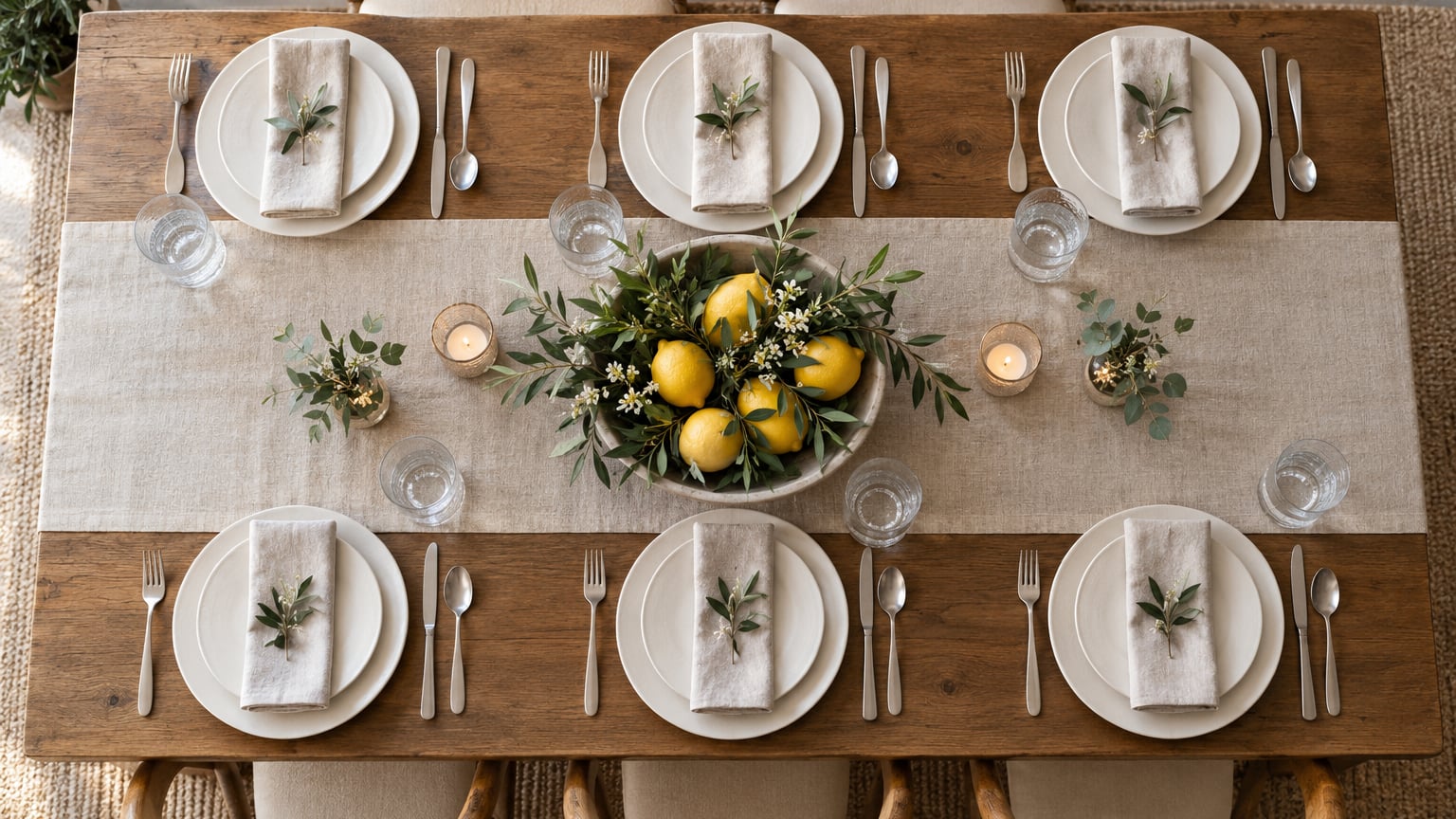
Knowing how to set a table for a dinner party comes down to three things: the plate goes in front of the guest, the forks go on the left, and everything else follows the same working order from the outside in. Most of it takes about fifteen minutes once you have your linens down, and none of it requires matching china or a storage closet full of serving dishes.
The rule people miss is that a place setting is arranged by course, not by popularity. The utensils for whatever is served first sit closest to the edge of the plate, and each course moves inward as the meal goes on. Get that one habit right and the rest is just measuring.
If a party runs on grazing rather than courses, the same rules apply with fewer pieces. If you’re feeding a crowd, a DIY sandwich bar works better than a seated one. Either way, lay out exactly what you’ll serve, and nothing more.
Table of Contents
- What You Need
- Step-by-Step: How to Set a Table for a Dinner Party
- Common Mistakes
- Frequently Asked Questions
- How far in advance should I set the table before a dinner party?
- Do I need a tablecloth or placemats?
- Should the napkin be on the left or right of the plate?
- Where does the water glass go, and should it be filled?
- What is the difference between a casual and a formal table setting?
- What if my plates and glasses don’t match?
- Conclusion
What You Need
Here’s the short list. Everything here is ordinary, and you can mix patterns as long as you commit to one napkin and one color of glassware.
- Linens: a tablecloth or a set of placemats. Leave 12 to 18 inches of cloth hanging on each side so people don’t push the cloth off with their knees.
- Plates: one dinner plate per guest, plus one more than you think for a second helping or a bread course.
- Flatware: a dinner fork and knife for every guest, plus a spoon and an extra fork if you’re serving a salad or soup first.
- Drinkware: one water glass per guest, one wine glass per guest if wine is being poured, and a glass for water at the table if the tumblers are small.
- Napkins: cloth napkins if you have them, paper if you don’t. Cloth napkins in one color read as deliberate even when nothing else matches.
- Serving pieces: at least one platter or bowl per dish, plus a spoon or tongs for each one and a small spoon for serving salad.
- Extras: salt and pepper, a bread plate or basket, a small trash bowl for shells, and a couple of small candles.
- Place cards: folded index cards or a phone note if people don’t know each other. Seating strangers apart and couples together is the whole job.
Step-by-Step: How to Set a Table for a Dinner Party
1. Choose the Table Layout
Pick the table before you pick anything else. Give each guest about 24 inches of width along the table, and keep at least 36 inches between the table edge and the nearest wall or piece of furniture so waiters and guests can move behind seated people.
A rectangular table against a wall is awkward for a party because the person with their back to the room can’t see anyone. Push it out into the middle of the space and let the hosts cover that side instead. Round tables make conversation easier, but a long table with a runner down the center works fine for eight to twelve people.
If you have more guests than chairs, set a second table rather than squeezing. Two comfortable tables always beat one crowded one.
2. Prepare the Table Linens
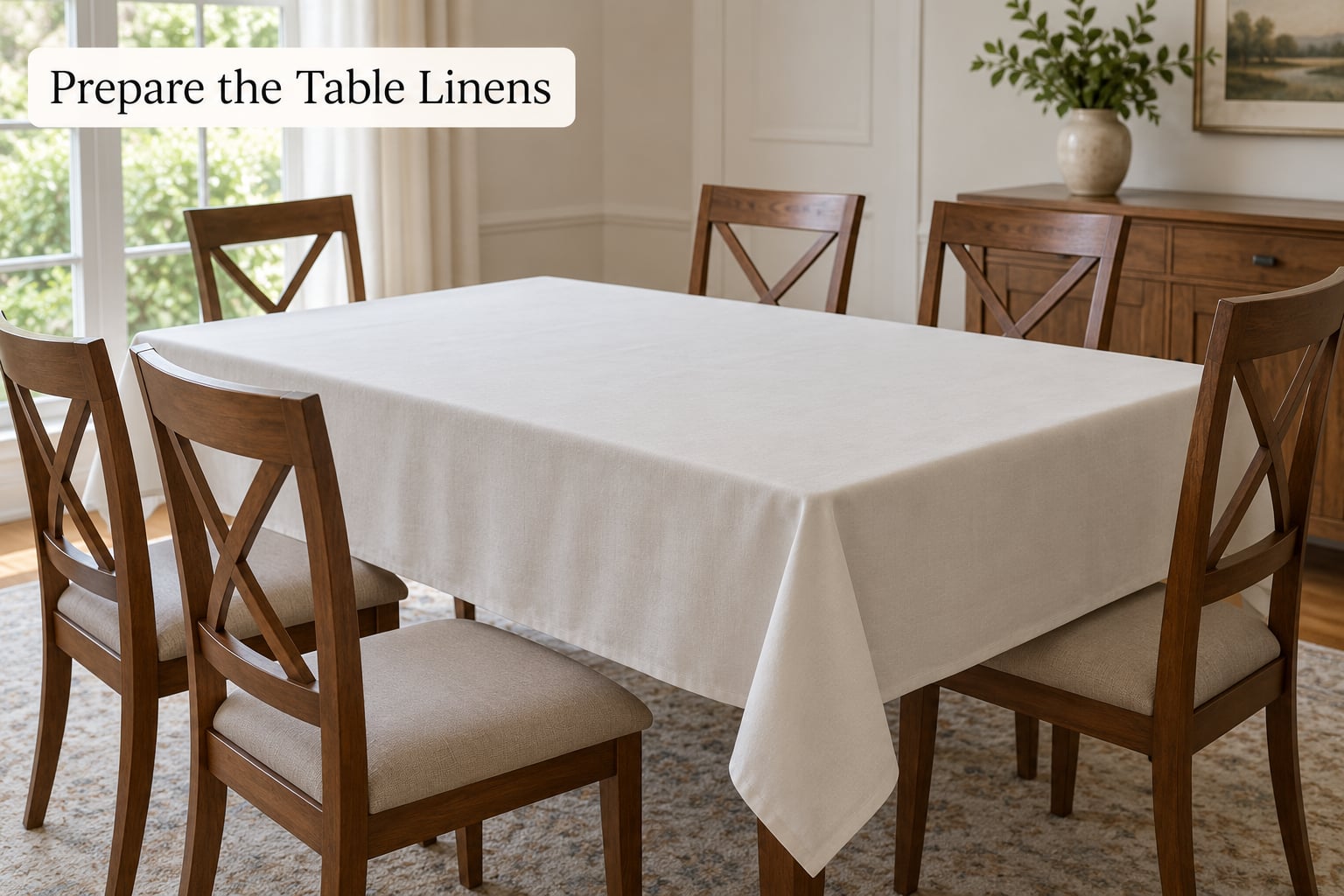
Iron the tablecloth the night before and lay it over the table centered, with the seams running straight so the pattern doesn’t wander. Smooth it with your palms from the center outward and let about a foot hang at each end.
Placemats work just as well and take less time. Set them flush to the table edge, in line with each other, and leave about three inches between neighbors. If you’re layering a runner over a cloth, keep the runner narrow enough that it doesn’t sit under the serving dishes.
3. Set the Dinner Plates
Place the dinner plate one to two inches from the edge of the table, centered in front of that guest’s chair. The plate’s bottom should line up roughly with the seat back so nobody has to lean forward.
Start at the head of the table or at one end and work down, measuring by eye as you go. Even spacing matters more than perfect centering, because a plate that lines up across the table makes a row of mismatched settings look deliberate.
Add a salad plate on top if you’re serving a salad first, or set it above the dinner plate if salad comes later. A bread plate goes at 10 to 11 o’clock above the forks unless you’re passing bread around instead.
4. Arrange Forks, Knives, and Spoons
Forks go on the left of the plate, knives and spoons on the right with the knife blade turned inward toward the plate. Leave about half an inch of space between each piece and align their bottoms with the bottom of the plate.
On the left, put the fork for the first course outermost and the fork for the main course closest to the plate. On the right, the knife for the main course sits closest to the plate, then any spoons for later courses move out toward the edge. This is the outside-in rule: during the meal, each guest picks up the utensil farthest from their plate first and works inward as courses arrive.
Check your own setting before you build the rest. Gloves off, forearms flat against the table, reach for the outer fork and the outer knife exactly the way your guests will. It takes fifteen seconds and it catches every placement error before it happens eight more times.
5. Place Water Glasses and Other Drinkware
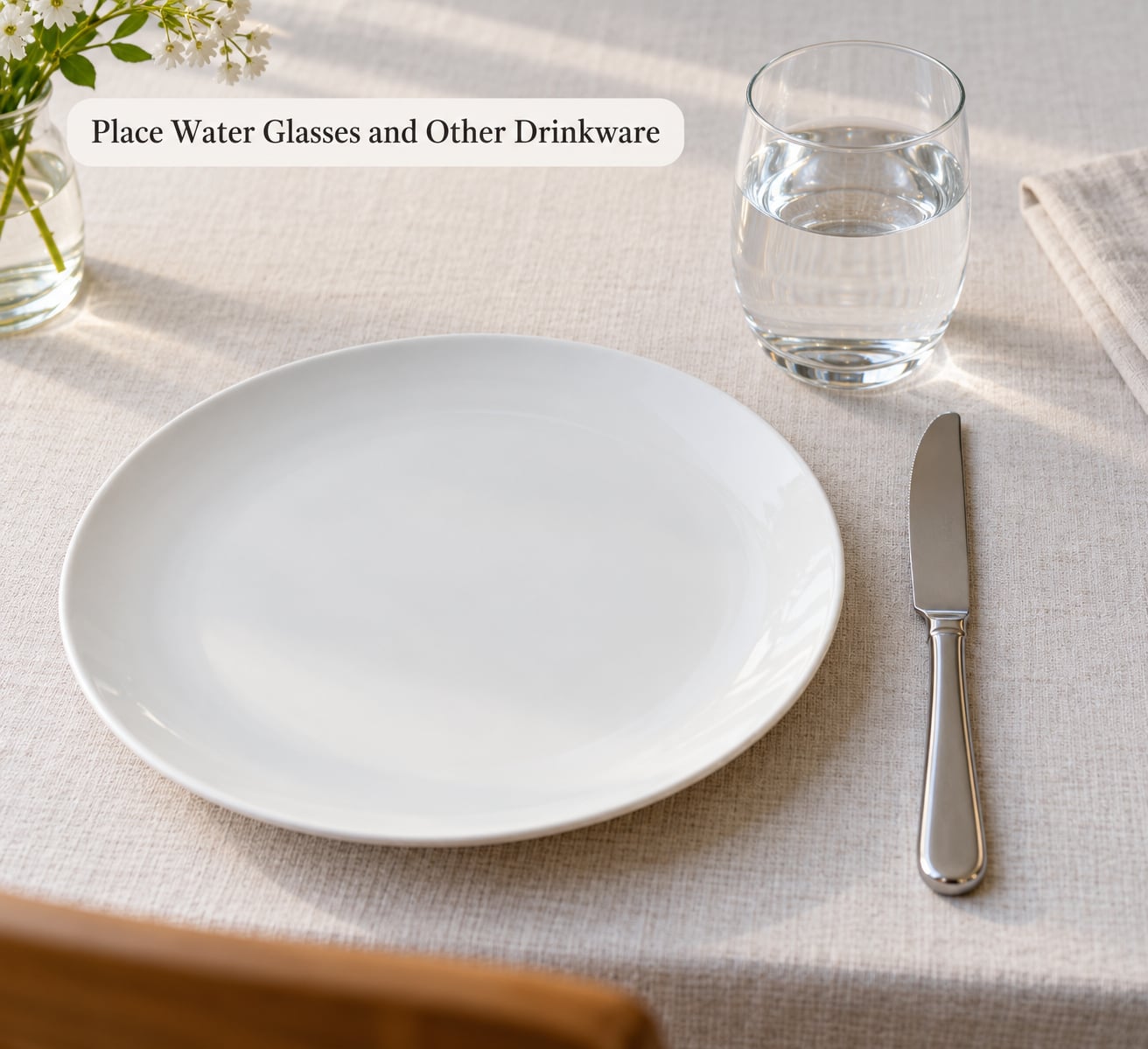
Set the water glass directly above the knife tip, roughly at one o’clock from the plate. If you’re serving wine, the wine glass goes to the right of the water glass and slightly lower and closer to the plate, with the stemware closer to the diner than the tumbler.
Fill water glasses before guests arrive if you can, and to about two-thirds full. Ice melts, salt beads on the glass rim, and a half-empty tumbler on a crowded table looks like an oversight. For a long dinner, keep a chilled pitcher nearby so refills are a two-second job instead of a trip to the kitchen.
Skip the water glass at the table entirely if your tumblers are big enough to handle both water and wine. Fewer pieces mean more room for food and elbows.
6. Fold and Position the Napkins
For a relaxed dinner party, the fastest method that still looks good is to lay the napkin flat on the dinner plate, folded once or twice. It’s tidy, it keeps hands off the tablecloth, and it gives each plate a spot of color against white china.
Two other easy options: fold the napkin into thirds lengthwise, roll it loosely, and slide it into a drinking glass so the top third shows. Or keep it flat on the plate and tuck one edge under, then fan the loose edge outward.
Skip the elaborate origami. A tight fan fold that collapses when someone picks it up makes the table look worse than no fold at all.
7. Add a Simple Centerpiece
Keep the centerpiece low enough that seated guests can see each other across the table. Twelve inches from the tabletop is the practical ceiling, which rules out tall vases of flowers and most candle arrangements on a pedestal.
Low bowls of fruit, a cluster of short votives, or a few eucalyptus stems in a squat jar all work. If you use candles, go unscented so they don’t compete with dinner, and light them last so nobody arrives to a table that smells like a department store.
Leave open table between the centerpiece and the plates for serving dishes. If a guest would have to lean over a candelabra to reach the salt, move it.
8. Add Serving Pieces and Do a Final Check
Place serving dishes so guests can reach them without passing food face to face across the table. Bowls and platters usually go at both ends and in the middle of long tables. Put the serving spoon or tongs on a small plate beside each dish, or on a folded napkin underneath it.
Salt and pepper go together, either at the table center or at both ends. Bread goes in a basket with a small plate nearby. Drinks should already be on the table so nobody is fetching.
Then do the final walk-around from the doorway rather than from above. Check that every setting has the same number of pieces, that no glass blocks a plate, that the chairs are pulled out evenly, and that nothing important is sitting where a guest’s elbow will land. Wipe the last fingerprints off the glasses.
Common Mistakes
Most of these come from setting a table by laying out whatever is in the drawer, rather than starting from the menu. Each one has a quick fix.
- Plates too close to the edge. A plate within half an inch of the table edge gets bumped by forearms and has to be recovered by hand. Move every plate back to one to two inches.
- Flatware lined up in the wrong order. If the main-course fork is the outer one on the left, guests pick it up first and the salad arrives after they’ve finished. Order by course: first course outermost, main course closest to the plate.
- Knives facing the wrong way. A blade pointed at the guest or, worse, at the next person reads as threatening. Every blade turns inward toward the plate.
- Water glasses in the wrong spot. A glass directly above the plate blocks the view and lands in the guest’s line of sight all meal. Put it above the knife tip instead.
- Glasses filled to the brim. Guests can’t lift a full glass one-handed without two hands on it, and a ring of condensation forms on the tablecloth. Two-thirds full.
- A tall centerpiece. Anything above seated eye level blocks conversation across the table, and the host who has to lean over it to refill a water glass will stop doing it. Keep it under about 12 inches.
- Too much on the table. A cluttered setting uses up the room guests need for plates, glasses, elbows, and serving dishes. If you’re not serving it, take it off the table.
- Setting everything at the last minute. Rushed settings lean, drift out of alignment, and leave the host sweating when the doorbell rings. Set the table 30 to 60 minutes ahead and save only the candles, the water, and a final wipe for the last five minutes.
- Ignoring dietary restrictions. Guests with allergies or vegetarian diets shouldn’t have to ask. Say at the invitation what you’re cooking, and when serving, deliver the restricted dish to that guest first from the host’s own hand so there’s no ambiguity about whose plate it goes to.
- Not telling guests how to move. If you’re clearing plates yourself, mention it once early so people don’t stand on their chairs trying to help. If you’re serving family-style, say which dishes are passed and which are served from the end.
One more that’s easy to miss: if people at the table don’t know each other, place cards do more for the evening than any centerpiece. Seat couples next to each other, split up the couples, and spread the people who know each other out.
Frequently Asked Questions
How far in advance should I set the table before a dinner party?
Set the table 30 to 60 minutes before guests arrive, which gives you time to fix alignment problems and lay out serving pieces without rushing. Fill water glasses about 10 minutes before the doorbell so condensation doesn’t form on the tablecloth. Light candles last, after guests are seated, so the room feels settled rather than staged.
Do I need a tablecloth or placemats?
Either one works. A tablecloth looks more formal and softens the room; placemats are faster to set and clean up, which makes them the better pick for a dinner party with kids. What matters more than the choice is leaving 12 to 18 inches of fabric hanging at each side and keeping the linens smooth and wrinkle-free.
Should the napkin be on the left or right of the plate?
On a casual table, the napkin goes on top of the dinner plate or to the left of the forks, and both are correct for an informal dinner party. Formal etiquette places it to the left of the forks or on the plate with the fold facing up. If you’re unsure, plate placement is the simplest option and never looks wrong.
Where does the water glass go, and should it be filled?
The water glass goes directly above the knife tip, about one o’clock from the plate, with the wine glass to its right and slightly lower. Fill it about two-thirds full before guests arrive so nobody has to lift a heavy glass with two hands. Keep a pitcher in the room for refills.
What is the difference between a casual and a formal table setting?
A casual setting means a plate, fork on the left, knife and spoon on the right, a napkin, and a water glass. A formal setting adds a charger plate under the dinner plate, a salad fork, a soup spoon, a dessert fork and spoon above the plate, and separate wine glasses. Three courses and place cards push a dinner into formal territory.
What if my plates and glasses don’t match?
Mixing is fine as long as you repeat one consistent element. Choose all napkins in a single color, use a single color of tumbler, or put the same salad plate at every setting, and the mismatched dinner plates stop reading as an accident. A plain tablecloth on top also unifies everything below it.
Conclusion
Start with three decisions: how many guests are coming, how much table space you have, and one color or napkin to repeat. Then work down the table setting the plate, forks on the left, cutlery on the right with blades in, water glass above the knife tip.
Set it 30 to 60 minutes ahead, keep the centerpiece low, and leave off anything you aren’t serving. If you want to talk through what goes on the table itself, our guide to setting up a DIY sandwich bar covers the other way most parties feed a crowd.