
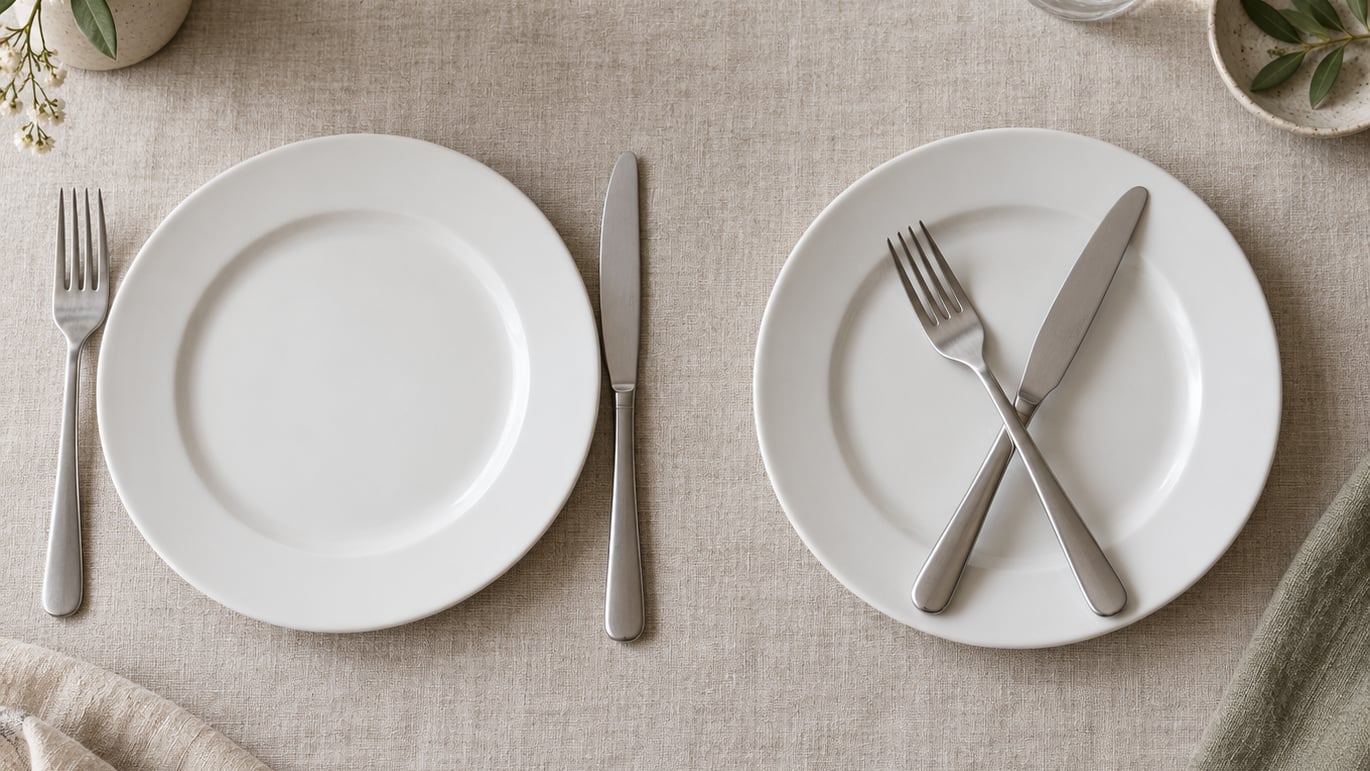
The short version of the american vs continental style of using a knife and fork comes down to one question: do you put the fork down when you pick up the knife? American style cuts with the knife in your dominant hand, sets it down, then moves the fork to that hand to eat with tines up. Continental style keeps the fork in your non-dominant hand with tines down and uses both utensils together for the entire course.
That is genuinely the only real difference. Everything else people argue about, the resting positions, the finished positions, which hand sits in your lap, comes out of that one mechanical choice.
Both styles are correct. The Emily Post Institute, Miss Manners and every etiquette trainer I have read say the same thing in different words: pick one, be consistent for the whole meal, and mirror the table you are sitting at. Nobody has ever been handed a napkin at a wedding because of how they held a fork.
Table of Contents
- American vs Continental Style of Using a Knife and Fork at a Glance
- What Is the American Style of Using a Knife and Fork?
- What Is the Continental Style of Using a Knife and Fork?
- How Do the Two Styles Differ?
- Which Knife and Fork Style Is More Comfortable?
- Which Style Is Used in Formal Dining?
- Which Should You Choose?
- Frequently Asked Questions
- What is the main difference between American and continental dining styles?
- What is continental style?
- How do you position a knife and fork when you have finished eating?
- What are the etiquette rules for eating with a knife and fork?
- Which countries use continental style eating?
- Is it rude to use the American style of eating in Europe?
- A Simple Rule for Choosing Your Utensil Style
American vs Continental Style of Using a Knife and Fork at a Glance
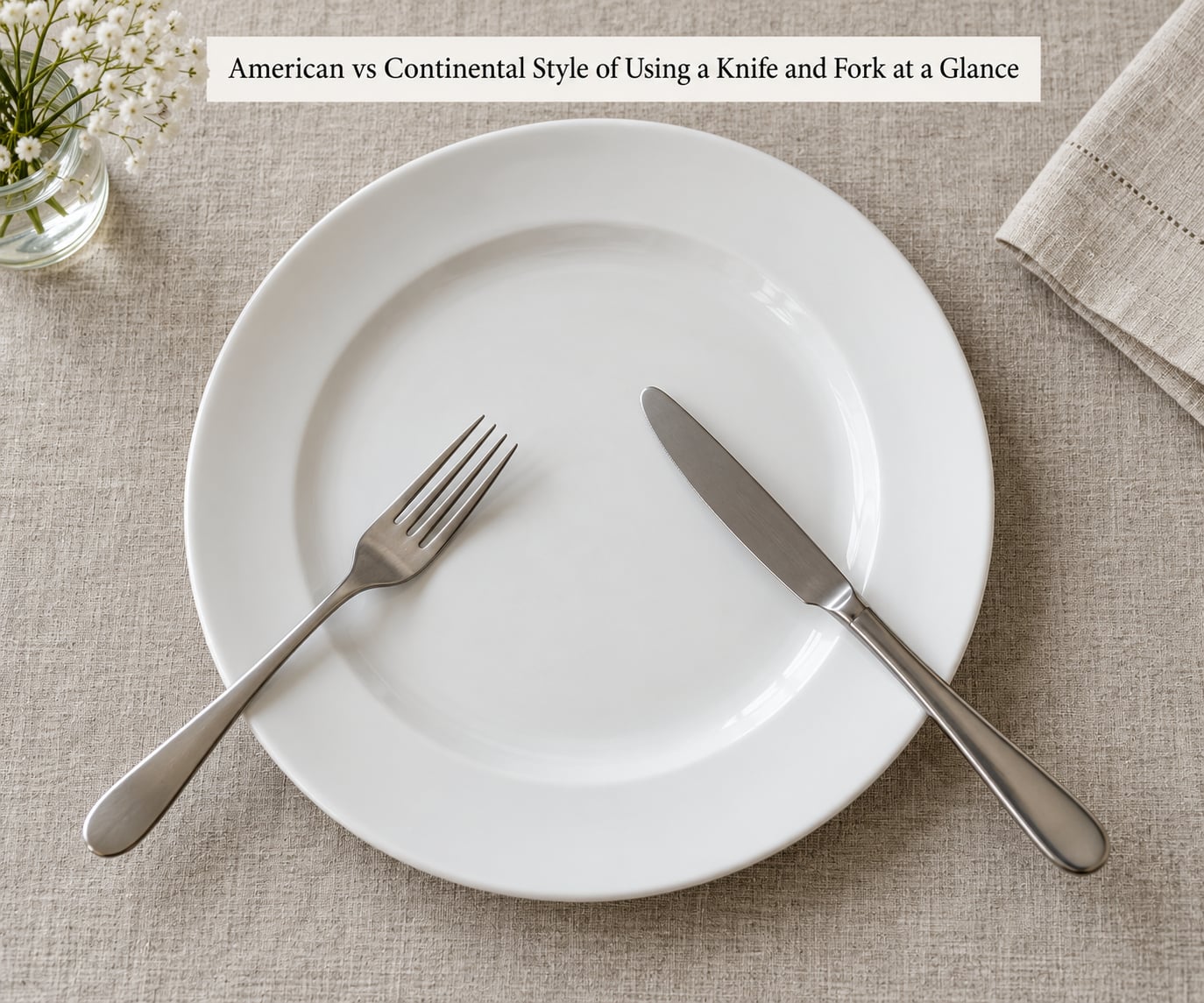
This table covers every variable the two styles actually disagree on. Clock positions are measured on the plate like a face, with 12 o’clock at the top nearest you.
| Variable | American style | Continental style |
|---|---|---|
| Utensil pickup order | Knife first, then fork, when starting a course | Knife and fork together, at the same time |
| Hands used while cutting | Both hands: knife dominant, fork pinning | Both hands: knife dominant, fork pinning |
| Fork tines while eating | Tines up, in the dominant hand | Tines down, in the non-dominant hand |
| What the knife does after cutting | Rested on the plate between cuts, never returned to the hand | Held in the dominant hand the whole time |
| Resting (paused) position | Knife at about 4 o’clock, fork at about 8 o’clock | Inverted V on the plate, tips down and handles toward you |
| Finished position | Knife and fork parallel at 10:20, handles to the right | Same: parallel at 10:20, handles to the right |
| Where the idle hand rests | Lap or table edge, under the wrist | Wrist resting on the table edge, below the plate line |
| Noise level | Noticeable, because the knife touches the plate often | Quiet, because the knife never leaves your hand |
| Left-handed adaptation | Cut with the left hand, switch the fork to the left | Mirror everything: fork tines down in the right hand |
| Where it is expected | Most of North America, business lunches, weddings, casual restaurants | Continental Europe, the UK, state dinners, much of fine dining |
If you only absorb one row, make it the finished position. Both styles finish the same way, which is why servers read it without needing to know how you eat.
What Is the American Style of Using a Knife and Fork?
American style is the cut-and-switch method. You hold the knife in the hand you write with and the fork in the other, tines down, pinning the food against the plate while you saw through it. Then you lay the knife down, pick the fork up with the same hand that held the knife, turn the tines upward, and eat the piece.
Emily Post called it zig-zag eating in the first edition of Etiquette, and the nickname stuck because it describes the motion: knife, fork, knife, fork, back and forth across the plate. She personally preferred continental, which is one reason American diners grew a bit self-conscious about the method even though it was the one they learned at home.
How the American style works, step by step
- Pick up the knife first, then the fork, once the plate is in front of you.
- Hold the fork tines down and press the back of the tines against the food to hold it steady.
- Cut with small sawing motions, using the full blade rather than the point.
- Set the knife down on the plate at about 4 o’clock when you pause between bites.
- Switch the fork into your dominant hand with the tines up to eat.
- Repeat until the course is finished.
- Place both utensils parallel at 10:20 on the plate when you are done.
The pause position is the part almost nobody teaches. Knife at 4 o’clock, fork at 8 o’clock, both resting on the plate rather than the tablecloth, and the handles sitting on the plate instead of hanging over the edge. Hanging handles are the single most common error I see at restaurants.
What Is the Continental Style of Using a Knife and Fork?
Continental style, also called the European style, never puts the fork down. It stays in your non-dominant hand with the tines angled down toward the plate for the entire course, and you spear each bite onto it while the knife is still in your other hand. No switching, no table-side break, no second pass with a different utensil.
The method was codified in the middle of the 1800s, when formal service in France shifted from service a la Francaise, where dishes arrived already cut, toward service a la Russoe, where guests carved at the table. Once diners began cutting their own food, a single utensil held in a single hand stopped working, and the two-handed continental method became the answer. Etiquette writers on both sides of the Atlantic still cite an 1852 French etiquette manual as the codification point.
Which countries use continental style eating?
| Region | Usual style at a dinner table |
|---|---|
| France, Spain, Portugal, Italy | Continental |
| Germany, Austria, Switzerland, Scandinavia | Continental, and unfinished dishes are taken away in Germany |
| United Kingdom, Ireland, Australia, New Zealand | Continental, often with the American zigzag tolerated at home |
| Central and Eastern Europe | Continental |
| United States and Canada | American, with continental accepted anywhere |
| Japan, South Korea, China | Chopsticks, with forks and spoons for Western food |
National habits are not absolutes. Immigrant families keep the style they grew up with, restaurants set the table with whatever their staff was trained in, and plenty of European households switched to the American zigzag decades ago. Treat the table as the authority, not the passport.
One regional wrinkle worth knowing: in Germany, placing utensils parallel across the plate is read as finished, and leaving them angled or crossed can mean the server keeps waiting. A thread on r/AskEurope went back and forth on whether this rule is real, and it is, at least widely enough that servers act on it.
How Do the Two Styles Differ?
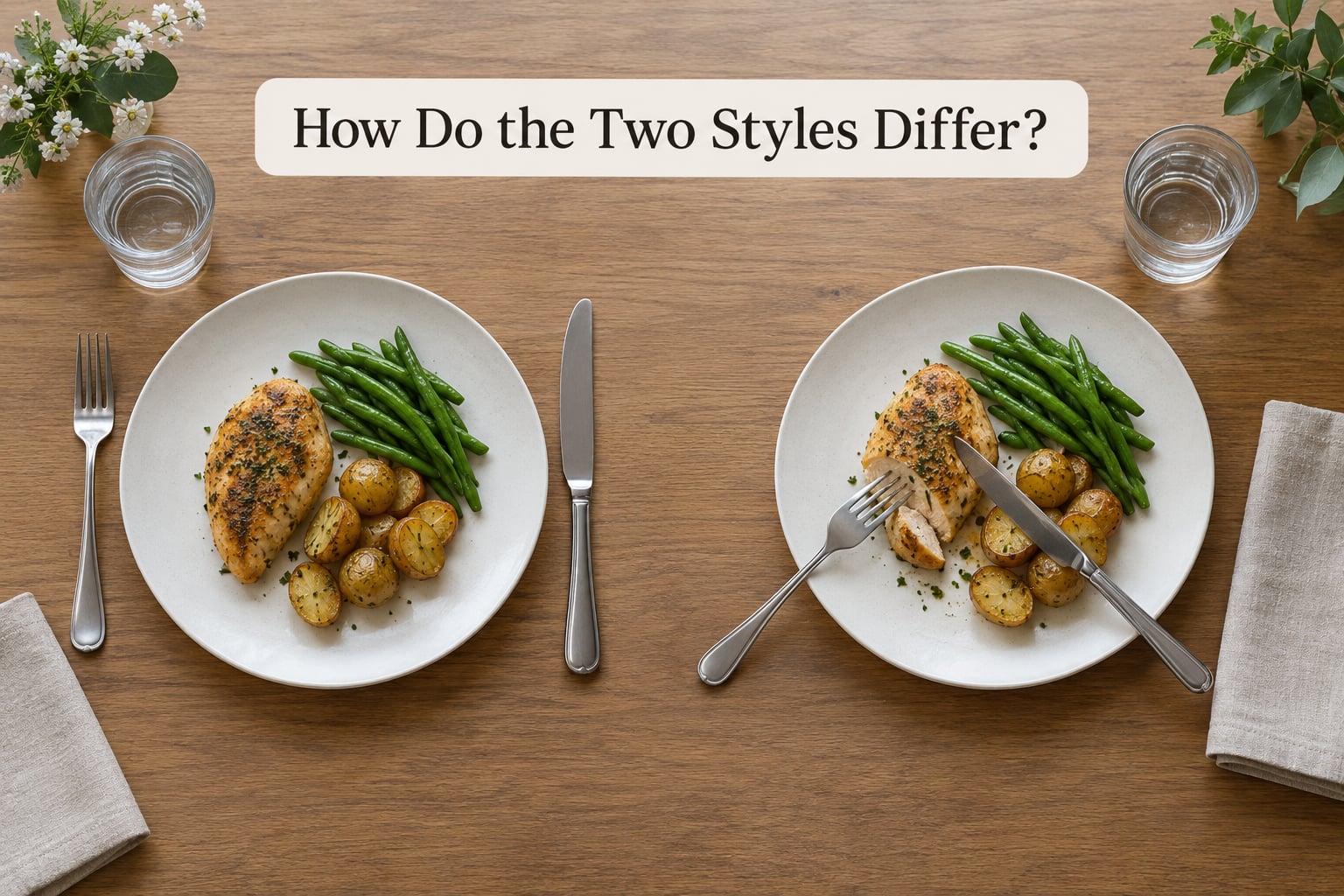
Where the difference actually shows up
The fork handling is the whole story. Everything downstream, the resting position, the noise, the speed, the hand in your lap, follows mechanically from whether you set the fork down. American style produces more movements per course and puts the knife against the plate many times. Continental style produces fewer movements and keeps your hands engaged the entire time.
Continental also asks more of your coordination. Holding food steady with a downward fork while cutting with the other hand is a fine-motor task, and it is why some people with limited dexterity or arthritis find the American style easier to manage.
How to hold a fork and knife properly
The grip is identical in both styles, because the grip only matters while you are cutting.
- Rest the handle of the fork in the crook between your thumb and index finger.
- Let the index finger run along the back of the fork, stopping at the bridge where the tines widen.
- Keep the handle in the palm rather than pinched between the fingertips.
- Hold the knife the same way, index finger on the flat of the blade, not in the handle groove.
- Rest the small finger of each hand on the plate edge for stability if that feels comfortable.
Gripping the fork like a shovel, knuckles white, is the giveaway that a diner has never been taught. It is not a disaster, but it is the most visible table habit there is.
Why experts disagree about resting positions
Published guidance genuinely conflicts here, and that is worth saying plainly. One widely copied article puts the American resting position at knife at 4 o’clock and fork at 8 o’clock. Another puts both utensils at 10:20 for everything. A third uses a crisscrossed knife over fork for continental pauses. All three appear in print.
The reconciliation is straightforward. Two messages matter to a server: still eating, and finished. The 10:20 parallel position is the finished signal in both styles, and there is broad agreement on that. The resting position varies by style and by source, and any tidy on-plate arrangement that clearly signals still eating will be read correctly. The 4-and-8 o’clock description is the classic American version; the inverted V is the classic continental one.
The British style is a third thing
Britain gets its own variant and is constantly confused with continental. British diners pick up both utensils together and use the fork tines down, as in continental, but many also use the fork to push food onto the knife or cut softer items directly with the fork edge. It is continental with a shortcut added, and it is fine.
If you are left-handed
Nothing about either style assumes a right hand. A left-handed diner cuts with the left hand, because cutting needs the steadier hand, and then moves the fork to the left to eat, tines up. In continental style, the fork simply lives in the right hand with tines down from start to finish, and the knife stays in the left. Every position on the plate stays the same as for a right-handed diner, since it is described relative to the plate, not your body.
Rules that apply to both styles
- Silverware never touches the tablecloth once eating starts. Rest it on the plate.
- Wait until everyone is served before you begin.
- Keep elbows in, wrists below the table edge or resting lightly on the table.
- Do not reach across another person for the salt.
- Place every utensil used in a course on the plate when that course is finished.
- Dessert utensils arrive above the plate or on top of it, and courses are eaten in the order they are set.
- Start with the outside utensils and work inward, unless the host says otherwise.
Which Knife and Fork Style Is More Comfortable?
For beginners and anyone eating soft, messy or saucy food, continental style is usually easier. One utensil does the eating, the knife never leaves your hand, and there is no moment mid-bite where you have to look down and work out which hand holds what.
American style suits diners who like their hands visible and active, and it feels natural to people who grew up with it. It is also more forgiving with larger, firm pieces of meat, because the pinning fork and the sawing knife are doing clearly separate jobs.
For limited dexterity, the American method wins in most cases, because the cutting motion does not depend on the fork staying angled downward at the same time. Children learning table manners are usually taught continental first, since it involves fewer decisions, then moved to American when they are ready for the switch.
One practical note for people eating one-handed, whether from an injury or a cast: continental style is genuinely easier because both utensils work from a single hand position. I have a friend who eats that way, and the difference is obvious within a course. If you want the same kind of setup at home, a deli-style shredded lettuce and sub salad is about as one-fork-friendly as dinner gets.
Which Style Is Used in Formal Dining?
Both are acceptable at formal tables. Etiquette authorities are unusually united on this point, and Jacqueline Whitmore of the Protocol School of Palm Beach, Lizzie Post of the Emily Post Institute, and William Hanson of Just Good Manners all describe both methods as correct.
What differs is the expectation. At a state dinner, a black-tie charity gala, or a formal dinner in most of continental Europe, continental is the default and an American zigzag will be noticed, usually not unkindly. At a US business lunch, a wedding reception, or a restaurant anywhere in North America, American is what the table is set up for, and servers read it that way.
Judith Martin, who wrote as Miss Manners, argued for American style on the grounds that it is slower and more dignified and sits oddly with a country built on egalitarianism, while etiquette writers such as Letitia Baldrige preferred continental as the quieter, more discreet option. That disagreement is still unresolved in print, which tells you how little it matters in practice.
When dining abroad, the burden sits with the guest and the host, not the visitor. Follow what the people around you are doing, and if you are unsure, watch for half a course before committing.
Which Should You Choose?
Here is the practical version, by situation.
- Home dinners and takeout: whatever you grew up with. Nobody is grading you and the food is usually too good to notice.
- Family dinners and holiday meals: continental if your family is European, American if it is not. Match the people who set the table.
- Business lunches and client dinners in the US: American. It is the local default and it reads as engaged rather than stiff.
- Formal events and fine dining in Europe: continental, or mirror the host.
- Traveling: learn continental, because it is the more widely expected formal method and it travels well. You can always do American quietly at home.
- Cross-cultural tables: copy your neighbour at the table, not your home country’s habit.
If you host, the responsibility is yours and the choice is easy. Set the table the way you eat and put your own fork and knife to work first; guests will follow within a course. Setting a full place is less work than most people expect, and it makes a home dinner feel considered.
We eat American most nights, mostly because that is what a Cuban sandwich, Miami style or Tampa style practically demands, since you want one hand free and a knife you would rather not put down. I switch to continental whenever there is a guest from Europe at the table, purely so nobody spends the meal wondering whether I am doing it wrong.
Frequently Asked Questions
What is the main difference between American and continental dining styles?
In American style you cut with the knife in your dominant hand, set it down, then switch the fork to that hand and eat with the tines up. In continental style the fork stays in your non-dominant hand with tines down and both utensils are used together for the whole course. Nothing else differs, and neither method is considered incorrect.
What is continental style?
Continental style, also called European style, is a knife-and-fork technique where the fork is never put down. It stays in the non-dominant hand with the tines angled down, pinning food against the plate while the dominant hand cuts, and food is then speared onto the fork for eating. It became standard when formal service shifted to guests carving their own food in the mid-1800s.
How do you position a knife and fork when you have finished eating?
Place both utensils on the plate, parallel, in a loose V shape at roughly the 10:20 clock position with the handles pointing to the right. This finished signal is the same whether you eat American or continental style, which is why servers read it without needing to know your habit. Handles should rest on the plate, never hanging over the edge.
What are the etiquette rules for eating with a knife and fork?
Both styles share the same underlying rules. Rest silverware on the plate rather than the tablecloth, wait until everyone is served, keep wrists below the table edge or lightly resting on it, and place every utensil used in a course on the plate when that course ends. Do not reach across another diner, and start with the outside utensils unless the host begins otherwise.
Which countries use continental style eating?
Continental style is standard across France, Spain, Portugal, Italy, Germany, Austria, Switzerland, Scandinavia, the United Kingdom, Ireland and most of Central and Eastern Europe, as well as in Australia and New Zealand. The United States and Canada default to American style. National habits are not absolute, so the table in front of you is a better guide than the country you are in.
Is it rude to use the American style of eating in Europe?
No. It is noticeable rather than rude, and most etiquette authorities describe both styles as correct. Continental is the expected method at formal European tables, so switching for a business dinner or a wedding is a courtesy that costs you nothing. At ordinary meals nobody will comment on it. The social rule that does matter is picking one style and staying consistent across the whole meal.
A Simple Rule for Choosing Your Utensil Style
Look at the table before you pick up anything, and copy the person sitting nearest you. Pick one style, stay with it from the first course to the last, and never leave the fork down mid-meal while switching back and forth, because that inconsistency reads as uncertainty rather than preference.
Do the mechanics the same way whichever style you pick: grip the handles in the palm, keep silverware off the tablecloth, rest it on the plate between bites, and lay both utensils at 10:20 when you are finished. Get those four right and the choice between American and continental style is a preference, not a risk.