
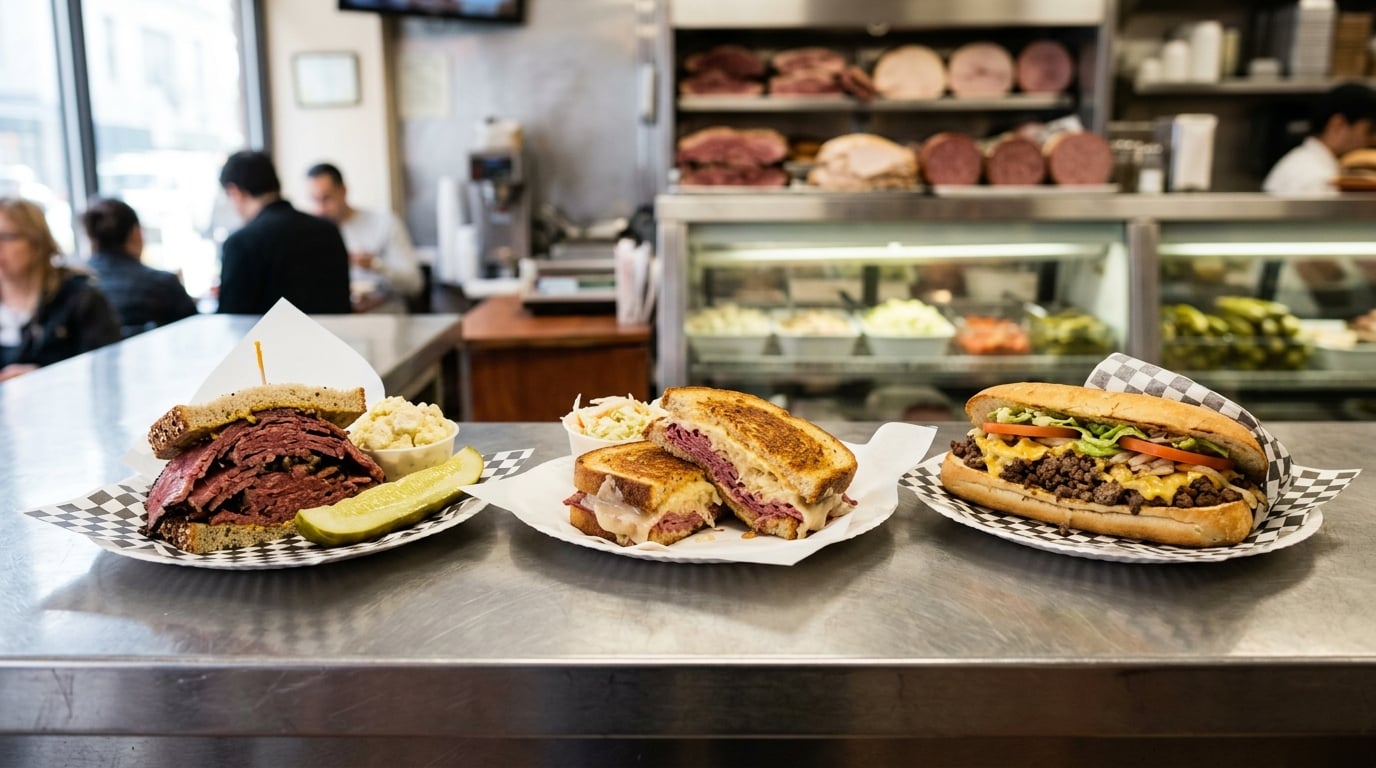
If you only have room for one, order the pastrami on rye: cured beef brisket, hand-carved at the counter, piled onto seedless rye with spicy brown mustard and a kosher dill pickle on the side. That is the sandwich most people mean when they say classic New York deli sandwiches, and it is the benchmark the other nine on this list get measured against.
What makes a sandwich a New York deli sandwich is not a secret ingredient. It is a short list, repeated consistently for decades: hand-sliced or hand-chopped cured beef, sturdy rye bread, mustard rather than ketchup, and a pickle. Everything else, from the chopped cheese to the lox and cream cheese bagel, is a variation on that same idea of good meat treated well and served fast.
Below I break down ten sandwiches by what they taste like, how they are built, and how to order them without the counter confusion that trips up first-timers. The details that turn out to matter are small ones: how much fat you want on the meat, whether the bread gets griddled, and whether you know that a half sandwich is a full meal for one person.
Table of Contents
- Best Classic New York Deli Sandwiches to Try at Least Once at a Glance
- 1. Pastrami on Rye
- 2. Corned Beef on Rye
- 3. Roast Beef on Rye
- 4. The Chopped Cheese
- 5. Reuben Sandwich
- 6. Classic Italian Deli Sandwich
- 7. Turkey Club Sandwich
- 8. Chicken Cutlet on Rye or a Roll
- 9. Bacon, Egg, and Cheese
- 10. Lox and Cream Cheese on a Bagel
- Frequently Asked Questions
- What is the difference between pastrami, corned beef, and roast beef?
- Which bread is traditionally served with a New York deli sandwich?
- What is the most classic New York deli sandwich for a first visit?
- Should I order mustard, Russian dressing, or both with a deli sandwich?
- What side or drink pairs best with a New York deli sandwich?
- Conclusion: Start with the Sandwich That Matches Your Taste
Best Classic New York Deli Sandwiches to Try at Least Once at a Glance
Here is the whole list in one view, sorted the way a counter would think about it: bread first, then filling, then the condiments that make it a deli sandwich instead of a plain one.
| Sandwich | Bread | Filling | Signature condiments | Best known for |
|---|---|---|---|---|
| Pastrami on rye | Seedless rye, optional marble rye | Smoked, pepper-crusted cured brisket | Spicy brown mustard, kosher dill pickle | The benchmark deli sandwich |
| Corned beef on rye | Seedless rye | Cured, unsmoked brisket or round | Mustard, sauerkraut or pickle | Denser chew, half-and-half combos |
| Roast beef on rye | Rye or marble rye | Roast beef, usually rare | Horseradish cream, onion, mustard | The mild option for first-timers |
| Chopped cheese | Hero roll | Griddled chopped beef | Mustard, onions, pickles, ketchup optional in a bodega | The authentic bodega sandwich |
| Reuben | Grilled rye | Corned beef, Swiss cheese | Russian dressing, sauerkraut | Hot, rich, tangy, pressed |
| Classic Italian | Hero roll or sub roll | Cured cold cuts, provolone | Oil, vinegar, pickled peppers, oregano | A cold, substantial lunch |
| Turkey club | Toast, kummelweck, or roll | Roast turkey, bacon | Mayonnaise, lettuce, tomato | Three textures in one |
| Chicken cutlet | Rye or roll | Breaded fried chicken cutlet | Sauce, lettuce, pickle | Hot and cold in one sandwich |
| Bacon, egg, and cheese | Roll, bagel, or toast | Bacon, egg, American cheese | Mustard, hot sauce, salt pepper | The all-day deli sandwich |
| Lox and cream cheese | Bagel, open-faced | Hand-cured salmon, thick cream cheese | Red onion, capers, cucumber, tomato | The one eaten in the morning |
Menus and hours change, and counters close or move, so confirm what a specific deli is serving before you travel across town for it. Everything above, though, has been on New York deli counters for a very long time.
How to Order the Best Classic New York Deli Sandwiches to Try at Least Once
The list works better if you know the mechanics first. Five steps cover almost every counter in the city.
- Pick your sandwich, then pick your portion. Ask for a half on rye if you want to taste something new, a quarter if you plan to eat two, or the full sandwich if this is lunch and you are hungry. A half is a real meal for most people, not a sample.
- Choose the bread and confirm it. Say seedless rye out loud, because sometimes the counter is holding marble rye and nobody will ask which you meant. Some sandwiches come on a hero roll by default; rye is the traditional choice for cured meat.
- Say the meat spec. All the way means lean meat, well trimmed. Lean means you want some fat left on. This is the single most useful phrase to learn and the one regulars use constantly.
- Add the condiment and the pickle. Spicy brown mustard goes on almost everything. A kosher dill pickle comes on the side, and you want the side, not it sitting on top of the bread soaking in juice.
- Decide whether the meal needs a side. A sandwich plus a drink is a normal lunch. A sandwich plus a knish and a pickle is how the day starts to get interesting.
Two more counter notes. If the deli offers both counter service and table service, the counter is where the sandwiches are made and the tables are where you sit with the number ticket you were handed when you ordered. And at a busy lunch rush the tip jar goes to whoever is on the slicer, which is a reasonable reason to have exact change.
1. Pastrami on Rye
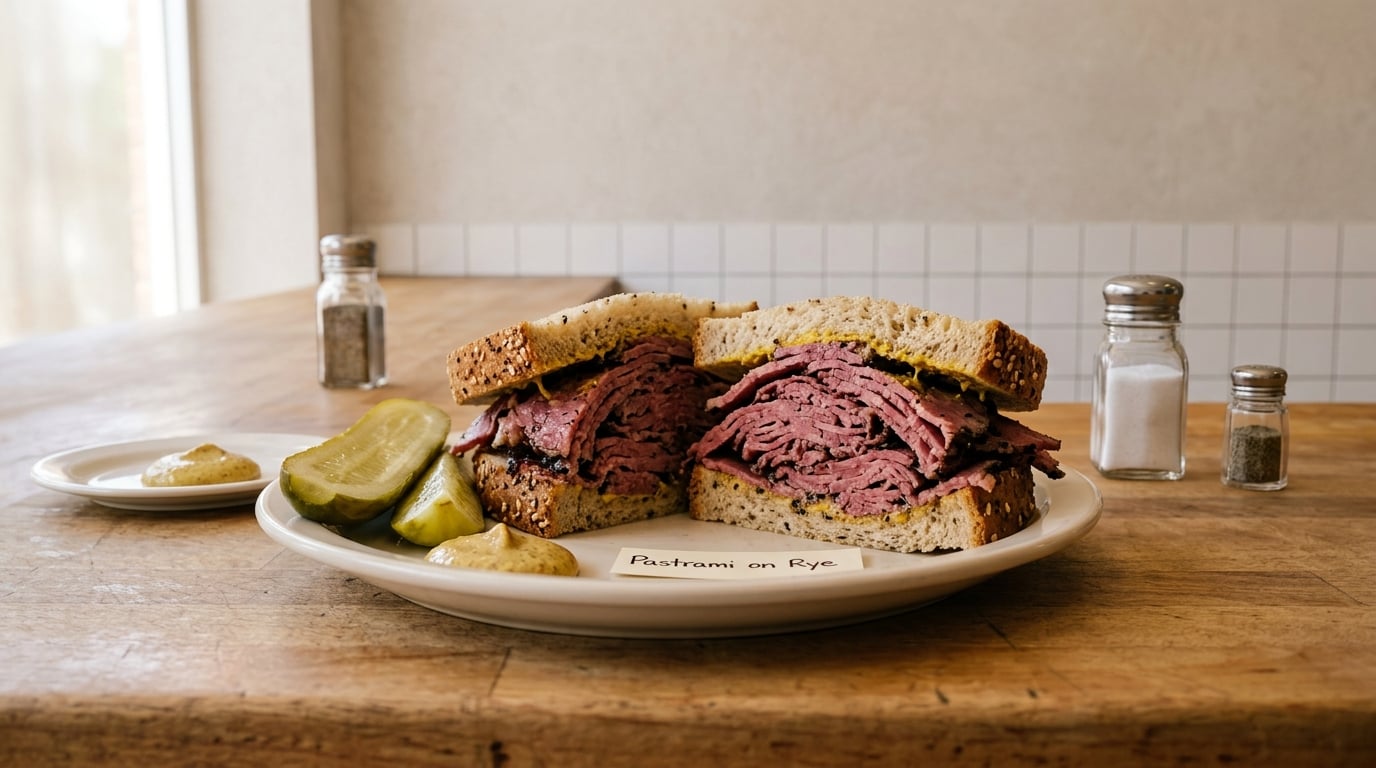
Pastrami is beef brisket cured in a rock salt and celery brine for days, then smoked hard, then coated in a coarse pepper and garlic rub. The result is a dark crust, a pink center, and a slice so thin it folds but still holds together.
The sandwich is almost insultingly simple: pastrami, spicy brown mustard, seedless rye, one kosher dill pickle on the side. What makes it good is the meat and the bread doing the same work, which is why the rye has to be sturdy and slightly sour and the meat has to be sliced thin enough to stack without sliding out. The pickle is not optional garnish. Its sour crunch is what keeps a fatty sandwich from being a mouthful of nothing.
Two practical notes. Ask for the sandwich warm rather than ice cold if the counter will allow it, because warmed rye and warmed fat smell better and the bread softens just enough to hold. And order a half unless you know what you want, because a full pastrami sandwich is a serious commitment and the second half of the day is hard to plan around.
Origin stories credit Sussman Volk, a Lithuanian immigrant, with curing beef in the 1880s, and the sandwich has been a New York fixture since long before most of the landmarks were founded. Katz’s Delicatessen is the name that comes up constantly in local food forums, and its pastrami on rye is the reference point most people measure against, though the queue is famously long. Pastrami Queen, S&P, and USA Brooklyn Delicatessen all come up in the same conversations, and regulars happily argue about hand-carved versus machine-sliced for as long as you let them.
2. Corned Beef on Rye
Corned beef is the same family of meat with the smoke left out. It is cured in a seasoned brine, packed with peppercorns and spices, and left unsmoked, which makes it a good deal more assertive in flavor and noticeably firmer in texture than pastrami. Slices are thicker and chewier, and a well-made one should taste of the brine rather than of fire.
Order it on rye with mustard and either sauerkraut or a pickle. Sauerkraut is the more interesting choice because its acidity cuts the salt and fat in a way a pickle does not, and the two together are the closest thing to a balanced plate you will get standing up. A corned beef on rye that tastes flat usually means the meat was sliced thin and sat on the counter too long before it was wrapped.
There is one ordering trick worth knowing, and regulars use it constantly: order half pastrami, half corned beef on the same sandwich. The smoke and the cure sit next to each other, and it solves the problem of wanting both. If you are visiting a counter for the first time, this is a reasonable way to compare the two meats directly without committing to a full sandwich of either.
3. Roast Beef on Rye
Roast beef on rye is the one to order when pastrami’s pepper crust feels like too much. It is mild, fatty, and savory in a quieter way, and the good version is sliced rare so the interior stays cool and soft while the outside holds its shape.
The build is simple: roast beef, rye, and horseradish cream, which is the condiment that actually belongs here. The sharpness of horseradish against cold beef is the whole point of the sandwich. Yellow mustard works too. Many counters will add thin slices of onion, which is a good idea if you like the sandwich to feel more like a roast beef dinner and less like a deli lunch.
A slice of cheese, usually Swiss or American, is a common addition and turns it into something closer to a French dip in bread form. Ask for the cheese inside rather than on top if you want it melted, and ask the counter whether they melt it, because a cold slice of cheese on a cold sandwich is a different sandwich entirely. This is the sandwich to order for the person in your group who is excited about the idea of a deli but unsure about cured beef.
4. The Chopped Cheese
The chopped cheese is the deli sandwich most people outside New York have never had, and it is not a Reuben, a cheesesteak, or anything else with a similar name. It is a thin layer of finely chopped beef pressed onto a flat-top griddle until it crusts, then buried under melted American cheese and chopped onions, and served on a hero roll with mustard and pickles.
That is the whole recipe, and the order of operations is what gives it its character. The beef hits the grill raw and salted, cooks into a patty, and gets cheese laid over it while it is still hot enough to melt. The bread never goes on the grill. The result is a sandwich that is crisp in the middle, soft at the edges, and extremely heavy.
Get it from a bodega, not a restaurant making a fashionable version of it. The chopped cheese belongs to Harlem and the Bronx, and a deli in one of those neighborhoods will hand you a sandwich on a roll that is structurally unsound in the best way, wrapped in foil, with a pickle spear on the side. Order it with the onions raw if you want the heat, and be realistic about portion: this is a sandwich that ends a person for the rest of the afternoon.
5. Reuben Sandwich
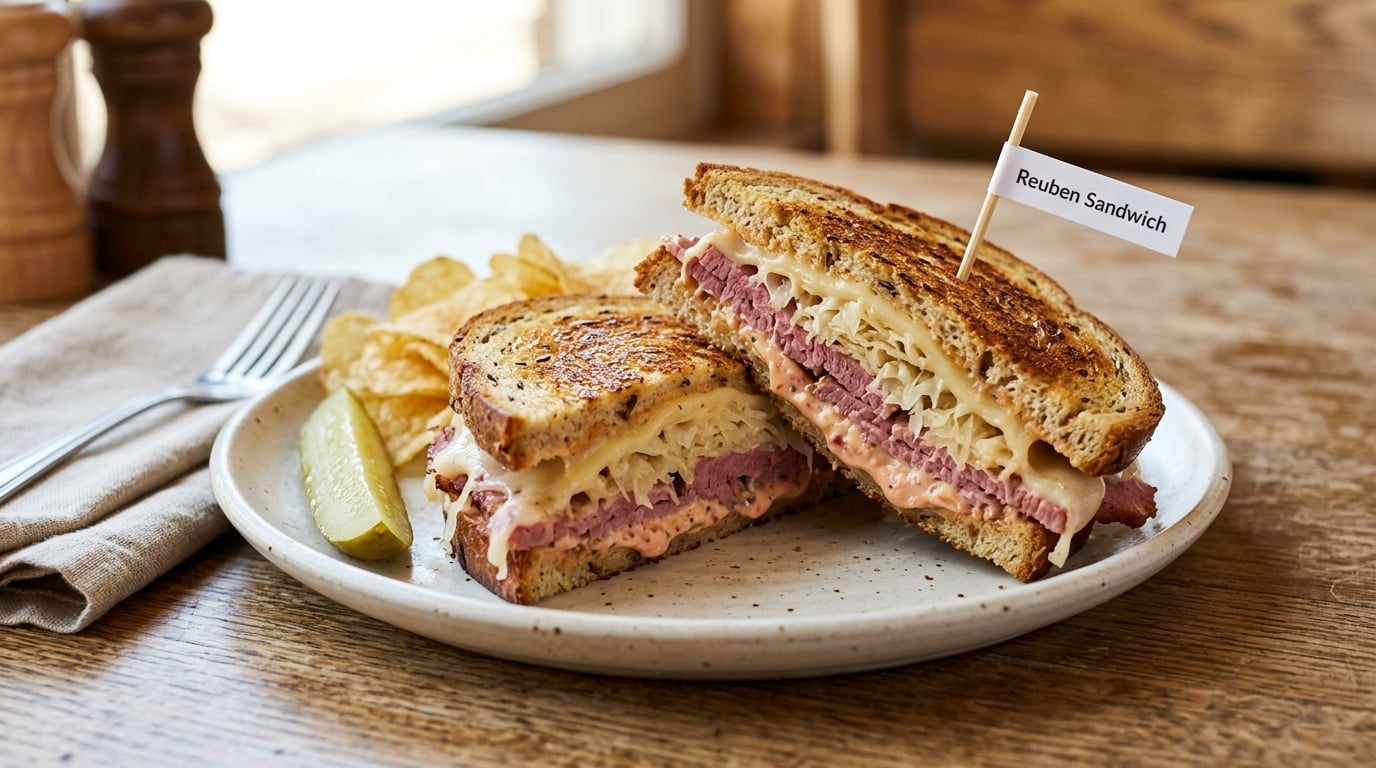
A Reuben is the one hot sandwich on this list that belongs to the deli rather than the diner. Corned beef and Swiss cheese go on rye with sauerkraut and Russian dressing, and the whole thing gets griddled until the bread is toasted and the cheese runs.
Every element earns its place. The Swiss melts into the corned beef and softens the salt. The sauerkraut, warmed through, loses its raw edge and turns sweet and sour. The Russian dressing is mayonnaise and ketchup with pickle relish in it, which surprises people who have decided they do not like ketchup until they taste it in this context. Grilling the sandwich is what fuses all of it, and a Reuben served cold is a different order entirely.
The sandwich is generally credited to Arnold Reuben, who is said to have served a version in 1914, and the Rachel, a cousin made with pastrami instead of corned beef and a thinner spread of dressing, has a following of its own. Order the Reuben when you want something rich, tangy, and toasted. Ask for extra sauerkraut if you like the acid, and eat it immediately, because the bread softens faster than a cold sandwich does.
6. Classic Italian Deli Sandwich
The Italian is the answer for anyone who wants the deli experience without the cured beef. It is built from cold cuts, which means it is sliced to order from a case behind the counter: salami, mortadella, prosciutto, coppa, and a layer of provolone, usually with a slice or two of provolone folded in as well.
Condiments here are about sharpness and fat rather than smoke. Pickled banana peppers or hot peppers, pickled tomatoes, a spoon of oil and vinegar, dried oregano if the counter offers it, and sometimes a hit of garlic. Lettuce and tomato are optional and split opinions, since they make the sandwich wetter and less portable.
Ask for the cold cuts sliced thin and specify which ones you want by name, because counters will happily hand you whatever is closest to the front of the case. This is a substantial sandwich, and the value of it is variety: several different textures and flavors in one order, which makes it a good choice for a group ordering lunch at a shared table rather than a solo counter lunch.
7. Turkey Club Sandwich
A deli club is a roast turkey sandwich built with care rather than assembled from whatever is in the fridge. The turkey is roasted in house, often with the skin left on, and sliced thick. Bacon is cooked crisp. The bread is usually lightly toasted, and the dressing is mayonnaise with a little salt and pepper, applied to the bread rather than the filling.
What makes a club good is the contrast. Cold moist turkey, salty crisp bacon, cool lettuce, and tomato with seeds running into everything. Three textures in one sandwich, and it is the only entry on this list where a mild, non-cured meat is the main event.
The most common complaint about a club is sogginess, and it is a fixable problem. Keep the lettuce and tomato on the side until the moment you eat it, keep the bacon on top rather than under the turkey so its fat does not soak downward, and toast the bread so it holds a barrier. If you are ordering at a counter rather than a diner, ask for the club on kummelweck, the seeded rye roll with caraway and salt on top, which is the traditional club roll in a New York deli and is far sturdier than plain white.
8. Chicken Cutlet on Rye or a Roll
The chicken cutlet is the bridge between the cold counter and the hot griddle, and it is a good bridge for anyone who wants the deli format with a hot filling. A chicken cutlet is a thin breast, breaded and fried, and the sandwich is that cutlet sliced or left whole on bread with sauce and a pickle.
The breading is the point. A good cutlet has a thin, brittle crust with almost no trailing crumbs, and a bad one is a thick coating that peels off in your hand and turns the bottom of the bread to paste. That is why the sauce matters: a thin sauce applied generously keeps the crust crisp and the bread from failing, while a thick sauce applied lazily does the opposite. Marinara, melted cheese, and a garlic-and-oil sauce are the usual choices, and mayo-based sauces and hot chicken cutlets both exist for a reason.
Order it on rye if you want the sandwich to read as deli rather than as a sandwich shop, and eat it soon after ordering. This is also the most filling item on the list. A cutlet sandwich with cheese and a side of fries is a full day of eating, and a half cutlet is not really a thing, so if you want to taste it without ending the afternoon, order the cutlet on its own and skip the sauce.
9. Bacon, Egg, and Cheese
Bacon, egg, and cheese is the sandwich that proves a deli works all day. It is listed here because the counter version, made on a good roll and handed to you at 8 in the morning, is a different animal from the breakfast sandwich you can get anywhere.
The bread does the work. Ask for a roll for a portable version, a bagel if you want something dense enough to survive the egg, or toast if you are eating it immediately at a counter stool. Specify the egg style, since it is the one thing that changes the character completely: over easy or hard for a diner sandwich, scrambled for something closer to a breakfast plate, over hard for the version that holds together through a commute.
Cheese means American by default, melted onto the bacon, which is right. Salt, pepper, and hot sauce go on top. Ketchup is the famous wrong answer here, and the standard correction is spicy brown or yellow mustard. Order it with a pickle and a coffee if it is morning, or a soda if it is not, and you have the single most reliable meal in the city.
10. Lox and Cream Cheese on a Bagel
Lox and cream cheese is the one sandwich on this list that is traditionally eaten in the morning, and the one most often left off lists like this because it is not meat on rye. It belongs anyway, because it is the deli’s oldest idea: take a cured product seriously, spread something rich, and hand it over quickly.
Lox is salmon cured with salt and nitrate, which is a different process from the cold smoking used for lox-adjacent smoked salmon, and it is closer in color and texture to a firm, slightly oily raw cured fish. Ask for the thick cut, which is often called belly lox, and ask for the cream cheese to be spread thick, not applied as a thin crumb coat. A good counter will hand you a bagel with enough cream cheese that a layer of it falls out when you pick it up.
The toppings are where preferences divide. Red onion is standard. Capers, cucumber, and tomato show up on about half the orders. Salted or plain cream cheese, and an everything bagel, are the other common decisions. Some counters slice the salmon and hand it over on a plate for you to build, which is worth doing if you have never had one. Eat it open-faced, with a squeeze of lemon and a cup of black coffee, which is how most regulars do it.
Frequently Asked Questions
What is the difference between pastrami, corned beef, and roast beef?
Pastrami and corned beef are both cured beef, but pastrami is smoked afterward and coated in a pepper and garlic crust, giving it a dark edge and a smoky flavor. Corned beef is cured in a seasoned brine and left unsmoked, so it is firmer, chewier, and more assertively salty. Roast beef is not cured at all. It is roasted, usually rare, and sliced thin, which makes it the mildest and least salty of the three.
Which bread is traditionally served with a New York deli sandwich?
Seedless rye is the traditional choice for cured meats like pastrami, corned beef, and roast beef, because its dense crumb and sour flavor hold up against wet, salty fillings. Marble rye, which bakes caraway or cracked pepper into the loaf, is the second classic. The chopped cheese and the club use a hero roll and kummelweck respectively. Whatever you choose, say it out loud, because the counter may be holding a different loaf.
What is the most classic New York deli sandwich for a first visit?
Order the pastrami on rye with spicy brown mustard and a kosher dill pickle on the side. It is the reference point the rest of the deli menu is measured against, and it is the order most regulars point a first-timer toward. If pastrami sounds too heavy, a roast beef on rye with horseradish is the gentler version of the same idea, and a chopped cheese is a good choice for someone who does not eat cured beef at all.
Should I order mustard, Russian dressing, or both with a deli sandwich?
On a cold sandwich, spicy brown or yellow mustard is the default and almost the only correct answer. Russian dressing belongs on a hot pressed sandwich such as a Reuben, where its mayonnaise, pickle relish, and ketchup base melds with melted cheese. Order both only when the sandwich is being griddled, such as a Reuben or a grilled cheese, and skip ketchup entirely on pastrami or corned beef unless you are in a bodega ordering a chopped cheese.
What side or drink pairs best with a New York deli sandwich?
A kosher dill pickle and a black-and-white cookie are the classic pair, and both are available at almost any counter. For something more substantial, add a knish, a bowl of matzoh ball soup, or a potato pancake with applesauce, which are the three sides that come up most often at a proper New York deli. A half sandwich with a knish and a drink is a complete lunch; a full sandwich with all three sides is closer to a nap.
Conclusion: Start with the Sandwich That Matches Your Taste
Pick your route by what you actually want to eat. If you want rich and smoky, the pastrami on rye is the only place to start. If you want something tangy and hot off the griddle, order the Reuben. If cured beef sounds intimidating, go with roast beef and horseradish, or a chopped cheese from a Harlem bodega.
Whichever one you pick, order a half, get the pickle on the side, and say the bread and the meat spec out loud. That habit alone will do more for the sandwich than anything you add to it. This list was last checked for October 2026, and the sandwiches at the back of it have not changed in a century, which is the whole point.