
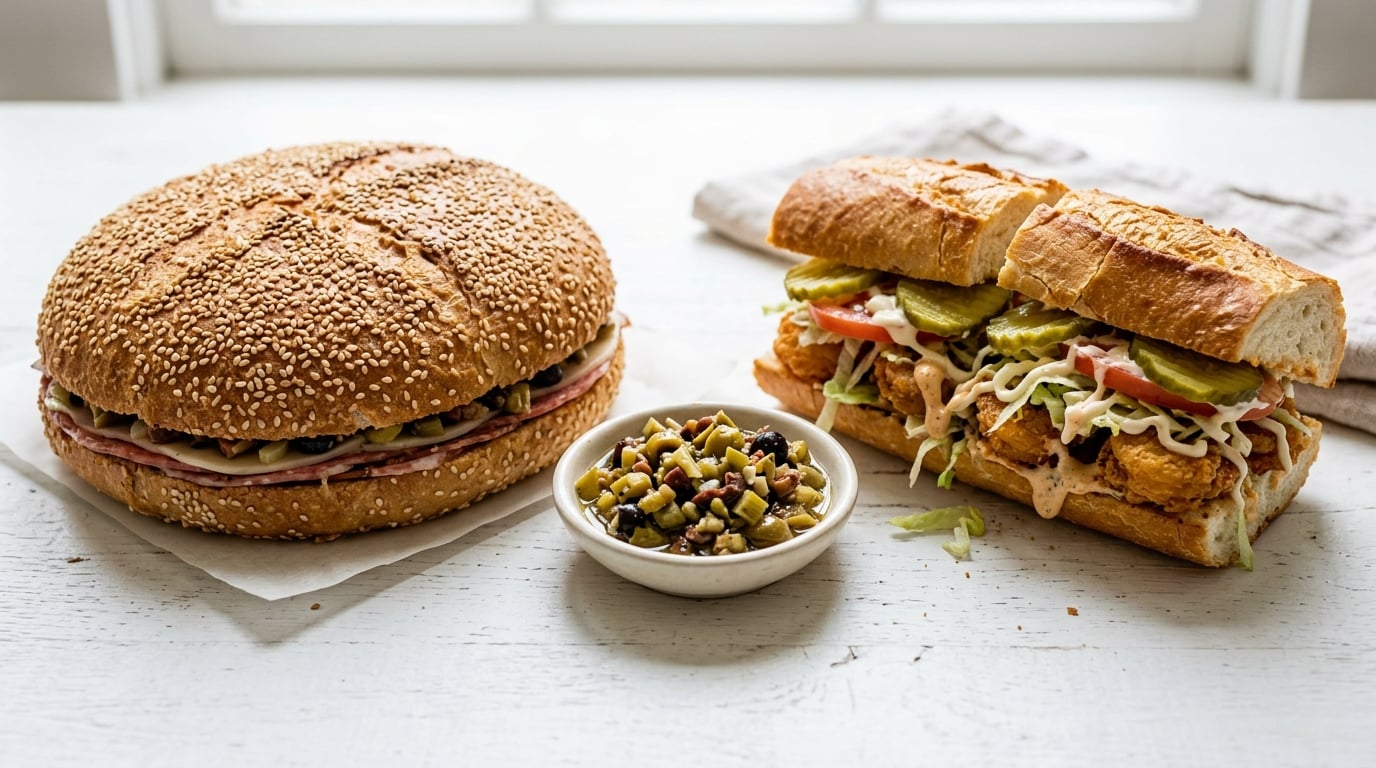
Start with the muffuletta if you only have time for one. It is the sandwich New Orleans actually eats every day, and it is the one you cannot get this quality anywhere else in the country. Order the po’ boy first instead if you want something hot, dripping and fried the moment it is handed to you.
Both are New Orleans sandwiches, and the confusion between them is a bread problem more than anything else. A muffuletta is a round, sesame-crusted Sicilian loaf packed cold with cured meats and a heavy layer of chopped olive salad. A po’ boy is a crusty French-baguette roll filled hot with fried seafood or roast beef and gravy.
I have watched first-timers make the same mistake: they order a muffuletta, take a bite in the parking lot, decide it is just Italian cold cuts, and never come back. Give it the resting period it asks for and it becomes an entirely different sandwich. That is the whole argument, honestly.
Table of Contents
Muffuletta vs. Po’ Boy at a Glance
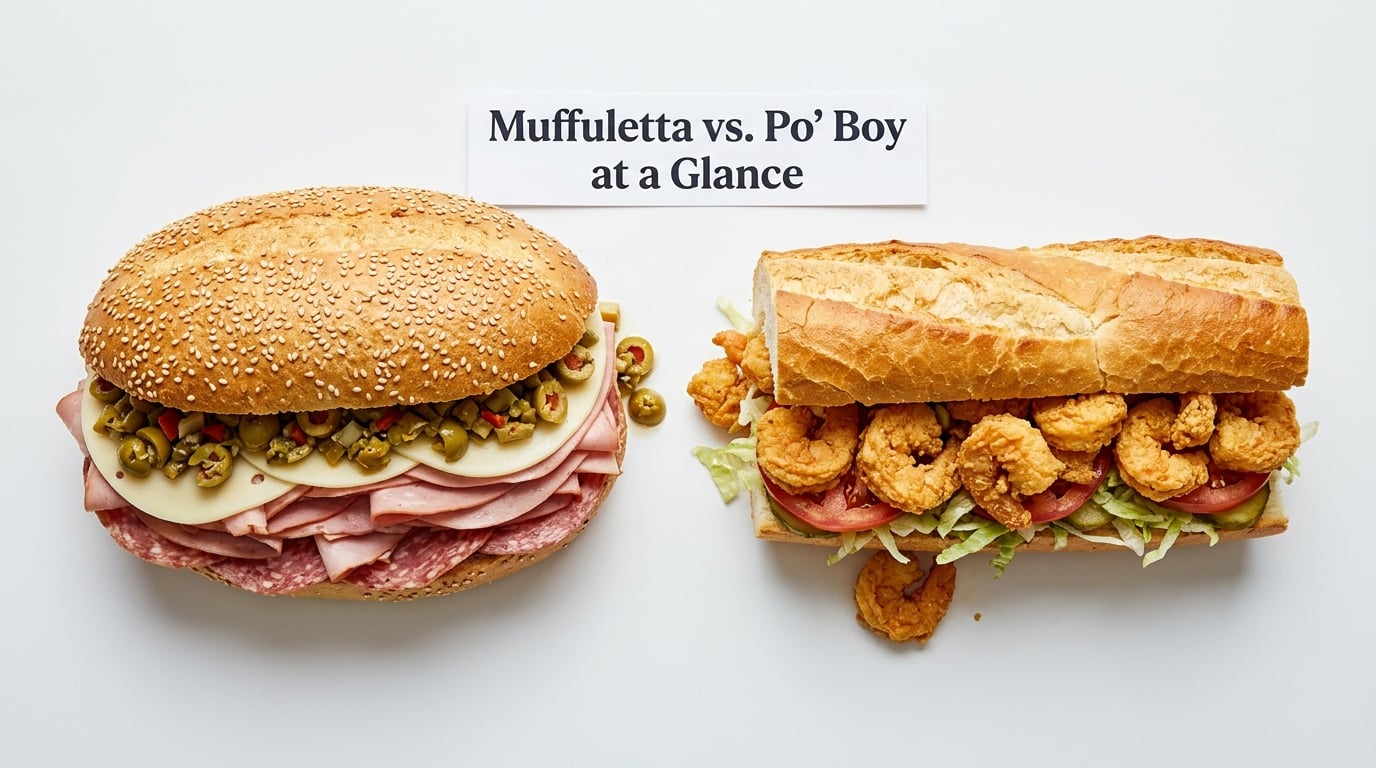
| Attribute | The Muffuletta | The Po’ Boy |
|---|---|---|
| Origins | Central Grocery, 1906, Salvatore Lupo, Sicilian immigrants | Clovis and Benjamin Martin, late 1920s streetcar strike |
| Bread | Round sesame-crusted Sicilian loaf | Long New Orleans French bread |
| Main filling | Salami, ham, mortadella, Swiss or provolone | Fried shrimp, catfish, crab or roast beef with gravy |
| Cheese | Sliced cold, melted only if pressed | Provolone or American, melted on contact |
| Toppings | Olive salad: olives, giardiniera, pepperoncini, capers, oil | Mayonnaise or remoulade, lettuce, tomato, pickles, hot sauce |
| Served | Cold, wrapped in paper, rested before eating | Hot, assembled to order, eaten immediately |
| Flavor profile | Salty, briny, garlicky, cured and cold | Hot, crispy, rich, acidic, dripping |
| Texture | Dense and soft, bread absorbing brine | Crusty outside, wet inside, structurally intact |
| Portion | Large round, usually a whole sandwich | Long roll, often cut in half or into sections |
| Best for | Cold, chopped, olive-forward eating and sharing | Seafood lovers, quick lunches, big appetites |
One more row worth knowing: neither sandwich is Cajun in origin. The muffuletta is Italian-American, built by Sicilian immigrants who settled on the Lower Pigeonwasher and later the French Market. The po’ boy is Creole city history, born on the streetcar line.
What Is a Muffuletta?
A muffuletta is a round Sicilian bread loaf, sesame-crusted and about the size of a dinner plate, split and filled with cold cuts, cheese, and a thick layer of olive salad. The sandwich is served cold, usually wrapped in paper, and traditionally eaten after it has rested so the bread soaks up the brine and oil from the olives.
The name comes from Salvatore Lupo, an Italian immigrant who opened Central Grocery on Decatur Street in 1906. He built the sandwich around olive salad, the chopped mix of olives, giardiniera, capers, and pickled peppers that Italian-American households kept in jars. The olive salad is not a topping you can skip. It is the structural center of the sandwich, and its brine is what the bread is designed to drink.
New Orleans bakers supply this loaf, including United Bakery and Alois J. Binder, and it is close to impossible to buy outside the region. People who try to fake it with focaccia at home report, in r/Sandwiches threads, that it simply does not work. The crumb has to be soft and thick enough to hold a heavy filling while staying sealed at the bottom.
You will see both spellings, muffuletta and muffaletta, on menus in the city. Locals say roughly moo-fuh-LET-uh, with the stress on the third syllable, and most New Orleanians are not going to correct you if you use the one-f version. Just order it confidently; the counter does not care about spelling.
Ask for it cold unless the shop specifically offers a pressed version. A pressed muffuletta is a legitimate choice, and some people prefer it, but the cold sandwich is the original argument.
What Is a Po’ Boy?
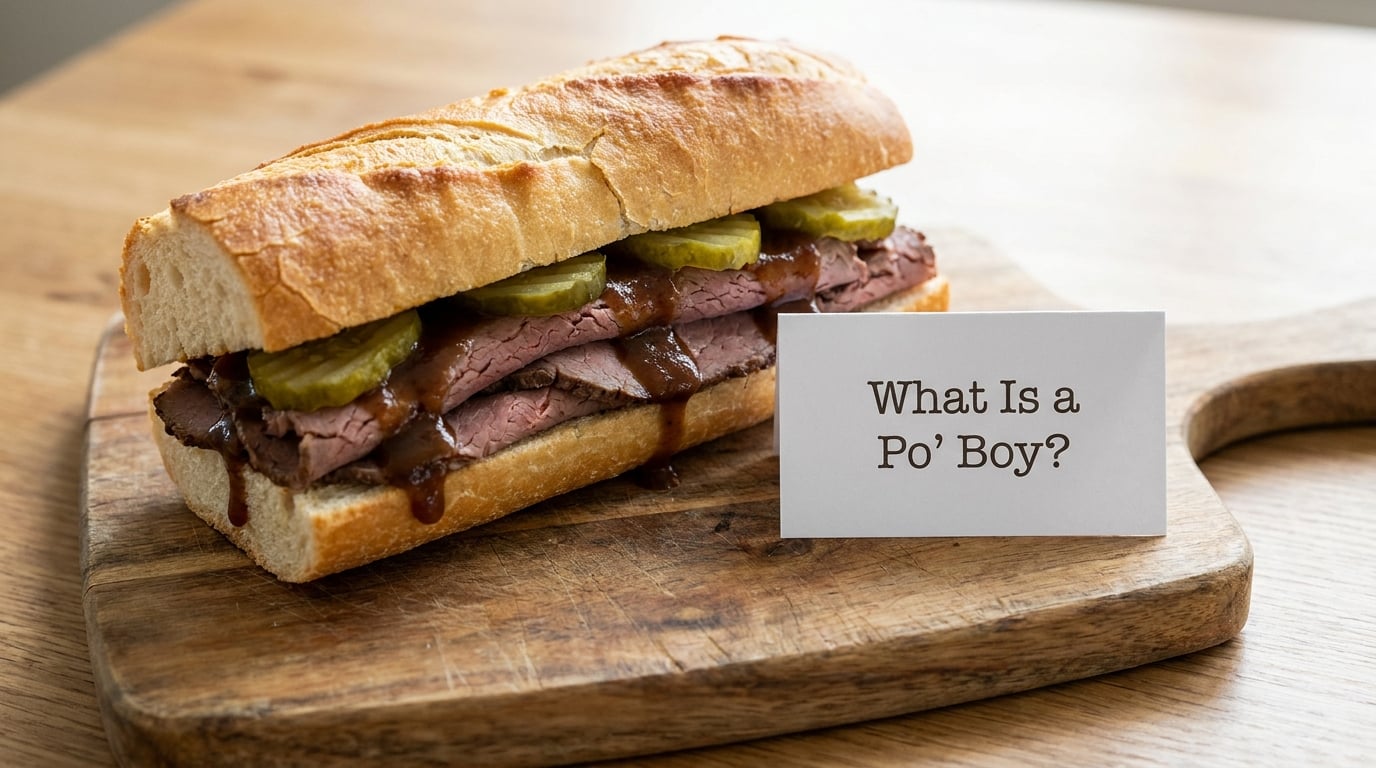
A po’ boy is a long French-baguette roll filled with hot fried seafood or roast beef, dressed with mayonnaise or remoulade, and finished with lettuce, tomato, pickles, and hot sauce. It is the New Orleans answer to a hoagie, and the bread is a New Orleans French loaf with a very specific crackly crust.
The origin story is well documented. In 1929, the streetcar workers of New Orleans went on strike, and the money they spent on transit went to food instead. The Martin brothers, Clovis and Benjamin, sold sandwiches from their Fourth Street grocery to those workers, and the name comes from poor boys. The sandwich has been changing ever since, which is why the version you get depends heavily on the neighborhood.
Fried shrimp is the version most visitors picture. Catfish, soft-shell crab, oysters, and a roast beef po’ boy with brown gravy and mashed potatoes are all standard orders, and roast beef is the answer for anyone who does not eat shellfish. Marinated steak, Italian sausage, and combinations of two proteins show up too.
At the counter, two words decide your order. Dressed means mayo and lettuce, which is the default and what most people want. Undressed means mayo and lettuce left off, and the toppings come dry. Mayo on the side is a real request, and it is the smart one if you plan to eat the sandwich over a table.
Muffuletta vs. Po’ Boy: Flavor, Filling, and Texture
Bread: the round loaf vs the French loaf
This is the cleanest way to tell the two sandwiches apart. The muffuletta’s sesame round is built to absorb. It starts soft, and after a short rest it turns damp and heavy with olive oil and pickle brine, which is the point, not a flaw. The po’ boy’s French bread is built to resist. It holds its crust against a hot, wet filling, and if the roll is right, the bread is still audibly crunchy ten bites in.
A related difference: muffuletta bread absorbs liquid until it is at risk of falling apart, so the sandwich is cut with a knife and eaten in sections. A po’ boy is meant to be held with two hands and folded, and the mess it makes is part of the deal.
Filling: cold cuts and brine vs fried seafood and gravy
The muffuletta is cured, not cooked. Salami and ham supply the salt and fat, mortadella adds a softer texture, and provolone or Swiss provides the mild, slightly sweet note. Nothing in it is fried, and nothing in it is hot. The intensity comes entirely from the olive salad, which can be strong enough to make a person who does not usually like olives sit up straight.
The po’ boy is the opposite. A shrimp po’ boy is dredged in seasoned flour or cornmeal and dropped in hot oil, so the defining flavors are crust, buttery fry, and the peppery remoulade. Roast beef po’ boys lean on gravy and melted cheese, and they taste more like a hot lunch than a sandwich.
One practical warning for people with shellfish allergies: there is no reliable substitute inside a seafood po’ boy. Order the roast beef version instead, and ask at the counter, because fryers and carving boards are often shared.
Temperature and texture: cold and dense vs hot and drippy
Cold versus hot is the cleanest dividing line in this muffuletta vs po’ boy comparison. The muffuletta is eaten cold or nearly cold, dense enough that a knife is the right tool, and it improves slightly as it sits. The po’ boy is eaten hot, structurally loose, and declines quickly, which is why locals eat it standing up near the shop door.
Messiness tracks the temperature. A muffuletta beads with oil at the cut face and leaves crumbs. A po’ boy leaks gravy down your forearm. Neither is wrong, but one of them is survivable on a street corner and the other is not.
Portion size is the last practical difference. A whole muffuletta is genuinely large, and people routinely report being unable to finish one. A whole po’ boy can be ordered in half or in sections, which makes it easier to share and easier to eat while walking. If you are ordering a muffuletta for two, ask for it to be cut in half and eat it at the table.
Which Sandwich Should You Choose?
Order the muffuletta first if you are visiting, if you want the thing that defines this city, or if you like cold cured meat and salty olives. It is a slower sandwich and it rewards a few extra minutes, and it is the one most locals eat regularly rather than the one they eat on a visit.
That last point comes up constantly in r/AskNOLA threads, where the recurring sentiment is that a po’ boy is a visitor food and a muffuletta is a Tuesday lunch. Nobody in those threads argues the sandwich is better. They argue about which one you would actually eat again next week.
Order the po’ boy first if you are a seafood person, if you are hungry now, or if your plan for the rest of the day involves walking. Fried shrimp po’ boys are the best quick lunch in the city, and the roast beef po’ boy is the safest choice for a group with mixed eaters and one shellfish allergy.
If you are trying both, order them in a different order than you expect. Muffuletta first, po’ boy second, with an hour or more between them. Both sandwiches are heavy, and eating them back to back means you taste neither one properly.
Where you eat matters more than which one you pick. Central Grocery on Decatur Street is the historical home of the muffuletta, though its storefront was badly damaged by Hurricane Ida in 2021, so check the current in-store situation before you build your day around it. Little Palermo, Napoleon House, Cochon Butcher, Parkway, and Short Stop are all well-known muffuletta counters. For po’ boys, the closer you get to a neighborhood bar or a hole-in-the-wall on a side street, the better the sandwich usually is, and Jazz Fest and the French Market have plenty of both.
Two etiquette rules that make the biggest difference on a first visit. Do not eat a muffuletta immediately; that paper wrap is a resting period, not packaging, and unwrapping it on arrival is the single most common way to waste one. And do not skip the counter vocabulary on a po’ boy; dressed or undressed and mayo on the side are three words that will get you exactly what you want.
There is also a third option worth knowing about. Some shops make a muffaletta po’ boy, muffuletta filling on po’ boy bread, which is a reasonable bridge if your group cannot agree and you would rather not order two completely different meals.
Frequently Asked Questions
What does muffuletta mean in Italian?
Muffuletta is the Italian word for a small round loaf, and in New Orleans the name applies to both the sesame-crusted Sicilian bread and the sandwich built on it. Salvatore Lupo opened Central Grocery on Decatur Street in 1906 and filled that loaf with cured meats and olive salad, and the sandwich took the loaf’s name from there.
How do New Orleans people say muffaletta?
New Orleanians say it roughly moo-fuh-LET-uh, with the stress on the third syllable. Both muffuletta and muffaletta appear on menus around the city, and one-f and two-f spellings are used interchangeably. Counter staff will not correct you either way, so say whichever spelling you know and move on.
Are po’ boys Cajun or Creole?
A po’ boy is Creole, not Cajun. It came out of New Orleans streetcar culture in the late 1920s, when striking transit workers spent their fares on food, and the Martin brothers sold them cheap sandwiches from a Fourth Street grocery. The muffuletta is neither; it is Italian-American, built by Sicilian immigrants.
What does muffuletta taste like?
It tastes salty, briny and cold, with cured Italian meats, mild cheese, and a heavy olive salad of olives, giardiniera, capers and pickled peppers. The sesame round loaf drinks the oil and brine, so the sandwich is dense, garlicky, and a little wet. It is nothing like a deli sub because of that olive salad, which is the point of the sandwich.
Is a po’ boy or a muffuletta better for a first visit?
Order the muffuletta first if you want the sandwich New Orleans actually eats every day, and the po’ boy first if you want something hot and fried right now. Most first-timers can only manage one properly, since both are heavy. If you get both, space them out by an hour so you can actually taste them.
Why is my muffuletta wrapped in paper, and can I eat it right away?
The paper wrap is a resting period. Traditionally the sandwich sits so the sesame loaf absorbs the olive oil and brine from the filling, which takes the sandwich from cold cuts on bread into something cohesive and much more flavorful. Eating it in the parking lot is the most common first-timer mistake, and it is the easiest one to fix: wait, then unwrap it.
Bottom Line
Order the muffuletta first, ask whether it is dressed or undressed if you are getting a po’ boy, and let the muffuletta sit before you unwrap it. Take the po’ boy second, with a roast beef version on the table so anyone avoiding shellfish is still fed.