
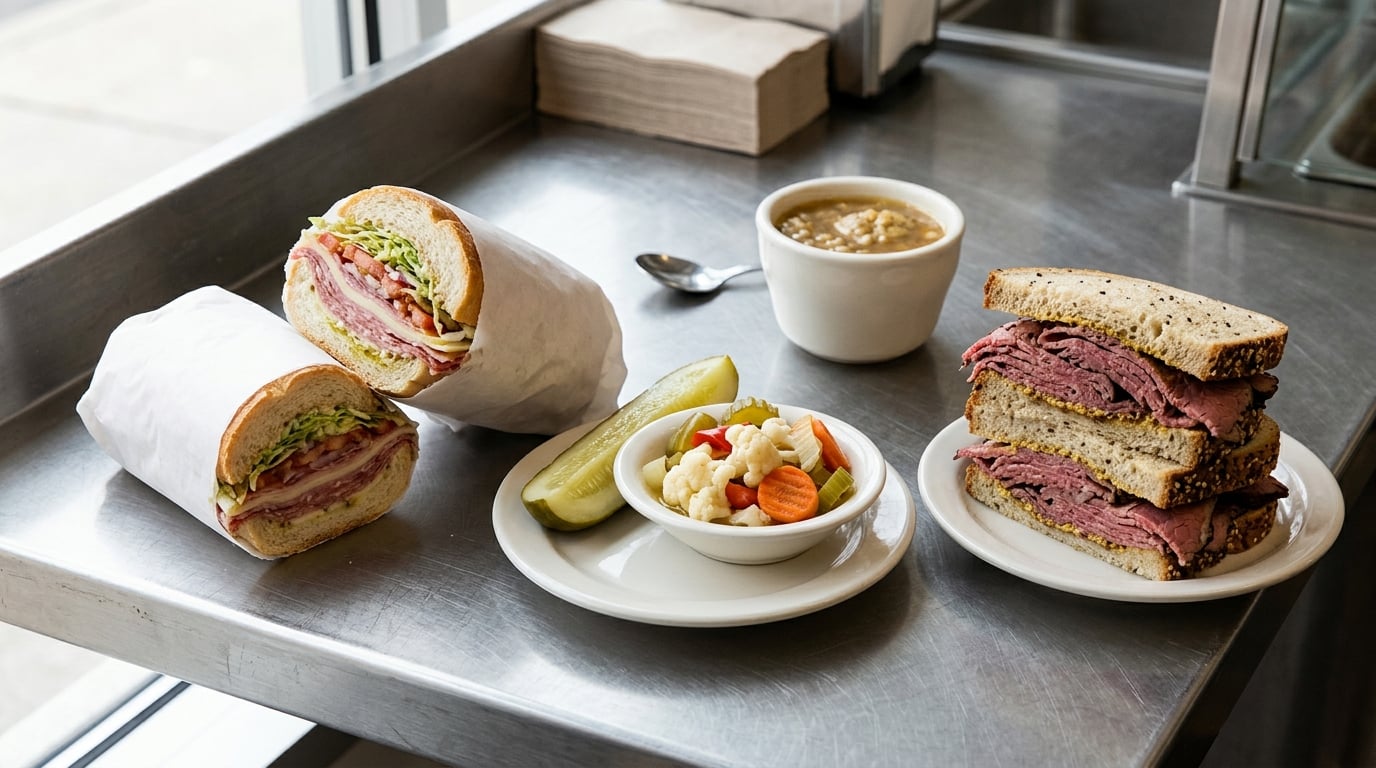
Italian deli vs. Jewish deli comes down to two different counters, two different units, and two very different sandwiches. An Italian deli, or salumeria, is built around a cold case of cured meats sliced to order by weight, so you name a meat and an amount. A Jewish deli, or delicatessen, is built around a hot hand-carved counter where pastrami and corned beef get piled onto thick rye, so you name a sandwich and a size.
I have stood at both counters often enough to know the confusion is mostly about mechanics. People freeze up in front of a salumeria because nobody told them the unit is a quarter pound, and they freeze up at a Jewish counter because they did not realize the meat is carved while you wait. Once you know those two things, both places are easy.
Table of Contents
- Italian Deli vs. Jewish Deli: What to Order at Each at a Glance
- Italian Deli: What to Order and Why It Works
- Jewish Deli: What to Order and Why It Works
- Italian Deli vs. Jewish Deli: Sandwiches, Bread, and Toppings
- Italian Deli vs. Jewish Deli: Flavors and Textures
- Which Should You Choose?
- Frequently Asked Questions
- What is the difference between an Italian deli and a Jewish deli?
- What should I order for my first sandwich at an Italian deli?
- What is the classic Jewish deli sandwich with mustard and pickle?
- Is rye bread usually served at Jewish delis?
- Can I order vegetarian sandwiches at either type of deli?
- How should I ask for a custom Italian sub or Jewish-deli sandwich?
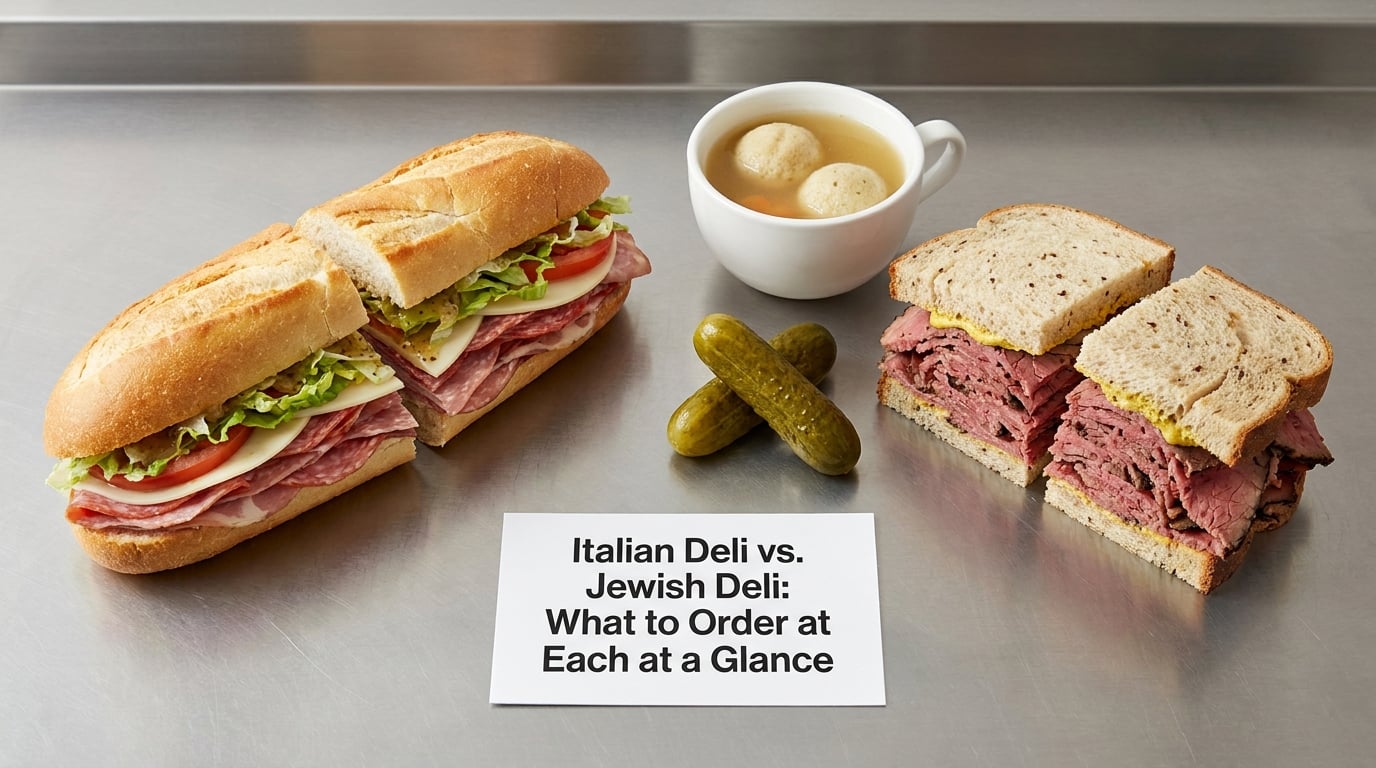
Italian Deli vs. Jewish Deli: What to Order at Each at a Glance
| Criterion | Italian deli (salumeria) | Jewish deli (delicatessen) |
|---|---|---|
| What the counter is built around | A cold case of cured and dry-aged meats | A hot carving case of brined and smoked beef |
| Signature meats | Prosciutto, mortadella, salami, capicola, bresaola, speck, soppressata | Pastrami, corned beef, roast beef, turkey, chopped liver, lox |
| Bread | Italian roll, focaccia, ciabatta, or nothing at all if you are building a board | Thick rye, seeded rye, open-faced on a single slice |
| Cheese | Provolone, fresh mozzarella, stracciatella, Asiago, aged fontina | Swiss, Muenster, American, or no cheese at all |
| Condiments | Olive oil, red wine vinegar, oregano, banana peppers, hot pepper spread, giardiniera | Spicy brown mustard, horseradish, Russian dressing, sour cream |
| Vegetables | Lettuce, tomato, red onion, roasted red pepper, banana pepper, artichoke | Sauerkraut, coleslaw, cucumber salad, tomato, lettuce, pickle |
| How you order | By weight: name the meat, the amount, and what you will do with it | By sandwich: name the meat, ask for a half or a whole, pick bread and condiments |
| Soup | Rare, sometimes a wedge of Parmesan and a few olives | Matzo ball, chicken noodle, or chicken soup with a large dumpling |
| Signature sides | Marinated vegetables, roasted peppers, olives, focaccia, a hard cheese wedge | Knish, latke, gribenes, coleslaw, potato salad, pickle on the side |
| Counter pace | Slow and deliberate, you watch the slicer | Fast and loud, sandwiches go out the door in a couple of minutes |
Short version: order the Italian deli when you want cured meat, sharp cheese, and raw vegetables dressed in oil and vinegar. Order the Jewish deli when you want one hot, abundant sandwich built around beef and mustard, with rye and a pickle doing most of the work.
Italian Deli: What to Order and Why It Works
An Italian deli is a salumeria, and the case is the menu. Almost everything in it was cured, dried, or smoked in Italy before it ever reached the counter, so the flavors arrive already built and your job is mostly choosing how much of each you want. Nothing is cooked to order, which is exactly why the unit is weight rather than a sandwich.
The order to make on your first visit
Ask for a prosciutto, salami, and provolone sub on an Italian roll, with lettuce, tomato, red onion, and whatever oil-and-vinegar dressing the shop mixes in its own jar. That is the order most people picture when they hear the word sub, and it is a good first order because every component is mild enough that you can taste the individual pieces.
Then try one thing that is sharper than what you expect. Capicola with hot pepper spread, or soppressata with pickled peppers, tends to be the one people remember. Salumerias vary a lot by neighborhood and by how long a family has been in the business, so treat the case in front of you as more interesting than any list I could write here.
What is in the case and what each meat is for
- Prosciutto is dry-cured pork, mild and almost sweet, with a fine texture that dissolves against the teeth.
- Mortadella is the emulsified one, studded with visible cubes of pork fat and often pistachio. It is the softest thing in the case and the cheapest per pound.
- Soppressata and salami are the heavily spiced, dry, firm end of the case, good when you want a sandwich to taste loud.
- Capicola, sometimes called hot capicola, comes from the shoulder and carries a real chili heat that builds as you eat.
- Bresaola is beef, air-dried and thinly sliced, leaner and more delicate than anything cured from pork.
- Speck is cured, smoked pork with a fat edge, the closest Italian relative to pastrami on a different continent.
Cheeses follow the same logic. Provolone and Asiago are firm and salty and can stand up to a strong meat. Fresh mozzarella and stracciatella are made in-house at many shops, milky and short-lived, and they are the reason people keep coming back.
How Italian deli counter ordering actually works
You will hear three things: the meat, the weight, and the thickness. Most counters start at a quarter pound and move to a half pound, and the person behind the case will ask what you are doing with it. For a sandwich, a quarter pound of one meat or a half pound of two is normal. For a board, a quarter pound each of three or four meats is the rule of thumb, with an equal weight of two or three cheeses.
It is completely normal to ask for a taste slice. The person at the case will cut a thin piece off whatever is in front of you and hand it over on a toothpick. Say how many people you are feeding and how you plan to use it, and you will get the right amount without overbuying. A half pound of prosciutto is a lot more food than a first-timer usually pictures.
Jewish Deli: What to Order and Why It Works
A Jewish deli is the opposite in structure. There is no case of raw product to weigh, because the meat has already been brined and smoked for days and is now carved to order onto bread. The transaction is a sandwich, not a quantity of meat, and the sandwich arrives hot.
The order to make on your first visit
Pastrami on rye with mustard and a pickle. That has been the default answer for decades, and it is still the right one, because it is the version with the fewest competing flavors. Add Swiss if you want, ask for the sandwich pressed if you like crunch, and ask for the pickle on the side if you plan to eat it last.
If you want to try the second one, order a corned beef on rye. It is the same brined beef treated differently, more defined and slightly sweeter than pastrami, and ordering both is a cheap way to settle the pastrami versus corned beef debate at your own table rather than in an argument online.
What is traditionally served at a Jewish deli
- Pastrami and corned beef, the two headline sandwiches, plus roast beef for a blander option.
- Turkey, usually hand-carved on a dark or multigrain rye.
- The Reuben, corned beef, Swiss, sauerkraut and Russian dressing on rye, grilled.
- Chopped liver with a heaping pile of chopped onion, served open-faced on rye.
- Lox, cream cheese, tomato and onion on a bagel, which is what the counter does before noon.
- Matzo ball soup and chicken noodle, served in a bowl large enough to be the meal.
- Knish and latke, with gribenes, the crunchy fried onion bits, as a side.
- Potato salad, coleslaw and sour cream and applesauce as the standard backups.
Kosher-style vs. strictly kosher and what changes when you order
Here is the part that trips people up, and it comes up constantly on deli message boards. Plenty of Jewish-style delis are kosher-style, not strictly kosher. They serve pastrami, corned beef, and roast beef, and they may also serve pork, bacon, and shellfish, and a Reuben with Swiss cheese and Russian dressing sits right on the menu. If you need strict kosher food, you have to confirm the specific shop is certified and ask what that certification covers, because it varies by establishment and by product.
A Reuben is not kosher because it puts meat and dairy in the same sandwich, and kosher law keeps those two categories separate. That is the whole reason, and it is worth knowing before you order one at a counter you assumed was certified. A pastrami on rye with mustard and no cheese, by contrast, is a straightforwardly kosher-style order and the one most counters are set up to make well.
Italian Deli vs. Jewish Deli: Sandwiches, Bread, and Toppings
Both counters will build you almost anything, so the difference is not permission, it is what the shop is set up to do well. The Italian counter has a case full of ingredients and someone who is very good with a slicer. The Jewish counter has a hot carving station and a stack of rye.
Italian deli vs. Jewish deli: bread, cheese and condiments
At the Italian deli, bread is a roll, and its job is to hold something wet without falling apart. Focaccia works, a plain Italian roll works, and a thick country loaf gets toasted and pressed if you want the outside to crack. Cheese is sliced to fit, and the dressing is usually an oil and red wine vinegar blend with oregano, sometimes with a hit of garlic. Order it lightly dressed unless you are sure, because a wet sub is a common first-timer mistake.
At the Jewish deli, bread is rye, and it is not a neutral slice. It is dense, slightly sour, and sturdy enough that a thick sandwich cut in half stays in one piece on the way home. Cheese is a slice or nothing, mustard is the default, and horseradish or Russian dressing are the two condiments people add when they want more than sharpness.
Combinations that reliably work at each counter
- Prosciutto, provolone, tomato, and red onion on a focaccia, dressed lightly.
- Mortadella with fresh mozzarella and a few arugula leaves, which is closer to a Roman sandwich than most people expect.
- Capicola with hot pepper spread, roasted red pepper, and provolone, pressed.
- Bresaola, arugula, shaved Parmesan, and a squeeze of lemon, no cheese slice needed.
- Pastrami on rye with mustard and a dill pickle, which stays the benchmark for a reason.
- Corned beef, Swiss, and coleslaw on rye, which is a Reuben-adjacent order without the grill.
- Turkey on rye with Russian dressing, tomato, and cucumber, a lighter version of the same idea.
- Chopped liver with a lot of onion, open-faced, no condiments at all.
Italian Deli vs. Jewish Deli: Flavors and Textures
The Italian deli is bright. Cured pork and beef bring salt and fat, sharp cheese adds acid and bite, and the raw vegetables plus oil and vinegar cut everything with crunch and freshness. A well-made Italian sub tastes like several distinct things at once, and the order of eating it matters, because the bread at the bottom has absorbed dressing by the time you get there.
The Jewish deli is concentrated. One meat, one bread, one mustard, and the flavor does not change much from the first bite to the last. Pastrami gets its character from the brine and the smoke, and rye adds a sour earthy note that most people do not notice until they eat the same sandwich on white bread and find it flat.
Texture tells the same story. Italian cold cuts slice paper thin and drape; a mortadella slice bends without breaking, and prosciutto almost melts. Jewish deli meat comes off the carving plane thick and rough-edged, piled so high the sandwich leans, and that lean is part of what people order it for. If you want variety inside one sandwich, go Italian. If you want one thing delivered with intensity, go Jewish.
Which Should You Choose?
For your very first deli sandwich, pick the Italian sub. You are choosing ingredients rather than a prebuilt combination, so there is less to get wrong, and you can taste several flavors at once. Pastrami on rye is the more famous order, but it is a stronger commitment for a beginner.
For a hot, filling lunch that you can eat in five minutes, pick the Jewish deli. The sandwich arrives hot, the meat is already carved, and the order is short. This is the better choice on a cold day or when you have twenty minutes between commitments.
For a vegetarian order, both work, and the Italian deli is usually easier. A prosciutto-free sub with roasted red pepper, eggplant, fresh mozzarella, and oil and vinegar is a genuinely good sandwich, and a shop will build it without any awkwardness. At a Jewish deli, ask before you order, because a strictly kosher counter cannot mix meat and dairy, and even a kosher-style one is simplest to keep meat-free with rye, cucumber salad, and a boiled egg.
For feeding a group, the Italian deli wins on variety. A half pound each of three meats, a few cheeses, marinated vegetables, and bread serves a dozen people without anyone getting stuck with a sandwich they did not choose. A Jewish deli serves large groups well too, but through soup and sides, not through a spread of cold cuts.
For trying something new, go wherever you have not been before, and order the thing with the longest line. Then order one familiar thing so you have something to compare it against. That is how most of my own opinions got formed.
Frequently Asked Questions
What is the difference between an Italian deli and a Jewish deli?
An Italian deli is built around a cold case of cured meats, sliced to order and sold by weight, with bread, cheese, and oil-and-vinegar dressing. A Jewish deli is built around a hot counter where pastrami, corned beef, and roast beef are carved onto thick rye, served with mustard and a pickle. One is assembled, the other is carved.
What should I order for my first sandwich at an Italian deli?
Ask for a prosciutto, salami, and provolone sub on an Italian roll with lettuce, tomato, red onion, and the shop’s oil and vinegar dressing. Every component is mild enough that you can taste it separately, which makes it a low-risk first order. After that, add something spicy, like capicola with hot pepper spread.
What is the classic Jewish deli sandwich with mustard and pickle?
Pastrami on rye with spicy brown mustard and a dill pickle. It is the default for good reason, because nothing on it competes with the meat. Add Swiss if you want cheese, ask for it pressed if you like crunch, and keep the pickle on the side if you want to eat it last.
Is rye bread usually served at Jewish delis?
Yes, rye is the default bread at a Jewish deli, usually a thick, slightly sour rye or a seeded rye, and it is dense enough to hold a piled sandwich. Wheat and multigrain are common for turkey, and an open-faced order on a single slice is also standard. Italian delis, by contrast, serve rolls, focaccia, or ciabatta.
Can I order vegetarian sandwiches at either type of deli?
Yes. Italian delis are the easier stop: ask for roasted red pepper, eggplant, fresh mozzarella, and oil and vinegar on a roll, and most shops build it without hesitation. At a Jewish deli, check the kitchen first, since a strictly kosher counter cannot combine meat and dairy, and a kosher-style counter is simplest with rye, cucumber salad, and a boiled egg.
How should I ask for a custom Italian sub or Jewish-deli sandwich?
At an Italian deli, name the meat, the amount, and what you plan to do with it, for example a quarter pound of salami and a quarter pound of provolone for a sub, and say how lightly you want it dressed. At a Jewish deli, name the meat, ask for a half or a whole, then specify rye, cheese, mustard, and toppings. People at both counters are happy to explain the options.
Start with the counter that matches your meal rather than the one with the longer line. Italian deli means naming a meat and a weight; Jewish deli means naming a meat and a sandwich. Once you say those two things out loud, the rest is easy, and asking for a taste slice is always the right move when something in the case is unfamiliar.