
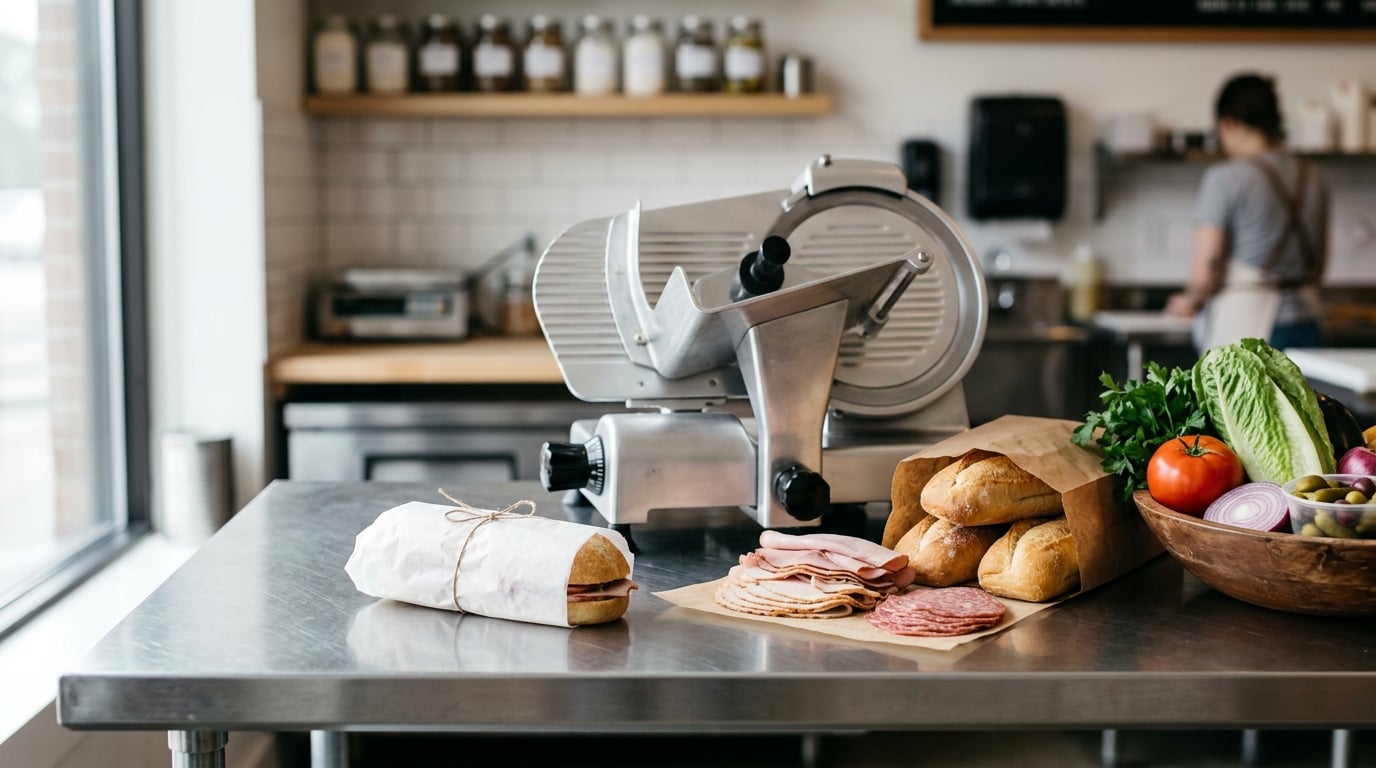
Why are deli sandwiches so expensive now? Because every layer of the cost behind a sandwich went up at the same time — the meat, the bread, the vegetables, the wages of the person slicing it, the rent on the counter space and the card fee when you pay — and a sandwich shop has so little room in its margin that almost all of that increase has to land in the menu price.
A bacon, egg, and cheese that ran about $6 to $7 a few years ago now shows up on a lot of boards in the $11 to $13 range. That jump feels like gouging, and I get why. It is not one cost rising, though. It is eight costs rising together, on a product where you can see almost none of them.
Here is the honest breakdown, with the industry figures and a real price survey behind it, plus the handful of levers that actually change what you pay.
Table of Contents
Why Are Deli Sandwiches So Expensive Now? Typical US Costs
A reasonable US sandwich these days runs $7 to $9 for a smaller or chain-made sub, $9 to $13 for a deli counter sandwich, and $13 to $18 for a specialty shop item with premium protein. These are typical US ranges — they vary a lot by region, by city rent, and by week, so treat them as a benchmark, not a quote.
| Sandwich type | Typical price | What you’re paying for |
|---|---|---|
| Roll, small, basic filling | $7 – $9 | Turkey or ham, one cheese, standard roll |
| Hoagie, deli counter | $9 – $12 | 3 to 4 ounces cold cuts, provolone, oil, lettuce, roll |
| Bacon, egg, and cheese | $10 – $13 | Egg cooked to order, bacon, cheese, oil, potato roll |
| Roast beef or pastrami | $12 – $16 | Sliced to order, high per-pound cost protein |
| Chopped salad or wrap | $10 – $15 | More prep steps, higher labor share of the price |
| Premium chopped cheese or specialty | $13 – $18 | Imported cheese, avocado, house-made spreads |
The clearest single data point I found is from Tasting Table’s March 2026 price survey of Subway footlong Italian B.M.T. sandwiches across US locations. The average landed at $9.40 to $11, up from roughly $7 before the pandemic — an increase of 30 to 40 percent. That lines up almost exactly with the roughly 33 percent average rise in the cost of dining out over the same stretch.
So the increase is real, and it is broad. What is worth sorting out is how much of it is inflation, how much is a shop recovering margin it gave up during the $5 footlong era, and how much is quieter than a price hike: a slightly smaller pile of meat.
That last one matters more than people give it credit for. A shop that faces higher costs has three levers — raise the price, cut the portion, or drop the quality. Raising the price out loud is the easiest to announce, so it gets all the attention. Portion shrink is invisible unless you happen to order the same sandwich every Friday, and it never triggers a complaint thread.
What Affects the Price
Here are the eight drivers behind the number on the board, in rough order of how much they move a typical sandwich price.
- Protein cost. Cold cuts, roast beef and sliced cheese carry the single heaviest line in the cost stack.
- Bread and bakery wholesale pricing. Flour, oil, yeast and rent all push up the price of a single roll.
- Produce and condiments. Lettuce, tomato, onion, olives, oil, salt and pepper still add up over hundreds of sandwiches a day.
- Labor and minimum wage. Someone has to slice, build, wrap and hand it over — and that minute costs real money.
- Rent and occupancy. A midtown storefront and a county-road shop pay wildly different rents for the same sandwich.
- Shipping and supply chain. Freight is hidden inside the wholesale food cost and nobody puts it on the menu.
- Packaging, utilities and equipment. Paper, foil, wax paper, ice, gas, electric, slicer repair and depreciation.
- Insurance, card fees and margin. Then the sandwich still has to leave the shop with a profit in it.
Put those together and you get the pre-pandemic operating model that restaurant trade groups still use as a baseline: roughly 33 percent food, roughly 33 percent labor, roughly 29 percent other operating expenses, and about 5 percent profit before tax. Change any one bucket and the math barely moves. Change four at once and the menu price has to move.
Here is what a single sandwich looks like when you spread the cost out, using a $12.99 cold-cut sub as the example.
| Line item | Share of the $12.99 | Notes |
|---|---|---|
| Meat and cheese | $3.00 – $3.75 | 4 ounces at deli-counter per-pound pricing, plus cheese |
| Bread | $0.60 – $0.90 | Wholesale bakery cost, not the grocery aisle price |
| Produce and condiments | $0.50 – $0.80 | Lettuce, tomato, onion, oil, salt |
| Direct labor | $1.50 – $2.00 | About 60 to 90 seconds of slicing and building at loaded wage |
| Occupancy and utilities | $0.75 – $1.00 | Rent, power, gas, cleaning divided by daily volume |
| Freight and packaging | $0.30 – $0.50 | Delivery on the food, paper and foil on the sandwich |
| Card fee and other overhead | $0.35 – $0.55 | Around 3 percent of the sale, plus insurance and software |
| Remaining margin | $4.50 – $5.50 | What pays wages, returns and everything unlisted |
Multiply those numbers by 200 sandwiches and the deli is doing around $2,600 in sales. Rent, wages and utilities still have to come out of it. This is why people say the meat only costs a few dollars, so the sandwich should cost a few dollars — the meat is never the sandwich.
How Ingredient Inflation Raises the Sandwich Bill
Start with the protein, since it is the most expensive thing in the basket. The National Restaurant Association’s 2026 State of the Industry report puts average restaurant food costs at about 34 percent above pre-pandemic levels, and 82 percent of operators reported higher food costs than the year before. When wholesale protein rises, the deli’s food cost rises, and the menu price follows with a lag of a few months.
The gap between grocery and deli is the part that surprises people. Boneless ham, turkey and roast beef that look like a few dollars a pound in the supermarket case routinely run several times that per pound at a deli counter. Forum readers home-slicing their own meat report paying roughly a third of the deli-counter price. The counter is not charging extra for the slicing alone — it is also absorbing trim loss, the small weekly volume it buys, the cost of throwing out the end of the roast, and labor to run the machine.
Then there is the recent input story. Wholesale bread follows flour, and flour follows fertilizer and fuel, and both have been pushed around by trade policy and freight costs. The Budget Lab at Yale put the effective US tariff rate near 14.6 percent before a February 2026 court ruling, and around 10.5 percent afterward under a global tariff mechanism. Imported cheese, olive oil, coffee and canned fillings all sit inside that. Nobody prices a sub line by line for tariffs, but the cost arrives in the invoice and the invoice arrives in the menu.
Fresh produce is the quiet one. Lettuce, tomatoes and onions move seasonally and regionally, and a bad week on any of them shows up as either a higher price or a thinner slice on the sandwich. Nobody in the chain is going to announce that the tomatoes were expensive this week.
The reason this shows up so visibly at the counter is timing. A deli that used to sell sandwiches for $10 to $11 and now sells them for $12 did not creep up. It stepped, and it stepped after the ingredient invoices caught up with the payroll. That sharp step-change is exactly what people described in an r/AskNYC thread asking whether delis had recently gone up. The answer is yes, and the arithmetic underneath it is boring: the wholesale bill got heavier, and the margin is too thin to absorb it quietly.
How Labor and Operating Costs Affect Your Sandwich
Labor is the other half. The National Restaurant Association’s 2025 Operations Data Abstract puts labor at a median 36.5 percent of sales for full-service restaurants and 31.7 percent for limited-service. Hourly earnings across the industry sit about 41 percent above pre-pandemic levels.
A sandwich is a labor-heavy product built from cheap-ish components. Slicing a roast to order, toasting, laying the bread, wrapping it, and taking payment might be 60 to 90 seconds of someone’s time. Multiply that by a few hundred sandwiches a day and it is a payroll line, not a rounding error. If the sandwich is chopped to order instead, or a wrap, or a chopped salad, the prep time roughly doubles — which is the real reason those items cost more than a plain sub.
Rent sits underneath everything. The same abstract puts occupancy at a median 5.7 percent of sales full-service and 5.2 percent limited-service, but the geographic spread is the part that matters to you: about 6.0 percent of sales in urban markets versus 3.2 percent in small communities and rural ones. A sandwich shop in a coastal city can be paying several times what an otherwise identical shop pays in a small town, and both put the difference straight into the price.
On top of rent sit utilities, refrigeration, insurance, licensing, cleaning, equipment repair and a slice of general liability coverage. Food safety alone means holding temperatures, logging them, and throwing out product that missed a mark. Waste is a real cost line and usually not a visible one.
Add the card fee. A roughly 3 percent processing charge on a $12.99 sandwich is about 39 cents, which does not sound like much until you process 200 of them a day.
This is also the honest answer to why a prepared sandwich costs more than the same sandwich at home. The grocery version of it is a few dollars of ingredients. The deli version is the same ingredients plus a minute of somebody’s wage, a share of the rent, a share of the power bill, the packaging and the profit. Nobody is padding it. The layers are just real.
Ways to Save on Deli Sandwiches
You cannot negotiate the rent or the freight. You can change which costs you pay, and you can change how many of them you pay at once.
- Buy the smaller or daily special. A half sandwich with a side is often priced to keep you in the shop instead of pushing you to the drive-through.
- Drop one premium filling. Avocado, bacon and imported cheese are usually the most expensive add-ons on the board, and dropping one is often the single biggest cut available to you.
- Ask about lunch pricing and combos. Before 11 am many boards carry a lunch sandwich and a lunch combo price, and a combo can beat the à la carte total even with the drink included.
- Skip the delivery fee. Delivery adds the sandwich, the service fee, the tip and the small-order fee. For one person eating alone, pickup almost always wins.
- Bring your own drink. Fountain drinks are priced at three or four times the grocery cost, and they travel with you either way.
- Compare unit price, not sticker price. A $9 sandwich with 5 ounces of meat is a better deal than a $7 one with 3. Price per ounce is the only number that compares two sandwiches honestly.
- Check the grocery deli. Supermarket counters and meal kits are now genuine competitors on price. The r/Costco thread makes the common counterargument, that a shift toward higher-end meat at higher per-pound pricing is part of what pushed prices up.
- Buy meat by the pound and build it at home. An r/Frugal thread on home slicers is full of people doing exactly this. The break-even on the machine is a few pounds of meat, and the per-ounce cost lands near a third of the counter price.
Here is one worked example. The tall order is a 12-inch roast beef and cheddar, extra roast beef, extra cheese, avocado, a fountain drink and a bag of chips. That runs well past $18.
The leaner order from the same shop: the 6-inch version of the same sandwich on the daily special, no avocado, no extra cheese, one cheese, tap water, no chips. That is usually a few dollars cheaper and often lands under $9. The difference is not a coupon or a trick. It is a smaller bread, a smaller protein portion, one fewer premium item, and no markup on a drink.
The instinct to just ask “what is fair” is worth keeping, too. A person in an r/longisland thread called a $12 bacon, egg, and cheese price gouging, which is a useful sanity check even if the arithmetic disagrees. In an r/subway thread the same split shows up from the other direction: people still anchored to the $5 footlong era treat a $10 sandwich as outrageous, which tells you how far the anchor has drifted rather than where the price should sit.
Frequently Asked Questions
Are deli sandwiches more expensive than they used to be?
Yes, by a lot. A March 2026 price survey of Subway footlong Italian B.M.T. sandwiches found an average of $9.40 to $11 across US locations, up from about $7 before the pandemic. That is a 30 to 40 percent jump, which tracks the roughly 33 percent average rise in the cost of eating out over the same period.
Why do sandwiches with turkey, roast beef, or cheese cost so much?
Because protein is the heaviest line in the cost stack and it carries the cost of everything around it. Deli-counter meat runs several times the price of the same cut in a grocery case, once you account for trim loss, small weekly buying volume, the cost of discarding the end of a roast, and the labor to run the slicer. Roast beef and pastrami sit at the expensive end of the ladder.
Are homemade sandwiches cheaper than buying from a deli?
Almost always, once you buy the meat. People on home-slicer threads report paying roughly a third of deli-counter prices for boneless ham, home-roasted turkey and roast beef. The deli version adds a minute of labor, a share of rent and utilities, packaging and a profit margin, which is exactly what a grocery sandwich does not have.
Does ordering deli delivery make a sandwich even more expensive?
Frequently, yes. Delivery stacks the menu price, a service fee, a delivery fee and a tip, and small orders often pick up an extra fee on top. On a single sandwich picked up at lunch, the total frequently exceeds the price of two sandwiches assembled at home, so pickup is usually the better deal for one person.
What is the cheapest sandwich to order at a deli?
A small roll with turkey or ham, one cheese, lettuce, tomato and onion, ordered before the lunch rush when boards sometimes run specials. Skip avocado, bacon and extra cheese, which are usually the most expensive add-ons, and bring your own drink. On most boards that lands in the $7 to $9 range.
Conclusion
Why are deli sandwiches so expensive now? Because protein, bread, produce, labor, rent, freight, packaging and card fees all went up together, and a sandwich shop runs on about 5 percent pre-tax profit, so there is nowhere for the increase to hide. Some of what you are seeing is genuine food inflation, some is a shop recovering margin, and some is a slightly smaller pile of meat that nobody announced.
Start with the number that is actually comparable: price per ounce of protein, not the sticker on the board. Then take the smaller size, drop one premium add-on, skip delivery and bring your own drink. Those four moves are worth more than any coupon.