
Short answer: no, you do not have to. Tipping at a sandwich shop is optional, not a social requirement, and nobody is going to judge you for walking out with your bag and a zero tip. That said, most people who do tip land somewhere between a dollar and 15 percent, and the choice feels better when you know what kind of service you actually received. Updated for October 2026.
Plenty of people ask this because the line has gotten blurry. A sub ordered to spec, assembled in front of you over four minutes, feels different from a pre-made cold-cut sandwich lifted out of a case. Add delivery apps, card readers with a tip screen that pops up before you have even handed over your card, and the old rule that says tips belong to table service, and you get a question that genuinely deserves a straight answer.
Table of Contents
- Do You Tip at a Sandwich Shop? The Short Answer
- When Customers Usually Tip at a Sandwich Shop
- What Sandwich Shop Workers Think About Tipping
- Does It Matter Whether You Eat In, Take Out, or Order Delivery?
- How Much Is Reasonable to Tip?
- When Tipping May Not Be Expected
- How to Tip Without Making It Awkward
- What Customers and Workers May Disagree About
- Frequently Asked Questions
- Use the Restaurant’s Signal and the Service You Received
Do You Tip at a Sandwich Shop? The Short Answer
You are not obligated to tip at a sandwich shop. It is counter service, not table service, and the person making your sandwich is doing their job. Leaving a small cash tip is a courtesy, not a debt, and whether it is customary depends on the shop, the service format, and local habit.
That is the whole answer. Everything below is the practical version of it: when people tip anyway, how much they leave, and how to do it without the awkward shuffle at the counter.
When Customers Usually Tip at a Sandwich Shop
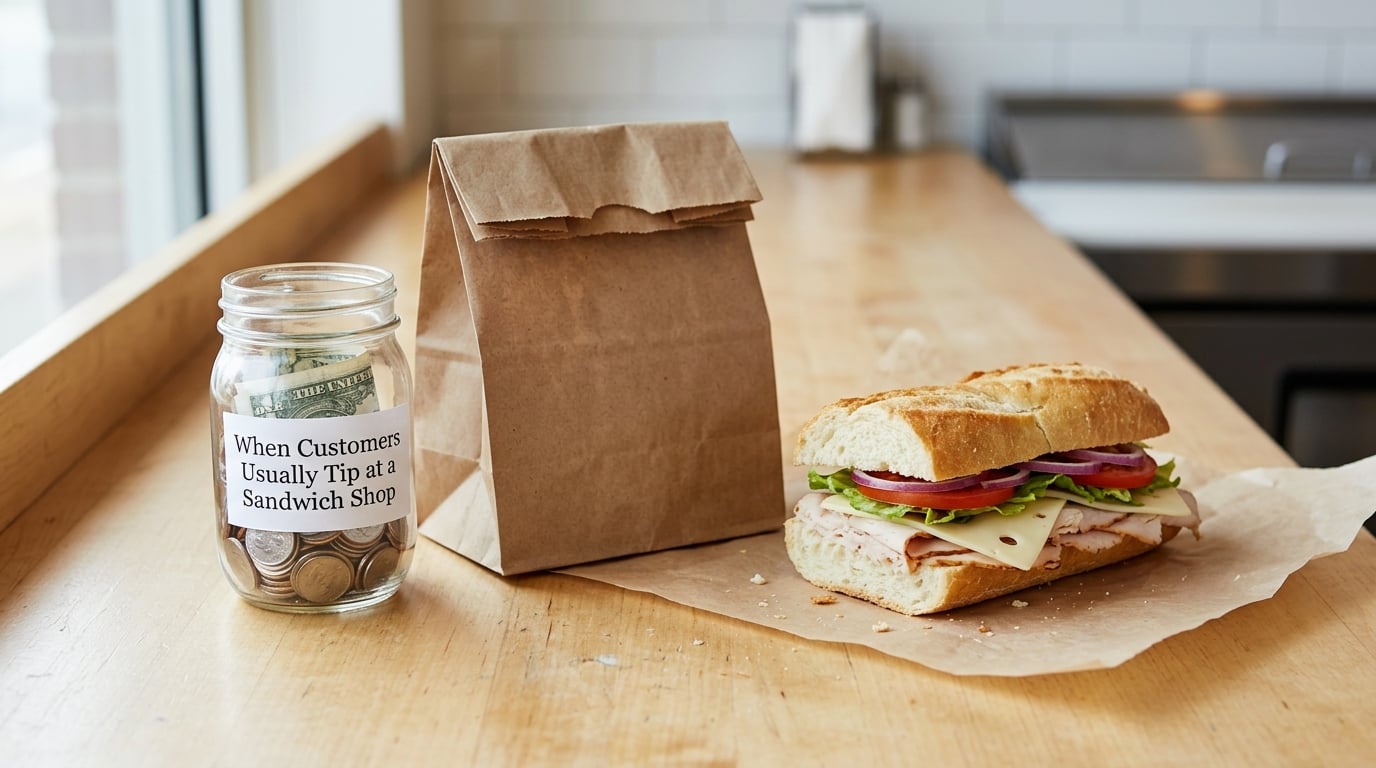
Tipping shows up most often in three situations, and none of them is a rule. It is just where the impulse tends to land.
A tip jar or a prompt is sitting right there
If a jar is on the counter or the card reader asks, you have been invited. That is a signal, not a trap, and a dollar or a couple of coins takes about four seconds. Ignore it if you like; just do not read the jar as an invoice.
The build was complicated
Four-inch toasted, cut in half, extra pickles, no onion, split into two sections with different fillings, plus a hot side and a drink that had to be made fresh. That is more than a transaction, and plenty of regulars tip on orders like that without thinking about it. A simple cold-cut sub picked from the case is a different job.
Someone went noticeably out of their way
A wrong order fixed before you reached the door, a sandwich wrapped carefully for a road trip, a line moved to the back so you could wait during a rush. That is the clearest case for a tip, and it has nothing to do with the shop’s category.
Here is the distinction that settles most arguments: a tip is optional even when it is genuinely appreciated. Courtesy and obligation are not the same thing, and treating a courtesy as a debt is how a small lunch becomes a small guilt trip.
What Sandwich Shop Workers Think About Tipping
This is the part of the question that gets the least honest coverage, because most writing about tipping is written by people who are not standing behind the counter. So let us be careful here. Without a named staff interview on record, the honest version is what line workers consistently say in public discussions and what the structure of the job explains on its own.
Counter staff are usually paid at or near the state minimum wage, and in many states tipped workers can legally be paid below it, with tips making up the difference. A voluntary tip is one of the few direct ways a customer can acknowledge the person who actually built the lunch. Regulars who tip a dollar every week are, in a real sense, part of somebody’s take-home pay.
What workers do not want is a tip presented as a bribe for basic competence. If your sandwich was cold or the order was wrong, that is a manager conversation, not a bigger tip. Paying extra to fix a bad interaction is a well-known way for customers to avoid saying something, and it leaves the shop with no idea it has a problem.
The sentiment on public forums is mostly split, which is worth saying plainly. In a long-running r/tipping thread about a sandwich chain, the top argument was blunt: counter service, zero tip, because assembling a sandwich is the job description, not extra service. On a separate fast-food forum thread, a regular wrote the position most customers seem to hold: they do not tip a basic sandwich and drink they filled themselves, but they do tip for a large or complicated order, and they would tip for delivery.
So the honest summary is not that workers expect tips. It is that workers notice when a tip appears, that it lands better when it comes with a thank you, and that most would rather be left alone than be asked to perform gratitude.
Does It Matter Whether You Eat In, Take Out, or Order Delivery?
Yes, and it matters more than anything else on this list. The service format does most of the work in deciding whether a tip is customary, because the tip worker changes from one format to the next.
| Service type | Is a tip expected? | If you tip | Why |
|---|---|---|---|
| Self-service kiosk or grab-and-go from a cooler | No | Not needed | No employee handled the order beyond scanning it |
| Pre-made cold-cut sandwich from the case | No | A dollar if you like | It is a grocery transaction with a person at the register |
| Standard counter order, made to order | No, but common | 10 percent or a flat dollar | Someone took your specifications and built it |
| Customized or complicated build | Courtesy | 10 to 15 percent | Extra steps, extra attention, real service |
| Dine-in seating with staff service | Customary | 15 to 20 percent | It functions as table service |
| Delivery through an app | Expected and separate | 10 to 15 percent to the driver | The driver does the work; the shop keeps a delivery fee |
Counter order and delivery are two entirely different tip economies that people keep mixing up. A delivery driver spends the tip on gas, wear on the car, and their own time, which is why tips there are closer to a normal expectation. The person who made your sandwich was on a clock behind a counter, on an hourly wage, and already has a break room.
App tip screens add one more wrinkle. The app keeps a cut of the delivery fee and a cut of the tip, and the prompt usually lands after you have already paid, which is the most effective moment to ask for money. If you would rather not, every major app has a skip option, and the food arrives exactly the same either way.
Direct delivery from the shop, meaning the shop’s own driver rather than an app, is closer to the counter case. A tip is a courtesy there, not a fee the driver depends on.
How Much Is Reasonable to Tip?
Percentages break down on small orders, so flat amounts work better. A 10 percent tip on a 5 dollar sandwich is fifty cents, which feels pointless to leave and adds nothing anyone counts on. A flat dollar reads as a deliberate choice and costs about the same as topping up the drink.
| Order | Reasonable if you tip | Reads as |
|---|---|---|
| Nothing, a single bottled drink | No tip | Normal and unremarkable |
| Basic sandwich | Nothing, or a flat dollar | A dollar is friendly; 20 percent is not |
| Sandwich, drink, side | 10 percent or a flat dollar | Ordinary counter courtesy |
| Large or heavily customized order | 10 to 15 percent | Generous for this service type |
| Delivery | 10 to 15 percent to the driver | What drivers actually expect |
Two more guides. A 10 percent tip is not disrespectful; it is a normal counter amount when the order was a little more than routine. And tipping on the pre-tax amount is the courteous habit, since the sales tax was never part of anyone’s work.
Worth saying: a 20 percent tip on a counter sandwich tends to read as sarcasm. It signals that the customer feels they are paying a performance fee, which is exactly the impression a line worker does not want from a lunch that took three minutes.
When Tipping May Not Be Expected
Some sandwich shops have no tip jar, no tip screen, and no mention of tips anywhere, and that silence is information. In those shops, walking out is not a slight.
- You ordered and paid through a self-service kiosk and nobody spoke to you.
- You picked a pre-wrapped or bagged cold-cut sandwich off a cooler shelf.
- You grabbed a pre-paid order from a shelf with a name on it.
- You were at a drive-through window for under a minute with one item.
- You bought a packaged item at the register like a grocery run.
Posted signage beats any general rule. A sign on the counter that says tips are split among the crew is the shop telling you its policy, and it should be respected either way, including the decision not to tip.
How to Tip Without Making It Awkward
The mechanics matter more than people expect. A tip that is hard to leave is a tip that does not get left, and then nobody feels good about it.
When there is a jar
Drop the coins in as you pick up your bag. No announcement, no eye contact negotiation, no lingering at the counter. A dollar in mixed change is the standard and nobody will read anything into it.
When the card reader offers a tip screen
Tip on the pre-tax amount, tap or enter your own figure rather than accepting the suggested button, and check whether a custom amount field exists. The screens that default high and bury the no-tip option are a well-known complaint, and the fix is simply to look for the smaller options or skip.
When there is no jar and no screen
Say it out loud: keep the change. That one sentence handles the whole situation, and it works whether the change is five cents or three dollars. The alternative is rounding up in cash, or sliding a dollar under the register, but saying it is cleaner because nobody has to guess whether you forgot your wallet.
When you are paying through an app
Add the driver tip before you submit the order, not after. Editing an order you already placed is a hassle, and drivers do not always see later edits the same way.
A thank you goes a long way on its own. A quick one, out loud, at the pickup counter, is a real acknowledgment and it costs nothing.
What Customers and Workers May Disagree About
The friction here is real on both sides, and pretending otherwise helps nobody.
Customers tend to see the tip as optional appreciation for a good interaction. What annoys them is the assumption that a good transaction is automatically a tipped one, especially when the same business tipped staff at a restaurant down the street. The loudest version of this comes from older forum threads, where regulars describe going from generous tipper to no tipper once the prompt started appearing at the counter. Tipping fatigue is the honest name for that shift.
Some workers rely on tips in a way that the front counter never shows, and some would rather you just did not bring it up at all. A passing comment about tips being expected is what the same threads describe as the deal breaker. The interaction that was fine becomes an argument about money in front of a line of people.
Neither side is asking for much. The fix is boring and works: a shop states its policy plainly, in writing, at the register, and the customer decides without a guessing game. Clarity removes the resentment from the customer and the awkwardness from the employee, and it is the only version of this that everybody can live with.
Frequently Asked Questions
Are you supposed to tip at a sandwich shop?
No, you are not supposed to, and you are not obligated to. A sandwich shop is counter service, not table service, so the person building your sandwich is doing their job rather than providing table service. A tip is a courtesy for good service, a complicated order, or exceptional attention, and skipping it is not rude.
Should I put money in the tip jar when ordering a sandwich?
Only if you want to. A tip jar is an invitation, not a requirement, and leaving nothing is completely normal at most shops. If you do put money in, a dollar in change is the standard for a basic order and needs no explanation. Read the jar as a signal about what the shop is comfortable with, not as a charge on your meal.
How much should I tip for a sandwich?
For a basic counter sandwich, no tip or a flat dollar both read fine. For a customized or complicated order, 10 to 15 percent is generous without being strange. For delivery, 10 to 15 percent to the driver is closer to an expectation. Percentages work poorly on small orders, which is why flat amounts are more common at the counter. Tip on the pre-tax amount.
Do I tip on a sandwich shop delivery order?
Yes, tipping the delivery driver is customary and separate from tipping the shop, because the driver covers gas, vehicle wear, and their own time. Ten to fifteen percent is the usual range. Whether the delivery came through an app or came direct from the shop makes little difference to the driver, and the app prompt is optional in every major delivery service.
What should I do if a sandwich shop worker says tips are expected?
Stay polite and pay what you decide, which may be nothing. It is not rude to decline, since counter service carries no obligation to tip. If the comment felt pointed, remember that a posted policy at the register is the shop’s real stance, and a passing remark from one person is not a rule. Too many customers respond to awkwardness by over-tipping, which makes the next visit worse.
Use the Restaurant’s Signal and the Service You Received
So, do you tip at a sandwich shop? As a choice, never as a debt. Look for a tip prompt, decide based on the service format, and tip small when it is customary or when someone went above and beyond. Start with a dollar for a made-to-order sandwich when a jar or a screen is sitting there. Leave nothing if there is no prompt, no table, and no special attention. Either way, you are not doing anything wrong.