
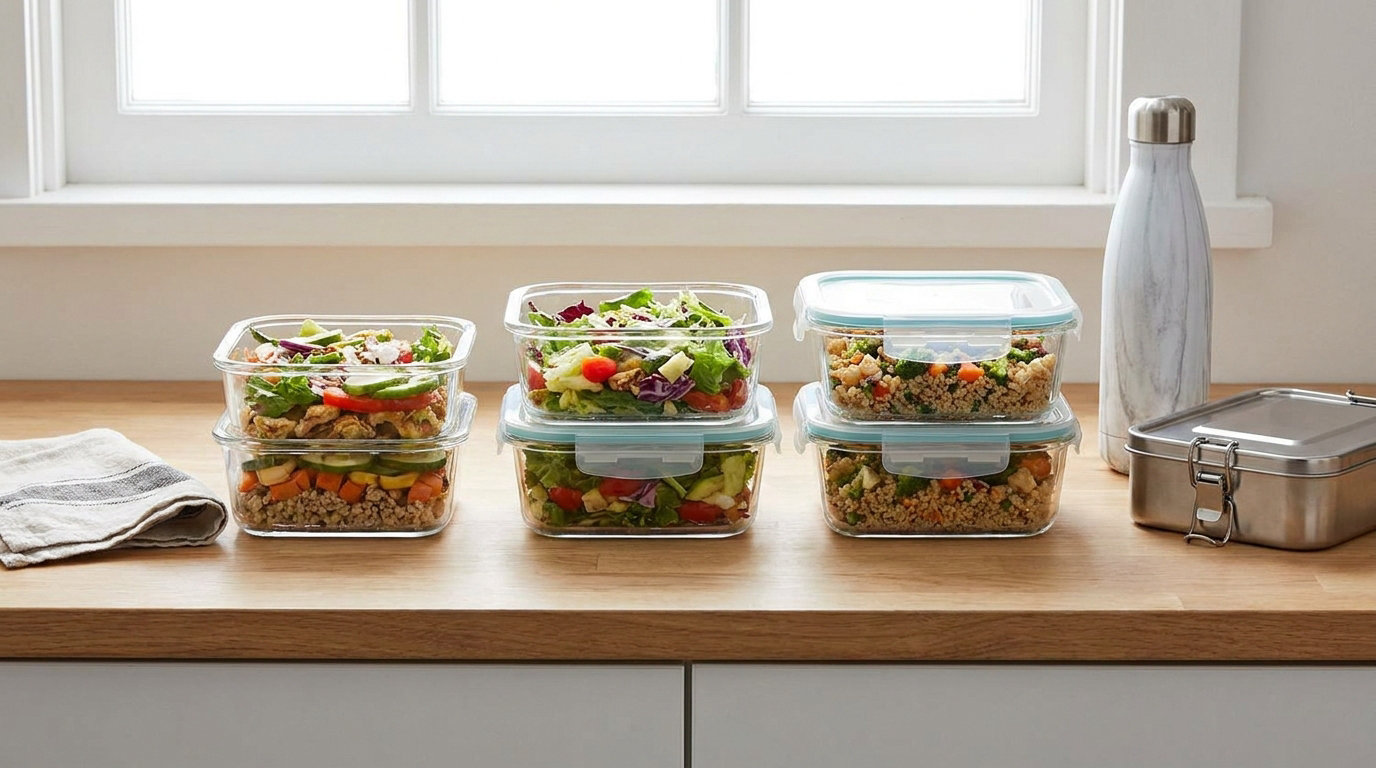
The way to stop wasting money on takeout lunches is to remove the decision, not the option. Set a weekly cash limit, pick two dependable lunches around food you already own, keep one no-cook backup within reach, and eat dinner leftovers before they turn. Twenty minutes of setup on a Sunday covers the week, and about five minutes a day keeps it running.
What most people try first is abstinence, and it collapses by Wednesday. A promise to never order again does nothing about the 1 p.m. moment when you are tired, hungry, and holding a phone. The system below is built for that moment instead of against it.
I have run this kind of week more times than I want to admit, and the version that sticks is always the boring one: a number on a card, two lunches, one backup, and leftovers moved to the front of the refrigerator.
Table of Contents
- What You Need Before You Start
- Step-by-Step: How to Stop Wasting Money on Takeout Lunches
- Common Mistakes That Break the System
- Frequently Asked Questions
- How much should I spend on takeout lunches each week?
- What can I eat for lunch when I do not want to cook?
- How can I stop ordering takeout when I am short on time?
- Is takeout cheaper than groceries for one person?
- How do I keep meal prep from becoming too expensive?
- How long can I safely keep lunch leftovers?
What You Need Before You Start
Nothing here requires equipment, a membership, or a cooking habit you do not have. You need five things, and three of them are free.
A weekly limit you can see. Pick a number and write it on an index card, a sticky note, or the notes app. If it exists only in your head, it does not exist. Decide whether the number is a cash envelope or a line in your budget app, and tell yourself which one before the week starts.
Somewhere to write the week down. A paper calendar, a notebook page, or your phone. Five weekday lines, each holding a lunch name, is the whole format. If paper feels like too much commitment, set two repeating phone alerts instead, one for Sunday setup and one at 11:45 a.m. as a lunch reminder.
Two or three containers. Glass, plastic, anything with a lid. If you do not want to buy them, zip-top bags, a clean jam jar, a microwave-safe mug, and a sheet of foil all work. Reusing one container and washing it at night is cheaper than owning a set you are afraid to use.
A short list of shelf-stable basics. Peanut butter, canned beans, tortillas or pita, rice, pasta, eggs, frozen vegetables, canned soup, crackers, yogurt that keeps until later in the week. These are the items that turn a half-empty kitchen into lunch. Store brand is fine on almost all of them, and nobody can taste the difference at day three of a workweek.
Five minutes to look at what you already own. Open both the pantry and the refrigerator and take a phone photo of the shelves. That photo is your inventory for the week, and it costs nothing. It also kills the single most expensive habit in this whole system: buying a second bag of something you already have a half-full bag of.
Step-by-Step: How to Stop Wasting Money on Takeout Lunches
The goal is not to eliminate takeout. The goal is to make a planned lunch easier and cheaper than an impulse order, so ordering stops being what happens by default. Setup takes about 20 minutes. Daily maintenance takes about 5.
1. Set a Weekly Takeout Lunch Limit
Start with a baseline, not a guess. Check last week’s bank statement and your delivery app history and add up every weekday lunch. Typical US takeout numbers land around 13 dollars for the food, plus a 4 dollar delivery fee, a 2 dollar service fee, and a 3 dollar tip, which is closer to 22 dollars a day once fees are included. That is roughly 110 dollars a week and about 5,700 dollars a year for a five-day workweek.
Now pick a limit that is a clear cut without being a punishment. A useful starting example is 35 dollars for the week: about 25 dollars of planned lunches and 10 dollars held back for one unavoidable order. Put the 10 dollars somewhere visible so spending it feels like using a plan rather than breaking one.
The limit works because it removes the vague daily choice. Without a number, the question at 1 p.m. is only whether you feel like ordering. With a number, the question is whether this order is one of the ones you already decided to allow.
2. Plan Lunches Around What You Already Have
Use a simple formula and almost anything turns into lunch: a base, a protein or bean, and a vegetable or fruit.
- Base: rice, pasta, bread, tortillas, potatoes, leftover grain
- Protein or bean: eggs, canned beans, tuna, cooked chicken, tofu, peanut butter, cheese
- Produce: frozen vegetables, whatever fruit is soft enough to eat this week, a carrot, a handful of greens
Half a bag of rice, one can of beans and a bag of frozen broccoli is three or four lunches. A loaf of bread, hard cheese and a few apples is a week of sandwiches. The point is not to cook a new meal every Sunday, it is to notice that the ingredients for lunch are usually already in the kitchen while the delivery app is always one tap away.
Readers in r/EatCheapAndHealthy threads about cutting back on takeout keep landing on the same practical answer: cheap staples plus bulk-added vegetables beats an order, and the meal does not have to be the same every day. Repetition is the thing that kills these systems, not the cooking.
3. Build a Two-Day Lunch Rotation
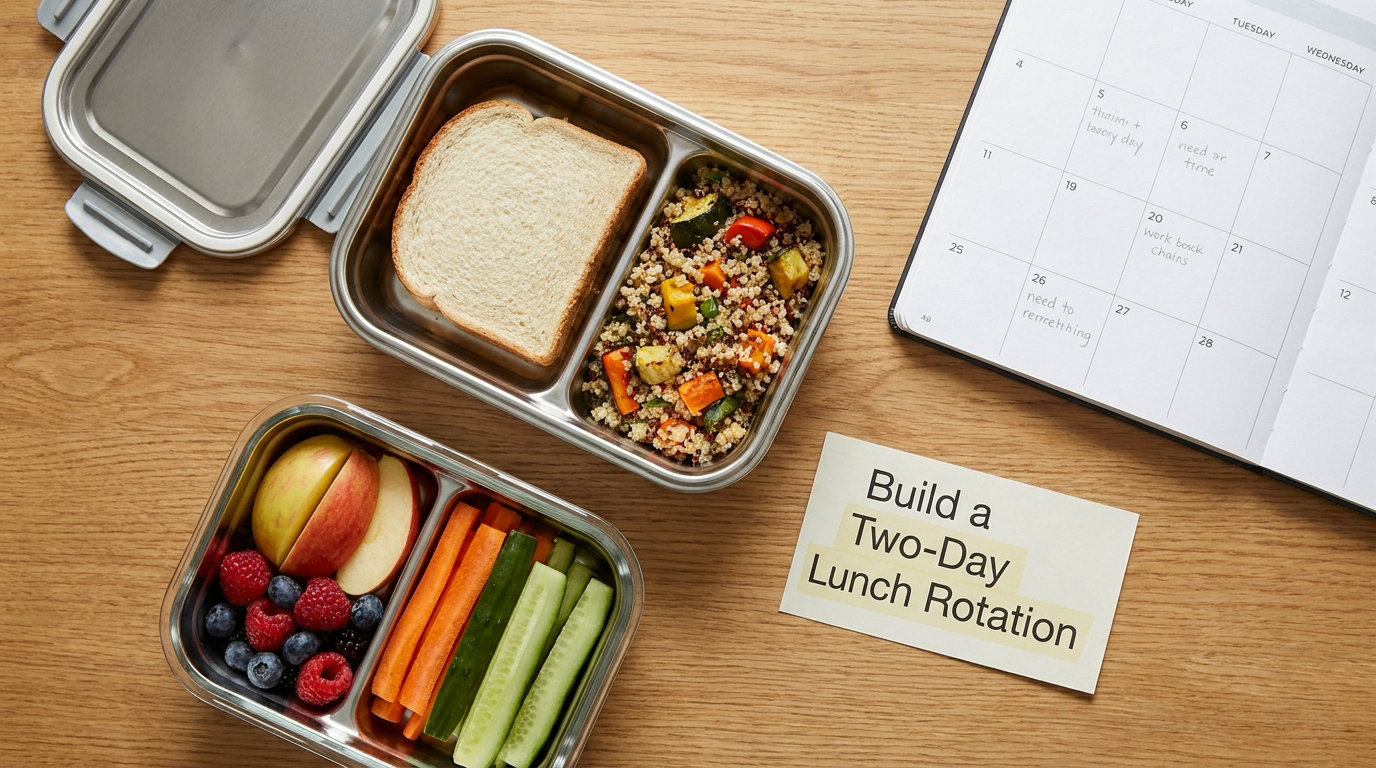
Pick two options, not five. Five planned lunches sounds generous and reliably collapses by Tuesday. Two options that you actually like will carry Monday through Thursday, and you leave Friday open because something always comes up.
Good rotation pairs are a grain bowl with a soup-and-toast, or sandwiches one day and leftovers the next. Both options should be fine cold or hot, and they should be interchangeable. If Monday goes badly, you swap in the other lunch instead of restarting the plan.
Write the two names on the calendar you set up earlier. That is the whole system: two words per line, no recipes, no chart, nothing to fail at.
4. Prepare a Flexible Five-Minute Backup
The backup is what saves the week, because plans fail in ways nobody predicted. These combinations need no cooking and about five minutes of assembly:
- Yogurt with sliced fruit and a spoon of nuts
- Hummus with carrots or peppers and a pita
- Soup from the freezer with toast or crackers
- Last night’s leftovers with a piece of fruit
- Crackers, sliced cheese, and a tomato, eaten at a desk
Keep the ingredients for at least two of these on hand all week. Shelf-stable items are what make this work, because the backup has to be available when you are hungry and tired, which is exactly when nobody wants to drive to a store.
Grocery delivery counts here, too. A scheduled weekly order removes the shopping trip, and several people in the r/EatCheapAndHealthy thread on stopping takeout describe preordering as the change that finally made cooking realistic on a bad week. Delivery is not the enemy here. Impulse delivery at 1 p.m. is the expensive part.
5. Use Leftovers Before Ordering
Most dinner nights already pay for tomorrow’s lunch. Portion one serving into a container before you sit down, put a piece of tape on the lid with the date, and place it at the front of the refrigerator on the highest shelf you have. Out of sight means out of the mental checklist, and leftovers at the front of the fridge get eaten instead of forgotten.
Follow standard food safety guidance: refrigerate cooked food within two hours, use most cooked leftovers within three to four days, and reheat to 165 degrees. Cook poultry to 165 degrees, ground meat to 160 degrees, and whole cuts of meat and fish to 145 degrees.
Freeze anything you will not eat inside that window. A frozen portion in January is worth more than a fresh portion you throw out in week two, and for a single-person household freezing one serving at a time is the whole answer to cooking too much.
6. Make the Last-Minute Decision Before Noon
At 11:45, before you are hungry, run four questions: Do I have a planned lunch? Do I have a backup lunch? How much of my weekly limit is unused? Do I actually have the time to wait for a delivery? If the answer to the first two is yes, the order is already decided and the phone stays down.
If the answer is no, take a ten-minute pause. Drink water, walk to the kitchen, eat the backup. Most cravings that look like a decision are just hunger arriving early.
Delivery apps are built to remove friction, so put friction back where you can. Move the app off your home screen, remove saved payment details, turn off promotional notifications, and skip free-delivery memberships that charge you monthly whether you order or not. Threads in r/MiddleClassFinance about why takeout feels easier than cooking land on the same point again and again: the choice is being made at 1 p.m. by someone with low energy, not by a budgeting system.
If you do order, eat it without a lecture. One order inside your allowance is the system working. The expensive pattern is shame on Monday, a strict promise on Tuesday, and four orders by Friday.
7. Review the Numbers Once a Week
Spend ten minutes on Sunday with four questions: How much did I spend on takeout? How many orders was that? How many planned lunches did I skip? What food did I throw away?
Adjust with no drama. On a heavy week, drop from two planned lunches to one and lean on backups and freezer soup. When two large dinners happen anyway, portion extra from both rather than cooking extra. If one rotation option got boring, replace that one and keep the other.
Adjust the weekly limit too, but slowly. Dropping from 110 dollars to 35 in a single week almost never holds. Stepping down a fifth at a time, and keeping the allowance, is the version that lasts past the first good Monday.
Common Mistakes That Break the System
Setting a limit that is far below your real habit. Going from 110 dollars a week straight to 20 is a rule you will break by Wednesday. A 20 to 30 percent cut in the first month, with a written allowance, is the version that sticks. How you set it should follow your own income and household budget rather than a number from an article, and a budget counselor can help if yours is tight.
Planning elaborate meals. If Monday’s lunch takes 40 minutes and four pans, you will not do it on a Wednesday when a meeting ran long. Two simple options beat five ambitious ones, every time.
Buying duplicates. The pantry photograph from the setup step exists for this. Check before you shop, and shop the shelves before the circulars. Store brand on staples and a smaller quantity of produce are the two fastest cuts available.
Forgetting leftovers. A labeled container at the back of the refrigerator is invisible. Move it to the front, and if you keep forgetting, put a note on your desk or your keys.
Treating one order as total failure. r/Frugal threads on cutting food spending make the same point: the habits that stick are the ones that survive a bad day. One planned order a week is not a slip, it is the part of the plan that keeps you from quitting the plan.
Ignoring scale when you cook for one. People in r/AskNYC threads on single-person households and food delivery describe the real barrier as quantity, not price. You cannot buy ingredients in amounts that make sense for one person, so buy smaller, freeze single portions, and treat deli-counter proteins and quick-cook grains as legitimate parts of the system rather than failures of it.
Three effort tiers keep the system flexible. Spend about 60 minutes on Sunday and cook a batch. Spend about 20 minutes in the morning and assemble sandwiches, grain bowls or pasta. Or spend zero and live on backups and leftovers. Any tier counts, including a week where you only use one of them.
Cooking for two or three makes the math easier, so share a prep block with a partner or roommate if you can. A shared Sunday hour often covers both households, and single-person systems work best when the portions get frozen the same night they are made.
Frequently Asked Questions
How much should I spend on takeout lunches each week?
Most weekday takeout lunches land near 22 dollars once food, delivery fee, service fee and tip are added, which is about 110 dollars across a five-day workweek. A practical first target is a 25 to 40 percent cut, with a written allowance for one or two orders so the limit stays realistic. Adjust for your income and household size, and raise or lower the number as your week actually goes.
What can I eat for lunch when I do not want to cook?
Build no-cook lunches from a base, a protein or bean, and something fresh: yogurt with fruit and nuts, hummus with vegetables and pita, crackers with cheese, soup from the freezer with toast, or last night’s leftovers. Keep those ingredients on hand at all times so the option exists on your worst day. You are assembling, not cooking, and that is enough.
How can I stop ordering takeout when I am short on time?
Short on time is exactly why decisions get made at 1 p.m., so decide earlier. Keep one five-minute backup lunch ready in the refrigerator at all times, decide your lunch before you leave the house, and make ordering require a ten-minute pause. Moving the delivery app off your home screen and removing saved payment stops the two-tap version of the habit.
Is takeout cheaper than groceries for one person?
For a single person, takeout is often the more expensive option once fees and tips are counted, but the honest comparison includes waste. Groceries are only cheaper if you actually use what you buy. Buy smaller quantities, freeze single portions the night you cook, and plan lunches around what is already in the kitchen. When you waste less than you buy, groceries win easily.
How do I keep meal prep from becoming too expensive?
Shop your kitchen first, then buy store brand staples that keep for months, then add fresh food last. Freezer vegetables, canned beans, rice, pasta, tortillas and eggs cover most assembly lunches and cost far less than takeout portions. Avoid prep tools unless you will use them, and cook two dinners that double as four lunches instead of cooking five separate meals.
How long can I safely keep lunch leftovers?
Refrigerate cooked food within two hours of serving and use most cooked leftovers within three to four days, following USDA guidance. Reheat leftovers to 165 degrees. Cook poultry to 165 degrees, ground meat to 160 degrees, and whole cuts of meat and fish to 145 degrees. Freeze anything you will not eat in that window rather than relying on the smell test.
Start with one number and one line on the calendar. Pick two lunches you already like, put a backup on the shelf, and check the numbers next Sunday. That is how to stop wasting money on takeout lunches without turning your week into a meal prep project. The system works because nothing on a Tuesday afternoon requires a decision from a tired person, and the money you save is the money that was always going to leave your account at 1 p.m.