
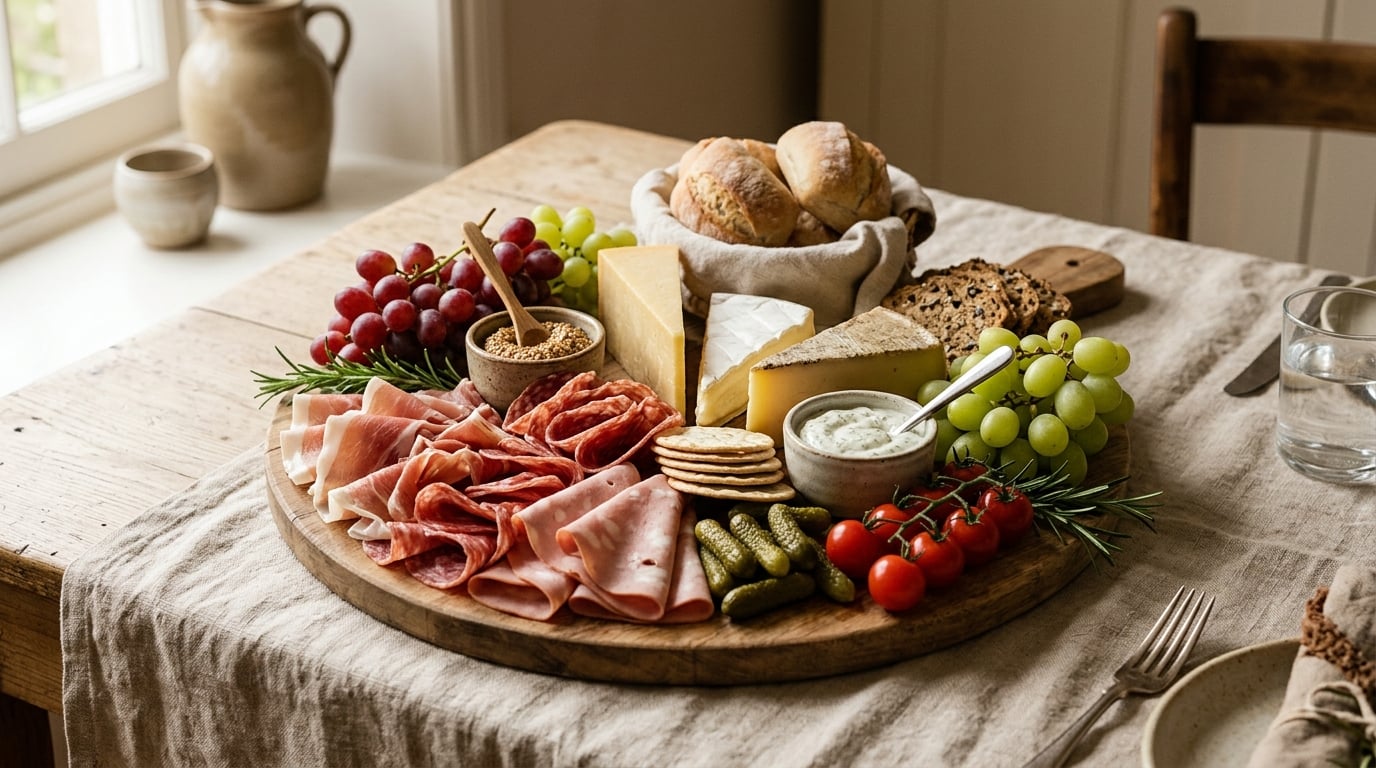
The difference between a homemade tray and a catered one is almost never the food. It is geometry: distinct sections, visible empty space between them, and a couple of items that add height. Learning how to make a deli platter at home that looks catered takes about an hour of active work and no special skills, and the payoff is a spread that reads as generous rather than leftover.
You buy sliced meats and cheeses by the pound from the deli counter, arrange them in tidy groups on a rimmed tray or platter, and add condiments in small ramekins so guests can eat with one hand. Plan for 2 to 3 ounces of meat and 1 to 2 ounces of cheese per guest, plus about 1.5 sandwich rounds if you are including bread.
Table of Contents
What You Need
For the platter itself, any large surface with a lip works. A rimmed sheet pan, a large rectangular platter, a wooden cutting board, or even a baking sheet lined with parchment will all read as intentional.
- Surface: one rimmed sheet pan or platter per 10 to 12 guests, or a single large board for a smaller crowd.
- Tongs: one pair per platter so nobody has to pick up a slice with fingers already holding cheese.
- Small forks or cocktail picks: for anything soft enough to slide off a plate.
- Two or three small ramekins: for mustard, dip, or olive tapenade. These are also your main tool for adding height.
- A sharp knife and a cutting board: for cutting cheeses and rolling meats.
- Liner: parchment, a linen runner, or a few leaves of romaine.
For the food, use a formula rather than a fixed recipe. The flexible version that works for six to eight people: 1 to 1.5 pounds of sliced deli meat, 1 to 1.5 pounds of cheese, two to three kinds of crackers, a small loaf or a few rolls, two ramekins of condiments, and one item each of pickles or olives, cherry tomatoes, and grapes.
Swap in vegetarian proteins without changing the layout: roasted red pepper strips, hummus, marinated artichoke hearts, or a few slices of brie stand in for the meat. Put them in their own section rather than scattering them, so guests can see the option without having to ask.
Step-by-Step: How to Make a Deli Platter at Home That Looks Catered
Plan the Size and Balance
Budget 2 to 3 ounces of meat per person and 1 to 2 ounces of cheese. That is roughly a quarter pound of each for every five guests. For a party that runs under two hours, stay at the lower end; for a lunch that stretches past three, add about 20 percent more because people graze longer than they eat.
Divide the total by the number of guests, then split each category across two or three varieties rather than buying one large amount. Three kinds of meat read better than a mountain of one, and they cost about the same at the counter.
Count trays last, because it depends on the surface. A standard rimmed sheet pan comfortably holds food for 10 to 12 people when you are using small groupings and ramekins instead of one big pile. Spreading thin looks better than doubling up.
Choose Complementary Foods
A platter reads as complete when it includes something salty, something sharp, something crisp, and something sweet. Build from those four roles.
- Salty: salami, prosciutto, coppa, roast beef, or turkey.
- Sharp: aged cheddar, Manchego, provolone, Swiss, or a blue cheese.
- Soft: brie or camembert, cut into wedges with the rind on.
- Creamy: goat cheese logs or whipped ricotta, piped or spooned into a small bowl.
- Crisp: two or three cracker styles, sliced baguette rounds, or crispbread.
- Sweet: grapes, figs, dried apricots, or apple slices tossed with a little lemon juice.
- Acidic: pickles, olives, cornichons, or quick-pickled red onions.
- Condiments: Dijon or whole grain mustard, fig preserves, honey, or olive tapenade.
Four cheeses is a good ceiling for a home platter. Beyond that, people cannot taste what they cannot identify, and the extra variety is not visible from across the room anyway.
Chill and Prepare the Ingredients
Chill everything the night before or early on the day of. Cold cheese slices cleanly, cold meat rolls without tearing, and a properly chilled platter holds its shape for hours.
Wash produce under running water and dry it thoroughly. Wet grapes and wet tomato slices are the two most common reasons a platter turns messy within an hour. A salad spinner or a clean towel works; the goal is surface-dry, not air-dried.
For the cheese, cut blocks from top to bottom in one continuous motion rather than sawing back and forth, which drags a thin skin across the surface. Leave a rim on bloomy-rind cheeses like brie, and break hard aged cheeses into chunks instead of slicing them.
For the meats, the traditional deli-counter technique is to lay the slices flat, overlap them slightly, roll the whole stack into a loose log, and pin it with a toothpick. The pin keeps the spiral intact when a guest takes a slice.
If you are adding anything cooked at home, cook it to the safe minimum internal temperature and cool it before it goes near the other foods: 165 degrees Fahrenheit (74 degrees Celsius) for poultry, 160 degrees Fahrenheit (71 degrees Celsius) for ground meat, and 145 degrees Fahrenheit (63 degrees Celsius) for whole cuts of beef, pork, lamb and fish. Use a separate cutting board and a separate pair of tongs for anything raw so it never touches the finished platter.
Build the Platter in Sections
Start with your largest item and place it off-center rather than in the middle. Off-center placement leaves room to work and makes the tray look composed instead of symmetrical.
Next, place the second-largest group, then fill in around them. Keep each food in one place. A tidy section with three or four folded slices of salami looks generous; the same salami scattered across the tray looks like an accident. Getting this right is most of how to make a deli platter at home that looks catered, and it costs nothing extra.
Use odd numbers of repeated items wherever you can. Five crackers, three cheese wedges, and a small cluster of seven grapes photograph better than even counts, because equal pairs tend to line up too perfectly.
The most common mistake is filling every inch. A platter should look like it still has room, so keep visible liner between sections. If the surface is covered edge to edge, remove a few pieces before you serve it.
Add Height, Color, and Texture
A completely flat arrangement is what makes home trays look flat. Fix it in three ways. Fold or roll the meats so they stand slightly proud of the tray. Stand cheese wedges on their edges or stack crackers in short leaning towers. Set the ramekins down first and nestle other items partly against them.
For color, aim for three distinct colors in view at once. The classic set is a pink or red meat, a pale yellow or white cheese, and something green from pickles, grapes, or herbs. Repeat that trio somewhere else on the tray so the eye finds balance wherever it lands.
For texture, contrast is what makes a bite interesting. Soft brie next to a crisp cracker, creamy goat cheese next to a pickle, a chewy dried apricot next to sharp cheddar. Put the two items that are meant to be eaten together next to each other.
Finish and Serve the Platter
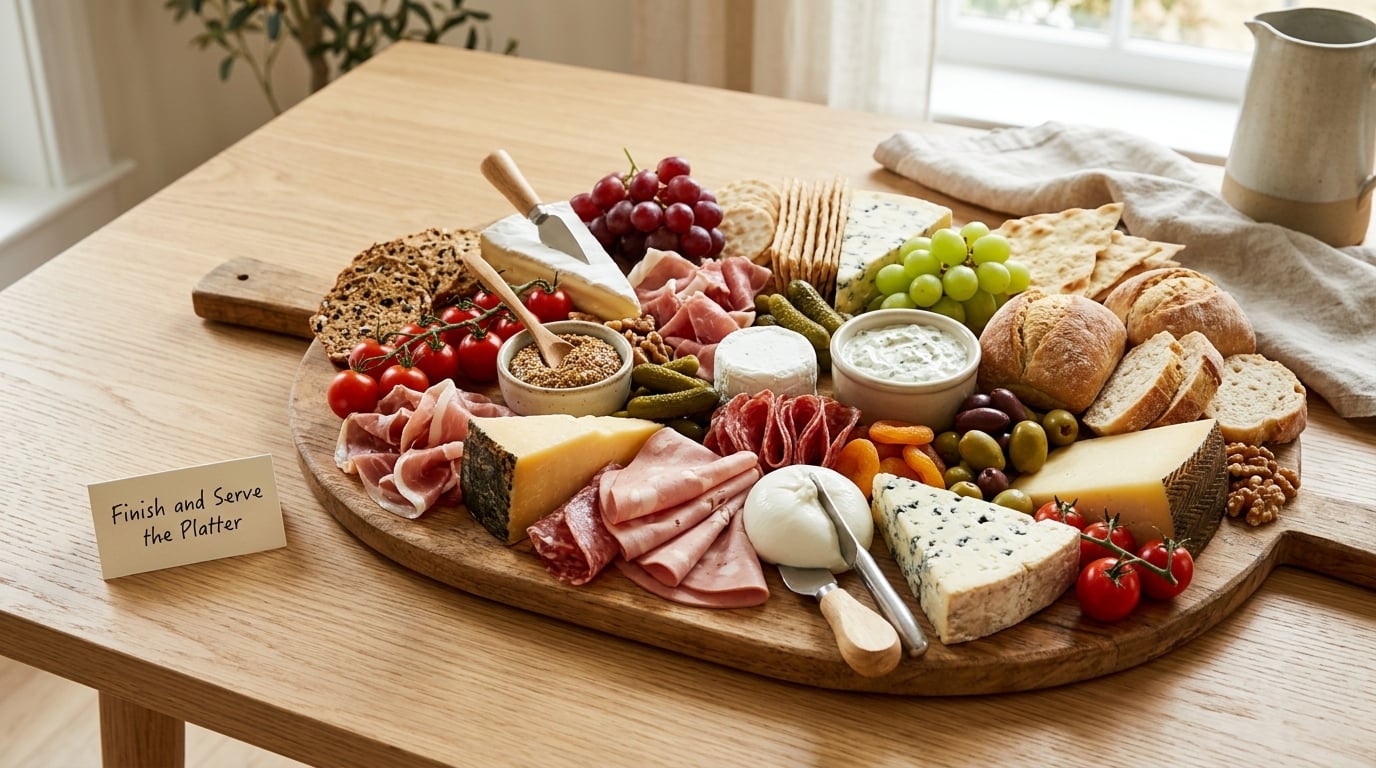
The last step is restraint. Add one small edible garnish, such as a few sprigs of rosemary, thyme, or fresh dill, tucked into one corner rather than scattered everywhere. Set the tongs beside each meat group and the small forks near anything soft.
If any guest has a dietary restriction, do not rely on a label alone. Set aside a separate small tray of crackers, cheese, and fruit, and place it slightly apart from the mixed sections so nobody has to dig for it.
Keep perishable foods at or below 40 degrees Fahrenheit (4 degrees Celsius) until about two hours before serving. Once the platter is out, eat the perishable items within two hours; if the event runs longer, keep a backup portion in the fridge and bring it out in waves rather than replenishing from the original tray. Cover the platter loosely with parchment or a cake dome if you need to move it, and keep small refills coming from cold storage so the display never sits on a warm counter.
Common Mistakes
A tray that looks amateur is almost always one of a handful of things. Here is each problem with the fix that solves it.
Overcrowding: the tray is full edge to edge. Fix: remove roughly a quarter of the food, and spread the rest out. Abundance reads as space between groups, not as quantity.
Unbalanced flavor: everything is savory and rich, so guests get tired after four bites. Fix: add something sweet and something acidic, usually grapes or figs and pickles.
Scattered grouping: foods of the same type are spread across the surface. Fix: consolidate each food into a single section before you add anything new.
Soggy crackers: crackers are placed directly on wet produce or on the damp parts of the liner. Fix: build a bed of romaine under the wet items, and keep crackers and bread on a dry area of the tray.
Awkward garnish: a large bunch of herbs or a stray sprig sitting in a corner. Fix: use one small cluster, edible, and place it where it does not cover food.
Not enough food: the tray is picked clean within an hour. Fix: plan on 2.5 to 3 ounces of meat per person for events longer than two hours, and stage a second, smaller tray in the kitchen to bring out later.
Unsafe room-temperature service: the platter sits out for hours in a warm room. Fix: keep perishable items cold until serving, and discard anything perishable that has been out longer than two hours.
Presentation Tips
A few extra finishing touches help more than most people expect. Vary the shapes: round crackers next to rectangular bread next to rolled meat keeps the eye moving. Use one liner color rather than mixed paper. Put the largest, most colorful item slightly off-center as an anchor. And if you can, choose a white or light platter, since food of any color stands out against it.
For utensils, one pair of tongs per section keeps traffic from crossing the tray, and a small plate of cocktail picks and toothpicks next to the soft cheeses means nobody has to spear a wedge with a serving fork.
Finally, build a separate small tray for vegetarian and allergen-friendly items rather than mixing them in. Guests will find it faster, and it takes ten minutes to assemble from the same ingredients you already have out.
Frequently Asked Questions
How much food should I put on a deli platter for 10 people?
For 10 guests, plan on 2.5 to 3 pounds of sliced deli meat, 2 pounds of cheese, about 15 sandwich rounds if you include bread, three to four types of crackers, two ramekins of condiments, and one each of pickles or olives, cherry tomatoes, and grapes. Spread that across two rimmed sheet pans rather than one crowded tray, and keep odd numbers of repeated items in each group. Anything perishable should stay refrigerated until about two hours before serving.
How long can a deli platter sit out at a party?
Perishable items such as sliced meat, cheese, dips, and cut fruit should not sit at room temperature for more than two hours, or one hour if the room is above 90 degrees Fahrenheit. Cheese and cured meats tolerate longer than anything with mayonnaise or cut produce. To stretch the safe window, set the platter out just before guests arrive, keep it out of direct sun, and stage a second cold portion in the kitchen to bring out in waves.
What foods look best on a catered-style platter?
The most photogenic platters combine a pink or red meat, a pale cheese, and something green, repeated in two places on the tray. Folded or rolled salami, standing wedges of aged cheddar, brie cut with the rind on, and small clusters of grapes or figs give you shape and height. Crackers stacked in short leaning towers and ramekins of mustard or tapenade add vertical interest without crowding the surface.
Can I prepare a deli platter the night before?
Yes, and it is the easiest way to look calm on party day. Chill all the meats, cheeses, and condiments overnight, then assemble the tray as close to serving as you can. Build the dry sections the night before, cover the tray, and refrigerate it, then add the ramekins, fresh fruit, and garnish in the last hour. Wash and dry the produce the day before and store it in a sealed container so it stays crisp.
How do I make a deli platter for vegetarian guests?
Build a separate small tray using the same layout rules: two or three cheeses, crackers, bread, roasted red peppers, hummus, marinated artichoke hearts, olives, pickles, and fruit. Keep each item in its own tight section, and add a ramekin of olive tapenade or pesto for the same height and color that the main tray gets from its meat sections. Placing it slightly apart from the mixed platter means nobody has to search for it or ask about ingredients.
Conclusion
Start with three decisions: how many guests, how long the party runs, and how much space you have to work with. Then chill everything, group a handful of complementary foods into distinct sections, and leave some of the surface showing. The arrangement matters more than the ingredients, so once the sections are tidy, stop adding. That is really all there is to how to make a deli platter at home that looks catered: a chilled surface, a few clean sections, and enough empty liner for the food to look like it has room to breathe.