
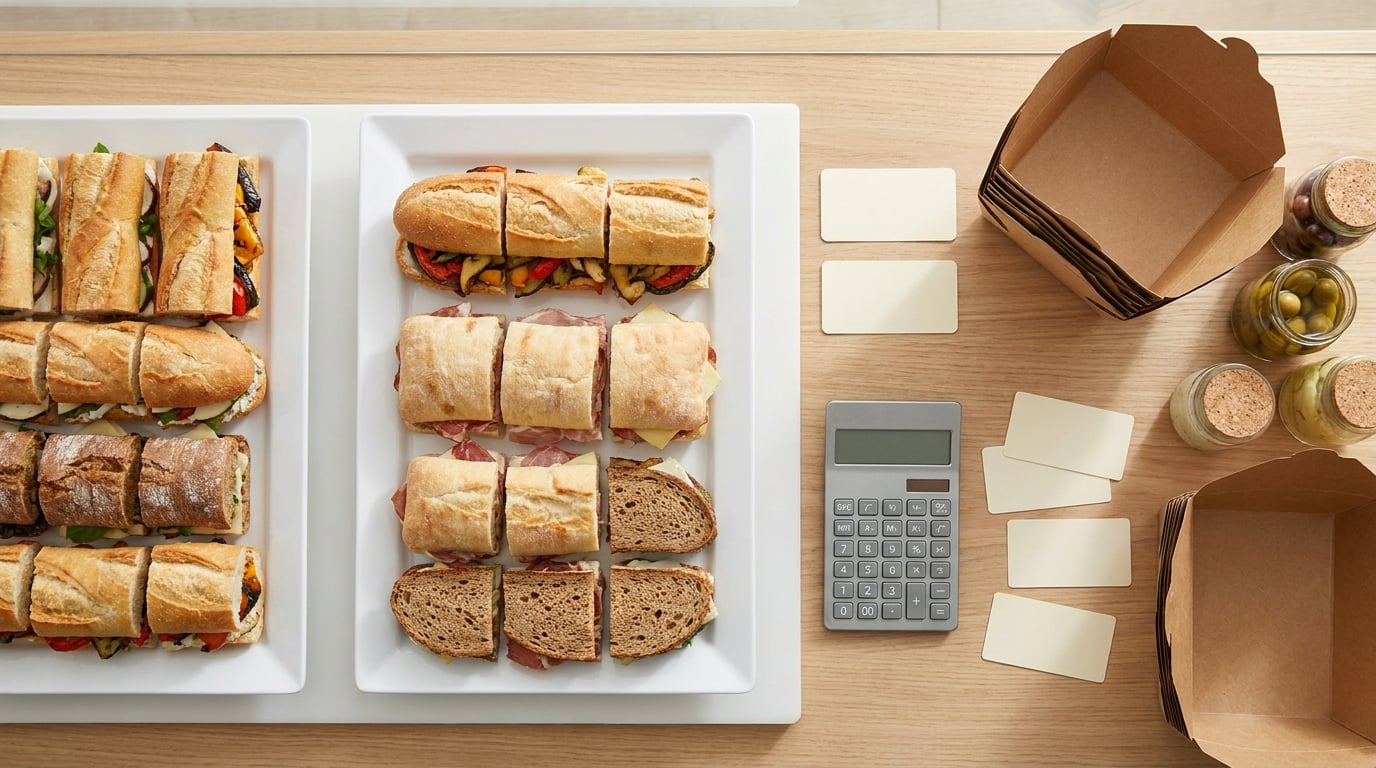
The math behind how to price sandwich platters for catering is simple: divide your total ingredient cost by your target food cost percentage, then add labor, packaging, delivery and profit. A typical small caterer quotes a classic mixed sandwich platter at roughly $5 to $8 per person, and a premium or deli board spread at $9 to $18 per person. Those are typical US ranges; they shift by region, season and how much service is attached.
The mistake most home bakers and new caterers make is pricing the sandwich and stopping there. The tray of meat and bread is about half of what it costs you, and the other half is the box, the two hours of assembly, the drive and the margin that keeps the business open.
Here is the whole method in seven steps:
- Cost every ingredient per sandwich half and write it on a cost card.
- Set your target food cost percentage, usually 28% to 35% of the selling price.
- Divide ingredient cost by that percentage to get a food-based price floor.
- Add packaging, delivery and any rentals as real line items, not rounding errors.
- Add labor at your loaded hourly rate, including prep, assembly, packing and cleanup.
- Add your margin, then layer on volume breaks, tiering and dietary upcharges.
- Quote with both a total and a per-person line so the client can check the math against their own headcount.
Everything below expands those seven steps with the numbers, worked examples and the cost drivers that actually move a sandwich platter quote.
Table of Contents
- How to Price Sandwich Platters for Catering: Costs at a Glance
- How to Price Sandwich Platters for Catering Step by Step
- Step 1: Build the cost card, line by line
- Step 2: Set your target food cost percentage
- Step 3: Price the tray off ingredients
- Step 4: Add the costs that are not ingredients
- Step 5: Work out servings and the portion buffer
- Step 6: Add tiers, volume breaks and dietary upcharges
- Step 7: Quote it so the client can see the build
- What Affects the Price
- Ways to Save
- Frequently Asked Questions
- Conclusion
How to Price Sandwich Platters for Catering: Costs at a Glance
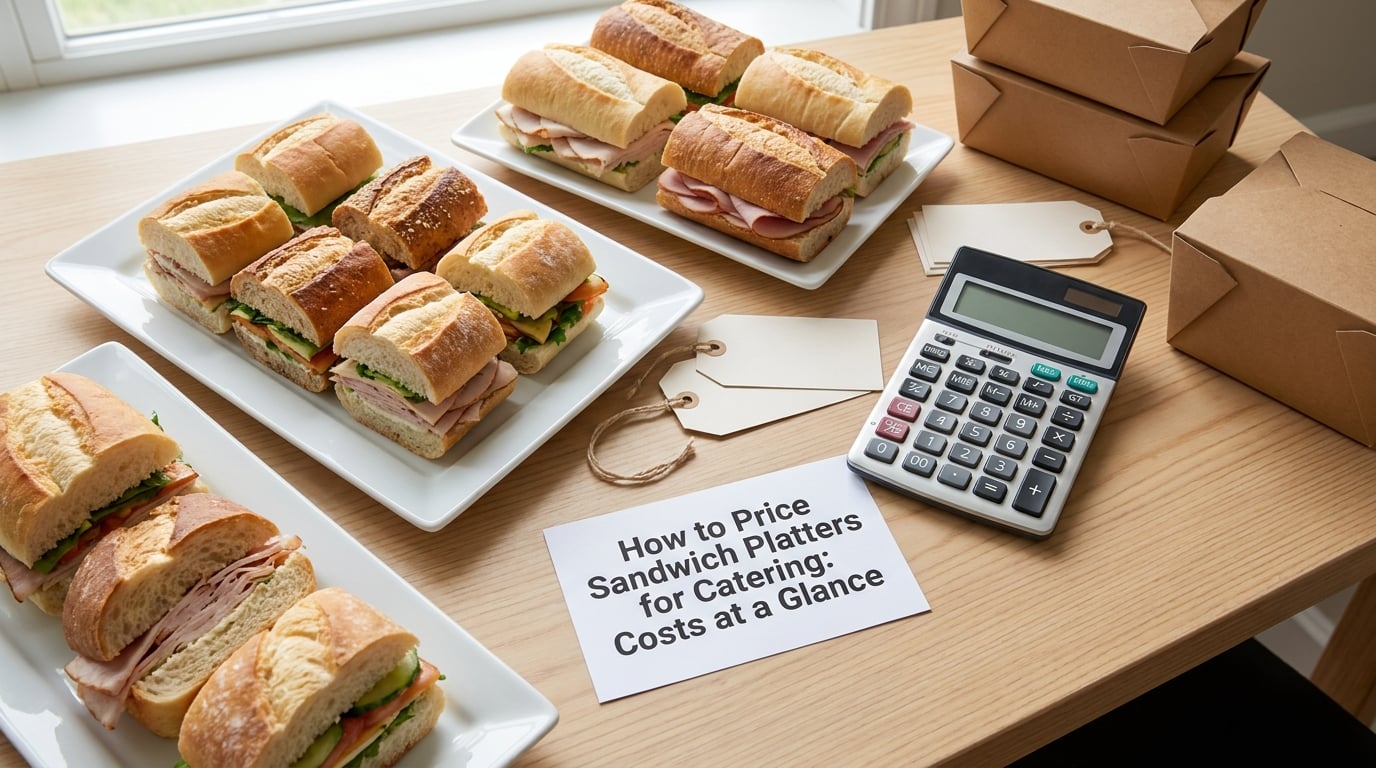
Sandwich platters are a low-complexity, high-volume item, so your pricing has to be repeatable rather than negotiated tray by tray. The table below models one classic mixed platter at three sizes, using per-half ingredient costs of roughly $1.45, which is where a wholesale deli-meat, supermarket-bread and standard-cheddar build usually lands.
| Package | Sandwiches | Serves | Ingredient cost | All-in cost | Quote range | Per person |
|---|---|---|---|---|---|---|
| Small mixed platter | 12 halves | 8-10 | about $17 | about $33 | $58-$74 | $6.50-$8.00 |
| Medium mixed platter | 24 halves | 16-20 | about $35 | about $65 | $99-$125 | $5.50-$6.75 |
| Large mixed order (two platters) | 48 halves | 36-40 | about $70 | about $118 | $185-$220 | $4.75-$6.00 |
Notice the per-person price falls as the order grows. Packaging, setup labor and the delivery run are mostly fixed, so they spread across more servings on a bigger order. That is exactly why a minimum order exists and why a one-tray drop-off should never carry the same per-person number as a four-tray delivery.
All-in cost in that table means ingredients, packaging, labor and delivery before profit. A small platter at a $65 quote puts ingredients at roughly 26% of price, which sits inside the 28% to 35% band most operations aim for once the per-tray rounding is considered.
How to price sandwich platters for catering against store and chain prices
Buyers anchor on numbers they have already seen, so it helps to know them. Grocery deli party trays are commonly priced by the ounce, running about $0.50 to $0.68 per ounce in recent listings. A sandwich portion with bread, meat and cheese weighs roughly 8 to 12 ounces, which works out to $4 to $8 per person at the deli counter.
Chain platters sit a little higher: a $45 sandwich tray serving 8 people is about $5.63 per person, and industry-reported averages for full lunch catering run $14 to $22 per person, with dinner events at $28 to $45. A sandwich platter should land well under the lunch average, because it is one course, not a full meal with a beverage and a staffed service line.
Community reports line up with the retail anchors: shoppers regularly mention paying around $30 for a tray that feeds 15 to 20 people, and one buyer planning for 50 guests landed on about 150 finger sandwiches, three varieties per guest. Your quote is not out of line if it sits near $5 to $8 per person for a classic build with delivery, setup and a real margin folded in.
Per person or per tray: which model to quote
Per-tray pricing is simpler and it protects you from a client who cuts the headcount after you shop. Per-person pricing is easier for the client to budget and it scales cleanly when an office lunch goes from 20 people to 60.
In practice, quote the per-person rate and show the resulting tray count, then list the tray price as a line item so both numbers are visible. For a set headcount with a firm menu, per tray. For a recurring office account where the coordinator is splitting a bill, per person.
How to Price Sandwich Platters for Catering Step by Step
Step 1: Build the cost card, line by line
Cost the sandwich in halves, because halves are the unit you assemble, price and compare. Divide every purchase by the number of usable portions it yields, not by the package size. A loaf that gives you 24 usable slices is not a 30-slice cost base once you account for trimmed ends.
| Line item | What it covers | Typical cost per half |
|---|---|---|
| Bread | 24 to 28 usable slices per loaf, sliced cold | $0.30-$0.40 |
| Protein | 2 to 3 ounces deli meat per half | $0.55-$0.90 |
| Cheese | 1 ounce per half | $0.25-$0.35 |
| Condiments and garnish | Mayo, mustard, pickle, lettuce, tomato | $0.12-$0.20 |
| Ingredient total | Sum of the four lines | about $1.45 for a classic build |
Write the card once per sandwich, not once per order. A turkey-cheddar-roast beef mix, a vegetarian and a gluten-free build each get their own line, and every price you quote afterwards is a multiplication rather than a guess.
Step 2: Set your target food cost percentage
Food cost percentage is ingredient cost divided by selling price. Most catering operations run between 28% and 35%, with 30% a workable default for a small operation carrying its own labor. Ask a deli colleague for their exact figure and you will often hear something near 32%, which is acceptable, just tighter than you want for a business with thin margins.
Convert your target into a markup multiplier and the arithmetic gets easy. A 30% food cost target is a 3.33 times markup on ingredient cost. A 28% target is 3.57 times. A 35% target is 2.86 times. One division does all the work.
Food cost is not the same as margin, and confusing the two is expensive. An $80 platter with $24 of ingredients has a 30% margin on sales and a 233% markup on cost. Both are true, they measure different things, and quoting the wrong one is how a business ends up working hard for nothing.
Step 3: Price the tray off ingredients
Take the medium platter from the first table: 24 halves at about $1.45 each is roughly $34.80 of ingredients. Divide by a 0.30 food cost target and you get about $116 as a food-based floor. That number is not your quote, because labor, packaging and delivery still have to be paid for, but it tells you what the sandwich itself supports. Anyone working out how to price sandwich platters for catering has to run both halves of that calculation before they commit to a number.
Step 4: Add the costs that are not ingredients
Stack the non-food costs honestly and you get the real landed cost of that medium platter: $34.80 in ingredients, about $5.40 for a catering board, film, a sturdy box, utensils and napkins, about $16.50 for 45 minutes of assembly and packing at a $22 loaded rate, and about $8 for a delivery run split across the order. Landed cost lands near $65.
Now you have two valid ways to set the price. Cost-plus takes the landed cost and adds your margin, so a 40% gross margin on the medium platter puts the quote near $108. The food cost method takes the ingredient number and divides by your target, so a 30% target puts it near $116. The second number is higher because it quietly assumes your labor and overhead are being paid from the margin, which is a more optimistic model.
Run both, compare them every few months, and keep using whichever matches the margin you actually need to cover rent, insurance, software and your own hours.
| Cost stack | Medium platter, 24 halves | Share of a $110 quote |
|---|---|---|
| Ingredients | $34.80 | 32% |
| Packaging and disposables | $5.40 | 5% |
| Labor at loaded rate | $16.50 | 15% |
| Delivery, allocated | $8.00 | 7% |
| Landed cost | $64.70 | 59% |
| Gross margin | $45.30 | 41% |
Quoting $110 for 20 servings gives the client $5.50 per person, which is the number most offices can approve without a meeting.
Step 5: Work out servings and the portion buffer
For office lunch service, plan 1.2 sandwich halves per person, or 12 sandwiches for every 10 guests. For a party or reception where people circulate and graze, three per person is closer to reality, which is how one buyer arrived at 150 finger sandwiches for 50 guests across three varieties. Reception-style service runs even higher, at 10 to 14 small pieces per person per hour.
A full-size platter should hold at least 8 to 10 whole sandwiches cut into halves, and most commercial platters carry 24 to 32 halves comfortably. At 24 halves and 1.2 halves per person, a medium platter serves about 20.
Add a 5% to 10% buffer on top of your count. It costs a few dollars and it covers the client who miscounts the room. The opposite lever also works: for a large office where a sandwich is one option among several, ordering to 85% of headcount is a common practice that trims waste on the table.
Step 6: Add tiers, volume breaks and dietary upcharges
Three tiers make your menu easier to choose from and give the client somewhere to move up. A classic build runs about $1.45 per half, a premium build with artisan bread, roast beef, provolone and arugula lands near $2.60, and a deli board with charcuterie, cheeses, spreads and crackers runs roughly $4 to $6 per guest equivalent.
Set the volume breaks before you need them: 3 or more platters at 3% off the per-person rate, 6 or more at 6%, 10 or more at 8%. Discount the per-person rate, not the total, so a bigger order still lifts the invoice. Where you discount, say so in writing, because a discount applied silently on the invoice reads as a pricing error.
Dietary builds cost more and should be priced, not absorbed. Typical upcharges are $2 to $4 per person for a vegetarian option, $3 to $5 for vegan, $4 to $8 for gluten-free and $5 to $12 for an allergy-safe preparation with separate handling.
That last one is a safety matter as much as a pricing one. An allergy-safe build needs separate tools, prep space and packaging to avoid cross-contact, and that labor is real.
Step 7: Quote it so the client can see the build
Give the client a number, the per-person equivalent and what is included. Something like: 3 medium mixed platters, 72 halves, serves about 60, $330 total or $5.50 per person, including platters, utensils, napkins, condiments and one delivery inside a 15-mile radius.
Send proposals as a banquet event order style line sheet with quantities, each item priced, and a total at the bottom. When a client can see the arithmetic, they negotiate the menu instead of the number, and menu changes are good for you because you re-cost them.
What Affects the Price
Sandwich size is the biggest lever. A 3-ounce deli-meat half and a 4-ounce roast beef half on ciabatta are not the same sandwich, and pricing them identically means one of them eats your margin. Decide your standard half weight and hold the line on it.
Bread quality moves the number in both directions. Day-old wholesale bread at a few cents a slice keeps a classic platter inside the table above. Sourdough or artisan loaves add real cost per slice, so they belong in the premium tier rather than hidden in the base price where every client feels the increase and nobody values it.
Protein and cheese choices follow the same logic. Turkey and ham sit at the low end, roast beef, ham and brie or a smoked spread push toward the premium tier. A deli board changes the model completely, because charcuterie, cheeses and crackers have a higher waste rate and a much higher perceived value per piece.
Add-ons are where quotes quietly leak. Extra cheese, avocado, bacon, a branded cookie tray or a custom garnish each carry their own cost plus labor. Quote them as line items with a price attached instead of folding them into a bigger sandwich and hoping nobody notices.
Platter and packaging size is worth watching. A flimsy plastic tray that bows under 24 loaded halves is not a saving, it is a return. Boards, film, sturdy boxes, forks and napkins for 20 servings run roughly $5 to $8, and that line is where a lot of caterers quietly underprice themselves.
Labor depends on the service model. A drop-off needs prep, assembly, packing and a drive, maybe 45 minutes per medium platter once batching is set. A staffed buffet adds a server on site for the whole event, and a service charge of 18% to 20% plus a gratuity of 15% to 20% is common industry practice for protecting that labor.
Delivery carries its own cost: fuel, vehicle wear, driver time and the route. Fee stacks in this industry commonly run 10% to 18% service charge, $8 to $25 delivery, $15 to $50 setup, and tax on top. Consolidation is the lever, which is why delivering four platters to one office is far cheaper per person than four separate drop-offs.
Minimums and lead time price themselves. Set a minimum order so a single platter does not absorb a whole delivery run, and require two to five business days notice so you can buy and assemble on your schedule. Same-day orders are a premium because they consume a whole day’s production capacity for a single client.
Seasonality works quietly in the background. Produce bought in season costs less and tastes better, while tomatoes, cucumbers and herbs in the off-season push a per-half cost up by cents that add up across 24 halves. Build a seasonal adjustment into your menu review twice a year rather than raising prices mid-quarter.
Ways to Save
Buy produce and bread in season and around local supply. A sandwich platter built in July with garden tomatoes costs a fraction of the same platter in January, and the quality difference is visible enough that you rarely need to lower the price to compensate.
Run fewer distinct sandwiches. Every extra variety means a separate bread, a separate protein, a separate label and a slower assembly line. Three builds sell almost as well as six on a mixed platter, and the savings show up in both the cost card and the labor line.
Buy bread in the quantity you can actually use and freeze it. A wholesale loaf priced per unit looks cheap until you count the trimmed ends, and sandwich bread that has been frozen and thawed for a day performs almost like fresh in a cold sandwich.
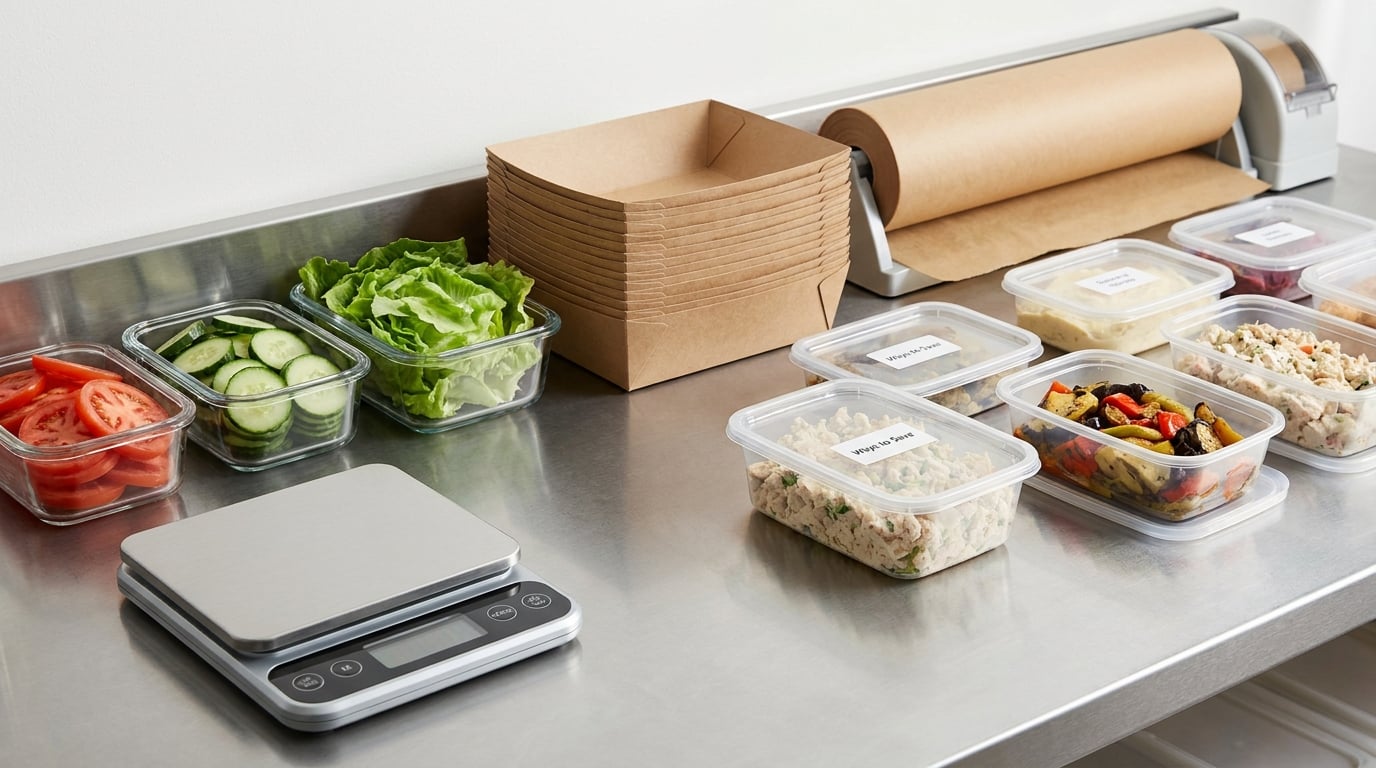
Assemble in a line rather than one at a time. Lay out every station in order, slice in batches, and keep one person on filling, one on wrapping, one on boxing. Most small operations cut assembly time by a third with setup alone, and labor is usually the second-largest line on the cost stack.
Offer pickup, or consolidate delivery. Pickup moves the delivery cost to the client, and a single scheduled drop to one office at a set time is the cheapest delivery model there is. Offer a standing weekly slot and the per-person price can come down a couple of dollars without touching your food cost. Together these are the levers that actually decide how to price sandwich platters for catering on a repeat account.
Two things are not worth saving. Food safety is non-negotiable: hold poultry at 165°F, ground meat at 160°F, and whole cuts and fish at 145°F, and keep anything perishable out of the danger zone for more than two hours, or one hour when the room sits above 90°F. And do not cut the portion buffer to recover a margin you lost on pricing. That is the one saving that reliably produces a refund request and a client who does not rebook.
Frequently Asked Questions
Should sandwich platters be priced by the platter or by the person?
Quote per person and show the tray count as a line item, so the client sees both. Per-tray pricing is better when the headcount is firm and the menu is fixed, because it protects you when the guest count drops. Per-person pricing wins for recurring office lunches and for clients splitting a bill. In both cases, state the serving assumption, such as 1.2 halves per person for office lunch service, so nobody has to guess.
What markup should I use when pricing sandwich platters for catering?
Most operations run a food cost of 28% to 35% of the selling price, which translates to a markup of 2.86 to 3.57 times ingredient cost. A 3.33 times markup is the same as a 30% food cost target. The 28% to 35% band refers to ingredients only, so add labor, packaging and delivery on top before you call the number final.
How do I calculate the cost of sandwich platters?
Cost every ingredient per sandwich half, then add packaging, labor at your loaded hourly rate and an allocated delivery cost. Sum those for landed cost, then either add your target margin for a cost-plus price or divide ingredient cost by your target food cost percentage for a food-based price. Recheck the card whenever a supplier changes price, because deli meat and bread move more often than anything else.
Should I charge extra for delivery and setup?
Yes, price delivery and setup as separate line items rather than absorbing them into the per-person rate. Set a delivery fee by distance and a setup fee for anything requiring tables, linen, chafing dishes or on-site service, then add a service charge of 18% to 20% on the labor portion of staffed events. Show clients exactly what the fee covers, since transparency tends to reduce pushback.
How should I price a last-minute sandwich catering order?
Add a rush premium of 20% to 30% on the food and labor lines, and hold the same per-person rate so the client still recognizes the menu price. The premium covers the production capacity the order consumes, not a shortage of sandwiches. Take a deposit on same-day orders, confirm the headcount in writing, and skip the premium for a client that books standing weekly slots.
Conclusion
Start with the menu, not the price list. Write out every sandwich you intend to offer, cost each one per half, decide your serving size per person, and add the packaging, labor and delivery that most quotes forget.
Then divide ingredient cost by your target food cost percentage, add the non-food costs and the margin you need, and present the quote with a per-person line next to the total. That one habit is what turns sandwich platter pricing from a guess into something you can defend, repeat and raise a little each year.