
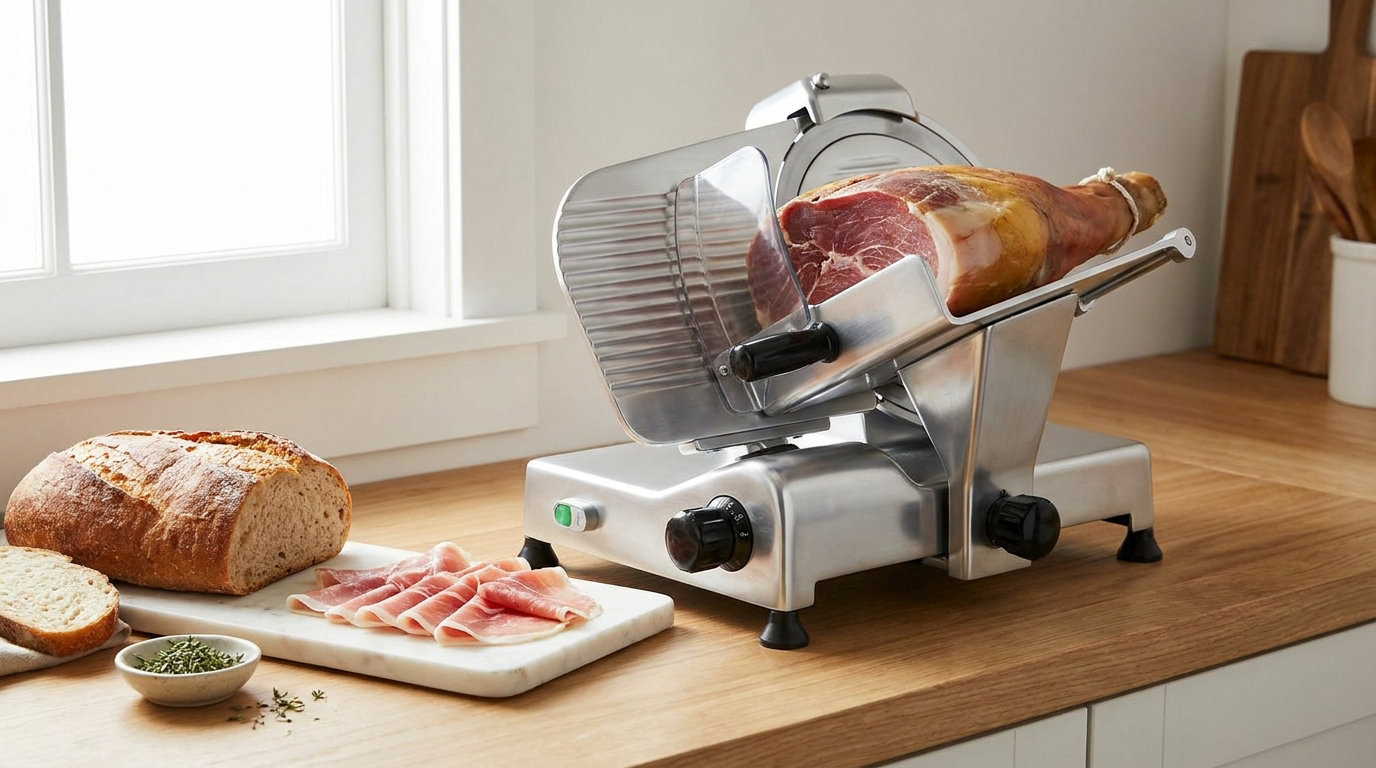
The best meat slicer for home use is the one whose carriage, blade, and thickness control match how often you actually slice meat. Most home cooks do not need a commercial machine, but they do need a carriage big enough for a real roast and a thickness gauge that holds its setting. Here is what each type of slicer handles well, where it falls short, and who it suits.
A meat slicer, also called a deli slicer or food slicer, is a machine with a powered circular blade and a sliding carriage. You set the thickness, place the food on the carriage behind the blade guard, and push the carriage back and forth so the blade shaves off slices at the gap you chose. It is the only kitchen tool that reliably produces paper-thin, uniform slices, which is why cheesesteak, pastrami, bacon, jerky, and charcuterie people buy one.
There is also an honest case against buying one. If you roast a chicken four times a year, a sharp long slicing knife does the same job and takes up no counter. The types below are ordered roughly from smallest and simplest to largest and most capable, so you can find your spot before you spend anything.
Table of Contents
- Best Meat Slicers for Home Use at a Glance
- 1. Compact Entry-Level Electric Meat Slicer
- 2. Mid-Size Stainless Steel Meat Slicer
- 3. Budget Manual Rotary Meat Slicer
- 4. Adjustable-Thickness Electric Slicer
- 5. Large-Capacity Home Deli Slicer
- 6. Compact Belt-Driven Meat Slicer
- 7. Easy-Clean Semiautomatic Meat Slicer
- 8. Low-Profile Slicer for Small Kitchens
- 9. Heavy-Duty Stainless Steel Commercial-Style Slicer
- 10. Best All-Around Meat Slicer for Sandwich Makers
- Frequently Asked Questions
- The Bottom Line
Best Meat Slicers for Home Use at a Glance
The four things that decide whether a slicer feels worth owning are the size of the carriage, the range and repeatability of the thickness control, how easily the blade comes out for cleaning, and how loud it is while running. Marketing language matters far less. Two machines with the same wattage and blade diameter can feel completely different based on whether the carriage has a non-slip surface and whether the thickness dial actually locks where you put it.
Here is how the ten types in this guide compare side by side.
| Slicer type | Approximate capacity | Slice-thickness range | Best use | Cleaning burden | Suits this cook |
|---|---|---|---|---|---|
| Compact entry-level electric | A few servings at a time | Thin to moderately thick | Weekly sandwich meat, small roasts | Low | One or two people, light use |
| Mid-size stainless steel | A medium roast or small ham | Deli-thin to thick | Roast beef, ham, turkey, cured meats | Moderate | Families who slice most weeks |
| Budget manual rotary | Limited by hand strength | Fixed or stepped | Turkey breast, roast cuts, small batches | Very low | Small kitchens, no motor wanted |
| Adjustable-thickness electric | Medium | Paper-thin to thick | Deli cold cuts, bacon, roast beef | Moderate | Charcuterie and bacon fans |
| Large-capacity home deli | Large roasts and multiple batches | Deli-thin to thick | Parties, game day, batch prep | Moderate to high | Holiday hosts and bulk cooks |
| Compact belt-driven | Medium | Even, repeatable | Frequent slicing in a small kitchen | Moderate | People who care about noise |
| Easy-clean semiautomatic | Medium | Adjustable | Weeknight meals, minimal cleanup | Low | Anyone who will not clean a machine |
| Low-profile | Small to medium | Adjustable | Limited counter space, stow-away use | Low | Apartment kitchens |
| Heavy-duty commercial-style | Very large roasts | Fine, repeatable | Frequent large-cut processing | High | Dedicated hobbyists |
| All-around for sandwiches | Medium to large | Full range, locked settings | Mixed sandwich prep, all week | Moderate | The generalist home sandwich maker |
Before buying any of them, chill the meat first. A roast that has sat at room temperature tears and crumbles; 30 minutes in the freezer firms it up enough for clean, intact slices without freezing it solid.
1. Compact Entry-Level Electric Meat Slicer
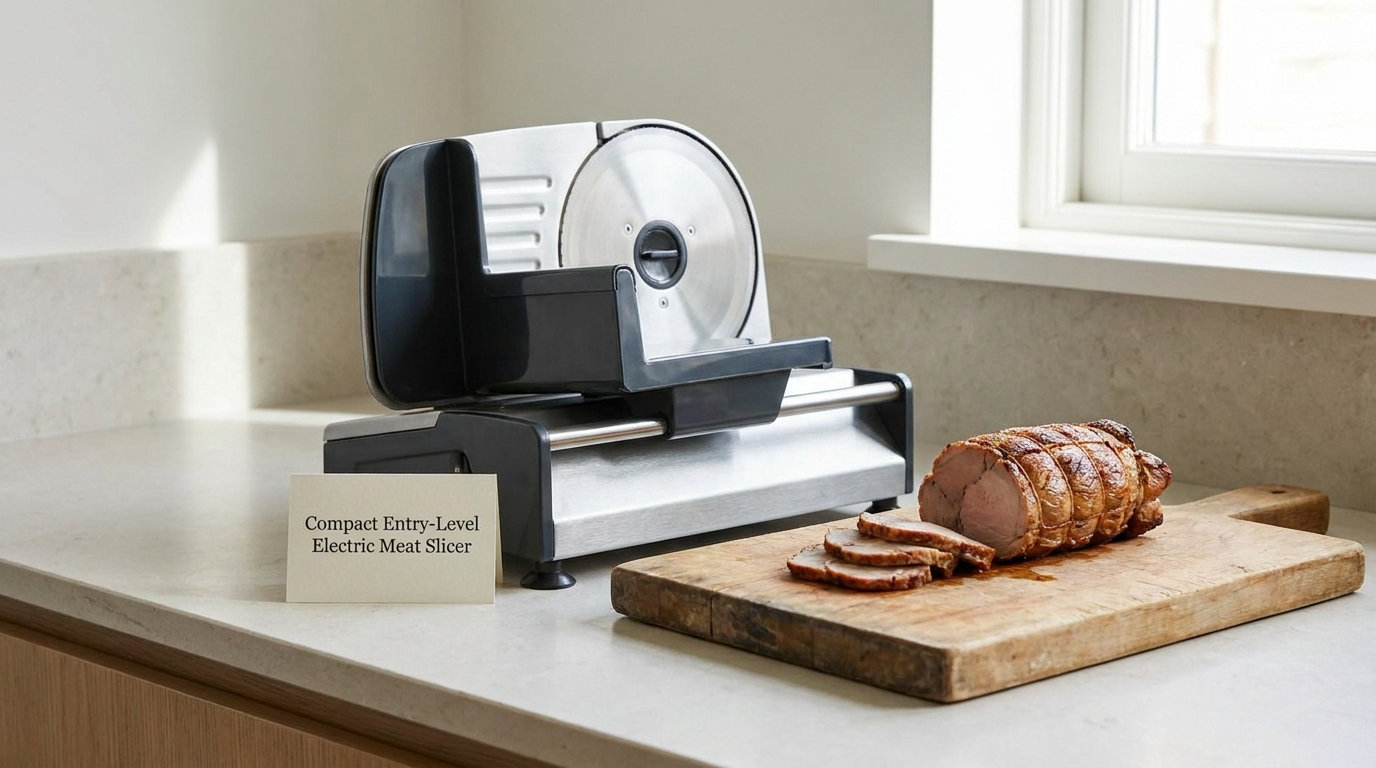
A compact entry-level electric slicer is the most common first machine for home cooks, and the footprint is its real advantage: it fits a counter corner or a lower cabinet in a way an 8.5 or 10 inch model does not. The trade is carriage size. A small carriage handles a dinner roast, a block of cheese, and a few slices of cold cuts, but it will not take a whole pork shoulder or a deep ham in one pass.
Controls on this tier are simple, usually a single dial for thickness and a rocker or foot switch for power. What separates a decent compact unit from a frustrating one is the surface treatment. A carriage with a non-slip strip or a serrated plate keeps a cold, slightly damp ham from sliding into the blade as you push. Interlock switches that stop the blade when the guard is removed are common and worth having.
My example: a 2 pound roast beef roast, salted and chilled, part-frozen for about 25 minutes, sliced at a setting near the thin end for a week of sandwiches. One pass through the carriage produces a stack that looks like deli counter output. On a small carriage you work in two or three batches, which takes a few extra minutes.
The honest limitation is capacity, not quality. If you regularly cook a whole turkey breast or a leg of lamb and want it sliced in one go, step up to a mid-size or large carriage instead of fighting this machine.
Best Meat Slicers for Home Use: What to Look For
Here is the buying framework I use, in the order that matters. Blade removability comes first: a blade that unscrews or lifts out without tools turns a ten-minute chore into a two-minute one, and owners single this out more than any other feature when they explain why their machine is still going. Next is the thickness control, which needs clearly marked increments and a positive lock, not a friction fit that drifts after a few dozen slices. Look for a carriage plate that grips food, rubber or non-slip feet so the machine does not creep when you push, and a blade guard with a food holder that keeps your hand a fixed distance from the edge.
Interlock switches, dishwasher-safe guards and trays, and a manual that explains how to reach the blade sharpener all matter for safety and upkeep. Noise is worth thinking about if you live above someone or plan to slice at odd hours; belt-driven motors are usually the quieter choice. Check ventilation clearance behind the motor, and read the warranty length and parts availability before you commit, because a machine with no replaceable blade or no stocked service is a dead end after a few years.
2. Mid-Size Stainless Steel Meat Slicer
A mid-size stainless steel slicer is the balanced choice for anyone who makes sandwiches more than a couple of times a month. The larger carriage than a compact model means a full ham, a whole turkey breast, or a good-size roast goes through in a single pass, and the sturdier frame keeps slice thickness consistent when the motor is loaded.
Stainless surfaces are the reason this tier feels like deli equipment: they shrug off the moisture and fat that come off cured meat, and they wipe clean. They do need care. Water spots and fingerprints show immediately, and if salt sits on a stainless surface long enough it can mark it. Wipe dry after every session, keep the carriage plate free of dried fat, and dry the blade before you put the guard back on.
For a home kitchen, this is the size that stops feeling like a compromise. Roast beef, ham, turkey, and a hard salami all behave. The only real cost is counter depth, so measure the space behind your cabinets before you commit to this size rather than a compact one.
3. Budget Manual Rotary Meat Slicer
A manual rotary slicer runs on a hand crank and a rotating disc, with no motor, no cord, and nothing that can burn out. If the idea of an electrical appliance in your kitchen bothers you, or your counter space is really a shelf, this is the whole machine and nothing else.
There is a learning curve. The first few slices come out uneven because you are managing blade pressure and crank speed at the same time, and consistency improves quickly once your hand finds a rhythm. The blades are usually standard circular blades that are cheap to replace, and sharpening them is a normal maintenance task rather than a return-to-manufacturer event. It is a sharp replaceable blade that makes a manual slicer viable, since a dull disc will tear anything you feed it.
Picture slicing a cooked turkey breast that has chilled for a few hours: the disc cuts through firm cold meat cleanly, and the effort is a slow steady crank rather than a hard push. Skip the crumbly end pieces. Manual slicers do real work on a full turkey for a holiday table, they just will not do it fast.
4. Adjustable-Thickness Electric Slicer
An adjustable-thickness electric slicer is defined by one thing: whether the thickness control is clearly marked and stays where you put it. A graduated dial with numbers you can read at a glance beats a friction-adjust lever every time, because you are switching between paper-thin deli meat, thick sandwich meat, and bacon constantly, and you do not want to guess.
Testing the settings takes two minutes. Run a soft meat like cold turkey through at the thin end of the range, look at the slice, then step up one or two marks at a time until you find your setting. Write the number down. The bigger question is whether that setting survives a hundred slices; cheap friction mechanisms drift, and the slices get thicker as the session goes on. A mechanism with a positive lock holds.
For charcuterie, bacon, and deli-style cold cuts, this is the feature that decides whether the machine is a pleasure or a novelty. A dial you can read is also a dial you can show somebody else, which matters if the slicer is shared.
5. Large-Capacity Home Deli Slicer
A large-capacity home deli slicer exists for the days you are feeding a group: a holiday table, a game-day spread, or a batch of sandwich prep for the week. The extra size comes from a wider carriage, a larger blade diameter, and a motor that stays stable under sustained load rather than bogging down halfway through a shoulder.
Two practical limits keep this tier honest. Larger motors and blades generate heat, so the machine needs clearance behind and above it and a break if you are running multiple long batches back to back. And the carriage will only hold food it can support, which means a large roast still has to be cut down to a size that sits flat and stable rather than balanced on the edge and pressed toward the blade.
If you host a lot, this size pays for itself in time saved and consistency. If you mostly cook for two, the same money buys a better-thickness-control mid-size machine, which is the more useful upgrade.
6. Compact Belt-Driven Meat Slicer
A compact belt-driven meat slicer uses a belt to transfer power from the motor to the blade, instead of a direct-drive or gear arrangement. That extra moving part buys two things a home cook notices: a noticeably quieter run and smoother delivery of power, which shows up as more even slices. Quieter operation is a real differentiator, and people mention it directly when they compare machines.
The cost of that design is a maintenance item. Belts stretch and lose tension, and alignment matters enough that the manual’s instructions are worth reading before you adjust anything. Replacement belt availability is a fair question to ask before buying; a machine whose belt is not stocked is one you will not repair. Cleaning around the drive mechanism needs the manual open in front of you, since water and powder near the belt housing is exactly the situation the manufacturer warned you about.
Small kitchens, early morning prep, and anyone who does not want a slicer to be the loudest thing in the room should look here first.
7. Easy-Clean Semiautomatic Meat Slicer
An easy-clean semiautomatic slicer is built for the fifteen minutes after dinner when you would rather not be elbow-deep in a gearbox. The design cues are visible: food trays that lift out and go in a dishwasher, blade guards that detach without tools, and a carriage with an open surface you can wipe in one pass instead of working around seams.
One rule applies to every slicer regardless of how easy the design claims to be: never submerge it. Unplug it first, remove the blade, wash the blade and detachable guards by hand, wipe the body and carriage with a damp cloth, and dry the stainless parts fully before reassembly. Trapped moisture under the guard is how rust and smells start.
Machines marketed for quick cleanup earn their reputation in the first five minutes after a session, not the first five. If you will not rinse anything, this is the tier to shop, and you will use it more often than a machine you resent.
8. Low-Profile Slicer for Small Kitchens
A low-profile slicer for a small kitchen solves one problem: the machine is too big to leave out and too heavy to move every time. A slim body, a lighter frame, and a folding or removable carriage let it go back in a cabinet or on a narrow pantry shelf between uses instead of owning a permanent piece of counter.
The trade-offs are predictable. A smaller blade and a shorter carriage mean a smaller maximum food height, so a tall block of cheese or a thick ham section may need trimming. Lower weight can also mean less stability when you push a firm cut, which is where non-slip feet earn their keep. For a cook who slices cured meat, bacon, or sandwich meat a few times a month and has a galley kitchen, that trade is clearly worth it.
Before buying any size, measure the depth of your counter run and the height of your lowest cabinet. A machine that gets used because it is reachable beats a better one that ends up in a garage.
9. Heavy-Duty Stainless Steel Commercial-Style Slicer
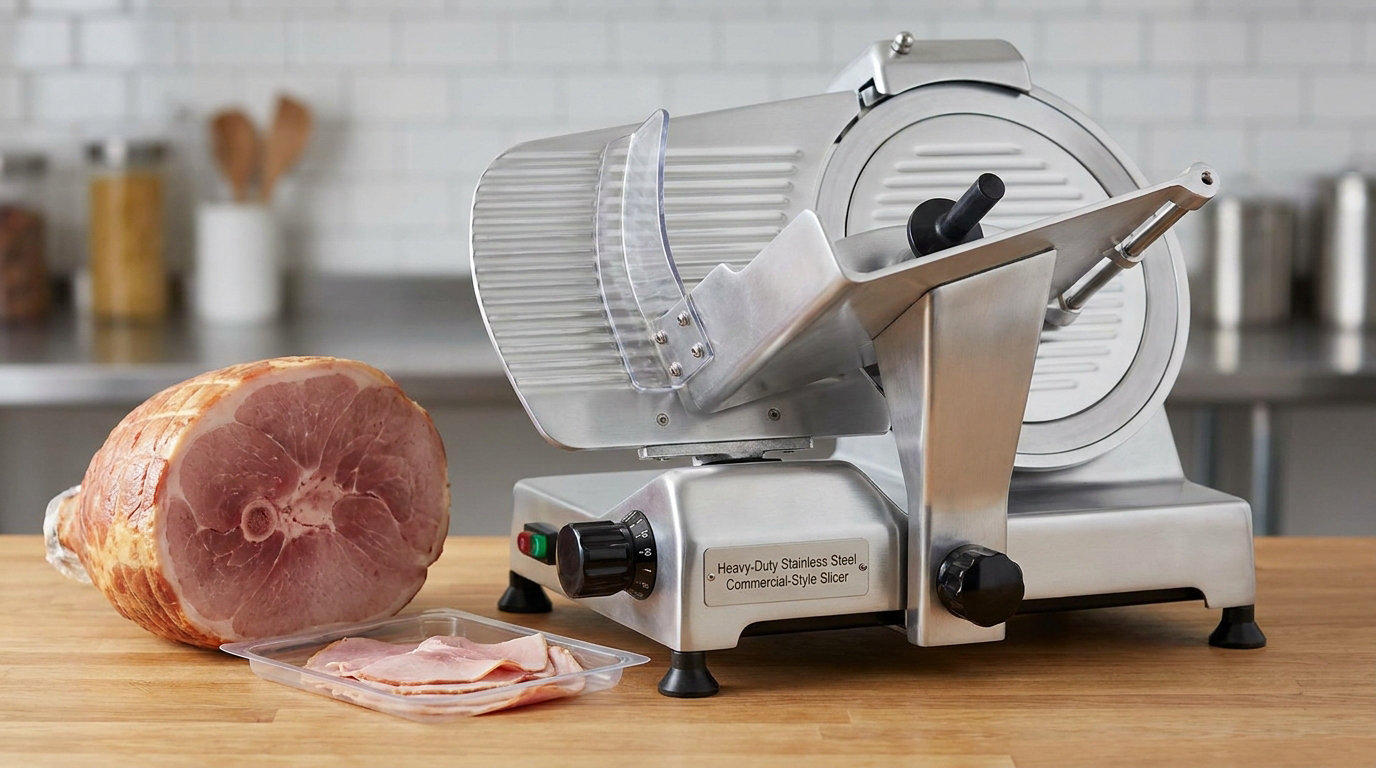
A heavy-duty stainless steel commercial-style slicer is the top of the home range: a hard-working carriage, a powerful motor, and a blade assembly that holds a fine edge through repeated sessions. It handles large roasts and long batches without complaint, and the thickness control stays consistent from the first slice to the hundredth.
It also demands respect. These machines need a sturdy counter with real space behind them, a grounded outlet within reach, and a real cleaning routine after every use, because the same blade assembly and motor that handle a big load also collect fat and debris in places that are hard to reach. Electrical safety is not optional here: keep the machine away from water, wipe spills immediately, and unplug it before any cleaning. None of that is a warning that it is dangerous; it is the same discipline a restaurant deli follows, and it is a fair part of what you are buying.
Be honest about frequency before you buy. This tier makes sense if you process large cuts regularly, run a home charcuterie or catering side project, or slice for a group every week. For ordinary home sandwich prep, it is far more machine than the job requires, and a mid-size stainless steel model will serve you better.
10. Best All-Around Meat Slicer for Sandwich Makers
The most versatile home slicer combines five specific things: a thickness control with clearly marked increments that locks in position, a carriage sized to take a full ham or turkey breast in one pass, a blade that removes without tools, noise low enough that you will not dread an early start, and a body you can actually lift and put away. Get all five and the machine fits nearly any menu. Miss the carriage or the lock, and you will be frustrated every single time.
A week of lunches is the test. Roast beef at a thin setting for Monday, turkey at a medium setting midweek, ham thick for Friday, and a block of cheddar or provolone for the sandwiches that need it. On a machine with a wide carriage and a locked dial, that is four short sessions with one wipe-down between each. On a narrow carriage with a drifting friction lever, it is four frustrating ones, because every session takes twice as long and the last slices come out too thick.
That is the whole argument for the all-around pick. The features that sound minor on a product page, a removable blade and a locking gauge, are the features that decide whether a home meat slicer stays in a cabinet after the novelty wears off or becomes the tool you reach for every Sunday.
Frequently Asked Questions
Is a meat slicer worth it for home use?
A meat slicer is worth it if you slice meat more than a few times a month, or if you make cheesesteak, pastrami, bacon, jerky, or charcuterie, where a knife cannot produce thin, even slices. If you cook meat four times a year, a sharp long slicing knife does the same job and takes up no counter space. The honest test is frequency plus the kind of slice you need, not the number of people you feed.
Which type of meat slicer is safest to use at home?
Any model with an interlock switch, a blade guard, and a food holder that keeps your hand a fixed distance from the edge. Never reach past the guard, and use the pusher for anything smaller than your palm. Unplug before cleaning, and never put fingers near a running blade. Models with a removable blade are easier to clean safely because the sharpest part comes out before you wipe anything.
Can a manual rotary meat slicer produce thin slices?
Yes, but with practice. A sharp blade and a steady crank rhythm will produce deli-thin slices from firm, chilled meat, and results improve quickly once your hand finds a pace. The limitation is consistency across a long session and the physical effort for large cuts, which is why manual slicers suit smaller pieces and lower volumes. A freezer-chilled cut helps far more on a manual machine than on an electric one.
How thick of meat can a home meat slicer cut?
The limit is carriage height and motor power, not the blade. Compact and low-profile models handle a dinner roast or a block of cheese. Mid-size and large-capacity machines take a full turkey breast or a deep ham in one pass. Very large cuts should always be cut down to a size that sits flat and stable on the carriage, and any cured meat should be chilled first so it holds together instead of crumbling.
How do I clean a meat slicer?
Unplug it, turn the thickness control to zero, and remove the food tray and blade guard. Detach the blade and wash it by hand along with any dishwasher-safe parts, then wipe the body and carriage with a damp cloth. Never submerge the machine. Dry every stainless part completely before reassembly, since trapped moisture causes rust and odors, and refit the guard before the blade runs again.
What can a meat slicer cut besides meat?
Cheese is the most popular second use, especially firm blocks like cheddar, provolone, and Swiss. Slicers also handle deli vegetables such as tomatoes and onions, and some people slice bread or rolls for sandwiches. The same uniform thickness that makes deli meat look right does the same for cheese, so a machine that feels like overkill for cold cuts stops feeling that way once you use it for a cheese board.
The Bottom Line
Start with the type that matches how often you slice, not with the biggest machine you can fit. Compact electric for a few servings a week, mid-size stainless steel for a family, a large-capacity model for parties, and a heavy-duty commercial-style unit only if you process big cuts regularly. Whatever you choose, chill the meat before it goes near the blade, and give a machine with a removable blade and a locking thickness control the highest priority. Those two features decide whether you keep using it.