
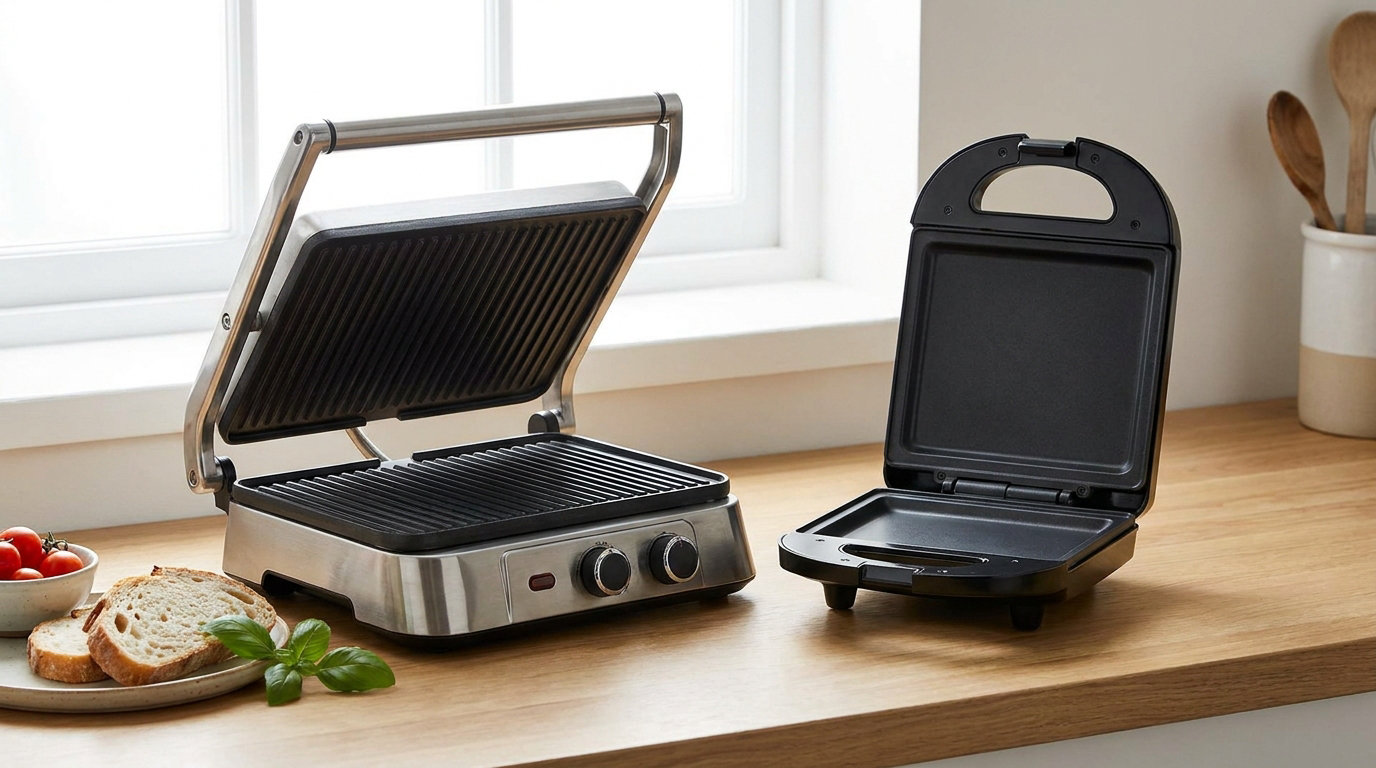
The best panini presses and sandwich makers for home cooks are hinged electric contact grills with removable, dishwasher-safe plates and a hinge that can take a thick, overstuffed sandwich without crushing the filling out the side. If you want a single decisive answer, buy a five-in-one contact grill with reversible plates: it presses a good panini, grills burgers and steaks, and flips to a flat griddle for pancakes and bacon, and the plates lift out and go in the dishwasher when you are done. Updated for October 2026.
That single appliance covers the job most people are actually shopping for. A straight sandwich toaster with sealed plates will warm the bread and melt the cheese, but it will not press grill marks into a ciabatta or toast the cut face of the bread the way a restaurant press does.
Table of Contents
- Are panini presses actually worth buying?
- Best Panini Presses and Sandwich Makers at a Glance
- 1. Best Overall Panini Press
- 2. Best Panini Press for Small Kitchens
- 3. Best Budget Panini Press
- 4. Best Large Panini Press for Families
- 5. Best Panini Maker with Adjustable Heat
- 6. Best Easy-Clean Sandwich Maker
- 7. Best Panini Press for Versatile Cooking
- 8. Best Portable Sandwich Maker
- 9. Best Multi-Sandwich Maker
- 10. Best Premium Panini Press
- How to get a good panini out of any press
- Frequently Asked Questions
- Conclusion
Are panini presses actually worth buying?
Worth it if you do not own a cast iron skillet and a second griddle, or if you want grill-marked sandwiches without firing up a burner and standing over the stove. Not worth it if you already have that setup, which a lot of people do and which costs nothing extra at a thrift store.
You will also read wildly contradictory reviews for the same model. That is not a sign the reviews are fake. It usually means the appliance is a grill first and a press second, so people who wanted a searing machine love it and people who wanted a dedicated sandwich slot find it frustrating. Knowing which one you are solves most of the star rating mystery before you buy.
Here is how the ten categories of press and sandwich maker below divide up, and what each one does well.
Best Panini Presses and Sandwich Makers at a Glance
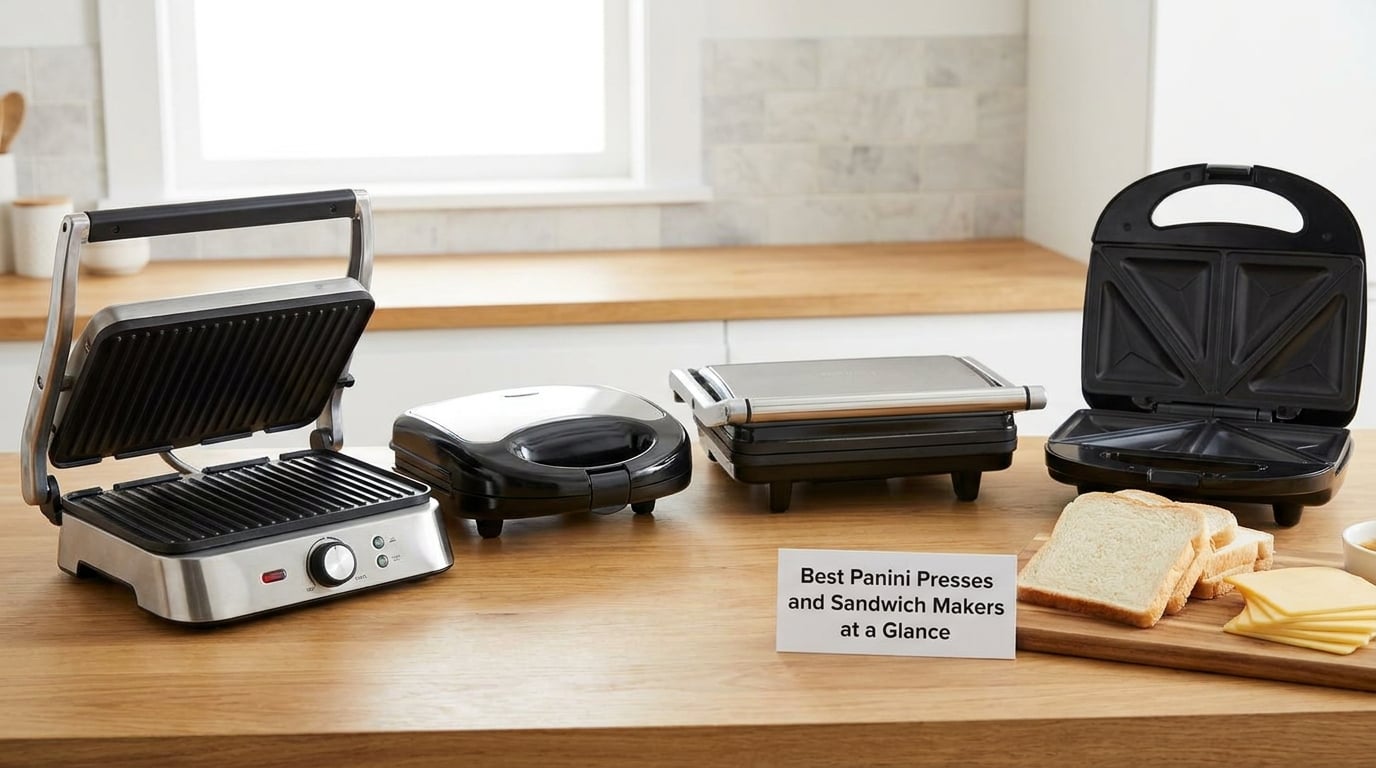
| Type of press | Best for | Plate size | Heat control | Cleaning | Standout feature |
|---|---|---|---|---|---|
| Five-in-one contact grill | Everything, most households | Large, full sandwich plus sides | Dial with presets | Reversible removable plates, dishwasher safe | Grill and griddle plates in one appliance |
| Compact sandwich press | Small kitchens, dorms | One to two portions | Single on/off, indicator lights | Nonstick plate wipes clean | Stores upright on a narrow counter |
| Budget two-slice press | Occasional use, first appliance | Two standard slices | Fixed heat | Wipe only, no plate removal | Simple, cheap, no learning curve |
| Large family press | Feeding four to six people | Wide surface, several portions | Dial or digital | Removable plates, drip channel | Batch cooking in one cycle |
| Adjustable-heat press | Thick bread, mixed fillings | Full sandwich size | Multiple graded settings | Removable plates | Avoids scorching while cheese melts |
| Dishwasher-safe press | Busy weeknight cooking | Full sandwich size | Dial, auto shutoff | Plates unclip, dishwasher safe | Wash-up takes under a minute |
| Multi-use contact grill | Meat, veg and sandwiches | Large, ribbed plus flat | Several settings, presets | Removable plates, drip tray | Steaks, burgers, quesadillas, pancakes |
| Portable press | Office, dorm, travel | One portion | Fixed heat | Wipe only | Light, narrow, stores anywhere |
| Multi-sandwich maker | Parties, tea sandwiches | Several pockets at once | Fixed or dial | Removable plates on most | Four or more pockets per cycle |
| Premium press | Frequent cooks, enthusiasts | Extra-wide, thick-capable | Precise digital settings | Removable plates, drip tray | Heat retention and build quality |
1. Best Overall Panini Press
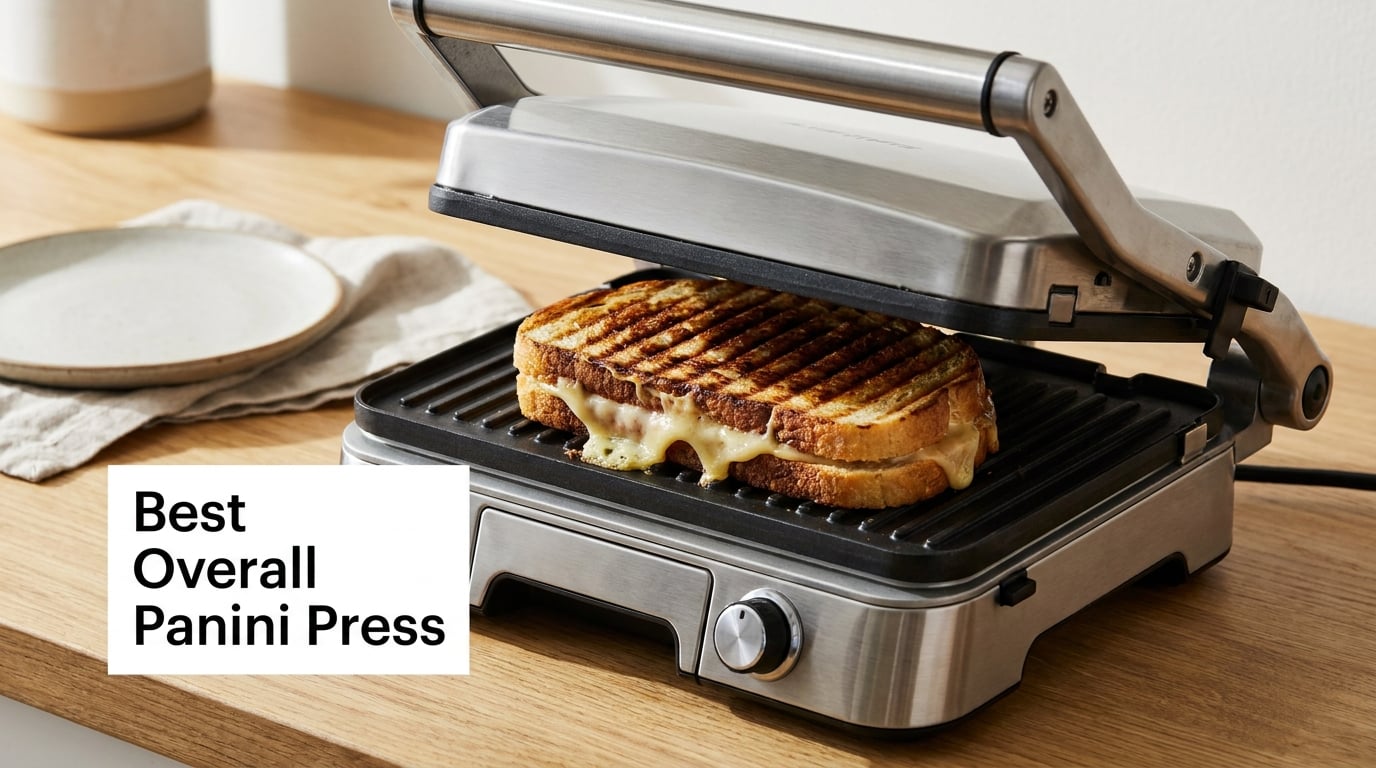
Look for a five-in-one contact grill with reversible, dishwasher-safe plates. The ribbed side gives you a proper panini with grill lines, and the flat side takes steaks, fish, eggs and pancakes without you owning a separate griddle. That two-plates-in-one design is the single reason this style wins the best overall slot in most kitchens, and it is the reason the reviews split: people expecting a dedicated sandwich slot rate it lower than people who use the grill plate three times a week.
Why the five-in-one design divides opinions
Contact grills are deeper and heavier than a slim sandwich press, so the sandwich sits in a well and the top plate may not press hard enough on a thick ciabatta to give you the dense, flattened result you would get in a restaurant. If you mostly press thin-to-medium sandwiches on soft bread, you will never notice. If ciabatta is your thing, buy a dedicated press with a stronger clamp instead.
Owners on r/Cooking describe this exact appliance as a near-daily driver for grilled cheese and quesadillas, and a Houzz owner reported the nonstick was still holding up a year in. That is the durability signal to look for: nothing exotic, just a coating that has not started flaking after a year of regular use.
What to check before you buy
Confirm the plates unclip and go in the dishwasher, that there is a drip channel or tray for grease, and that the hinge floats rather than sitting on a fixed stop. Those three details decide how the appliance feels after month six, not day one.
2. Best Panini Press for Small Kitchens
For a galley kitchen or a studio flat, a compact press that stores upright is the whole answer. Look for a narrow footprint, a lid latch that holds the appliance closed on its side, and enough plate area for two portions rather than a full party batch. A single or double portion machine heats faster, which matters when the kitchen is hot and you only want one sandwich.
The trade-off is capacity. A compact press will not handle a fat ciabatta, and the shallower top plate means less even browning on thick bread. Counter space is a real constraint in apartment kitchens, so measure the space you actually have before anything else, including the clearance needed to lift the lid.
Storage is where most people get this wrong. A press that cannot latch closed stands open on the counter collecting grease and dust, and it will be there six months later getting used twice a week instead of daily. Vertical storage only works if the unit has a real lock-down latch.
3. Best Budget Panini Press
The budget end of the market is simple toasters with two flat plates, a single on/off control and a light that tells you when it is hot. For grilled cheese and reheating a leftover panini, that is genuinely enough, and if you make one sandwich a week it is all you need.
Here is what you should expect to compromise on. A fixed hinge will squash a thick sandwich and squeeze the filling out the sides. The plates usually do not unclip, so you wipe them with a damp cloth while the unit is unplugged and cooled. And the lower wattage is the complaint that shows up most often in owner reviews: the plates warm up, but they do not get hot enough for a real sear on a thick loaf.
One owner on r/AskReddit put it plainly: they would not recommend a cheaper press to someone who does not own a pan, because it does not get hot enough to get a good sear. That is fair. Buy budget for grilled cheese, and set your expectations there.
4. Best Large Panini Press for Families
Households cooking for four to six want surface area, not more buttons. A wide cooking plate lets you press two large sandwiches and a quesadilla in the same cycle, which is the difference between one round of toasting and three. The wide format also handles thicker bread because the hinge has more room to travel before it bottoms out.
Check the distance between the plates at the hinge, not just the overall width. A press that measures well but has a shallow hinge will still flatten a stacked ham and cheese into a puddle of filling. Two widely spaced plates with a floating hinge handle volume far better than a large press with a short gap.
Grease is the other consideration at this size. A drip channel or removable tray keeps rendered fat from pooling under the plates, which is where the coating eventually gets attacked from underneath. Large surfaces also heat slightly more slowly, so budget a few extra minutes on the first press after preheating.
5. Best Panini Maker with Adjustable Heat
Adjustable heat matters more than most roundups admit. A single fixed setting is tuned for one bread, and it is wrong for everything else: too hot for a soft white roll with fresh mozzarella, too cool for a dense sourdough that needs time to brown all the way through. Graded settings let you match the browning to the filling instead of guessing.
Low settings suit delicate ingredients. Fresh mozzarella, provolone and soft cheeses melt happily at a gentle heat, and a thin bread such as a brioche bun will scorch before the cheese finishes. High settings suit sturdy bread and thin, dry cheese that needs the extra push to crisp.
Independent control on the two plates is the upgrade version of the same idea. It is the difference between toasting the top faster than the bottom and being able to leave the underside gentle while the cut face gets the heat. Check whether the settings are marked in actual degrees or just labelled low, medium and high, because the vague labels tell you very little about what happens to a ciabatta.
6. Best Easy-Clean Sandwich Maker
The cleanest design is the one with plates that unclip and go straight into the dishwasher. An owner on r/waterloo singled out that feature on a mini removable-plate grill as the reason it works for them, and it is the single most practical thing to filter on when you shop. Scrubbing a cooked-on cheese crust off a fixed plate takes far longer than it should, and the scrubbing is what wears the coating out early.
A drip tray is the second thing. Melted cheese and butter run downhill; a channel catches it before it reaches the heating element. Appliances with a tray are noticeably easier to keep tidy between uses, which is often the difference between a press on the counter and a press in a cupboard.
On cleaning method: let the plates cool, wipe with a damp cloth, and never put a coated plate in the dishwasher unless the manufacturer says so. Warm water and a drop of detergent are enough for most messes. A dishwasher-safe label on the plate is the one exception, and even there, rinsing off visible grease first keeps the coating in better shape over a year of regular use.
7. Best Panini Press for Versatile Cooking
A contact grill earns its counter space through everything that is not a sandwich. Burgers and steaks on the ribbed plate, a quesadilla or two, sliced vegetables with a little oil and salt, then flip to the flat griddle side for pancakes, bacon and fried eggs. Cooks who buy one of these usually stop using a separate griddle at all.
The ribbed plate gives you heat and smoke pockets, so the surface reads as grilled rather than merely browned. The flat griddle plate is the one for anything liquid or delicate, where the ridges would catch it and tear it apart. A flat griddle surface also makes it possible to cook a small pizza or a folded omelette in the same appliance.
Frozen food is a common use people discover by accident. Pressed frozen fries or a frozen vegetable blend come out crisp and evenly heated with no oil because the closed lid traps steam and the contact plate browns the outside. The trade-off of all this versatility is size and weight: multi-use contact grills are the bulkiest appliances in this category and need real counter space to sit open.
8. Best Portable Sandwich Maker
Portable means dorm room, home office, RV or a rental kitchen where an appliance has to come out of a cupboard. Look for a low weight, a narrow body and a handle or latch that lets it travel. Single-portion presses are the most useful for this, since two slices is one person’s lunch and heating a small plate is faster than heating a large one.
Fixed heat is normal at this size and perfectly acceptable. You are making one sandwich at a time, usually in a couple of minutes, and the difference between settings barely registers. What does matter is that the plate is nonstick, because a small press gets washed in a sink rather than a dishwasher.
One honest caution: an underpowered press in a cold room can be slow to reach temperature, and the first sandwich of the day may come out pale while the plates catch up. Give it a couple of minutes with the lid closed before the first sandwich goes in.
9. Best Multi-Sandwich Maker
Multi-sandwich makers are built for hosts, not for a weekday lunch. They cook several sandwiches or filled pocket breads in a single cycle, which is the difference between serving a party in one batch and standing at the counter pressing sandwiches one at a time while guests wait.
Capacity is the headline number, and it is worth reading carefully. Some count individual triangles, some count full pocket sandwiches, so a machine advertising eight pockets may hold far less bread than another. Look at the physical plate dimensions instead, and check that the pockets sit flat rather than riding up on a curve, since a curved pocket browns unevenly at the fold.
The trade-off is even browning across a large surface. Bigger plates heat more slowly and develop temperature variations, so the sandwiches nearest the hinge tend to toast before the ones at the front. Two shorter cycles at a lower setting beat one long cycle at full heat for most fillings, and it keeps the bread from going hard before the cheese melts.
10. Best Premium Panini Press
A premium press is a heavier appliance with thicker plates, more precise controls and better heat retention. That mass is the point: plates that hold temperature drop less when you put a cold sandwich on them, so the bread toasts evenly instead of starting pale and finishing dark. If you press sandwiches most days, that difference shows up every single time.
Wattage is the number to compare here. Higher-wattage presses preheat faster and recover temperature better between batches, which is exactly the sear complaint that shows up in owner reviews of cheaper models. On a standard 120-volt kitchen circuit, anything in the 1500-watt range handles most loads, and 1800 watts is at the upper end of what a normal outlet circuit is comfortable supplying. Very high draw matters if you plan to run the appliance alongside a kettle or toaster on the same outlet.
There is also the cast iron option, which no electric roundup really covers. Cast iron stovetop presses, sold under names like Lodge and Le Creuset, are a completely different approach: no electricity, no cord, and a preheat of roughly fifteen minutes that buys exceptional heat retention. The trade is storage and convenience. You have to be at the stove, they are heavy, and they do nothing for you between uses. If you already cook on a cast iron skillet most evenings, weigh that honestly before adding another heavy piece of iron to the cabinet.
How to get a good panini out of any press
Preheat fully before the first sandwich. The indicator light comes on long before the plates are at temperature, and pressing early gives you a pale sandwich with a cold middle.
Butter the outside of the bread, not the inside. That is what produces the golden, crisp surface and the lines from the ribbed plate. Keep the filling modest. Overstuffed sandwiches are the number one reason a fixed hinge sprays mozzarella across your counter, and no press fixes that except a floating hinge.
Press for three to five minutes on medium, then check. A cheese that has not melted needs more time, not more heat, and lifting the lid halfway to peek costs you more heat than waiting an extra minute. Let the sandwich rest on a rack for a minute so the cheese sets instead of sliding out.
Frequently Asked Questions
Can I use a panini press for regular grilled sandwiches?
Yes, and that is what most people use theirs for. A panini press is a contact grill, so it does everything a sandwich toaster does and adds even pressure and a heated top plate. The difference shows up on thicker bread and bread that needs to crisp rather than just warm. Thin sliced cheese and soft white bread do fine on either appliance.
What heat setting is best for a panini press?
Start at the middle or second-lowest setting for almost everything, and only go higher for dense bread such as sourdough or a thick ciabatta. Low heat suits soft, moist fillings like fresh mozzarella, which melts happily without the bread scorching. Press for three to five minutes, then lift the lid halfway to check rather than guessing from the outside.
How do I keep bread from sticking to a panini press?
Butter the cut face of the bread lightly, and always oil or butter the inside face of the bread that touches the plate. Filling a panini with a thin layer of oil or mayo on the inside face does more than anything else. If the coating is already worn, the plate needs cleaning rather than the sandwich needing a workaround.
Are panini presses dishwasher safe?
Usually the plates are and the appliance is not. Removable nonstick plates are commonly labelled dishwasher safe, and those are the part that benefits most from a cycle. The heating unit, the housing and any drip tray generally need a damp cloth instead. Check the manual, and never immerse the body of the press with the plates still fitted.
Should I press a panini twice for a crispier result?
Usually no. The first press toasts the bread and melts the cheese, and a second press mostly dries it out and makes the crust leathery. If you want more, press slightly longer on the first cycle, or leave the sandwich to rest on a rack for a minute so the cheese sets. Bread left on the hot plate to keep crisping is the usual cause of a soggy result.
How do I store panini made ahead of time?
Let the sandwich cool on a rack rather than on a plate, so steam escapes instead of soaking the bread. Loosely wrap it in foil or a paper bag and refrigerate for up to a day. Reheat in a dry pan or back in the press for a few minutes, never in a microwave, which reheats the cheese while leaving the bread soft.
Conclusion
Choose by the food, not the price. A five-in-one contact grill with reversible dishwasher-safe plates fits most kitchens. A compact latching press fits small ones. A wide plate with a roomy floating hinge feeds a family, and a multi-sandwich maker feeds a room. Before you commit, check three things: that the hinge floats enough for thick fillings, that the plates unclip and go in the dishwasher, and that the wattage is high enough to recover heat between sandwiches. If you already own a cast iron skillet and a griddle, the honest answer is to keep using those instead.