
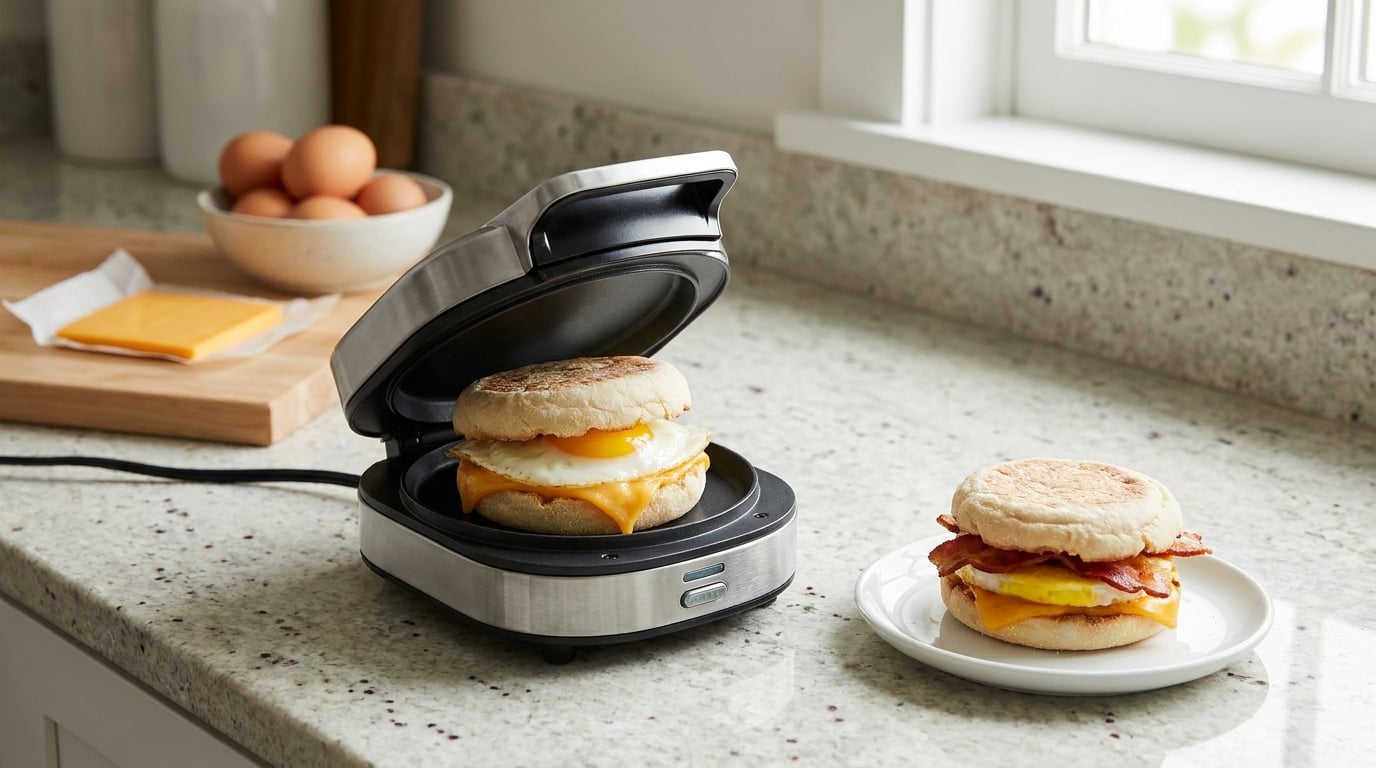
Short answer: yes, a breakfast sandwich maker is worth it if you eat a hot breakfast four or more mornings a week, buy English muffins or bagels regularly, and don’t already own a griddle or panini press. It isn’t worth it for batch cooks, one-person households, or anyone short on counter space.
That conditional answer matters, because the appliance is a small single-purpose machine that either earns its drawer every week or collects dust in it. Nothing sits in the middle.
The honest version of this guide comes from the people who own one. The top-ranking thread on r/Cooking is an owner with a year-plus of daily use, and their first line was that it “took a bit of time getting it right.” That’s the whole verdict in eight words: it works, but it has a learning curve nobody mentions in the product photos.
Table of Contents
- Is a Breakfast Sandwich Maker Worth It?
- How Does a Breakfast Sandwich Maker Work?
- Is a Breakfast Sandwich Maker Worth It for Convenience?
- What Can You Make in a Breakfast Sandwich Maker?
- How Much Does a Breakfast Sandwich Maker Cost?
- How Do You Clean and Maintain One?
- Who Should Buy a Breakfast Sandwich Maker?
- Breakfast Sandwich Maker vs. Stovetop or Oven
- How to Decide Before You Buy
- Frequently Asked Questions
- Are breakfast sandwich makers easy to clean?
- Can you cook bacon and eggs in a breakfast sandwich maker?
- How long does it take to make a breakfast sandwich?
- Are breakfast sandwich makers safe to leave plugged in?
- What size breakfast sandwich maker is best for one person?
- Do breakfast sandwich makers use a lot of electricity?
- Bottom Line: Test the Habit Before the Appliance
Is a Breakfast Sandwich Maker Worth It?
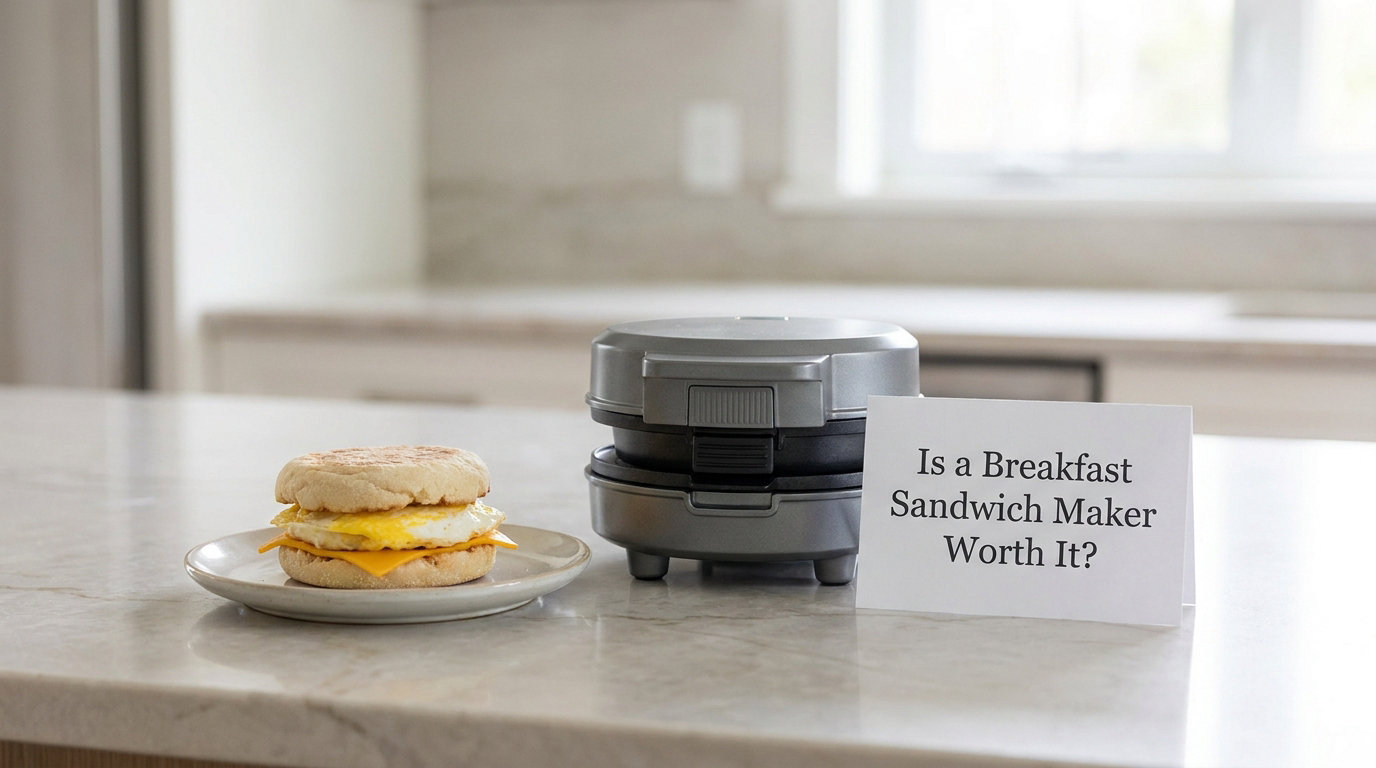
A breakfast sandwich maker is worth it when it’s a shortcut to a breakfast you’d otherwise buy, not when it’s a hobby. It presses an egg and a sandwich together in one closed cooking well, roughly the size of a thick stack of plates, and does it in about five minutes.
Owners on Reddit tend to divide into two camps, and the split is predictable. People who eat a sandwich-style breakfast most weekdays describe it as the best small appliance they own. People who bought it on a whim and then went back to a skillet describe it as one of those gadgets that lived in a drawer.
Worth it if:
- You eat a hot breakfast four or more mornings a week
- Your current routine is a drive-thru stop, a frozen sandwich, or skipping breakfast entirely
- You buy English muffins or bagels in bulk anyway
- You do not already own a griddle, skillet or panini press that does the same job
- You will actually pre-cook the bacon on a Sunday
Skip it if: you cook for one, you batch-cook on Sundays, you have about a foot of usable counter, or your breakfast is oatmeal, yogurt, or eggs any way you like them.
One Reddit commenter in a BuzzFeed roundup of worthwhile kitchen gear keeps hers out on the counter even in a tight kitchen, and the reason was blunt: it’s worth it. r/minimalism threads go the other way, treating it as a redundant single-purpose appliance that competes with a cast iron skillet and griddle for the same shelf. Both positions are honest. They describe different kitchens.
How Does a Breakfast Sandwich Maker Work?
The basic design hasn’t changed much in twenty years: two nonstick cooking wells, a ring-shaped barrier in the middle, a hinged or sliding lid, and an indicator light that tells you the plates are hot.
The sequence runs in a fixed order, and the order is the whole trick. Bottom bread goes into the well first, then cheese, then a crack of egg into the central ring, then your pre-cooked meat, then the top bread, then the lid. The egg cooks at the same time as the bread, in the same well, which is why these machines exist at all.
Cook time lands somewhere between three and six minutes depending on what you put in. The five-minute figure on most product pages is close enough for an egg and a slice of cheese, but a thick sausage patty or a double layer of cheese pushes it toward the six-minute end.
What the different designs actually change
Single-slot models cook one sandwich. They’re small enough to store upright in a cabinet and they’re the right choice for a one or two person household. Dual models cook two at once and take up noticeably more counter, but they turn a four-person Sunday breakfast into a single batch.
Multi-function stations swap the cooking plates for a griddle, a waffle plate, or a toasted-sandwich plate. They cost several times more and take up the footprint of a small suitcase, so they only make sense if you genuinely want a second appliance and have nowhere else to put it.
Flat-top designs, sometimes sold as mini griddles, skip the egg ring entirely. They’re the ones that handle bacon and pancakes, and they’re closer to a skillet in behaviour than to a sandwich press.
Is a Breakfast Sandwich Maker Worth It for Convenience?
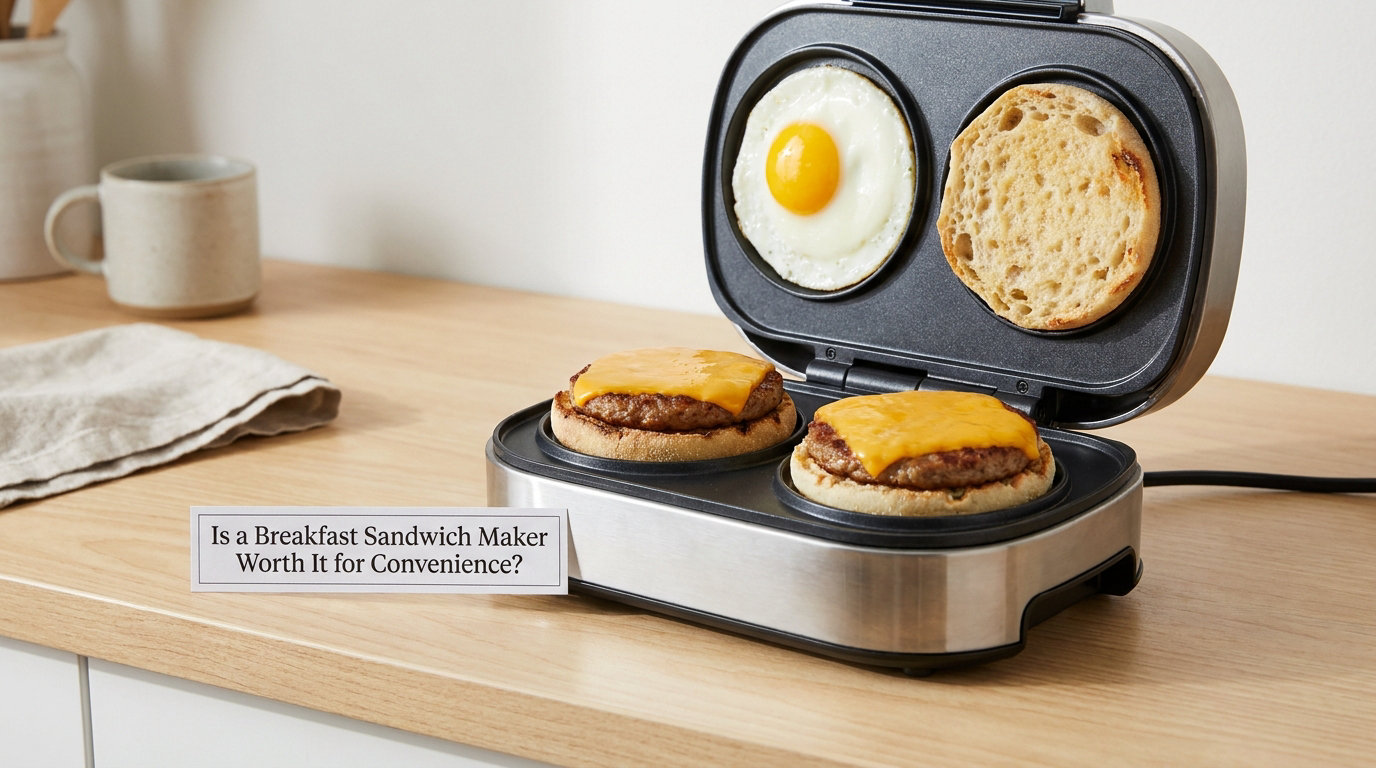
Here is the part most product pages skip: the appliance saves you waiting time, not attention time. You still stand at the counter, you still watch the plates, and on most models you still run a separate timer because the built-in indicator is a light, not a countdown.
CNET’s hands-on test made exactly this point years ago, and it’s still true of most models on the shelf. The reviewer reported having to stand and watch, with no reliable timer, and noted a cook range of three to six minutes. If your morning involves a shower and a school run happening simultaneously, that’s the detail that decides it.
The pre-cook requirement eats into the savings more than you’d expect. Raw bacon or sausage patties have to be cooked first on a sheet pan or in a skillet, which adds roughly fifteen minutes once a week if you batch it. Owners also report that pre-cooked bacon tastes less satisfying than bacon cooked that morning, which is the honest version of the trade.
Against a stovetop, the count of pans is where it wins clearly. A skillet version means a griddle or pan for the meat, a second pan or the same one rinsed for the egg, a butter knife for the toast, and a plate. The sandwich maker needs the appliance and a spatula.
Set against a toaster oven, it loses on flexibility and wins on speed. You cannot crisp leftover bacon, melt a tray of cheese, or reheat four breakfast sandwiches in a breakfast sandwich maker.
What Can You Make in a Breakfast Sandwich Maker?
The classic build is an English muffin, a slice of American cheese, an egg, and pre-cooked bacon or a sausage patty. That combination is what the wells are sized for, and it’s the one that works every time.
Bread choices that work
English muffins are the right answer because the wells are cut to their diameter. Bagels work if you cut them in half and trim the wide part. Standard sliced bread fits only on flat-top models, since a square slice corners overhang the round well. Splitting a slice of bread and pressing it in as two triangles is the workaround owners use, and it toasts unevenly at the corners.
Gluten-free bread works fine. Because gluten-free loaves tend to be drier, a light spread of butter or mayo on the cut side before it goes in makes a noticeable difference. Several gluten-free community regulars actually use a mini waffle maker for the same sandwich, which is worth knowing if you already own one.
Filling choices that work, and the ones that don’t
Cheese, pre-cooked bacon, pre-cooked sausage patties, ham, and shredded turkey all cook well. Sliced tomato and spinach are fine in small amounts. Thick raw patties, refrigerated sausage links, and anything that releases a lot of water are problems, because steam has nowhere to go in a closed well and the bread goes soggy underneath.
A runny yolk is the single most common complaint across every forum thread. Owners report raw egg escaping the wells and running across the counter, and CNET’s tester found that shutting the lid too firmly squeezes the egg out even faster. The workaround is a smaller splash of egg, or scrambling it first in a mug and dropping it in.
The appliance stretches further than the name suggests. Owners report pancakes, quesadillas, toasted sandwiches, reheated pizza slices, and using it for dinner grilled cheese. Those are bonus uses, not the reason to buy it, and none of them replace a panini press or a waffle maker if you want those on a regular basis.
How Much Does a Breakfast Sandwich Maker Cost?
Single-slot models cluster at the cheap end of the small-appliance shelf, dual models sit roughly in the middle, and the multi-function griddle stations reach several times higher. Prices move constantly, so treat these as tiers rather than figures.
| Tier | Capacity | Cook time | Plates | Best for |
|---|---|---|---|---|
| Entry single-slot | One sandwich | 4 to 6 minutes | Usually fixed, sometimes removable | One or two people, small kitchens, upright storage |
| Mid dual | Two sandwiches | 5 to 7 minutes | Removable, often dishwasher safe | Families of three or four, weekend batch breakfast |
| Multi-function station | Two to four items | 6 to 10 minutes per batch | Interchangeable griddle, waffle and sandwich plates | Cooks who want a griddle and a press in one box |
The features that push a model up a tier are predictable: nonstick or ceramic coating quality, whether the cooking plates lift out, a real timer rather than just a light, dishwasher-safe parts, cool-touch handles, and a warranty longer than a year. Interchangeable plates are the biggest jump in price and the least necessary for most people.
Now the math nobody does. A homemade sandwich costs roughly a muffin, a slice of cheese, one egg and a slice of bacon, which lands between one and one and a half dollars. A drive-thru breakfast sandwich is three to four times that, and a frozen grocery-store sandwich runs about half the homemade price with a worse texture. Against the drive-thru, the break-even point is the first sandwich you make. Against frozen sandwiches, the saving is thinner, and the real argument becomes taste and sodium rather than money.
On that basis, an entry model pays for itself within roughly twenty sandwiches if you were buying drive-thru breakfasts, and considerably more if you were cooking at home already. That’s the honest framing: this is a small money decision with a large habit attached to it.
How Do You Clean and Maintain One?
Cleanup is the easiest part, and it depends entirely on whether your plates lift out. Models with removable plates go in the dishwasher or the sink. Models with fixed plates get wiped down with a damp cloth while the unit is still slightly warm, which takes about a minute.
The routine is the same either way. Unplug it and let the plates cool to the touch. Wipe away grease with a paper towel, since letting it cool and harden is what turns a two-minute job into a soak. Wash the removable parts, dry them, and put the appliance away with the plates open so nothing traps steam.
A few cautions. Never put a fixed-plate unit in the dishwasher, and check the manual before assuming any part is safe, because designs differ. Don’t use metal utensils or a scraper on a nonstick coating; a soft spatula and a wooden spoon are enough. Don’t spray cooking oil directly onto the plates, and don’t use a very high heat setting to try to force a burn, because most plates have no temperature control at all.
For food safety, cook raw meat and raw egg to their safe minimum internal temperatures before they go in or, if you are cooking them in the well, check them with a thermometer. Ground meat reaches 160°F, poultry 165°F, and whole cuts and fish 145°F. Cook eggs until the whites and yolk are set if you’re serving someone in a higher-risk group, and refrigerate leftovers within two hours.
Who Should Buy a Breakfast Sandwich Maker?
The case for it is strongest for people with a repeated routine. If four mornings a week already look the same in your head, a sandwich press turns a multi-pan sequence into one appliance and one spatula.
- Busy individuals and couples who want a hot breakfast without starting a full stovetop sequence at 6am.
- Families with a fixed breakfast routine, who should look at a dual model so everyone eats at once rather than in shifts.
- Dorm and apartment cooks who want a hot breakfast from one appliance instead of a shared stove and a waiting line.
- People replacing a drive-thru habit, who will feel the savings and the sodium difference within a couple of weeks.
- Batchers who pre-cook on Sunday, since a weekend sheet pan of bacon is what makes the weekday version realistic.
- Anyone who wants a consistent single-serving format, which matters for protein-focused and portion-controlled routines.
Who should skip it
Cast iron and griddle owners already have the tool. A commenter in the r/Cooking thread suggested buying a thrift store skillet and griddle instead, on the grounds that the combo will do everything the sandwich press does and then some. If that’s your kitchen, the sandwich maker is a duplicate with a smaller footprint and a narrower job.
One-person households should skip it too. A single-slot model exists, but the multi-function stations that justify their price assume two or more eaters, and the single-slot versions are barely more capable than a toasted sandwich pressed under a heavy skillet.
Batch cooks get frustrated by the ceiling. These machines cook one or two sandwiches at a time by design, and nobody has built a version that feeds six. If your Sunday cooking produces ten portions, a griddle does the job in one pass.
Finally, skip it if you dislike cooking raw egg. The leak problem is real, it happens to most owners early on, and it is the number one reason people quietly abandon the appliance.
Breakfast Sandwich Maker vs. Stovetop or Oven
The stovetop wins on flexibility and serving size. The sandwich maker wins on hands-on effort, cleanup, and consistency. Most households end up using both, with the appliance for weekday mornings and the skillet for anything that isn’t a sandwich.
| Criterion | Breakfast sandwich maker | Stovetop skillet | Oven or toaster oven |
|---|---|---|---|
| Hands-on time | About 1 minute of assembly, plus pre-cooking meat | Active throughout, roughly 10 to 15 minutes | Mostly waiting, roughly 20 minutes |
| Total time | 4 to 6 minutes, with a pre-cook step first | 10 to 15 minutes | 20 minutes or more |
| Serving size | One or two sandwiches | Feeds two to four | Feeds four to six |
| Flexibility | Sandwich-shaped well only | Almost anything | Almost anything |
| Cleanup | Wipe, or wash removable plates | Pan, spatula, grease management | Rack and tray |
| Heat control | On, off, and sometimes a timer | Full burner control | Set temperature |
| Consistency | Very repeatable | Depends on your attention | Depends on the oven |
| Counter footprint | Small, often stores upright | None beyond a burner | Large if freestanding |
If a panini press is what you actually want, note that the two appliances overlap more than the names suggest. Pressing a sandwich for two to three minutes gets you a toasted sandwich; the egg ring is the only genuinely unique part. Owners on the Straight Dope board thread split on this, with some calling the press redundant and others reporting daily use for years.
How to Decide Before You Buy
Work through these in order, and the answer usually falls out before you reach the price question.
- Measure the counter first. Single-slot models are roughly the footprint of a thick hardcover book and usually store upright. Dual and multi-function units do not, and a unit you can’t leave out is a unit you won’t use.
- Check plate removability. Removable plates get washed. Fixed plates get wiped. That’s the single biggest predictor of whether you’ll still be using the thing in six months.
- Confirm the well size against your bread. Wells fit English muffins and bagel halves. If you plan to use square sliced bread, you want a flat-top griddle style instead.
- Look for a timer, not just an indicator light. The light tells you the plates are hot. A timer tells you the egg is set. Without the timer you are standing there watching.
- Note the wattage. Higher wattage preheats faster and recovers heat better when you add cold bread, which matters more in a dual model than a single one.
- Read the warranty length and the parts list. The cooking plates and any silicone barrier ring are the consumables. A two-year warranty with replaceable plates is worth more than a longer warranty on a sealed unit.
- Think about your meat supply. If you will not cook bacon and sausage in advance on a weekend, this appliance will not fit your week.
- Decide if you want the extras. Waffle plates and griddle attachments are only worth their cost if you genuinely lack another appliance for that job.
Frequently Asked Questions
Are breakfast sandwich makers easy to clean?
Usually yes, and the difference comes down to plate removability. Models with lift-out plates go in the dishwasher or a quick sink rinse. Fixed-plate models get wiped with a damp cloth while the unit is still warm. Unplug first, let the plates cool, and wipe grease off before it hardens. Avoid metal utensils and cooking spray on nonstick coatings, and never put a fixed-plate unit in the dishwasher unless the manual says to.
Can you cook bacon and eggs in a breakfast sandwich maker?
Yes, but the egg should go in the ring well and the bacon should be cooked first. Raw bacon needs around fifteen minutes on a sheet pan, which is why most owners batch it on a weekend. Trying to lay raw strips across a narrow egg well gives you uneven cooking and grease that runs down the plates. If you want a bacon-and-eggs plate rather than a sandwich, a flat-top griddle style model suits you better.
How long does it take to make a breakfast sandwich?
Plan on four to six minutes once the indicator light comes on, which matches the five-minute figure most product pages quote. Thicker cheese, a double sausage patty, or a cold plate pushes it toward six minutes. The preheat adds another minute or two on an entry model. And if the meat is raw, add fifteen minutes of advance cooking, or skip that by using pre-cooked bacon.
Are breakfast sandwich makers safe to leave plugged in?
Only in the sense that any countertop appliance with a heating element is. Nothing in the design changes the basics: cook on a stable surface with clearance around it, don’t leave it unattended while it’s heating, and unplug it when you are done rather than leaving it on all day. Because most models lack a shutoff timer, an unplugged habit is the safer default, especially in homes with kids or pets.
What size breakfast sandwich maker is best for one person?
A single-slot model, without hesitation. It cooks one sandwich at a time, measures roughly the footprint of a thick hardcover book, and stores upright in a cabinet so it costs you almost nothing when it is not in use. Dual models are built for feeding two to four people at once and eat real counter space for the privilege. Only consider a larger unit if you also want a griddle or waffle function.
Do breakfast sandwich makers use a lot of electricity?
Less than you would guess, because they are small and heat up fast. They draw roughly the same power as a hair dryer and typically run for five or six minutes per sandwich, so the actual energy cost per breakfast is negligible. The comparison people care about is a drive-thru trip, which involves far more energy and time than plugging in a small appliance. Leave it unplugged between uses and it makes no difference at all.
Bottom Line: Test the Habit Before the Appliance
Is a breakfast sandwich maker worth it? Yes, if your weekdays already run on egg-and-cheese sandwiches and you buy them or a drive-thru version most mornings. The saving is real money and less mess, not less time, and the learning curve is a weekend of practice.
Here’s what to do first: make the sandwich in a skillet on a panini press, or with two pans, three mornings in a row. If you find yourself reaching for it without thinking, the appliance will get used and it will be worth every counter inch. If you make it twice and go back to yogurt, skip the purchase and keep the space.