
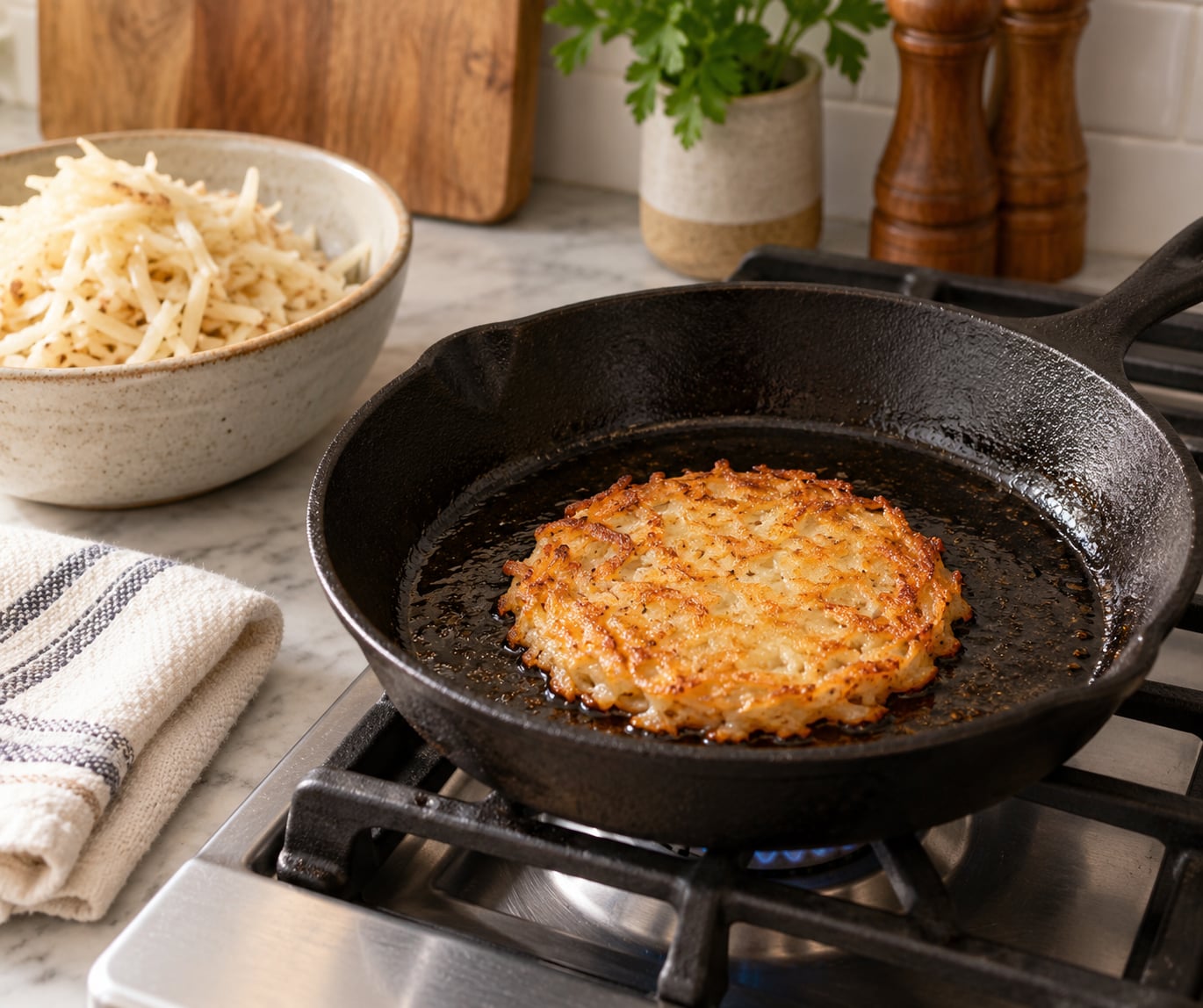
Knowing how to make crispy hash browns in a skillet comes down to one thing: squeeze every drop of water out of shredded russet potatoes, press them into a thin single layer, and fry undisturbed in a very hot, well-oiled pan until the underside is deeply golden. Do not stir them, do not crowd the pan, and flip exactly once. The whole thing takes about 25 minutes, and the towel-drying step is where it is won or lost.
Dry potatoes brown and crisp. Wet potatoes steam, and steaming is the whole reason most home hash browns come out pale and bendy. Everything else on this page, the pan, the fat, the heat, the timing, matters far less than getting that towel time right.
Table of Contents
- What You Need
- How to Make Crispy Hash Browns Step by Step
- Heat the Skillet and Oil
- Cook the First Side Until Golden
- Flip and Finish the Hash Browns
- Season and Serve Immediately
- Common Mistakes and Quick Tips
- Frequently Asked Questions
- Are frozen hash browns as good as fresh potatoes?
- Why are my hash browns sticking to the pan?
- Do I need to rinse shredded potatoes before making hash browns?
- What is the best potato for crispy skillet hash browns?
- How do I keep cooked hash browns from getting soggy?
- What should I serve with crispy hash browns?
- Conclusion
What You Need
This skillet method makes two to four servings depending on how hungry your table is. It needs about 10 minutes of prep and 12 to 15 minutes of cooking.
Ingredients
- 2 large russet potatoes, about 1 1/2 pounds, peeled
- 3 tablespoons neutral oil such as canola, avocado or grapeseed, divided
- 1 tablespoon unsalted butter or ghee, optional
- 1 teaspoon fine salt, divided
- 1/2 teaspoon black pepper
- 1/2 teaspoon onion powder
- 1 large egg and 2 tablespoons flour, optional, for hash brown patties that hold together
- 1 teaspoon cornstarch, optional, for a crunchier shell
The oil is not optional and neither is the salt. The egg, flour, cornstarch and butter are all optional, and I would skip all of them on your first attempt so you can learn what the potatoes do on their own.
Equipment
- A 10-inch cast iron skillet, heavy stainless steel or carbon steel. A good nonstick pan works too, though you will use a little less oil.
- A box grater with the large holes, or a food processor with a shredding disc.
- A clean kitchen towel or a piece of cheesecloth for squeezing.
- A colander or fine mesh strainer.
- A wide spatula, ideally a thin-edged fish spatula for flipping.
Russet potatoes are the right call because of their starch content, which is what gives you that craggy, brittle crust. Yukon Gold and red potatoes are waxy, hold their shape nicely and taste good, but they fry flatter and paler. If you hate wasting food, grate two or three extra potatoes and freeze them in a single layer on a sheet pan, then bag them once solid.
How to Make Crispy Hash Browns Step by Step
Prep time is about 10 minutes, cook time 12 to 15 minutes, total around 25. The method below is one I use in a 10-inch cast iron skillet, but any heavy pan works the same way.
Prepare and Dry the Potatoes
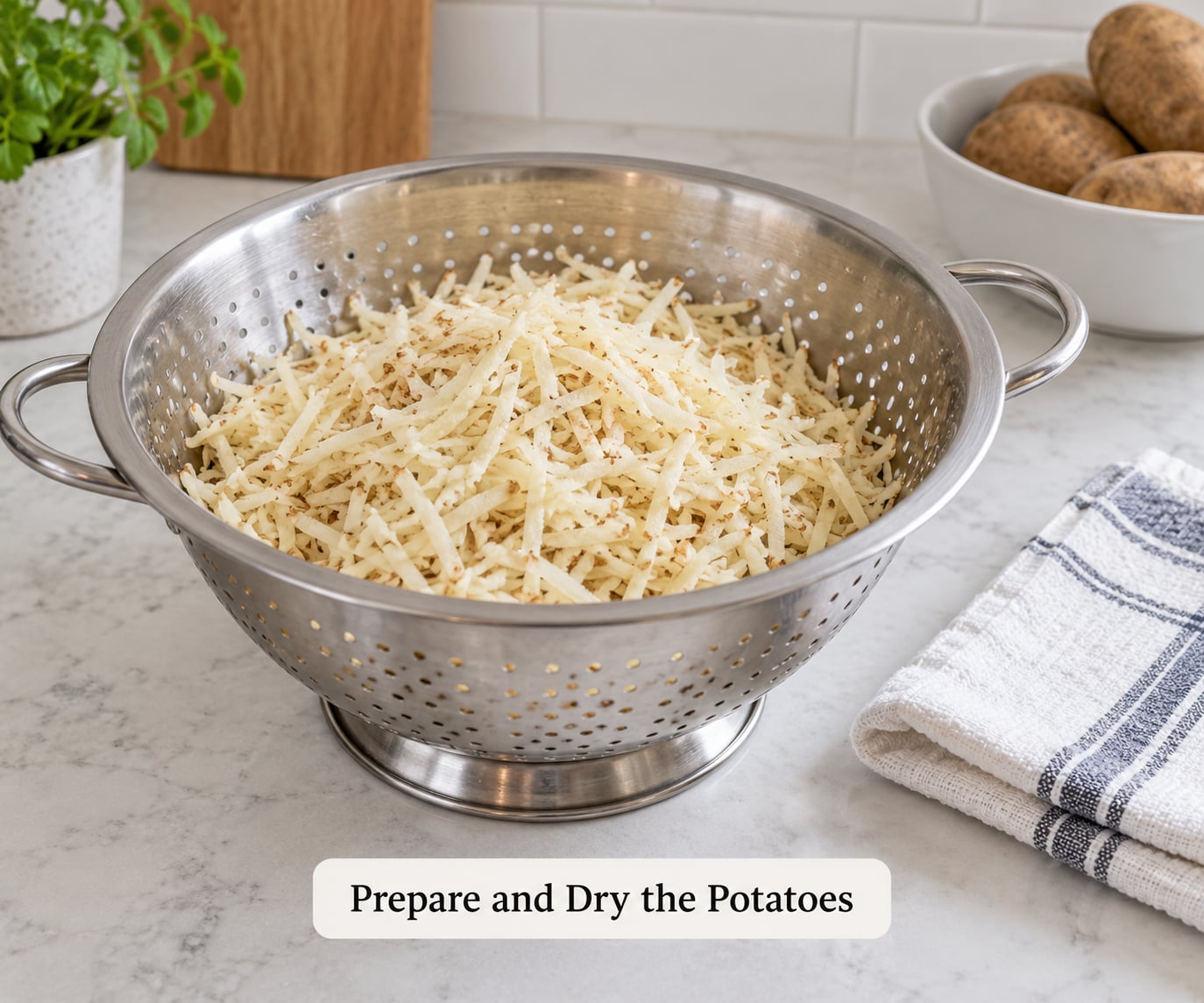
Grate the peeled potatoes on the large holes of a box grater. Longer strands from a food processor shredding disc are easier to flip without breaking, which is why a lot of cooks prefer them.
Rinse the shreds in cold water until the water runs cloudy, then swish them again in fresh water. That rinse pulls off the loose surface starch that would otherwise glue the strands together into a pale, gummy mat. It takes about 30 seconds and it is not skippable if soggy hash browns are your problem.
Drain in a colander, then pile the shreds into a dry towel and squeeze. Squeeze harder than you think you need to, twist the towel, and do it again. You are looking for shreds that feel cool and barely damp, not wet and heavy. Pick up a handful and squeeze it hard: if water is running between your fingers, keep going.
Season now with about three quarters of the salt, the pepper and the onion powder, then toss with your fingers so the seasoning spreads through the shreds. Do not salt earlier than this, because salt pulls water out of the potato and you have just worked very hard to get the water out.
If you want hash brown patties that hold together, mix in one beaten egg and two tablespoons of flour now. If you want the loudest possible crunch, toss in a teaspoon of cornstarch. Skip both and the patty will hold together fine as long as you press it firmly into the pan.
Heat the Skillet and Oil
Put a 10-inch cast iron skillet over medium-high heat and let it heat empty for three to four minutes. Cast iron cooks like this because the metal stores heat and keeps handing it to the potatoes after the burner is turned down, which is exactly what you want.
Add about two tablespoons of oil and swirl it to coat the whole base and ride up the sides. Wait until the oil shimmers and flows easily when you tilt the pan, usually another minute. If it smokes, turn the heat down one notch and let it settle.
A properly heated pan is the difference between searing and soaking. Potatoes that hit a hot pan brown within seconds and the oil stays on the surface. Potatoes that hit a lukewarm pan sit there sweating, and the oil soaks in instead of cooking, which is where greasy hash browns come from.
If you are using cast iron and you tend to get sticking, heat the empty pan first, turn the burner down to medium, then add the oil and the potatoes. Plenty of cast iron cooks use that lower-heat-then-fat order and report almost no sticking.
Cook the First Side Until Golden
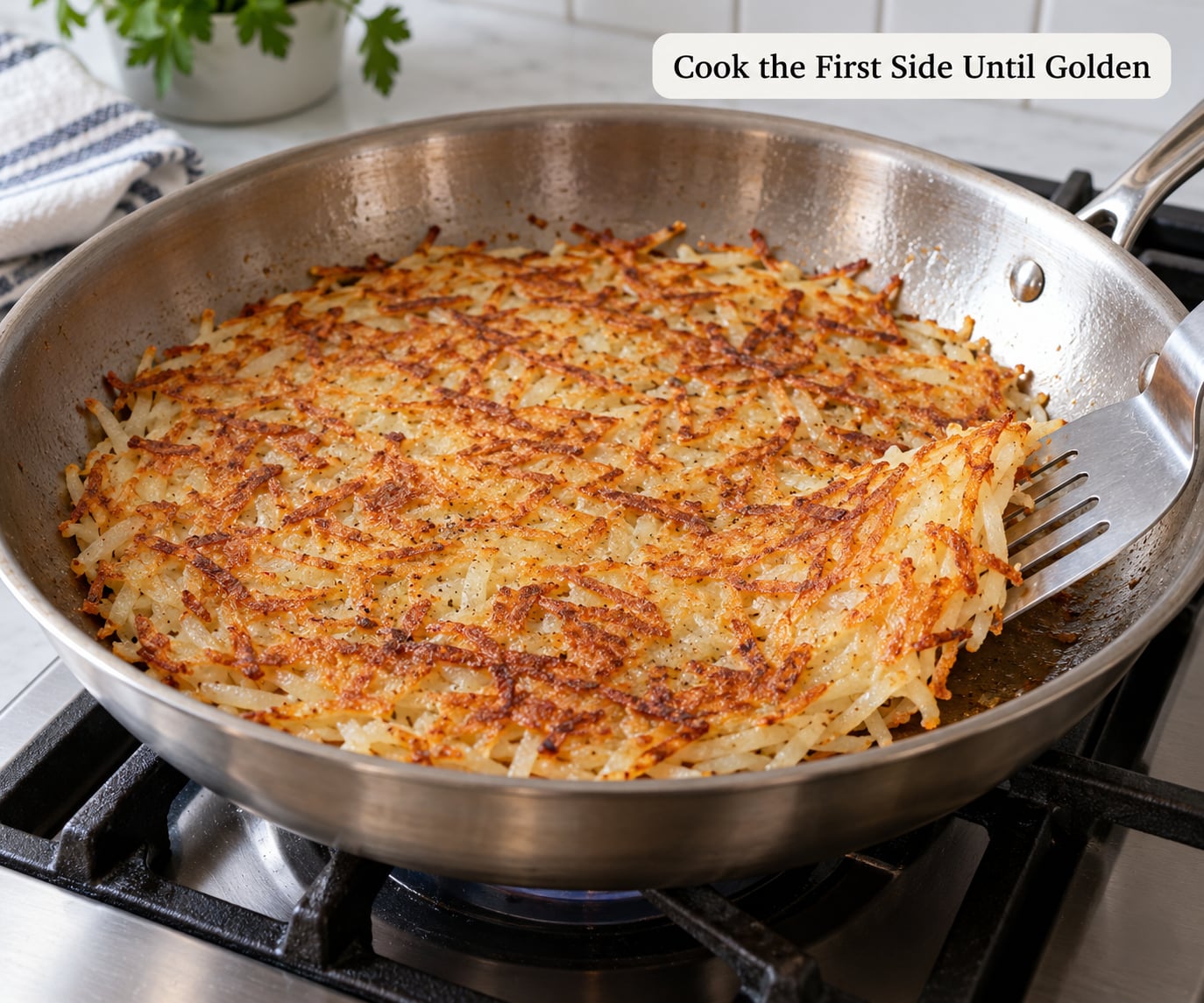
Add all the potatoes at once and spread them with the spatula into one flat, even layer about a third of an inch thick. Press down firmly with the back of the spatula so it makes full contact with the pan. A thick layer steams in the middle and only the bottom browns.
Add a pinch of salt now, which is the second seasoning point most recipes skip. Then leave it alone. Do not stir, press, or nudge for five to seven minutes.
You will know the first side is done when the underside is deep golden brown, the edges look set and slightly darker, and the layer has started to pull away from the edge of the pan on its own. That pulling away is the single most reliable doneness cue there is, much better than any clock. Slide the spatula under the edge and if it slides with no resistance at all, you are there.
Flip and Finish the Hash Browns
Get a thin-edged fish spatula under as much of the patty as you can, from the far edge toward you. Do not scoop from underneath and do not try to hold it in midair. Slide it forward, let the middle fold over onto the spatula, then lower it back into the pan in one piece. If the patty breaks into two pieces, push the pieces together and press them back into a flat layer.
Drizzle the remaining tablespoon of oil around the edges of the pan and add the butter or ghee if you are using it. It melts against the hot metal and bastes the second side as it cooks.
Season the second side with the last of the salt and cook another four to six minutes without moving it, until that side is golden as well. The center should give slightly when you press the top with your finger. Fully cooked hash browns will feel soft in the middle and firm at the edges, and that is exactly right.
One thing confuses people: hash browns can look a little soft the moment they leave the pan and crisp up within a minute or two as the interior steam escapes. Do not shove them back in the pan to compensate. They finish themselves.
Season and Serve Immediately
Slide them onto a warm plate, not a stack, and eat them fast. Crispness fades quickly in a pile because the steam from the top layer softens the bottom one.
Good finishing options: more black pepper and flaky salt, a spoonful of sour cream, ketchup, hot sauce, or a soft scramble on top. If you are cooking for a crowd, batch it, because the second batch can wait on a sheet pan in a single layer in a 425 F oven for up to 20 minutes without losing much of its crunch.
I keep a batch going alongside [crispy bacon for BLTs](https://www.hillcrestsandwich.com/how-to-make-crispy-bacon-for-blts-in-bulk/), which is the same pan-temperature logic with a different shape. If you want to turn the whole thing into a meal you can reheat later, stack them into [breakfast sandwiches you make ahead and freeze](https://www.hillcrestsandwich.com/best-breakfast-sandwiches-to-make-ahead-and-freeze/).
Common Mistakes and Quick Tips
Almost every bad batch traces back to water, heat or a pan that is too full. Here is the fix for each one.
- Pale, soggy potatoes. Water was left in the shreds, so they steamed instead of browning. Squeeze in a towel until the shreds feel cool and barely damp.
- Sticking to the pan. The pan was not hot enough, there was too little fat, or you moved the potatoes too soon. Preheat empty, add oil, wait for a shimmer, then leave the layer untouched for five minutes.
- Breaking apart when flipped. The layer was too thick, or you flipped it while it was still pale and fragile. Keep it one third of an inch thick, wait for the edges to release, and slide rather than scoop.
- Greasy or oil-soaked. The pan was too cool, so the potatoes drank in the fat. Use medium-high heat, enough oil to coat the pan, and no more.
- Dark edges, grey center. A crowded pan and a layer thicker than one third of an inch. Cook in batches of four in a single layer only.
- Soft after reheating. Microwave reheating steams the crust. Spread them on a sheet in a 400 F oven for eight to ten minutes, or reheat in a dry skillet.
Quick tips that move the needle
- Par-bake for extra crispness. Bake the squeezed shreds on a lined sheet at 400 F for 15 to 20 minutes until dry to the touch, then fry them in the skillet. The cooking is mostly done, so all you have to do is crisp them, and it is the single most effective trick in this whole method.
- Rinse more than once. Cloudy water means starch is still coming out. A second rinse in fresh cold water costs nothing.
- Press hard. A firmly pressed layer has more contact with the pan, and contact is what browns.
- Do not overcrowd. Two pans of half a batch beat one pan of a whole batch every time.
- Hold finished batches warm in a single layer on a sheet pan in a 425 F oven, never stacked in a covered dish.
- Use bacon grease instead of oil if you want the flavor, since it has a high smoke point and costs you nothing extra. Save butter for the second side, where its flavor does the work and its burning point never gets tested.
Frequently Asked Questions
Are frozen hash browns as good as fresh potatoes?
Fresh potatoes give you more control and usually a better result, but frozen shredded hash browns can be excellent. Cook them straight from the freezer, never thawed, in a single layer with no crowding, and shake the basket or flip the layer halfway through. Thawing first is the single mistake that turns frozen hash browns limp and soggy in the skillet. Buy ones with nothing but potatoes on the label, and let them sit out five minutes so they are not rock solid when they hit the oil.
Why are my hash browns sticking to the pan?
Three things cause sticking: the pan was not hot enough, there was not enough oil, or you moved the potatoes before a crust formed. Preheat the empty skillet for three to four minutes, add oil until it shimmers, and let the layer cook undisturbed for at least five minutes before touching it. If you use cast iron and keep catching yourself pulling up bare metal, heat the empty pan first, turn the burner down to medium, then add the oil and potatoes.
Do I need to rinse shredded potatoes before making hash browns?
Yes, and this is the step most home cooks skip. Rinsing shredded potatoes in cold water until the water runs cloudy, then again in fresh water, removes the loose surface starch that otherwise binds the strands into a gummy, pale mat. Rinsing is not the same as soaking. Thirty seconds is enough, and there is no reason to leave potatoes sitting in water, which would undo the drying work.
What is the best potato for crispy skillet hash browns?
Russet potatoes. Their high starch content is what produces the craggy, brittle crust when fried, and their dryness after squeezing works in your favor. Yukon Gold and red potatoes are waxy, so they hold their shape but fry flatter and paler, though they taste sweeter and are more forgiving about timing. Yukon Golds are a good choice if you are cooking for someone who prefers a softer potato, or if you want the color of a diner patty without the fuss.
How do I keep cooked hash browns from getting soggy?
Spread them in a single layer on a sheet pan and put that pan in a 400 F oven for eight to ten minutes, or put them back in a dry skillet over medium heat for a few minutes. Do not cover them and do not use the microwave, which heats the water inside the potato and steams the crust. Stacking hot hash browns traps steam between the layers, so if you must hold them for more than a few minutes, spread them out rather than piling them in a bowl.
What should I serve with crispy hash browns?
Anything with protein and acid works. Scrambled or fried eggs are the obvious pairing, followed by crisp bacon, sausage links or a thick slice of tomato with butter. For the acidic side, ketchup, hot sauce, sour cream, salsa verde or a spoonful of pickled onions all cut through the fat. A short stack of [breakfast sandwiches you make ahead and freeze](https://www.hillcrestsandwich.com/best-breakfast-sandwiches-to-make-ahead-and-freeze/) turns the whole plate into something you can eat on the go.
Conclusion
Start with the potatoes, because that is the part that decides everything else. Squeeze the shreds until they are cool and barely damp, heat a heavy skillet until the oil shimmers, press the layer about a third of an inch thick, and then leave it completely alone until the underside is deep golden and the edges release on their own.
Flip once, season again, and eat them off a warm plate right away. Once you have one batch where the outside shatters and the middle is still soft, you will know exactly what the difference is, and you will never go back to soggy hash browns. If you are plating for more than a few people, the same seasoning and temperature logic applies to [a deli platter at home that looks catered](https://www.hillcrestsandwich.com/how-to-make-a-deli-platter-at-home-that-looks-catered/), just at a larger scale.