
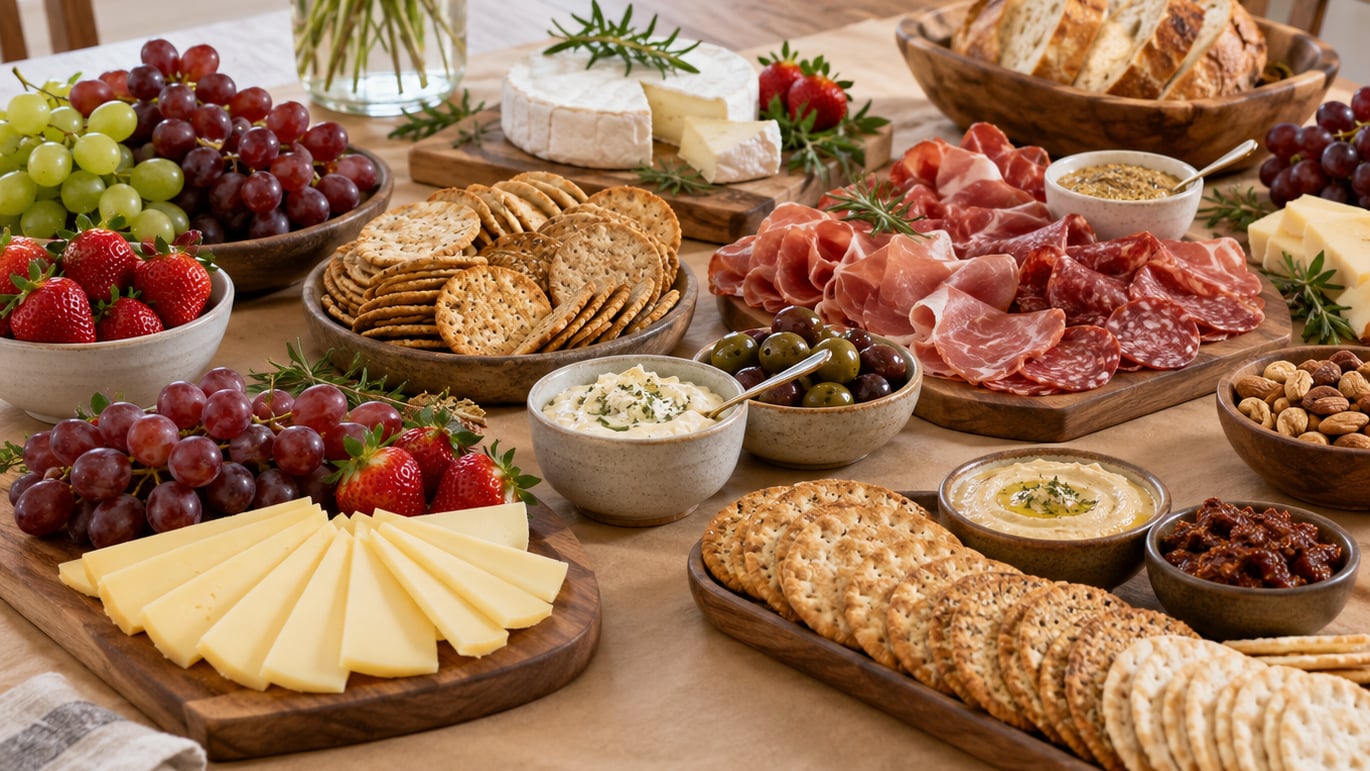
A grazing table is a large shared surface covered with a sheet of paper or a few boards and layered with cheeses, cured meats, crackers, fruit, dips and sweets, so guests serve themselves small portions, stand and talk, and come back as often as they like. Building one takes about an hour of arranging and almost no cooking, and a single table can feed anywhere from 10 to 100-plus people without anyone carrying a plate.
The whole thing comes down to three decisions: how much food per guest, which surface you are using, and what you lay down first. Get those right and the rest is placement. I put these tables together for birthday brunches, holiday open houses and once a 50-person shower, and the same routine works every time.
Table of Contents
What You Need
You need very little equipment. Most of the work is choosing serveware in at least three different heights, because a table where everything sits flat on one level looks empty in the middle and crowded at the edges.
Reusable essentials:
- A table, counter run, or two tables pushed together
- Food-grade parchment paper or plain kraft butcher paper, cut about 12 inches longer than the surface on each side
- A mix of serving pieces in three heights: flat platters and boards, small raised stands or cake stands, and short risers made from inverted bowls or clean boxes
- Small bowls or ramekins for dips, olives and spreads
- Tongs or serving spoons for every communal dish, plus a separate pair for each dip
- Small plates, napkins and a marker for labels
- A cooler or ice trays for keeping perishable items cold
Optional presentation pieces: slate or marble boards, wooden paddles, glass cloches, small risers, and a few sprigs of rosemary or thyme. These matter less than people expect. Mixing heights and colors does most of the visual work.
Food, with quantities:
- Cheese: about 2 ounces per person, which is roughly a quarter-pound
- Cured meat: about 1.5 ounces per person
- Crackers, bread or pretzels: about 8 pieces per person, roughly 2 ounces
- Fruit and vegetables: about 1 cup per person
- Dips and spreads: 2 tablespoons per person per dip, with two or three dips total
- Something sweet: 2 small pieces per person
Those numbers add up to roughly 6 to 8 ounces of food per person when the table is the main event. If you are also serving a meal, cut every number roughly in half. As a rule of thumb, plan 10 to 12 bite-sized items per person, and see how to make a deli platter at home that looks catered for turning a supermarket tray into a centerpiece.
Step-by-Step: How to Make a Grazing Table
Work in this order: measure, cover, add height, place anchors, fill gaps, then label and finish. Skip ahead and build from the outside inward, which is the mistake that turns a full table into a hollow one.
1. Estimate Quantities and Choose a Style
Guest count, length of the event, food type and dietary needs all change the numbers. Two to three hours of grazing with no other meal means 6 to 8 ounces per person; a two-hour drinks party with dinner afterward means 3 to 4 ounces. People eat more cured meat and cheese than they do fruit, and much less of both than you will buy.
Pick a style before you shop. Casual calls for chunky bread, salami, cheddar and pickles on wooden boards. Elegant wants thin prosciutto, several cheeses, blistered grapes, crackers and small ramekins on risers. Brunch leans toward lox, cream cheese, bagel chips, berries and yogurt dips. Holiday adds dried figs, spiced nuts and sliced pears, while a dietary-focused table builds around hummus, olives, crudites, fruit, seed crackers and clearly labelled nut-free items in their own bowls.
You know it worked when your shopping list totals roughly the per-person numbers above and nothing is doubled for safekeeping. Most hosts overbuy by a third.
2. How to Make a Grazing Table Layout Without Clutter
Measure your surface first. A long table needs roughly 24 to 30 inches of usable width per guest on a self-serve grazing table, so 10 guests want about 20 feet of run or a table with solid access on all four sides. Push two tables together if you have to; the seam disappears under the paper.
Divide the surface into zones before placing food, roughly one zone per category. Alternate colors and textures as you go: a dark cured meat, then pale cheese, then something bright red or green. Leave an open lane along each edge so people can reach the middle without reaching across someone else, and never stack food only where one side can get to it.
It worked when you can walk the perimeter and see distinct groupings rather than one continuous smear. A simple formula: total surface area times 70 percent equals your usable food area. Cover more than that and you have a pile, cover less and you have gaps.
3. Prepare and Portion the Foods
Wash produce and cut cheese, cured meat and fruit into single-bite pieces a few hours before guests arrive. Two small bites beat one big wedge that goes stale before anyone eats it.
To stop bleeding and browning, cut apples, pears and stone fruit shortly before serving and toss them with a little lemon juice. Keep melon, tomato and other watery produce in bowls rather than straight on the paper. Put crackers, bread and pretzels in their own dishes so they never sit under a wet food, and portion dips into shallow ramekins so a spoon does not drag half the dip across the platter.
Wash berries the day of the party, not the night before. They go soft and shiny overnight and lose the shape that makes a table look good.
You know it worked when every piece can be eaten in one or two bites with no knife on the table, and nothing is leaking. If you like a diy deli-style shredded lettuce and sub salad alongside, cut it two hours before so it holds its crunch.
4. Build Balanced Food Zones
Group related foods instead of scattering them. Keep savory together, sweets together, and dips near the crackers they go with. Within each group, odd numbers of items look better than even ones, so three cheeses read as intentional where two read as an accident.
Vary heights: a wheel of cheese or a stack of crackers on a stand, cheese at table level, small ramekins tucked underneath. Fill every visible gap with something small, since gaps are what make a table look sparse in the middle.
Balance matters more than volume. Two to three cheeses, one or two meats, crackers or bread, two fruits, two vegetables, two or three dips and one sweet covers the bases. If you want to add a sandwich-style layered bite that holds together, cut it small and spear it with a pick.
5. Add Labels and Finishing Touches
Write a small card or stick-on label for anything a guest might hesitate over: nut-containing mixes, soft cheeses, smoked salmon, anything with dairy or gluten in it. A marker on a small folded card works fine. Keep nut-heavy items in their own bowl and, if a guest has a serious allergy, use separate serving utensils so nobody crosses dips.
Place a utensil with each dish rather than a single cluster of tongs, and set napkins and small plates at both ends and, for a crowded table, in the middle too.
Keep decor restrained: a few herb sprigs, some clusters of odd-numbered items, and not much else. The food is the centerpiece, not the flowers. Tell guests to put food on a plate first rather than eating straight from the communal platters.
6. Keep the Food Safe While Serving
Cold perishable foods such as cheese, cured meat, dips, cut fruit and anything with mayonnaise should stay at or below 40°F or sitting on ice, following USDA guidance. Nestle serving bowls into trays of ice or set platters over chilled serving dishes, and put out small batches at a time instead of everything at once.
USDA guidance is to discard perishable food that has been at room temperature for more than two hours, or one hour when the outdoor temperature is above 90°F. That two-hour clock starts the moment the first platter hits the table, so if you are building outdoors in July, expect the meat and cheese to leave early.
Common Mistakes
- Building from the outside in. This is the most common failure. Place your largest items first in the middle and the empty gaps, then fill outward. Fix: anchors first, always.
- Buying too much food. A full table needs placement, not volume. Fix: work the 6 to 8 ounces per person number and stop.
- Crowding the center. If people reach over each other, the spread collapses within an hour. Fix: keep an open lane at each edge and split a long table into two runs.
- Everything the same color and texture. Six pale crackers and three beige cheeses read as one beige mass. Fix: alternate light and dark, soft and crisp, at least every other platter.
- All the utensils in one basket. Fix: one utensil per dish, sitting with that dish.
- Forgetting dietary labels. Fix: label nuts, dairy, gluten and seafood before guests arrive, not during the party.
- Leaving perishable food out too long. Fix: set out cold items in two rounds, and keep them on ice.
- Wet foods directly on the paper. Melon, tomato and marinated vegetables will soak through. Fix: put them in bowls.
- Piled, hard-to-reach stacks. Fix: one layer deep where possible, and use risers for height instead of stacking.
- Washing fruit too early. Berries go soft overnight. Fix: wash the day of, dry thoroughly, and skip pre-washing entirely for delicate fruit.
Two hosting habits make the biggest difference. Set the table up two hours before guests arrive so you are not arranging food while answering the door, and refill in small amounts rather than replacing whole platters, which keeps everything cold and looks fuller longer.
Frequently Asked Questions
How many hours should a grazing table last?
Plan for two to three hours of active grazing. Beyond four hours, most guests have eaten what they want and the food sits out getting warm and picked over. If you expect a longer event, bring out fresh platters in smaller rounds every 90 minutes rather than setting out everything at once, and keep the cold dishes on ice between rounds.
How much food do I need per person for a grazing table?
When the table is the main food, plan 6 to 8 ounces per person, which works out to about 10 to 12 bite-sized items. Break that down as roughly 2 ounces of cheese, 1.5 ounces of cured meat, 2 ounces of crackers or bread, 1 cup of fruit and vegetables, and 2 tablespoons of each dip you offer. If a meal is also being served, cut every number in half.
What foods should I put on a grazing table?
Cover seven categories: two or three cheeses, one or two cured meats, crackers or bread, two fruits, two vegetables or pickled items, two or three dips, and one sweet. Variety in color and texture matters more than any single item. Skip watery produce directly on the paper, and keep nuts in their own bowl so guests with allergies are not guessing.
How do I keep food from getting messy on a grazing table?
Use shallow dishes instead of deep bowls, keep wet foods such as melon, tomato and marinated vegetables in separate bowls, and put crackers and bread on their own platters so nothing sits on top of them. Put meat and cheese on slate, wood or marble rather than paper, and tell guests to plate their food first. Wiping boards down every twenty minutes does more than any amount of planning.
How long can perishable food sit on a grazing table?
USDA guidance is to keep cold perishable food at or below 40°F or on ice, and to discard it after more than two hours at room temperature. Above an outdoor temperature of 90°F, that window shrinks to one hour. Count from the moment the first platter goes out, bring cold dishes out in rounds, and skip the cheese and meat entirely if the table is outdoors on a hot afternoon.
Conclusion
A grazing table works because it removes service, not because it removes effort from the setup. Estimate 6 to 8 ounces per person, choose your surface, then build from the middle outward: anchors first, fillers second, garnish and labels last. Keep the cold food cold, label the allergens, and resist buying the extra third of everything.
Start tonight with the three numbers. Multiply your guest count by 2 ounces of cheese, 1.5 ounces of meat and 8 crackers, write it down, and shop to that list. Everything after that is placement, and placement you can fix in an hour.