

Short answer: tip 15 to 20 percent of the food and beverage total for full-service catering, 10 to 15 percent for drop-off or pickup orders, or a flat $20 to $50 per server. The one thing to do before you calculate anything is read your catering contract, because a large share of contracts already include a service charge of 18 to 22 percent that changes the whole answer.
I say this as someone who has planned enough office lunches and family gatherings to have handed over a tip envelope more times than I care to count. The percentage rule is genuinely simple. Almost every awkward moment around catering tips comes from hosts who never checked the contract, then felt strange about tipping twice or not tipping at all.
Below are typical US ranges with real dollar math attached, updated for October 2026. Amounts vary by region and change over time, so treat every number here as a planning figure rather than a quote.
Table of Contents
How Much to Tip a Caterer: Typical Ranges
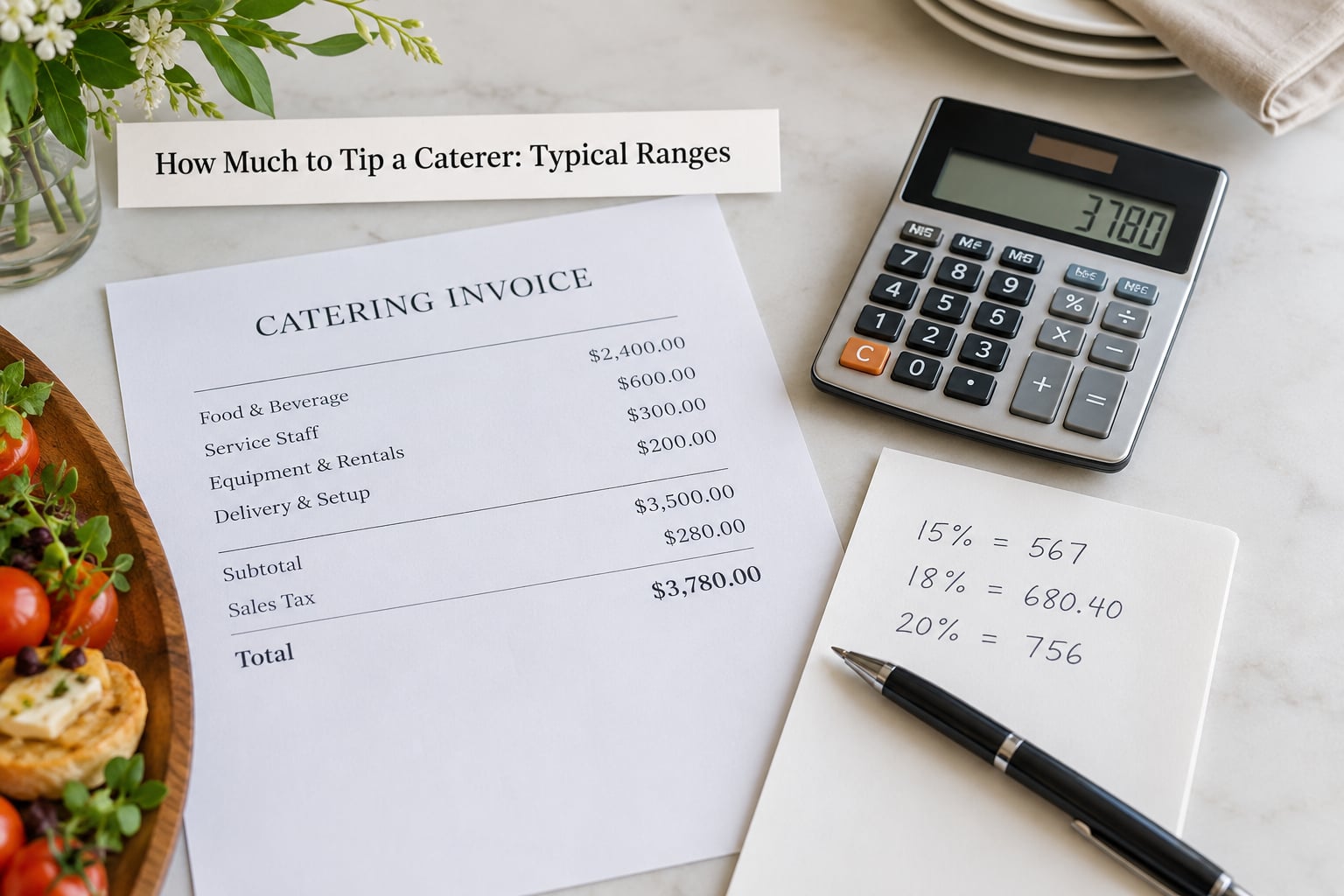
The typical range is 15 to 20 percent of the food and beverage subtotal for full-service catering, and 10 to 15 percent for drop-off, pickup, or delivery-only orders. Where staff are present and working, most hosts round toward the top of the range when service is good.
| Service type | Typical tip | Tip base | Per guest at a $150 plate |
|---|---|---|---|
| Drop-off or pickup | 10 to 15 percent | Food subtotal | $15 to $23 |
| Corporate or office lunch | 10 to 15 percent | Food subtotal | $15 to $23 |
| Buffet reception | 15 to 18 percent | Food and beverage total | $22 to $27 |
| Plated dinner | 18 to 20 percent | Food and beverage total | $27 to $30 |
| Full-service wedding or gala | 18 to 20 percent | Food and beverage total | $27 to $30 |
| Cocktail party, hors d’oeuvres only | 15 to 18 percent | Food subtotal | $22 to $27 |
If you would rather tip by role than by percentage, the usual alternative is $20 to $50 per server, $75 to $100 for the banquet captain or head server, and $50 to $100 for the executive chef. Bartenders are commonly tipped on the bar bill rather than the food total, and a delivery or setup crew that loads and unloads gets 10 to 15 percent or a flat $20 to $30.
How to Calculate the Right Tip
Calculate the tip on the food and beverage subtotal, not on the final invoice. Taxes, delivery fees, rental charges, and staffing surcharges are not part of the tip base, and including them inflates the number by hundreds on a large order.
Work through a mid-size order like this. A catering invoice shows $4,000 of food and beverage, then adds $320 of sales tax, $250 for delivery, $180 for rentals, and a 22 percent service charge of $880. The tip base is the $4,000 food and beverage line, and 18 percent of that is $720. Tipping the $5,630 invoice total at 18 percent would come to $1,013, and the servers would never see the difference.
Worked example on a $400 order: the subtotal is $400, so 15 percent is $60 and 20 percent is $80. Most hosts land at $60 to $80, and a caterer who delivered and set up the whole spread is happy with the higher end.
Worked example on a $2,000 order: 15 percent is $300, 18 percent is $360, and 20 percent is $400. On 50 guests that is roughly $6 to $8 per guest, which lines up with what caterers usually suggest for a wedding or gala.
Worked example on a 50-guest event: at a $150 per-guest food and beverage rate, the total is $7,500. Fifteen percent is $1,125, and twenty percent is $1,500, which spreads across servers, captain, chef, and bar staff as somewhere between $25 and $50 per server depending on headcount.
What Affects the Price
What decides the final number is service level, event complexity, staffing, and anything the contract already includes. Understanding which factors move the total the most helps you decide whether to bump or trim the tip.
Service level. Drop-off catering involves one person with a van for an hour. Full-service catering means a captain, servers, a chef, sometimes a bar team, and hours of setup before your guests arrive and breakdown after they leave. The percentage difference exists because the labor is real, not because hosts are expected to tip based on menu choices.
Event complexity. A plated dinner with three courses, dietary accommodations, and a timed seating plan takes far more coordination than a buffet line. Chefs working a wedding week usually have staff working directly for them rather than for the caterer, which is one reason a separate tip for the chef is customary even when a service charge is already included.
Staffing ratios. Servers handle a limited number of guests each, so a 150-person event might run eight servers and a captain while a 20-person party needs one person. Percentage tips fall below the per-server method when the headcount is small, and rise above it when a large event needs a big team.
Existing charges. This is where most confusion lives, so it deserves its own explanation before you go further.
A gratuity is money handed directly to service staff outside the contracted price. A service charge is a mandatory line item on the invoice that goes to the catering company and may never reach the servers who carried your trays. An admin fee is overhead the company adds to cover office costs, and it is not a tip under any reading.
Hosts who tip on top of an 18 to 22 percent service charge usually assume they are tipping twice. Sometimes they are not. Some companies pool the service charge and distribute it to staff at the end of a shift, and some keep it entirely. The way to find out is one direct question to the caterer before the event: does the service charge reach your on-site staff, or should I be adding a gratuity on top?
Delivery, setup and rentals. A crew that carries, sets, heats and clears is doing more than a courier. Tipping them on the food subtotal, or handing them a flat amount, is customary and often overlooked.
Venue catering versus an independent caterer. When the venue handles its own food, the service fee is often corporate revenue and no tip may reach the kitchen at all. Tipping the banquet staff directly is the clearer gesture, unless the venue has a strict no-tipping policy you have to follow.
Owner-operated businesses. If the person who cooked your food is also the owner and is working the event personally, a percentage of the bill can feel enormous for one person. A flat amount in the $100 to $200 range is common and appreciated.
Hourly rates already being paid. Some catering companies pay servers $20 an hour or more, which is well above minimum wage. One former server on a wedding forum argued that when the company already pays properly, a smaller tip is defensible. That view is contested, and most servers would still take the gratuity.
Service quality. If service was poor, a reduced tip is normal and not automatically an insult. Talk to the caterer the next day rather than withholding it silently, because your server likely had no control over the problem.
Ways to Save
The most effective way to control the catering budget is to settle the gratuity question before you sign anything, not after the invoice arrives. These steps keep the total predictable and remove the awkward math later.
Ask about the charge in writing. Put the question in the email thread before the contract is signed. Requesting a written breakdown of food, beverage, service charge, admin fee, delivery, rentals, tax, and staffing is normal and every caterer expects it.
Agree on gratuity in the contract. If your company has a fixed policy, write the amount or percentage into the contract as a line item. A fixed gratuity is usually taxed differently and needs no rounding decisions on the night.
Bundle the services you actually need. Full bar staffing, a plated dinner, and same-day rentals add up faster than most hosts realize. Deciding which of those the event genuinely needs is the cleanest saving available, and it changes your tip base too, so recalculate after cutting.
Choose drop-off for casual gatherings. For a family birthday or a small office get-together, drop-off or pickup is frequently the right call. You pay less and you tip less, and nobody is standing around waiting.
Cap the per-guest cost. Setting a per-guest ceiling before you shop keeps service charges and rental line items in check. If a quote runs over it, ask what you can remove rather than accepting it silently.
Use the right amount of staff. Overstaffing is easy when a venue offers packages. A package priced for a larger guest list than you have still charges for the larger team, so adjust the staffing count on the contract.
For the food side of planning, our how much food to order for an office lunch by headcount guide covers the quantities, and how much deli meat to buy for a family of four works through a week of sandwiches. Both keep the per-guest number in check, which is the same number your tip is calculated from.
Frequently Asked Questions
How much should I tip a caterer?
For full-service catering, most hosts tip 15 to 20 percent of the food and beverage subtotal. Drop-off, pickup, and delivery-only orders usually get 10 to 15 percent. If staff worked the event, another approach is twenty to fifty dollars per server, plus seventy-five to a hundred for the banquet captain. Calculate on the food and beverage line only, never on the final invoice.
Should I tip a caterer if there is already a service charge?
Ask first. A service charge of 18 to 22 percent goes to the catering company and may never be passed to the servers carrying your trays, so tipping on top can be fair even when it feels like paying twice. Some companies pool and distribute it to staff. One question to the caterer before the event settles this completely.
Do I tip the caterer separately from the delivery driver?
Usually yes, and they are rarely the same person. A delivery driver drops the order and runs, while a setup crew stays to heat, plate, arrange and clear. Tip the crew at 10 to 15 percent of the food subtotal or a flat twenty to thirty dollars, and give the driver a separate flat amount for the run. Ask the caterer who is doing which job.
How much do I tip a caterer for bartending service?
Bartenders are commonly tipped on the bar bill rather than the food total. Ten to fifteen percent of bar revenue works out to roughly fifty to a hundred dollars per bartender on a typical event. If the bar is consumption-based, keep track of what was poured, because the drink count is the honest tip base. Give it to the bartender or the captain at the end of the night.
Should I tip a caterer for a pickup order?
Tipping a pickup order is optional, but it costs you almost nothing and the person is often the chef or owner. Ten percent of the order, or ten to twenty dollars, is a reasonable gesture. It matters most when you order often from the same small business, since repeat customers are where an extra few dollars actually gets noticed.
When should I discuss the caterer’s gratuity?
Before the event, in writing. Email the caterer and ask whether a service charge or admin fee is included, whether it reaches on-site staff, and what their tipping custom is locally. Hosts who ask in advance report that caterers are glad to answer, and companies frequently suggest a per-person figure. Waiting until the end of the night makes it awkward for everyone.
Conclusion
Read your contract first. If it already carries an 18 to 22 percent service charge, find out whether that money reaches the servers before adding anything on top. If it does not, tip 15 to 20 percent of the food and beverage subtotal for full-service catering and 10 to 15 percent for drop-off or pickup work.
Then adjust for the effort. Long service, a hard guest list, an owner cooking your event personally, or staff who went well past their shift all justify moving up the range. A written thank-you note, a review, and a referral to the next host also land well, and for a small catering company they matter more than the cash.
Last updated: October 2026.