
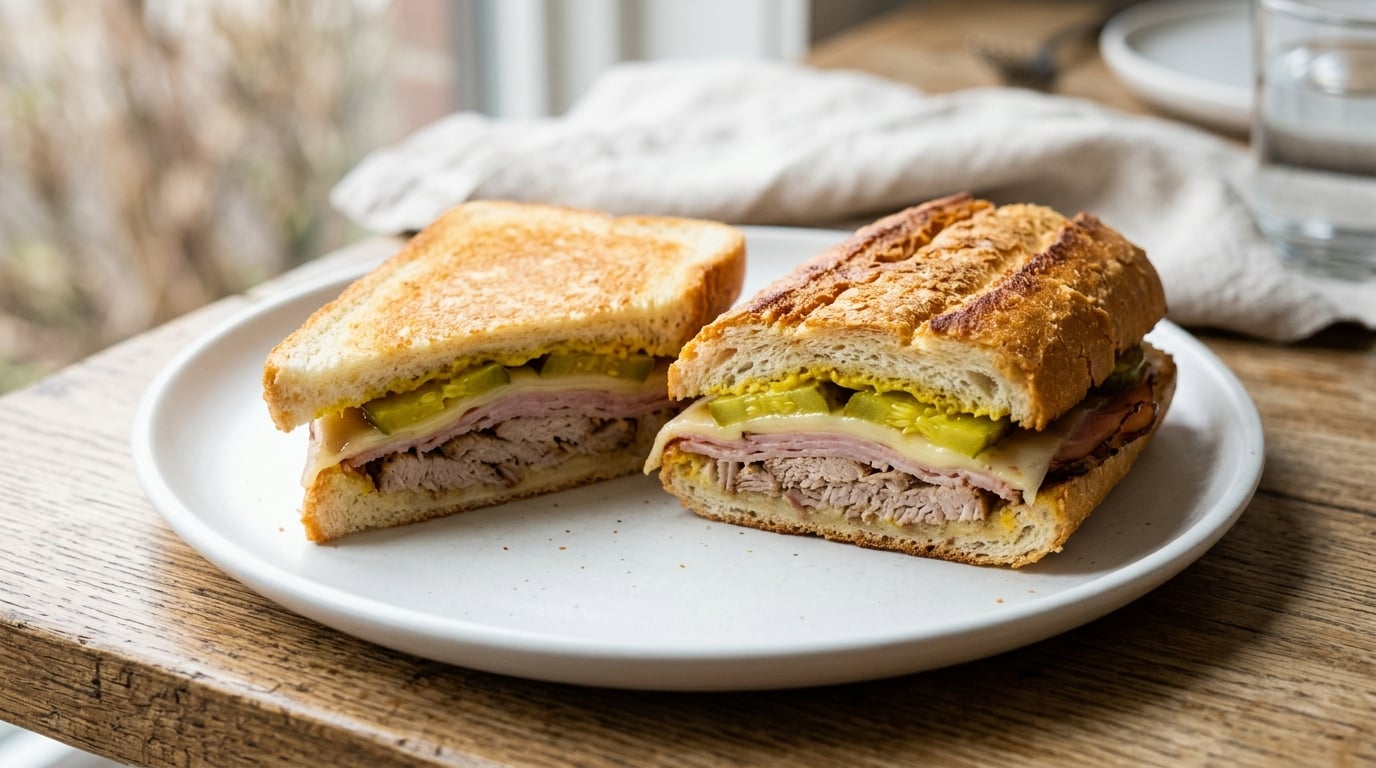
If you only remember one thing about the Cuban sandwich Miami vs. Tampa style fight, make it this: Tampa’s version layers in Genoa salami, and Miami’s does not. Everything else that people argue about, the bread shape, the pickle count, how hard you press it, is a consequence of that one addition. Both sandwiches are good. They are also genuinely different sandwiches, not one regional variation of the other.
I’ve made both in a home kitchen with a panini press and a skillet, and I’ve eaten enough of them to know the shortcuts that ruin each one. What follows is the ingredient-by-ingredient difference, then two complete methods with quantities, times and layer order so you can make either version without a recipe card in front of you.
Table of Contents
- Cuban Sandwich: Miami vs. Tampa Style at a Glance
- What Is the Difference Between Miami and Tampa Cuban Sandwiches?
- Bread
- Meat
- Cheese
- Pickles, Butter, and Other Toppings
- Flavor and Texture
- How to Make a Cuban Sandwich: Miami vs. Tampa Style
- How to Choose the Right Style
- Storage, Leftovers, and Food Safety
- Frequently Asked Questions
- Which Cuban sandwich is better, Miami or Tampa style?
- Are Cuban sandwiches supposed to be grilled?
- What is the difference between Cuban bread and a Miami Cuban sandwich bread?
- Can I make a Cuban sandwich with roast pork instead of ham?
- What cheese goes on a Cuban sandwich?
- How do I keep a Cuban sandwich from getting soggy?
Cuban Sandwich: Miami vs. Tampa Style at a Glance
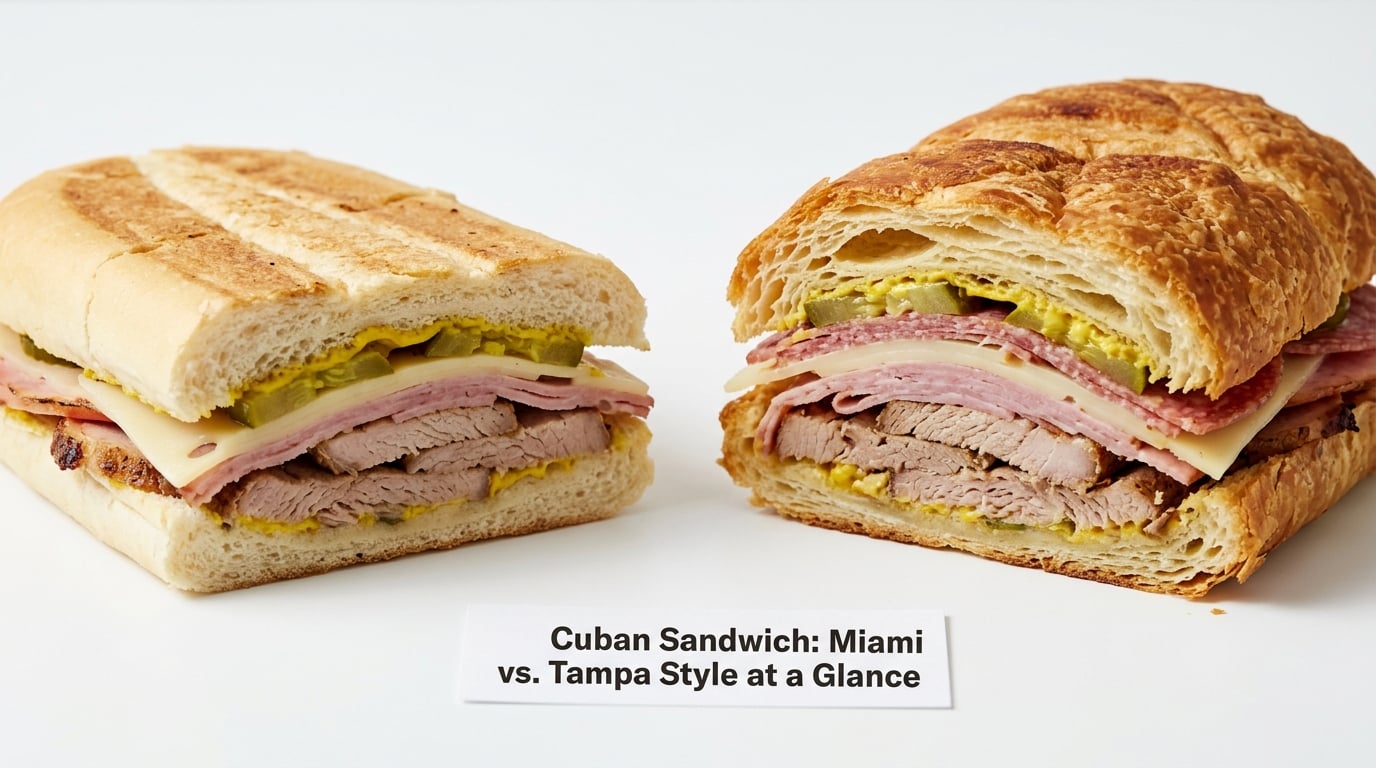
Here is the short version, row by row. Read the salami line and you have already guessed most of the rest.
| Criterion | Miami style | Tampa style |
|---|---|---|
| Bread | Soft enriched white sandwich bread, egg-dipped or brushed, cut smaller | Longer, larger, chewy and flaky Cuban bread with a crisp crust |
| Ham | Thinly sliced sweet or roasted ham | Thick-cut sweet-glazed or roasted ham |
| Pork | Roast pork, often shredded, sometimes omitted at counters | Mojo-marinated roast pork, generously shredded |
| Signature meat | None beyond ham and pork | Genoa salami, a thin layer |
| Cheese | Swiss, often omitted or swapped | Swiss, layered more generously |
| Pickles | A generous pickle layer, often spears or chips | Exactly three dill pickle slices, by local rule |
| Condiments | Butter outside, mustard and pickles inside, little else | Butter outside, mustard, plus more optional toppings |
| Layer order | Bread, ham, pork, cheese, pickles, mustard, bread | Bread, ham, pork, salami, Swiss, three pickles, mustard, bread |
| Press style | Pressed thin, hard and fast, crisp edges | Pressed longer and heavier, chewy crust, melted cheese |
| Texture | Compact, tidy, crisp-edged, easy to eat in one hand | Larger, meat-heavy, chewy, structurally tall |
| Classic pairing | Cafecito and a cortadito in Little Havana | Cafecito in Ybor City, often with a croqueta on the side |
One caveat before going further: individual restaurants and family kitchens do not follow these rules to the letter. A Little Havana counter that leaves out the pork is not doing anything wrong. Use the table as the clearest version of each style, not as a checklist a chef has to pass.
What Is the Difference Between Miami and Tampa Cuban Sandwiches?
The difference comes down to geography and immigration history. Tampa’s sandwich grew up in Ybor City, where cigar workers came from Cuba, Italy and Spain at the same time, and the Italian palermo salami they already ate at home ended up in the sandwich. Miami’s version reflects a later Cuban community that arrived after 1959, brought its own preferences, and never picked up the salami habit.
In practical terms, a Miami-style Cuban sandwich is a smaller sandwich on soft bread, pressed thin and crisp, built on ham and roast pork with pickles and mustard. A Tampa-style Cuban sandwich is a bigger, heavier one on chewy Cuban bread, built on ham, mojo pork and a thin layer of Genoa salami, pressed until the Swiss melts and the crust crackles.
The honest framing matters more than picking a winner. Reddit’s r/Miami threads split cleanly, with plenty of Miami residents openly saying they have never tried the Tampa version. A Florida forum poster put the meat question plainly: the salami layer is the deciding flavor factor for them. Both cities are right about their own sandwich, and the disagreement is a sign of two real traditions rather than one being a mistake.
Bread
Miami-style Cuban sandwiches are built on soft, enriched white sandwich bread, the kind you buy at any grocery store. It soaks up egg wash or melted butter without falling apart, and it toasts into something close, crisp and thin. The slices are cut down so the finished sandwich fits in a hand and can be eaten on a walk.
Tampa-style sandwiches use Cuban bread, a longer loaf with a crusty, slightly flaky exterior and a dense, chewy crumb that resists compression. That structure is the whole point. It takes the weight of three meats and a press without collapsing, and it gives you a chew that survives the long toast.
Bread size also decides how you assemble. A small slice has room for a thin, tidy stack, so a Miami sandwich ends up compact. A long roll gives a Tampa cook space for the layered salami-and-pork-plus-Swiss construction. If you cannot find Cuban bread outside South Florida, a sub roll or a sturdy French loaf is the workable substitute, and Italian bread works too, just a little softer than what Ybor City would recognize.
Meat
Tampa is the meat-heavy style. Its defining layer is Genoa salami, sliced thin and laid directly on the ham, and no argument about authenticity moves that layer. The roast pork is typically marinated in mojo, a garlic, cilantro, cumin and citrus mixture, then roasted and shredded. The ham is thick-cut and often sweet-glazed.
Miami’s version runs leaner and simpler. Ham and roast pork are the center, and what you are tasting is the bread and the pickles as much as the meat. Many Miami sandwiches use only ham, or a modest amount of pork, because the sandwich is meant to be eaten quickly with a cafecito rather than sat on a table.
Both styles reward good meat handling more than any exotic ingredient. Sweet, glazed ham plus salty, fatty salami plus acidic pickles is the flavor engine of a Tampa Cuban. A Miami sandwich is cleaner and more balanced, and it lets the bread and mustard do more of the work. That is a preference, not a defect.
Cheese
Swiss is the conventional cheese on both styles, usually Emmental or a similar mild, holey variety that melts without fighting the pork. It is the piece most likely to be dropped, and the recipe below still works without it, just with a drier, less rich filling.
In Tampa, the cheese is a structural layer, added between the meat and the pickles so it melts into a thin sheet across the sandwich. Miami sandwiches are looser about it. Plenty of Little Havana counters skip cheese entirely, arguing that the pickles and mustard already provide enough contrast, and some use a different mild cheese when that’s what is on hand.
Whatever you choose, thin slices melt better than thick ones under a press. Too thick and the cheese stays rubbery in the center while the outside overcooks.
Pickles, Butter, and Other Toppings
Miami’s presentation is restrained. The traditional set is butter on the outside, yellow mustard on the inside, and pickles. Dill pickle chips or spears both show up. Salt on the pickles is not unusual, since the ham is already salty and the sandwich still needs that acid hit.
Tampa keeps the same base and then gets more elaborate. The famous local rule is exactly three dill pickle slices, no more, and plenty of home cooks who break that rule get gently roasted by their coworkers. Beyond that, Tampa sandwiches are open to toppings that a classic Miami order would not expect: lettuce, tomato, onion, mayonnaise, olive oil, a hot pepper, or a swipe of spicy mustard.
Know which kind of sandwich you are making before you start, because the topping logic is different. Tampa rewards a few assertive additions, and Miami rewards restraint. Adding a full salad pile to a Miami-style sandwich turns it into something else entirely.
Flavor and Texture
Put the two side by side and the profiles are easy to separate. The Tampa sandwich is fattier, saltier and more aromatic, with cured salami and mustard doing most of the talking, and the chewy bread keeps changing as you chew. The Miami sandwich is milder and slightly sweet from the ham, sharper from the pickles, and crisper, with a toasted shell that cracks.
Portability is the practical difference. A pressed Miami sandwich holds together through a lunchbox or a long afternoon. A Tampa sandwich is taller and heavier, and it wants a plate, a napkin and a few minutes. If you are building a platter for a party, the Tampa version photographs better and cuts into thicker, more impressive halves.
How to Make a Cuban Sandwich: Miami vs. Tampa Style
Both recipes below make 4 to 6 sandwiches. Allow about 45 minutes of hands-on time for the Miami version, mostly unattended pressing and resting. The Tampa version takes closer to 2 hours because the pork needs roasting, though you can cook it ahead. Both are beginner-friendly; the only real skill is not overstuffing the bread.
How to Make the Miami-Style Cuban Sandwich
Ingredients: 8 slices soft white sandwich bread, 8 thin slices sweet or roasted ham, 4 to 6 slices Swiss cheese, 1 cup dill pickle chips or spears, yellow mustard, 2 tablespoons melted butter, 1 egg beaten with 2 tablespoons of milk for the bread, salt and pepper.
Step 1, 20 minutes of prep. Lay out 8 slices of bread. Butter the outside faces lightly with the melted butter, leaving the inner faces bare. Beat the egg with the milk in a shallow dish.
Step 2, dip the bread. For the traditional soft-crumb version, dip each slice in the egg mixture for about 5 seconds, letting excess drip off. For a simpler, slightly crisper result, brush the inner faces with egg instead. Both work, and the dip is the version most closely tied to Little Havana counters.
Step 3, build the stack. On each slice of bread, layer mustard, then ham, then 1 slice of Swiss, then a scattering of pickle chips. A light sprinkle of black pepper on the ham is traditional in many kitchens. Keep the mound roughly 2 cm high. Anything taller and the sandwich will slide apart on the press.
Step 4, close and weigh. Top each stack with a second slice, dip side inward. For a Miami-style press, set a heavy skillet or a plate on top of each sandwich to imitate the weight of a counter press.
Step 5, cook, 3 to 4 minutes per side. Preheat a skillet or panini press to medium. Cook 3 to 4 minutes per side until the bread is golden and crisp at the edges and the cheese has melted. Let the weight sit on the sandwich for the last minute of each side, which is what gives the Miami version its flat, compact profile.
Step 6, rest, then cut. Rest 2 minutes off the heat, then cut on the diagonal with a sharp serrated knife. Serve immediately, ideally with a cafecito.
How to Make the Tampa-Style Cuban Sandwich
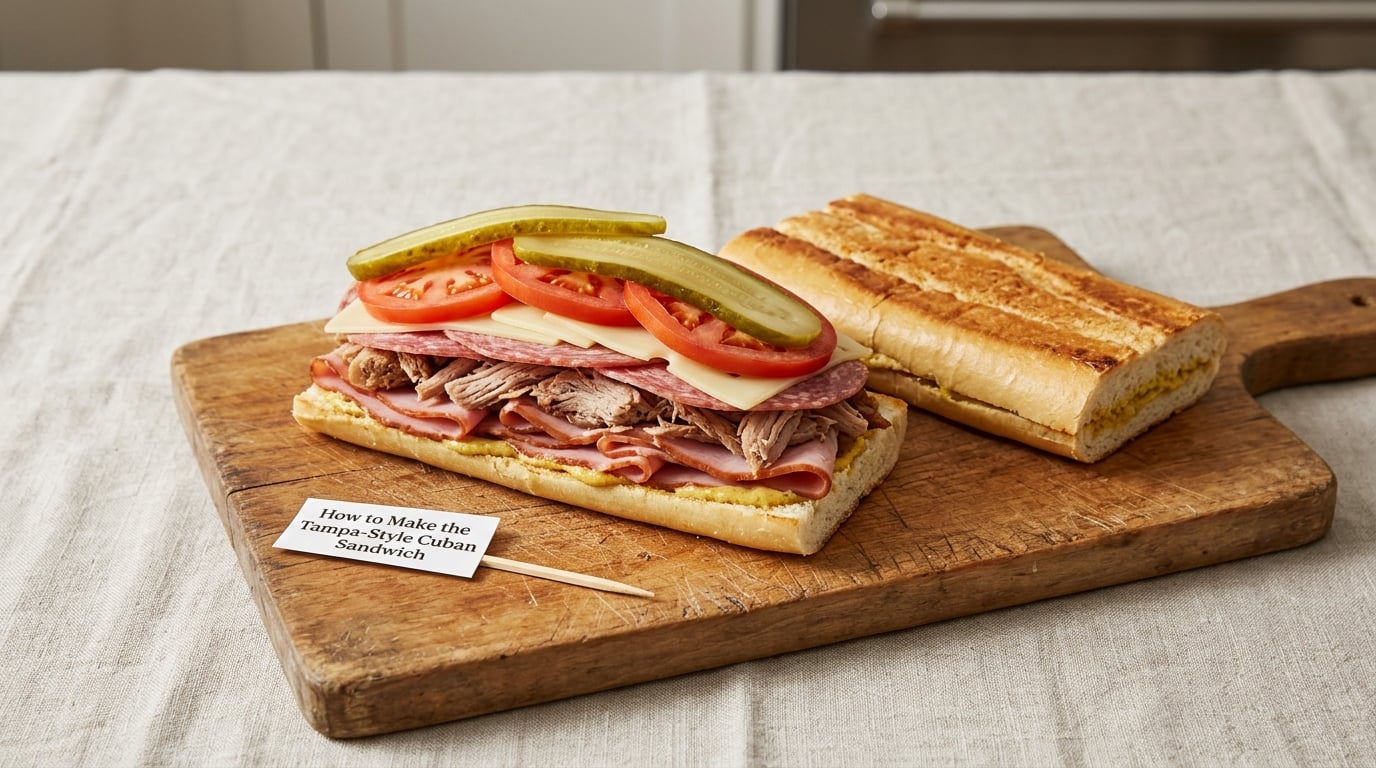
Ingredients: 1 large loaf Cuban bread, 1 pound roast pork shoulder marinated in mojo and roasted, 8 thick slices sweet-glazed ham, 4 to 6 thin slices Genoa salami, 4 to 6 slices Swiss cheese, 1 dill pickle, yellow or spicy mustard, 2 tablespoons softened butter, 1 large tomato and a few leaves of lettuce for serving, salt and pepper.
Step 1, roast the pork ahead, 2 to 3 hours. If you are starting from scratch, marinate the pork in mojo, which is garlic, cumin, oregano, cilantro, orange juice, lime juice, olive oil and salt, for at least 4 hours. Roast it covered at 325 F (163 C) until a probe reads 145 F (63 C), then rest it 3 minutes before shredding. Shred with two forks, keeping the pieces moist rather than fine. If you are short on time, deli roast pork works fine and many Tampa homes use it.
Step 2, butterfly the loaf, 2 minutes. Slice Cuban bread lengthwise into a top and a bottom half without cutting through the bottom crust, so the sandwich stays one piece. Butter the cut faces lightly and season with a little salt.
Step 3, layer in the traditional order. On the bottom half, lay mustard, then ham, then roast pork, then the thin salami layer, then Swiss, then exactly three dill pickle slices, then a thin line of mustard again. Cover with the top half. The order is not superstition; salami under Swiss melts into a savory sheet, and the pickles sit closest to the bread so they soften without turning the crumb to mush.
Step 4, wrap and weigh, 15 minutes. Wrap the sandwich tightly in foil or parchment and place it between two baking sheets with a heavy pot on top. A canner, a cast iron skillet or a stack of bricks all work. Press for 15 minutes at room temperature so the layers fuse and the bread takes the weight of the filling. This step is the one most often skipped, and skipping it is why home Tampa sandwiches fall apart when cut.
Step 5, finish on the press or in the oven, 8 to 10 minutes. Unwrap and place seam-side down in a panini press or skillet at medium-high. Cook 4 to 5 minutes per side until the crust is golden and crackling and the cheese runs. For a softer, more even melt, finish in a 400 F (204 C) oven for 8 minutes instead.
Step 6, rest 4 minutes, then cut. Rest before cutting so the juice stays in the meat. Cut on the diagonal, secure each half with a sandwich pick, and serve with lettuce and tomato alongside, never inside, if you want to keep the bread from softening.
How to Choose the Right Style
Pick the Miami version for a quick weekday lunch, a lighter appetite, a mild flavor profile, or a sandwich that has to survive a lunchbox. Pick the Tampa version for a party spread, a family gathering, a big appetite, or any occasion where the sandwich is the main event and you want the salami.
Choose based on your equipment too. A panini press does both styles well. With only a skillet, a weighted skillet on top gives you the compressed Miami look, and a foil-wrapped sandwich pressed under a heavy pot overnight gives you the best approximation of a Tampa counter sandwich.
And if you are building for people who have never tried the other city’s version, make both. A half-and-half platter is the fastest way to end the argument in your own kitchen.
Storage, Leftovers, and Food Safety
Cook whole cuts of pork to at least 145 F (63 C) with a three-minute rest, according to USDA guidance. Browning the outside is not a substitute for that reading, so check with an instant-read thermometer in the thickest part. If you buy pre-cooked pork from the deli, reheat it until steaming hot, 165 F (74 C), rather than serving it cold.
Refrigerate cooked meat and assembled sandwiches within two hours, and keep the fridge at or below 40 F (4 C). Eat refrigerated sandwiches within three to four days. Bread goes stale and soft in that window, so most cooks press a fresh one rather than serving day-old sandwiches cold.
The safest leftover option is a full reheat. Put the sandwich on a skillet or in a 350 F (175 C) oven until the cheese is melted and the center is steaming throughout, not just at the edges. Microwaving works, but it leaves the bread soft and chewy rather than crisp. For a party, press the sandwiches ahead, wrap them, and hold them in a cooler; they are best served within a few hours of pressing.
Frequently Asked Questions
Which Cuban sandwich is better, Miami or Tampa style?
Both are authentic to their cities, and the honest answer is that it depends on what you want. Miami style is milder, smaller and crisper, with cleaner ham and pork flavor. Tampa style is meatier and more assertive, with Genoa salami, chewy bread and more melted cheese. If you have never tried the salami version, that is the one to make first, because it is the version most people are missing.
Are Cuban sandwiches supposed to be grilled?
Pressed is the better word than grilled, but yes, both styles are cooked on a flat surface under weight until the bread toasts and the cheese melts. A panini press, a skillet with a heavy plate on top, or a foil-wrapped sandwich pressed under a pot all work. Some counters in Ybor City will hand you an unpressed sandwich to eat cold, but the pressed version is what most people mean by a Cuban sandwich.
What is the difference between Cuban bread and a Miami Cuban sandwich bread?
Cuban bread is a long, dense, crusty loaf with a chewy crumb, and it is the traditional Tampa-style base. Miami-style sandwiches use ordinary soft white sandwich bread, usually dipped in egg or brushed with butter before pressing. Cuban bread gives you structure and chew for a tall, heavily filled sandwich, while the soft bread compresses into something thin, crisp and easy to hold.
Can I make a Cuban sandwich with roast pork instead of ham?
You can, and many Tampa versions are mostly pork. Roast pork marinated in mojo and shredded is the traditional Tampa meat, while the sweet ham is what makes a Miami-style sandwich milder. If you skip ham, add a little extra mustard and keep the pickles, because without ham the sandwich loses some of its salt and sugar balance. Deli roast pork is a fine shortcut if you are not roasting your own.
What cheese goes on a Cuban sandwich?
Swiss is the conventional choice for both styles, usually Emmental or a similar mild variety with holes. Thin slices melt cleanly under a press, which is why the Tampa version layers them between the meat and the pickles. Miami sandwiches are more flexible, and plenty of Little Havana counters skip cheese entirely or use another mild cheese. Sharp cheeses and thick slices both tend to turn rubbery when pressed.
How do I keep a Cuban sandwich from getting soggy?
Drain your pickles well and keep them away from the very bottom of the stack, near the bread, where liquid collects first. Press the sandwich under weight for at least 15 minutes if you assembled it ahead, which sets the structure, and rest it a few minutes after cooking before cutting. Finally, serve lettuce and tomato on the side, and only reheat in a skillet or oven so the crust stays crisp.
Start with the bread and the meat, because those two choices decide everything else. If you want the version most people have never tasted, go Tampa-style with a thin layer of Genoa salami, press it under real weight, and let it rest before you cut. If you want something fast and tidy for a weekday lunch, the Miami-style egg-dipped version on soft white bread takes less time and holds together better. Make one of each, and the argument in your house settles itself.