
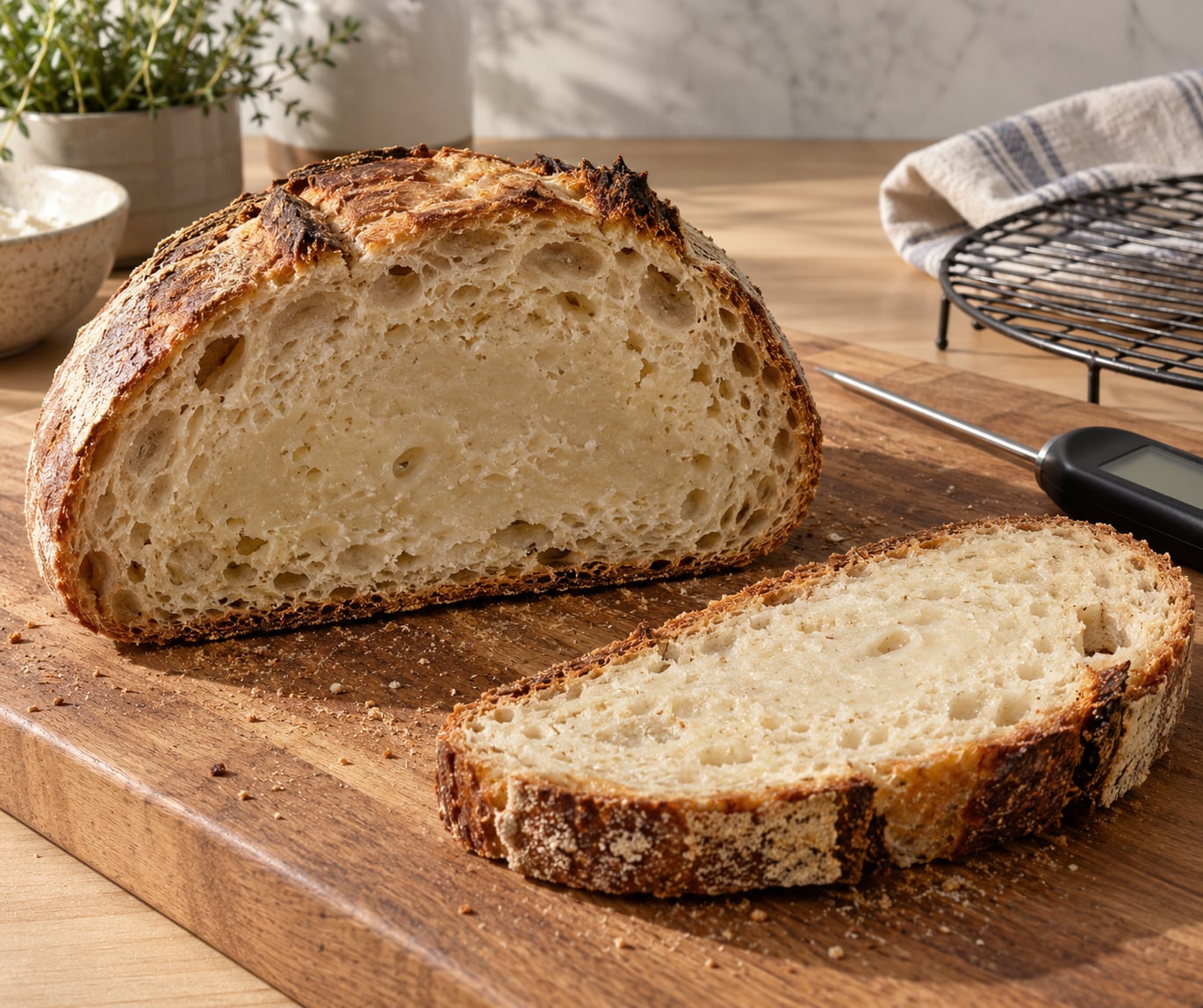
Most of the time the answer is one of three things: you sliced the loaf while it was still hot, you pulled it out of the oven too early, or the dough never fermented enough to build the structure that crumb needs. Search for why is my sourdough bread gummy inside and you will find the same three answers repeated across forum threads, and for one good reason: those three account for the large majority of gummy loaves.
The tricky part is that fermentation problems and baking problems look identical once the bread is sliced. A dense, sticky center does not tell you whether the dough was underproofed or simply underbaked. So this guide starts with a four-check diagnostic, then walks through each cause with the specific fix that goes with it.
One piece of background helps more than any single tip. Starch gelatinizes — fully sets into the firm, slightly springy structure that makes bread feel like bread — only when the center of the loaf gets close to the boiling point of water, roughly 205-210F (97-99C) at sea level. Stop the bake before that and the interior stays a wet paste, no matter how good it looks outside.
Table of Contents
- why is my sourdough bread gummy inside?
- How to Tell Whether the Dough or the Baking Is the Problem
- Common Reasons Sourdough Bread Is Gummy Inside
- How to Fix Gummy Sourdough in Your Next Bake
- Can You Rescue a Gummy Loaf?
- A Simple Troubleshooting Checklist
- Frequently Asked Questions
- Conclusion: Start With the Slice Test
why is my sourdough bread gummy inside?
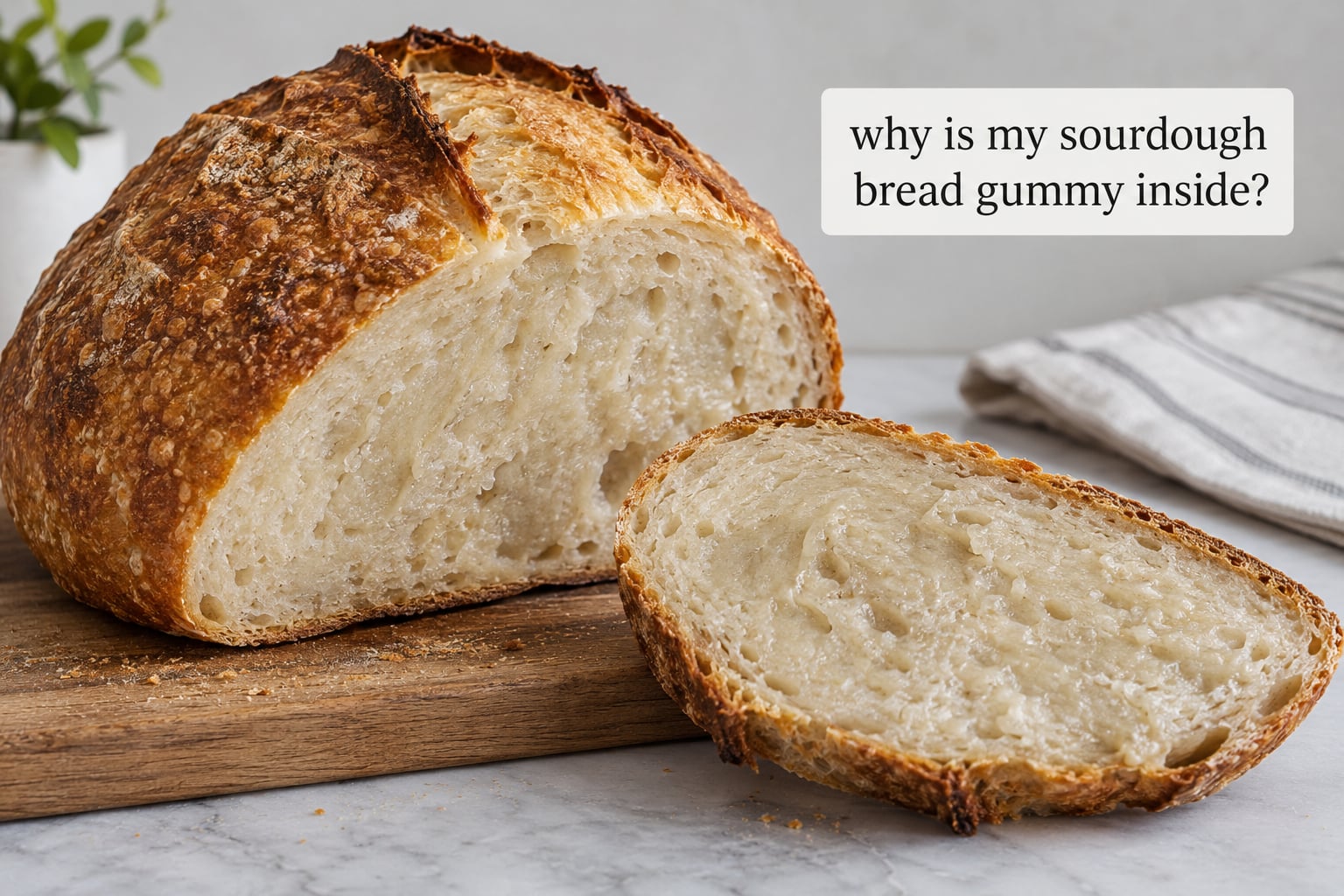
A gummy crumb is a dense, often shiny interior that feels sticky or rubbery instead of springy and open. Almost never is this a flavor problem. It is a fermentation problem or a baking problem, and because the two produce the same result when you slice the loaf, most bakers change the wrong variable and repeat the failure three bakes later.
Below is the practical version of what causes it.
- Sliced while still hot. The starches have not finished setting and moisture is still moving out of the crumb. This is the easiest fix and the most common miss.
- Underbaked. The loaf sounded hollow, browned fine on top, and was still raw and wet in the middle. Internal temperature never reached 205-210F.
- Under-fermented. The dough did not have enough gas and enough developed gluten to hold a structure, so the center compressed into a dense paste during shaping and baking.
- Too wet for the flour. Slack dough sticks to itself, shapes badly, and bakes into compressed pockets.
- Weak starter or low inoculation rate. A starter that doubles in four hours at a 1:10 ratio still leaves the dough a long way from ready.
- Too much bread flour. High-protein flour can produce a tight, rubbery crumb that stays gummy even with good oven spring. Several bakers on The Fresh Loaf flagged this as the overlooked cause.
There is also a reframe worth having early: a slightly shiny, slightly sticky crumb is normal sourdough. It is not a defect on its own. The problem only starts when the crumb tears like rubber, compresses under a knife, or feels wet between your fingers.
How to Tell Whether the Dough or the Baking Is the Problem
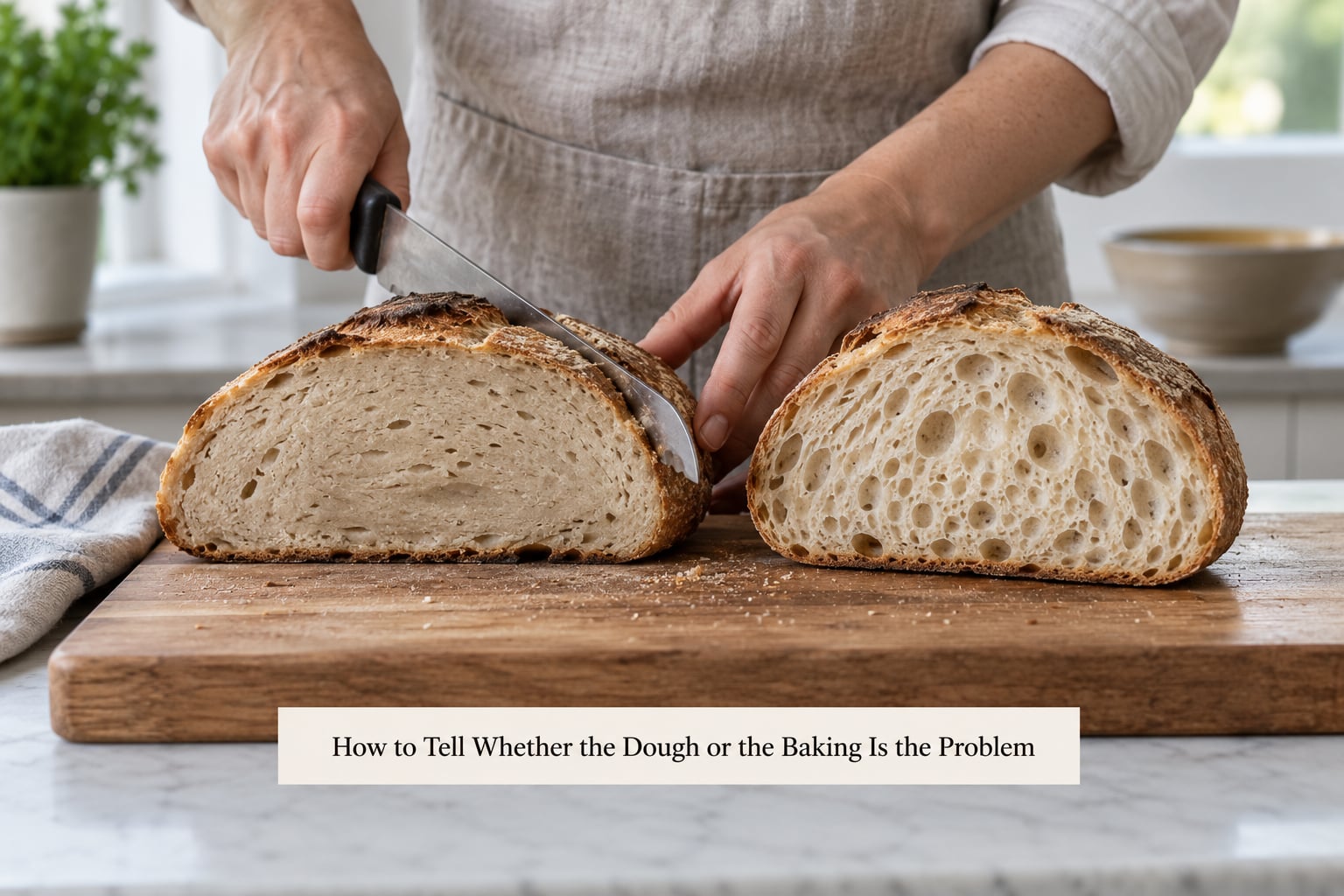
Run these four checks in order before you change anything in your recipe. Each one rules causes in or out, and together they give you a fair answer in about a minute.
Check 1: Did you cool it for at least two hours?
If you sliced it straight out of the oven or after an hour, stop here. Wait until fully cool, even overnight, and re-evaluate. Many bakers on r/Sourdough say their second guess for a gummy loaf is always slicing it warm, and it turns out to be the right second guess more often than not.
Check 2: Did it collapse or spread in the oven?
A loaf that rose well, then fell and spread flat during the bake usually had weak structure going in: under-fermented, under-developed, or badly shaped. If the loaf held its dome and kept a good ear, the baking was probably fine and the crumb problem is more likely starch, flour, or a still-warm slice.
Check 3: Where is the gumminess?
Gummy only in the bottom third points at the bake — heat did not reach the base, or the loaf sat on a cold surface too long. Gummy in a compressed band near the top of the crumb usually points at shaping and surface tension. Gummy everywhere in a tight, dense crumb points at fermentation.
Check 4: What does the crust and bottom tell you?
Pale crust, pale bottom, no blistering: your oven is running cool or your bake was far too short. Dark crust over a wet interior: the outside outran the inside, which usually means the bake ended before the center temperature caught up.
| What you see | What it points to | Most likely cause |
|---|---|---|
| Hollow knock, dark crust, wet center | Center never set | Underbaked — check internal temperature |
| Tight crumb, poor slice, flat spread | No structure built in the dough | Under-fermented or weak starter |
| Shiny, rubbery, tears when pulled | Dense protein network, or bake too cool | Too much bread flour, or underbaked |
| Gummy only at the bottom | Base never fully cooked | Bake too short, or a cold stone or tray |
| Fine open crumb, sticky feel | Probably fine | Sliced warm — cool it fully and re-check |
| Dough tore instead of stretching at shaping | Overworked or too cold | Handle gently, shorten the bench rest |
Write down what you found. The next time you bake, one variable is much easier to change than six, and a three-line note on your phone beats trying to remember six weeks later what you actually did.
Common Reasons Sourdough Bread Is Gummy Inside
Five causes cover almost every gummy loaf. They are ordered roughly by how often they turn out to be responsible, not by how dramatic they sound.
Under-Fermented Dough
An under-fermented dough has not produced enough gas or developed enough structure to support itself, so it bakes into a dense, sticky crumb with poor oven spring. The signs are consistent: tight slicing that tears instead of compressing, a crumb with few holes, a loaf that spreads rather than rises, and dough that felt slack and lifeless rather than airy and alive at the end of bulk.
The most common mistake is judging fermentation by the clock. Volume increase is the real measure, and even that is only a proxy. Track the percentage increase from your starting volume and repeat it. A 1:10 inoculation rate at cool room temperature takes considerably longer than a 1:5 rate in a warm kitchen, which is exactly the point The Fresh Loaf regulars make in the thread where a four-hour bulk at about 70% hydration was diagnosed as badly under-fermented.
Adjust by extending bulk, raising dough temperature, increasing inoculation, or all three, in that order of simplicity. Warm dough ferments faster; a cooler kitchen slows everything, so winter recipes that work in July fail in January.
Expect some of the same symptoms when your starter is simply young. Starter maturity takes two to four weeks to establish and considerably longer to fully mature, and bakers routinely overrate their own.
Worth reading next: why my homemade sandwich bread comes out so dense covers the same fermentation diagnosis in more depth.
Too Much Hydration or Poor Dough Development
Slack, sticky dough makes shaping difficult and leaves large compressed pockets in the finished bread. Hydration above what your flour can absorb produces exactly that: a dough that spreads on the bench, sticks to your hands, and tears rather than holding a taut skin.
Two things often get confused here. Hydration is the water-to-flour ratio, and it is flour-dependent — a high-protein bread flour holds more water than an all-purpose flour, and a humid day changes effective hydration without changing a single gram. Dough development is whether you built a gluten network strong enough to hold gas, which depends on autolyse, fold schedule, salt timing, and time.
Useful checks: after autolyse the dough should feel smoother and slightly more cohesive, not identical. During stretch and folds it should tighten visibly between sets and hold a dome when you tip the bowl. If salt goes in with the starter at the very start of a long, cool bulk, fermentation slows noticeably — add salt after the first fold or two instead.
To lower hydration, drop five percent and bake again before dropping more. Five percent at a time is enough to feel the difference and small enough that you still recognize the dough.
Weak Shaping or a Poor Loaf Build
A gummy, compressed center often starts with a loaf that was shaped without enough surface tension. If the dough is not pulled tight on the outside, the crumb stays compressed in the middle no matter how well it ferments or bakes.
Preshaping is where most tension comes from. Drag the dough gently on the counter with cupped hands, let it rest uncovered, then do a proper final shape and let the seam sit seam-side down in the basket so the loaf holds its rise. Proofing should be handled minimally; a warm, humid kitchen plus a warm basket can add a lot of handling on its own.
If your seam opened and the loaf spread in the oven, the fix is more tension at shaping, not more time in the basket.
The Loaf Was Baked Too Little
This is the single most common baking-related cause: a loaf that knocks hollow but still contains a wet, set-but-not-baked crumb. Hollow is a shell test, not a center test. Use an instant-read probe in the thickest part of the loaf and aim for 205-210F (97-99C).
Preheating matters more than bakers expect. Give a stone or steel a full 45 to 60 minutes, or put the empty Dutch oven in to preheat with it. Then check your oven’s actual temperature with an independent oven thermometer — home ovens commonly run 20 to 30 percent off the dial in either direction, and one The Fresh Loaf baker found theirs was finishing a loaf in half the stated time.
If the center is still short, add time in small increments and watch the bottom. Late in the bake, dropping the oven to around 375F (190C) or tenting loosely with foil dries the crumb out without burning the crust, and that is where most underbaked loaves get rescued.
| Method | Preheat | Lidded / steam phase | Uncovered phase |
|---|---|---|---|
| Dutch oven | 500F (260C), 45 min with pot inside | 20 min, lid on | 20-25 min, lid off at 450F (230C) |
| Stone or steel, no pot | 500F (260C), 60 min | Steam pan or ice cubes, 20 min | 20-25 min uncovered |
| Convection oven | 480F (250C), 45 min | Fan off for the steam phase, 10 min | Fan on, 410F (210C), 15-20 min |
Convection deserves its own note. The fan strips moisture from the crumb and cooks the outside faster, which is precisely the combination that produces a gummy center. Most bakers who switched to convection report success once they turned the fan off for the first ten minutes and dropped the final temperature by about 20F.
At altitude, water boils below 212F, so the number to aim for shifts down a few degrees. Above 5,000 feet, target roughly 200-205F instead of 205-210F.
You Cut the Bread Too Soon
A warm loaf feels gummy because its starches are still setting and its moisture is still migrating out of the crumb toward the crust. Nothing about the bake was wrong. You just cut it open too early and read warm crumb as raw crumb.
The rule most people need: at least two hours before slicing, and four hours or more for dense or high-hydration loaves. Big, heavy, high-hydration loaves genuinely need longer than that. If the crumb still feels tacky at four hours, leave it overnight and look again in the morning.
One baker on The Fresh Loaf described a loaf that looked genuinely underdone as its first cut revealed, then set into a fine crumb after several more hours. Same bread, different hour.
The Flour Is Doing Something You Did Not Plan For
High-protein bread flour is the quiet cause. A tighter protein network holds more water and resists the spread that gives crumb its open structure, and the result bakes dense and rubbery even with good oven spring and a correct bake. Swapping part of the bread flour for all-purpose lowers the network strength and often fixes a crumb that is open but wet, which is a confusing combination: the loaf rose beautifully and still feels wrong.
Whole wheat behaves similarly for a different reason, since bran and germ absorb water the dough never gets back. If your gummy loaf is the only one with whole grain in it, that is usually why.
How to Fix Gummy Sourdough in Your Next Bake
Change one thing. That is the whole strategy, and it feels slower than rewriting a recipe until you realize the recipe was never the problem.
Work through these in order, stopping as soon as the crumb behaves:
- Fix fermentation first. Judge bulk by volume increase and dough feel, not by the clock. If the dough ends bulk slack and lifeless, everything downstream fails with it.
- Reduce hydration by five percent if shaping is a fight. Keep everything else identical so you learn something.
- Build stronger dough. Extend autolyse, add a fold or two, and delay the salt until after the first fold.
- Shape with real tension. Preshape, rest, final shape, seam down. If the seam opened last bake, this is your fix.
- Bake to temperature, not to color. Probe to 205-210F. Extend in five-minute increments and watch the bottom color.
- Let it cool completely. Two hours minimum, four for dense or wetter loaves, longer for very large ones.
If you only change one thing next bake, make it the bake. Cooling and internal temperature are free, they are the two most commonly missed steps, and together they resolve more gummy loaves than any recipe edit.
Can You Rescue a Gummy Loaf?
Sometimes, yes, as long as the problem is moisture rather than structure. If the crumb is wet but the cell structure is decent, you can drive the moisture out.
Return the loaf to a 350-375F (175-190C) oven for 10 to 20 minutes, sliced-side up on a rack, until it dries and crackles when you tap the bottom. Slicing first opens the crumb so heat reaches the interior faster. A microwave on a short burst with a damp towel alongside works too, though it will not crisp the crust.
Toasting slices hard, or using the loaf for French toast, pan bread, or croutons, all sidesteps the problem entirely. Those applications forgive a wet crumb that a sliced loaf never will.
What this cannot fix: an under-fermented crumb. You can dry it out and you can make it palatable, but the density stays, because the structure was never built.
A Simple Troubleshooting Checklist
Run this before the next bake and note the answers somewhere you will find them.
- Did bulk rise enough, judged by volume rather than time?
- Did the dough feel aerated and cohesive at the end of bulk?
- Did the final shape hold tension with no seam opening?
- Did the basket proof look bubbly and jiggly, not flat?
- Was the oven preheated long enough, and verified with an independent thermometer?
- Did the internal temperature reach 205-210F?
- Was the bottom evenly colored, or pale?
- Did the loaf cool at least two hours, four for dense or high-hydration loaves?
- What was the loaf’s weight, hydration, inoculation rate, bulk time, bake time and bake temperature?
That last line is the habit worth building. The same loaf gets misdiagnosed three times because nobody remembers that bulk was two hours shorter than usual.
On food safety: gummy texture on its own is not a safety problem. Flour and water are the concern, not the texture, and sourdough’s acidity and long fermentation make it lower risk than a quick yeasted loaf. The one thing to watch is a center that is raw, wet, and doughy, particularly in a loaf with whole grains or inclusions. Toasting it thoroughly or giving it another bake removes any doubt, and normal handling and storage apply once it is fully baked and cool: keep it in a paper or cloth bag at room temperature and use it within a few days, or freeze it sliced.
Frequently Asked Questions
Why is my sourdough bread gummy inside?
Three causes cover most cases: you sliced the loaf while it was still hot, you pulled it out of the oven before the center reached 205-210F, or the dough was under-fermented and never built enough structure. Slice a fully cooled loaf and probe the center next time. That one check usually tells you which of the three it was.
How do you fix gummy sourdough bread?
Cool the loaf fully before judging it, then fix the bake: preheat properly, verify your oven with an independent thermometer, and use a probe to hit 205-210F in the thickest part. If the bake was correct, adjust fermentation next, judging bulk by volume and dough feel instead of the clock. Change one variable per bake.
Can I still eat a gummy loaf?
Gummy texture by itself is a baking and texture issue, not a safety one. Sourdough is long-fermented and acidic, and the flour and water are what carry the risk, not the density of the crumb. The exception is a center that is raw and doughy: bake or toast it thoroughly first, especially with whole grains or inclusions.
Can I rebake my gummy sourdough bread?
Yes, if the crumb is wet rather than dense. Slice the cooled loaf and return it to a 350-375F oven for 10 to 20 minutes until the bottom crackles when tapped. You can also toast slices hard or use them for French toast, pan bread, or croutons. Rebaking dries the crumb out but cannot rebuild an under-fermented structure.
Can I still bake my sourdough if the dough is sticky?
Sticky dough at shaping is normal for wetter sourdough. Use a floured bench, wet hands, and a plastic scraper, and shape gently rather than adding more flour to the dough itself, which throws off hydration. Stickiness becomes a real problem when the dough tears instead of stretching, which points to overworking or a dough that is too cold.
What internal temperature should sourdough reach when done baking?
Aim for 205-210F (97-99C) in the thickest part of the loaf, measured with an instant-read probe. That is close to the boiling point of water, and starch only fully gelatinizes when the crumb gets there, which is why a pale, hollow-knocking loaf can still be wet inside. At altitude, target closer to 200-205F.
Conclusion: Start With the Slice Test
Let the loaf cool completely, then look at the crumb and decide what you are actually looking at: density from poor fermentation, moisture from an underbaked center, or raw starch from cutting it warm. Once you can name which one it is, change that single variable next bake and leave the rest of the recipe alone.
Start with the two free fixes — a full cool and a probe reading of 205-210F. More than they cost, they explain the largest share of gummy sourdough loaves.