
Learning how to use grocery coupons as a beginner comes down to one habit: read the fine print before you buy, not while the line is forming behind you. A grocery coupon is a discount offer from a manufacturer or a store, applied on paper, inside a retailer app, or as cash back after you pay. Most of the work is now done by your phone.
That shift matters if you learned couponing from older advice. The Sunday insert is mostly gone, printable coupon sites are a thin slice of what is out there, and paper money-back coupons keep shrinking. What replaced them is digital: you clip an offer in a store app, it attaches to your loyalty account, and the register applies it at checkout. In 2026, that is the version worth learning first.
Beginners on r/couponing repeat the same advice over and over: only clip offers for products you already buy, and wait for the sale to meet the coupon before you spend. The people who quit usually quit because coupons made them buy things they did not need. Approach it as a discount on an existing list and it stays fun.
Time is the other honest part. Once your apps and accounts are set up, expect a rough half hour a week of prep. The first few times, plan on a couple of hours. That setup cost is why beginners should start with one store they already visit.
Table of Contents
- What You Need
- Step-by-Step: How to Use Grocery Coupons as a Beginner
- Step 1: Set a Savings Goal Before You Clip Anything
- Step 2: Find Offers That Match Your List
- Step 3: Check Every Restriction on the Coupon
- Step 4: Match Offers to Your Grocery List
- Step 5: Clip and Organize Your Coupons
- Step 6: Confirm the Coupon Loaded Into Your Account
- Step 7: Verify the Discount at Checkout
- Common Mistakes and Quick Fixes
- Frequently Asked Questions
- Conclusion
What You Need
You need five things, and you probably have most of them already.
- A real grocery list and a budget. Coupons work against a plan. Without one, an offer becomes an invitation to wander the aisles.
- A smartphone. Nearly every current grocery coupon lives in a store app or a cash back app. Paper still works, but it is no longer the main channel.
- A store loyalty account with the number saved. Write it on the back of your card or keep it in your phone’s notes. Register staff usually ask for it before they can attach anything to your cart.
- The app for the store you actually shop at. Start with one. Two or three retailers is plenty to start, and adding more rarely pays off for a beginner.
- A folder or sleeve system for the rare paper coupon. A plastic sleeve page or an envelope sorted by expiration date is enough. No binder needed yet.
That last item matters more than it sounds. If you are building a sandwich habit while you learn, our guide to the best rolls for Italian subs you can buy at the grocery store gives you a set of regular items to track prices on, which is the honest way to test whether an offer is real.
Step-by-Step: How to Use Grocery Coupons as a Beginner
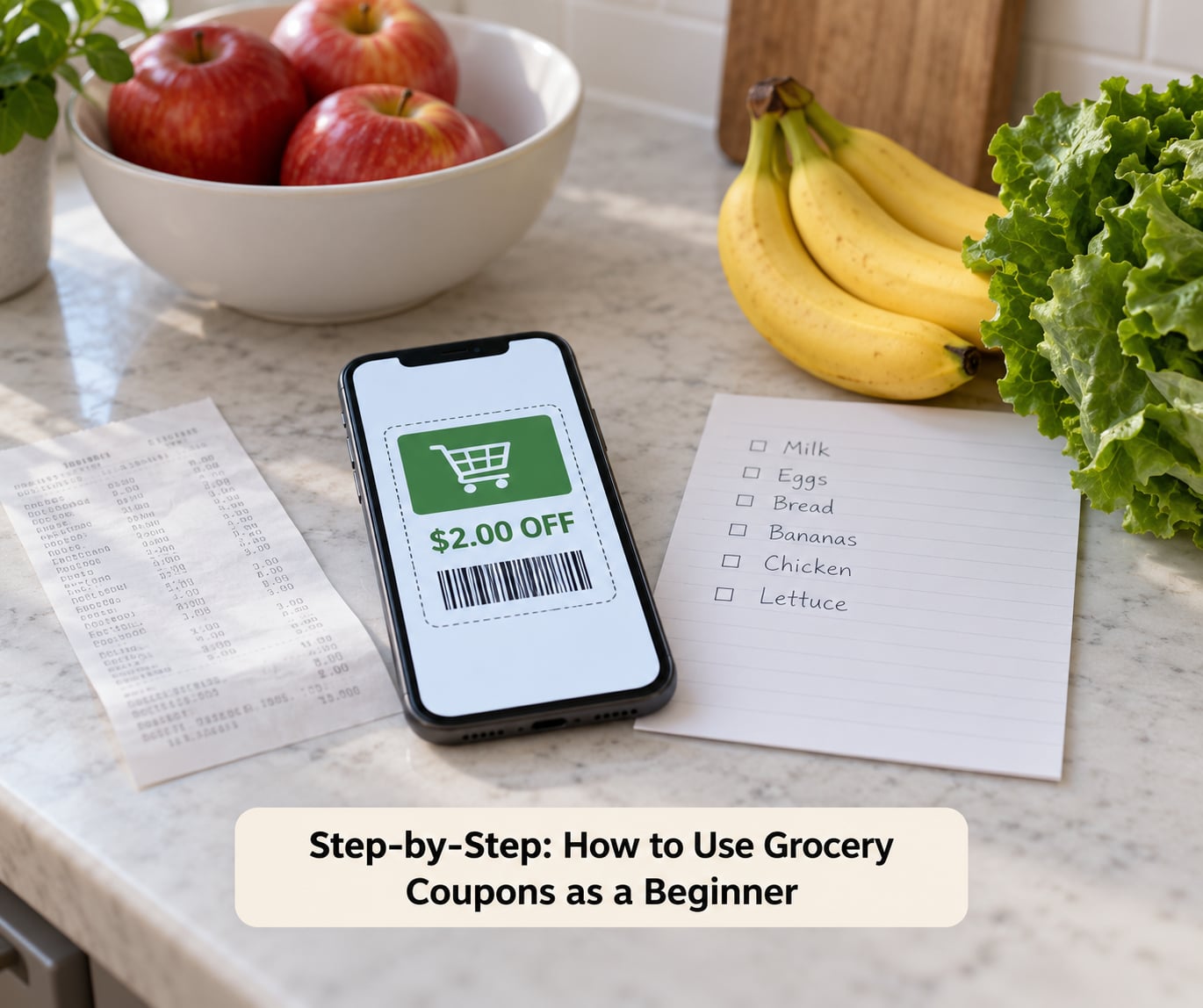
Seven steps, roughly in the order they happen in a week. Skip a step and the offer quietly evaporates at the register.
Step 1: Set a Savings Goal Before You Clip Anything
Pick a number before you start. A realistic first target is shaving a modest percentage off your next four weeks of grocery spending, then checking whether you hit it. People who set an open-ended goal tend to lose track of whether couponing worked at all.
Write the savings into your budget as a line item rather than treating it as a windfall. If you plan to spend four hundred dollars a month on groceries, a ten percent trim is a real number you can audit in a month. Nothing dramatic, just measurable.
Then decide which staple categories deserve research. Coffee, cereal, laundry detergent, pasta, and canned goods get bought constantly and go on sale on a predictable cycle. Starting there keeps you inside your own habits instead of exploring.
Step 2: Find Offers That Match Your List
Offers come from a handful of places, and beginners should use all of them eventually but only need two to start.
- Your store’s app and weekly ad. App-only digital coupons are the highest-value source, and the store circular that loads inside the app shows what is on sale this week.
- Your loyalty account. Points, member pricing, and targeted digital offers ride along with the number on your card.
- Manufacturer sites and mailers. Brand pages still send coupons for email signups, and shoppers on Reddit swear by writing directly to a company asking for one. It is not guaranteed, but it costs you a paragraph.
- Coupon databases and browser extensions. Useful for checking a brand you do not shop at, and where scam filtering matters.
Some famous names in this space are dead. RedPlum, Smart Source insert schedules, Cartwheel, and double coupon days are all legacy references you will see in older guides, including some still-ranking pages. Skip them.
When you are deciding what to buy on a normal week, our list of grocery store deli meat brands ranked by taste and value is a decent stand-in for building a repeatable list rather than reacting to offers.
Step 3: Check Every Restriction on the Coupon
This is the step beginners skip, and it is the reason coupons get rejected. Every coupon carries the same set of fields, and each one can disqualify your purchase.
| Field on the coupon | What it means | What trips you up |
|---|---|---|
| Value | The amount or percentage taken off | Some are money off a minimum spend, so a small basket never qualifies |
| Barcode | Scans the item, not the coupon | A scanned coupon means the store deducts the discount itself; a missing barcode means a code to key in |
| Expiration date | Last day the offer works | Expired offers are unenforceable, no matter how they were advertised |
| Size or variety restriction | The exact size, flavor, or formulation | The small size, the plain one, the single flavor, the family pack when it says two pack |
| Limit one per purchase | Quantity cap per transaction | You can use the coupon twice on two trips, but not on four items in one basket |
| Participating retailer | Which stores honor it | A coupon for a discount store is not valid at a supermarket chain |
| Loyalty number or account | Ties the offer to your account | Without the number at the register, a digital offer cannot attach to your cart |
A manufacturer coupon and a store coupon are the two types you will meet most. A manufacturer coupon comes from the brand and is usually limited to one per purchase. A store coupon comes from the retailer and is typically valid only in its own stores, with its own rules.
Step 4: Match Offers to Your Grocery List
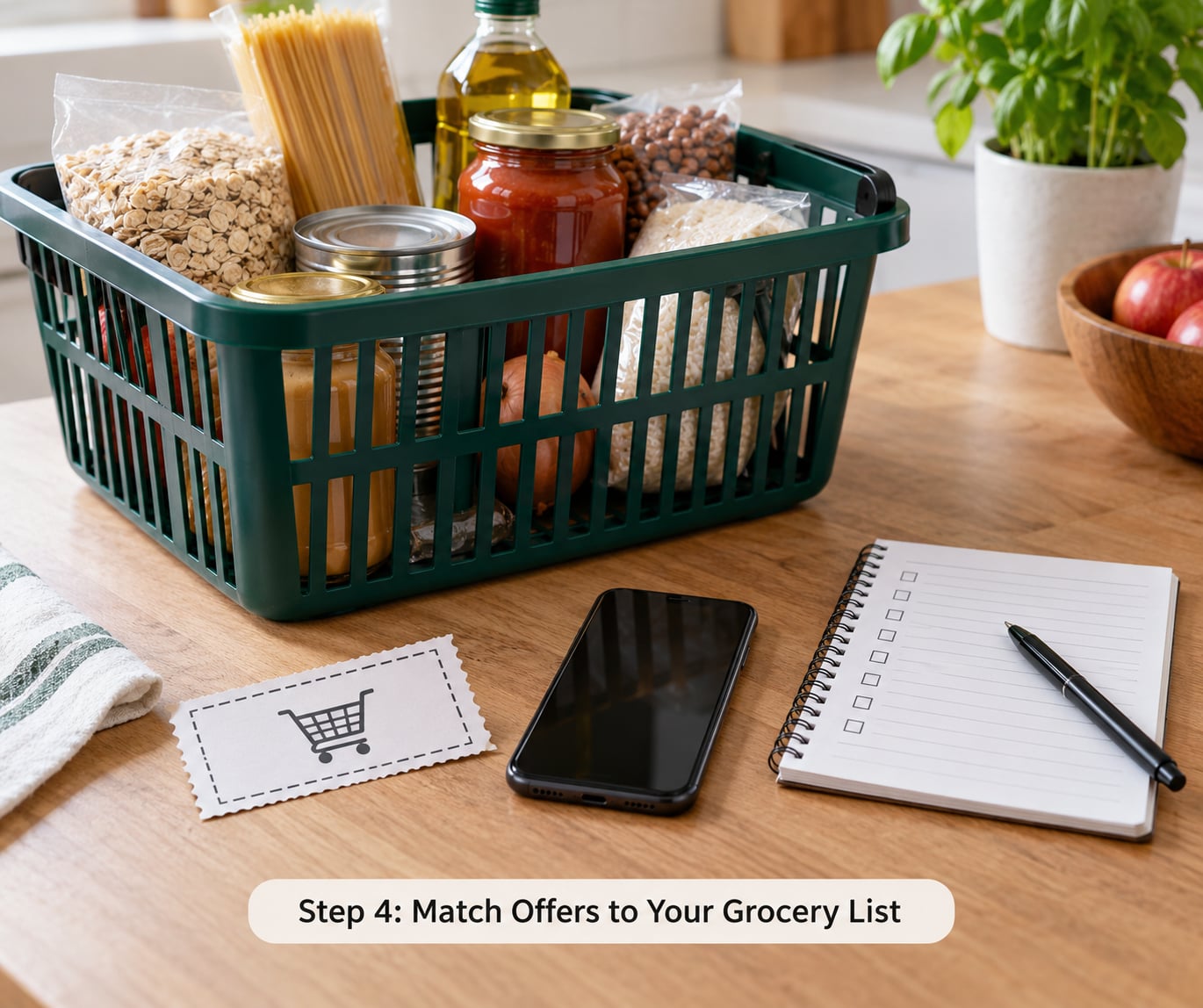
This is where good couponing becomes ordinary shopping. Take the items already on your list, look for a coupon or sale price that applies to them, and buy those. Do the reverse and the coupon is running your list for you.
Compare the per-unit price, not the sticker. A large bottle that looks cheaper per trip often costs more per ounce than the one already in your pantry. Use the unit price printed along the shelf edge, then check whether a store brand version is equivalent before paying for the name brand.
Having a coupon is not a reason to buy. That line comes up constantly in beginner forums and it is the single rule that keeps the hobby from turning into a monthly overbuy.
Step 5: Clip and Organize Your Coupons
For digital offers, clipping means tapping the coupon in the app so it attaches to your loyalty account. Clip only what you will actually buy this week, and note the quantity limit while you are there, because you cannot increase it later.
For the paper coupons you still get, sort them by expiration date in a single folder rather than by category. Date sorting is the only system that matters at first; categories come later if the volume grows.
Resist saving offers for stores you do not visit. A coupon for a retailer twenty miles away is not a deal, it is clutter, and clutter is how people lose interest in the whole system.
Step 6: Confirm the Coupon Loaded Into Your Account
Most digital rejections happen before the cashier touches anything. The offer loaded to a different account, the phone number at the register does not match the account, or the store has the item flagged as already promoted.
Check three things before you get to the register: your loyalty number is attached to the account you clipped to, the coupon still shows as clipped in the app rather than consumed, and you have given it a few minutes to sync. If you just clipped while standing in the parking lot, waiting a moment is often the whole fix.
Step 7: Verify the Discount at Checkout
Using grocery coupons as a beginner is simpler than most guides make it sound. Paper coupons with a barcode scan at the register; paper coupons with a printed code get typed or keyed by the cashier; digital offers apply themselves once your number is attached.
Watch the running total as items cross the scanner. If an eligible offer is not reflected, say so politely before the transaction is finished, and have the coupon or the app screen ready. Cashiers process hundreds of items an hour and cannot reverse a discount after the sale closes.
Take the receipt with you and confirm the discount appears. This step takes ten seconds and it is how you catch an offer that failed silently before you assume the math worked.
Common Mistakes and Quick Fixes
These are the errors beginners repeat, with the fix that resolves each one.
- Buying the wrong size. The coupon says a specific size or variety. Check the restriction line against the exact package, not the brand.
- Forgetting to clip. An advertised offer does nothing until you attach it. Clip before you leave home.
- Missing expiration dates. Sort by date weekly and throw out what expired. Expired clutter hides the live offers.
- Exceeding quantity limits. One per purchase means one per transaction. Split the extra units across a second trip.
- Combining incompatible offers. Most stores let you use one manufacturer coupon and one store coupon on the same item, but they will not stack two manufacturer coupons or apply a coupon to an item already reduced by a sale.
- Skipping the receipt. Check the total before you leave. A missed discount cannot be fixed after you get home.
When something fails anyway, walk down this list: expired, wrong size, not clipped, item already on promotion, quantity limit exceeded, or a store that does not honor that coupon. Ask the cashier to check with a supervisor before you abandon the cart, because the answer is often a data entry error.
Two habits add up over time. Stock non-perishables when a coupon and a sale meet, and keep roughly three months of supply on hand, which is the ceiling the couponing community treats as the line between saving and hoarding. And compare store brands against the national versions you are couponing, because that switch produces steadier savings than any single offer.
One last thing: retailer coupon policies, offer terms, and prices all change, sometimes mid-week. Treat everything here as 2026 behavior rather than a permanent rule, and check the app before you trust an old screenshot.
Frequently Asked Questions
Should beginners use digital coupons or paper coupons?
Digital coupons are the better starting point. Most current grocery offers live in a store app or loyalty account and apply themselves at checkout, which removes barcode scanning and coding errors. Paper coupons still work at most retailers and are useful for a few brand and manufacturer offers, so keep them. Use whichever the store near you honors most reliably.
What should I do if a grocery coupon says it has expired?
Set it aside and check whether the same offer exists as a current digital version in the store app. Brands and retailers rotate their offer sets often, so a fresh version may be sitting in your account already. If nothing matches, let it go. Expired coupons are unenforceable, and keeping them in a folder only hides the offers you can still use.
Can I use more than one coupon on the same grocery item?
Usually one manufacturer coupon plus one store coupon per item, which is called coupon stacking. You generally cannot use two manufacturer coupons together, and a coupon usually will not apply to an item already reduced by a sale price. Policies differ by retailer, so the store coupon policy page is the final word for your basket.
Why was my grocery coupon rejected at checkout?
The usual causes are an expired date, the wrong size or variety, a digital offer that never attached to your loyalty account, an item already flagged as promoted, a quantity limit, or a retailer that does not honor the coupon. Ask the cashier to check before the transaction finishes, and confirm your loyalty number matches the account you clipped the offer to.
How can I use coupons without buying products I do not need?
Build your list first and search offers against it, never the other way around. Clip only items already on that list, compare the per-unit price instead of the sticker price, and wait for a sale to meet the coupon before buying. Treat the unit price and a store brand comparison as the final check, and skip any offer that would add a product to your cart.
If you have been comparing retailers, shoppers have also ranked the grocery store delis they rate highest, which helps you decide where to concentrate your couponing before you spread it thin.
Conclusion
Start with one staple you buy every single week. Research its cycle, clip one offer that matches the size and variety you actually buy, and read the restriction line before you go.
At the register, say your loyalty number first, watch the total, and read the receipt before you leave. That is the whole routine for a first shop. Add a second store only once the first one runs without you thinking about it.