
To make a grocery budget, work out what your household actually spends on groceries over two to four weeks, strip out restaurants and takeout, and turn that average into a weekly number with category limits you can check at the checkout. It takes about an hour to set up and about ten minutes a week to maintain.
Most grocery budgets fail for the same reason: the number came from a guess instead of receipts. A figure that looks sensible on paper does not survive contact with a real shopping trip, and by week three the whole plan gets abandoned.
The fix is not more discipline. It is a baseline that is honestly derived, split into categories you can actually see at the register, and reviewed on a fixed day. That is the whole system, and it works whether you shop twice a month or twice a week.
One more framing note. A grocery budget is the only budget you have to renegotiate every single week, which is why a rigid monthly framework tends to collapse. People who stick to it, from my experience reading budgeting discussions, almost all think in weekly amounts rather than monthly ones. I cover that shift in which sandwiches to make ahead for the whole week as a low-effort way to absorb the leftover part of the week.
Table of Contents
- What You Need
- How to Make a Grocery Budget: Step-by-Step
- 1. Know How to Make a Grocery Budget That Fits Your Household
- 2. Review Two to Four Weeks of Real Grocery Spending
- 3. Separate Fixed Staples from Flexible Meals
- 4. Set Weekly Category Limits
- 5. Build a Shopping Plan Before Leaving Home
- 6. Track Spending During the Checkout
- 7. Review the Budget Every Sunday
- Common Mistakes
- Frequently Asked Questions
- Conclusion
What You Need
You need five things, and four of them you already have somewhere in the house. Nothing here requires a paid tool, and every amount in the steps below is a general planning example you replace with your own local prices rather than financial advice.
- Recent spending records. Two to four weeks of receipts, a bank or credit card statement, or order history from your grocery apps. Four weeks is better than two because it captures a monthly cycle.
- A list of regular purchases. The things you buy almost every trip, so you can see what is structural versus one-off.
- Household size and dietary needs. Number of people eating at home, plus any restrictions, allergies, or a baby or toddler in the mix.
- A fixed amount available for food. The money you can genuinely hand to groceries this month, decided before you start spending it.
- A place to write. A spreadsheet, a budgeting app, or a notebook. All three work. Paper has one advantage: it cannot quietly reorder your transactions.
If you track zero spending right now, start with two weeks of notes and treat that period as observation only, not as a budget. Readers on building a spread board on a fixed small budget usually get there faster by costing a single shared meal first than by budgeting everything at once.
How to Make a Grocery Budget: Step-by-Step
Seven steps, roughly an hour of setup the first time. Each one ends with something you can check, so you know the step worked before you move to the next.
1. Know How to Make a Grocery Budget That Fits Your Household
A grocery budget covers groceries and household staples, not everything that touches food. Restaurants, takeout, coffee runs, and convenience store stops belong in their own line, because that separation is what tells you whether your grocery shopping is the problem.
Most households overestimate how much of their food spending happens in the cart. If you have never separated the two, the grocery figure you quote is probably too high and your overall food figure is not far off.
Once the grocery total is clean, divide the monthly amount by the number of weeks in the month. A month with four shopping weeks needs a higher weekly limit than a month with three, and budgeting for four always leaves you with slack.
2. Review Two to Four Weeks of Real Grocery Spending
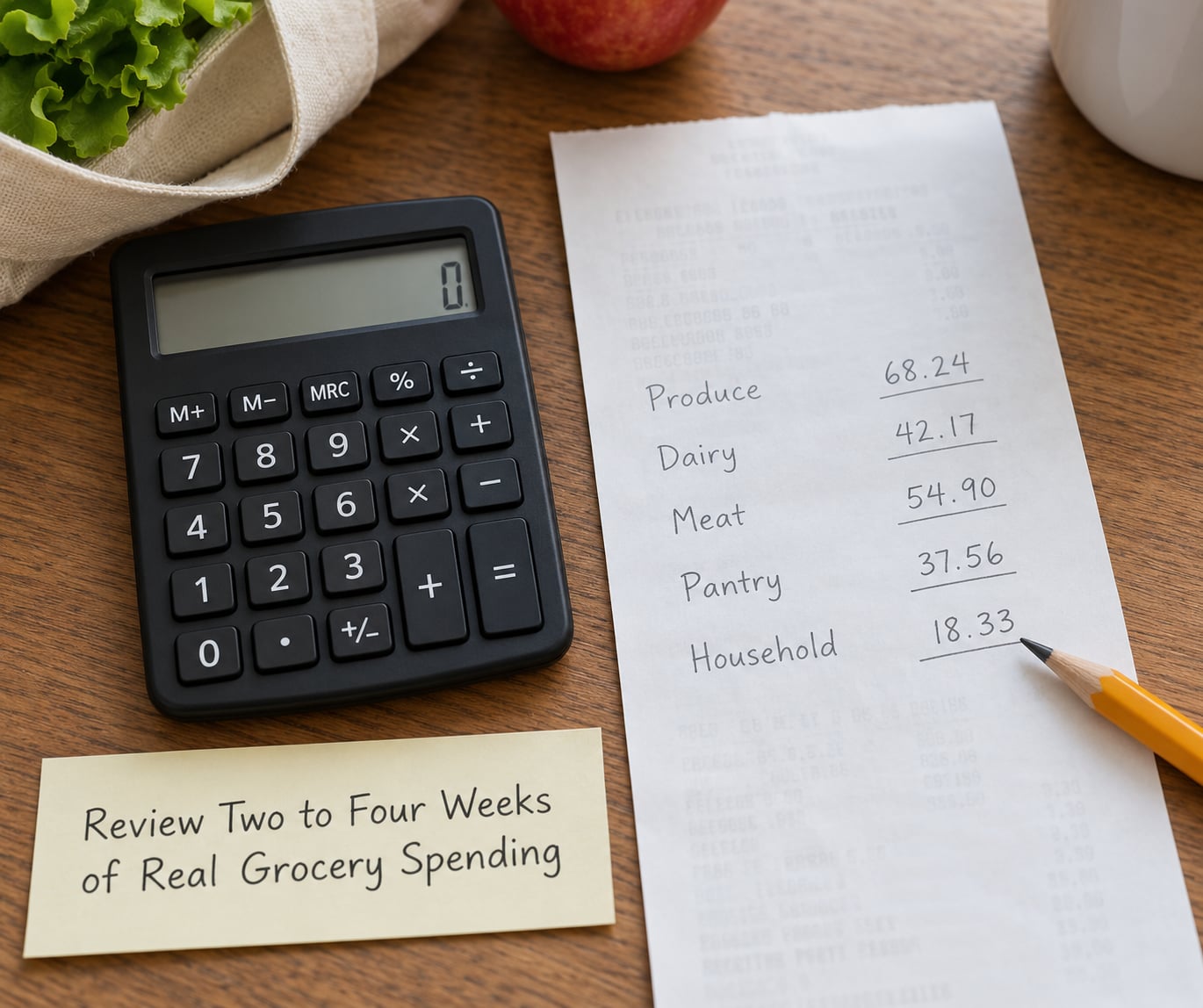
Pull the records and group every grocery purchase into categories: produce, meat and protein, dairy and eggs, bread and bakery, pantry basics, frozen, snacks and treats, household and cleaning. Write down refunds and mark them negative rather than deleting them.
Exclude non-food items if your store puts them on the same receipt, or track them separately so cleaning products never quietly consume your produce allowance. Store-bought bakery and prepared deli items are still groceries, so keep them in, but give them their own category if they run high.
Add up each category, divide by the number of weeks, and you have your baseline. Then take the higher of two typical weeks rather than your average week. Using the higher figure builds in a buffer, and it also stops one unusually cheap trip from setting a limit you will blow in a normal month.
Write the baseline number down and date it. This is the honest version of your spending, and every target from here is a small step away from it.
3. Separate Fixed Staples from Flexible Meals
Split your categories into two groups. Core staples are bread, eggs, milk, produce, meat, rice, pasta, canned goods, and cleaning basics. Flexible foods are snacks, specialty cheeses, prepared meals, desserts, and anything you buy because it looked good.
Fixed does not mean unchangeable. It means a category you refill on a rhythm, so you should know its cost before you get to the store and notice the gap early instead of at the register.
Give staples a generous allowance and flexible foods a hard ceiling. When money is tight, people cut the treats and then run out of bread, which costs more than the treats did.
4. Set Weekly Category Limits
Set a limit per category and add them up. The total should land close to your baseline from step 2, not far below it. A budget that assumes you will suddenly cook more and waste less usually breaks in the first fortnight.
Here is a worked example. Fictional household of four, mid-cost region, one full month of shopping, figures illustrative only:
| Category | Monthly limit | Weekly limit |
|---|---|---|
| Produce | 160 | 40 |
| Meat and protein | 200 | 50 |
| Dairy and eggs | 110 | 28 |
| Bread and bakery | 50 | 12 |
| Pantry basics | 120 | 30 |
| Frozen | 60 | 15 |
| Snacks and treats | 80 | 20 |
| Household and cleaning | 70 | 17 |
| Total | 850 | 212 |
Weekly figures are the monthly limit divided by four, rounded to the nearest dollar. That total lands between the common planning ranges for a family of four in many US regions, which is a useful sanity check rather than a rule. High-cost-of-living cities sit at the top of those ranges; smaller towns sit well below.
Adjust every figure for your household size, region, dietary needs, and any store sales you rely on. If your household eats out four nights a week, its grocery budget should be smaller than a neighbor’s, not equal to it.
Check the result by dividing the monthly total by people, then by four weeks. A number per person per week makes the budget far easier to compare against a colleague or a sibling household than a monthly figure does.
5. Build a Shopping Plan Before Leaving Home
Start with an inventory, not a list. Check the pantry, the freezer, and the refrigerator, and write down what you already have that needs using this week. Reverse meal planning works the same way: inventory first, build the menu from what is on hand, then shop only for the gaps.
Then plan the week’s meals around what is already in the house plus the produce you need to buy. Meals you can build from five ingredients tend to cost a fraction of meals built from fifteen, and they clear out the freezer at the same time.
Write the list in store order: produce, bakery, meat, dairy, then the aisles. A list organized by layout cuts the walk substantially, and the walk is where impulse spending happens.
Compare unit prices rather than sticker prices. A larger package is cheaper per unit only if you will actually finish it before it turns. Store brands can cut the cost of staples noticeably, and seasonal or frozen produce is often cheaper than fresh with no waste at all.
Go after a meal, not before one. The list works far better when you are not hungry.
6. Track Spending During the Checkout
Keep a running total as the cart fills. Writing the price down when each item goes in, rather than crossing items off, costs nothing and gives you a mid-trip number instead of a surprise at the register.
Then subtract that running total from your weekly allowance. What remains is the amount you can still spend, and the formula is simple: weekly limit minus what is already in the cart.
Check the category closest to its limit before you decide anything. If produce is done and you still have money left, buy a pantry item. If you are near the weekly ceiling with a full cart, put the unplanned item back.
Automatic categorization in banking apps mislabels store visits now and then, so double-check anything odd. A discount store run that shows up under a different category is the single most common reason a budget appears to be broken when nothing was missed.
7. Review the Budget Every Sunday
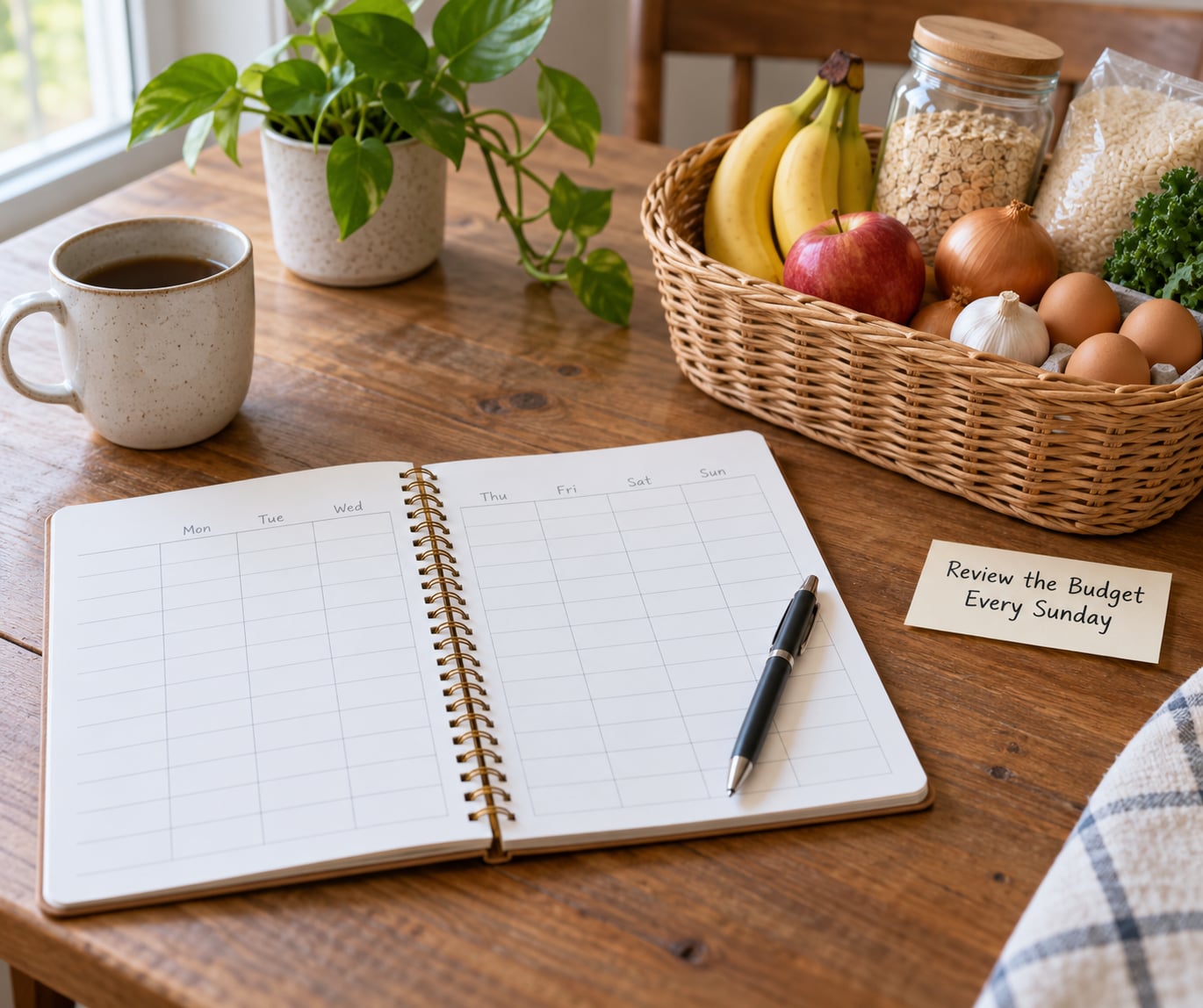
Spend fifteen minutes on the same day each week. Compare actual spending against the plan, write down the difference for each category, and make exactly one adjustment for the week ahead.
The difference is the number that teaches you something. A category running well under plan for four weeks straight is a candidate for a small cut. A category over plan every week means the limit was fiction, not a discipline failure.
Tell the difference between an adjustment and a reaction. Prices rose, the household got bigger, and a big monthly purchase landed early: those are reasons to revise the plan. One impulsive basket is not.
When a week goes over, look at what is already in the fridge and build the next meals around it. Extra portions from dinner become the next two lunches, which quietly replaces an unplanned restaurant meal and repairs the week without starting over.
Common Mistakes
Almost every failed budget comes down to one of six errors, and each has a simple correction.
Starting from a wish instead of receipts. Set the target at 70 percent of what you spend and watch it collapse. Fix: use step 2’s baseline, then cut 10 percent at most, and give it a month before touching it again.
Forgetting the irregular purchase. A monthly bulk run, holiday food, or a restock of paper towels looks like a catastrophe in the data. Fix: keep an irregulars category and fund it monthly, so it never lands as a surprise.
Counting rewards twice. Applying a coupon in the store and then subtracting the discount again from your records understates a category. Fix: record what you actually pay, then note coupons separately as a habit you track, not a number you subtract.
Comparing unit price to total cost. The better value on the shelf is not the better buy if it will sit unused for six weeks. Fix: compare unit price only between items you will finish at the same rate.
Shopping without a pantry-based list. A list written without opening the cupboard produces duplicate purchases and an overage every trip. Fix: inventory first, list the gaps, and treat the written list as the whole permission to buy.
Abandoning the plan after one bad week. A single overage is data, not failure. Fix: do the Sunday review anyway, make one adjustment, and continue. The budget you keep adjusting beats the perfect one you abandon.
Simple Tips for Staying on Track
These are repeatable habits, not restrictions. Most households that succeed on a small budget are not eating worse, they are buying the same food with less thrown away.
- Cook once, eat twice. Every dinner you cook produces the next day’s lunch for free. Sandwiches built from the leftovers you already planned are the cheapest meal in the house.
- Freeze before it turns. Bread, sliced meat, grated cheese, and overripe bananas all freeze well. Freezing turns a perishable into a future meal instead of a loss.
- Plan a substitute slot. Decide one protein and one vegetable each week that you can swap in without rewriting the whole menu.
- Buy for the household, not the shopper. One hungry person in the house can undo a careful list. Decide the week’s quantity before anyone goes.
- Keep a separate want list. A second list for nonfood and impulse items keeps the grocery total clean and makes the extras visible without judgment.
- Watch the shelves. Stores put their highest-margin items at eye level. The top and bottom shelves are where the basics and the better values sit.
Give it a month before deciding whether it works. Most people find their comfortable level by adjusting in small steps over several weeks rather than by picking the right number on day one, and a supermarket cheese shortlist is a good example of a category with a real ceiling you can plan around.
Frequently Asked Questions
Should my grocery budget include restaurant meals and takeout?
No. Keep restaurants, takeout, coffee, and convenience store visits in a separate line so you can see each one clearly. Mixing them hides the real cause of an overage: if your grocery cart is under limit and your food total still climbs, dining out is where the money went. Many households give dining out its own small weekly allowance and treat it as a planned expense rather than a failure.
How much should I budget for groceries per person each week?
Divide your own weekly grocery limit by the number of people eating at home, then compare that per-person figure with what you actually spend now. That number beats any published average, because region, household size, and how often you eat out move it more than any national figure does. Revisit it every few months as prices and your household change.
How do I adjust a grocery budget when prices change?
Do not change all the categories at once. When prices rise, trim the flexible categories first and leave staples alone for one month, then read the Sunday review to see whether the staples line actually moved. If it did, adjust it next. Changing the whole plan at once makes it impossible to tell which change helped and which one hurt.
Should I use grocery rewards and coupons in my budget?
Build the budget on what you pay without rewards, then treat rewards as a bonus rather than as planned income. Digital coupons clipped to items you already intended to buy are worth using every week. Rewards programs change their rules often, and budgeting as though a certain monthly rebate is coming back tends to hide a rising total.
What should I do if my grocery budget is too low every month?
Raise it in steps of about ten percent and keep the weekly review going, because a limit you exceed by half every month is a number that was never built from real spending. Also check the big one-off purchases and household staples for gaps. If cutting further would leave the food itself thin, use local food assistance programs rather than trying to budget around a shortfall.
Conclusion
Start tonight: pull your last two to four weeks of grocery spending, subtract the restaurants and takeout, and add up what is left. Divide that by the number of weeks, write it as one weekly number, and pick a single category to give a hard limit first.
That is how to make a grocery budget that survives a real month, because every number in it came from your own receipts. Review it on a fixed day, change one thing at a time, and expect the plan to need adjusting rather than abandoning.