
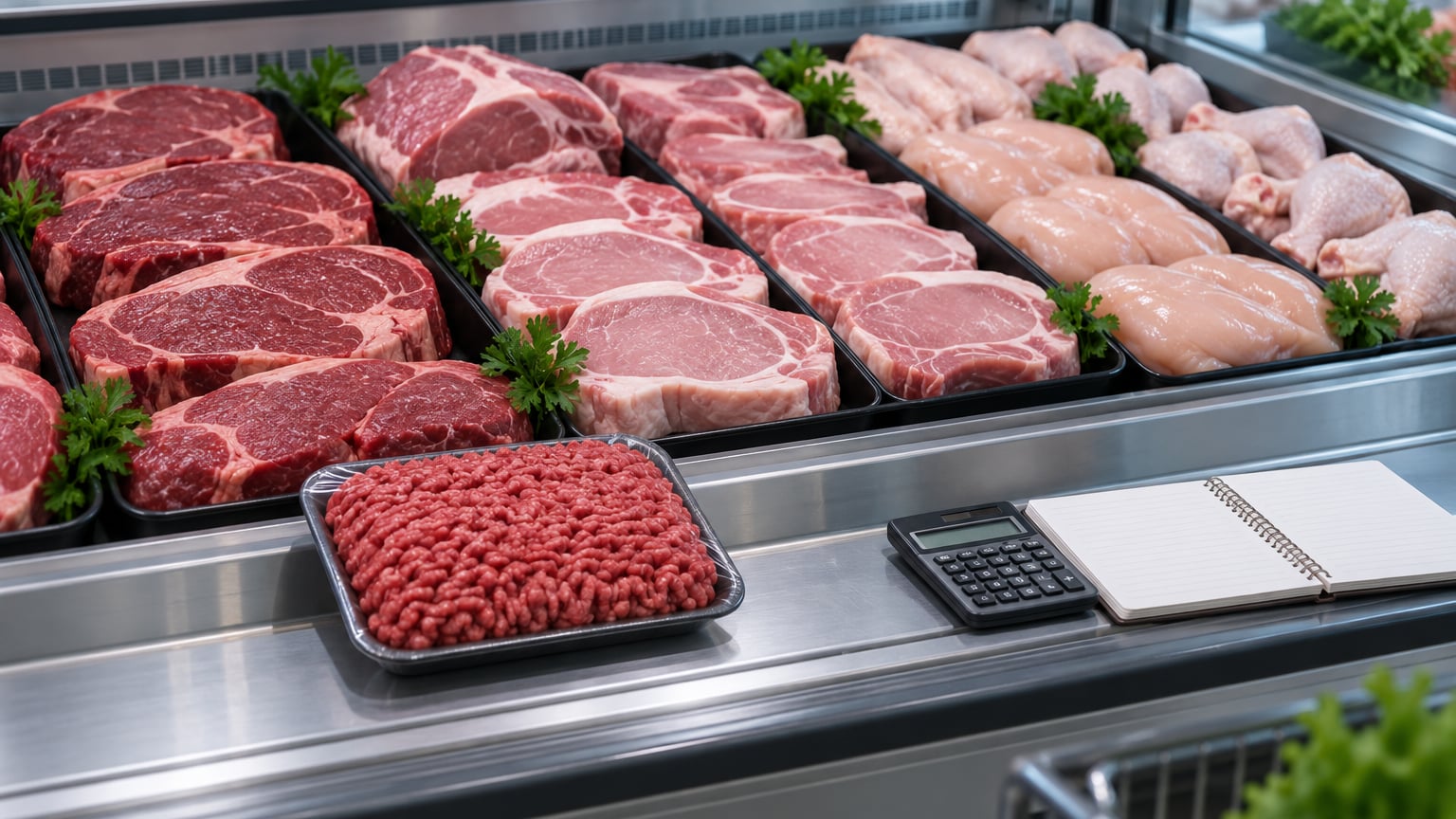
To save money on meat at the grocery store, compare the price per pound instead of the package price, swap premium cuts for value cuts that suit slow cooking, buy whole uncut roasts and slice them yourself, and freeze sale buys in single-meal portions so nothing spoils. Most of the savings come from those four moves, and they take about ten extra minutes a week.
Meat is usually the most expensive line on a grocery bill, and it is also the item most often thrown away. Shoppers who treat those as two separate problems lose twice: they overpay for convenience and then pay again for what they never ate.
Here is the short version of the system, then the details. Every tactic below is store-agnostic, works without a chest freezer or a vacuum sealer, and costs nothing but attention.
- Compare the unit price per pound, not the sticker price.
- Trade premium cuts for value cuts built for slow cooking.
- Buy whole uncut roasts and cut them into steaks yourself.
- Drop from Prime to Choice or Select unless the dish is a steak.
- Shop warehouse clubs and butcher counters for uncut bulk.
- Buy marked-down meat late in the week, in low-traffic stores.
- Portion and freeze bulk buys in single-meal packages.
- Remove air and label every package with the date.
- Keep a written list so meat does not get bought twice.
- Stretch meat with vegetables, grains, and legumes.
- Use bones, trim, and fat for broth and cooking.
- Grind big cuts at home instead of buying pre-ground.
Now the process behind each one.
Table of Contents
What You Need
Five things, and none of them cost money.
- A loose meal plan for the week. Not a strict calendar, just a list of the meals you actually intend to cook and roughly how many people you are feeding.
- A written grocery list. A phone note counts. The written part matters because memory is how meat gets bought twice.
- A meat budget for the week. Pick a number you can live with and divide it by the number of meat-based meals. That gives you a target cost per pound before you walk through the door.
- A unit-price habit. Learn to read the small shelf tag that shows price per pound, and do the division in your head rather than trusting the eye.
- A record of what your household finishes. A note on the fridge listing the last three dinners is enough. Most waste comes from buying for meals nobody cooked.
A small calculator app or a pen in your bag helps with the division, but eyeballing gets you most of the way. The habit matters more than the tool.
Step-by-Step: How to Save Money on Meat at the Grocery Store
Plan Meals Before You Shop
A plan fixes the quantity problem before it becomes a price problem. Without one, you buy whatever looks good in the case, and the price tag stops mattering.
Write down the meals first, then look at what you already have. Two chicken thighs left in the freezer plus a bag of rice becomes a meal, and that meal removes a chicken item from the list.
Plan for cuts that repeat. A whole pork shoulder can become pulled pork for two dinners, cubed pieces for a stir-fry, and a handful of slices for sandwiches. One purchase, three meals, a third of the cost per serving compared with buying each ready-made version separately.
If deli meat is a big part of your week, our notes on cheap sandwich builds that skip expensive deli meat fit naturally here, because lunch meat and dinner protein compete for the same budget line.
How to Compare Price per Pound Instead of Package Price
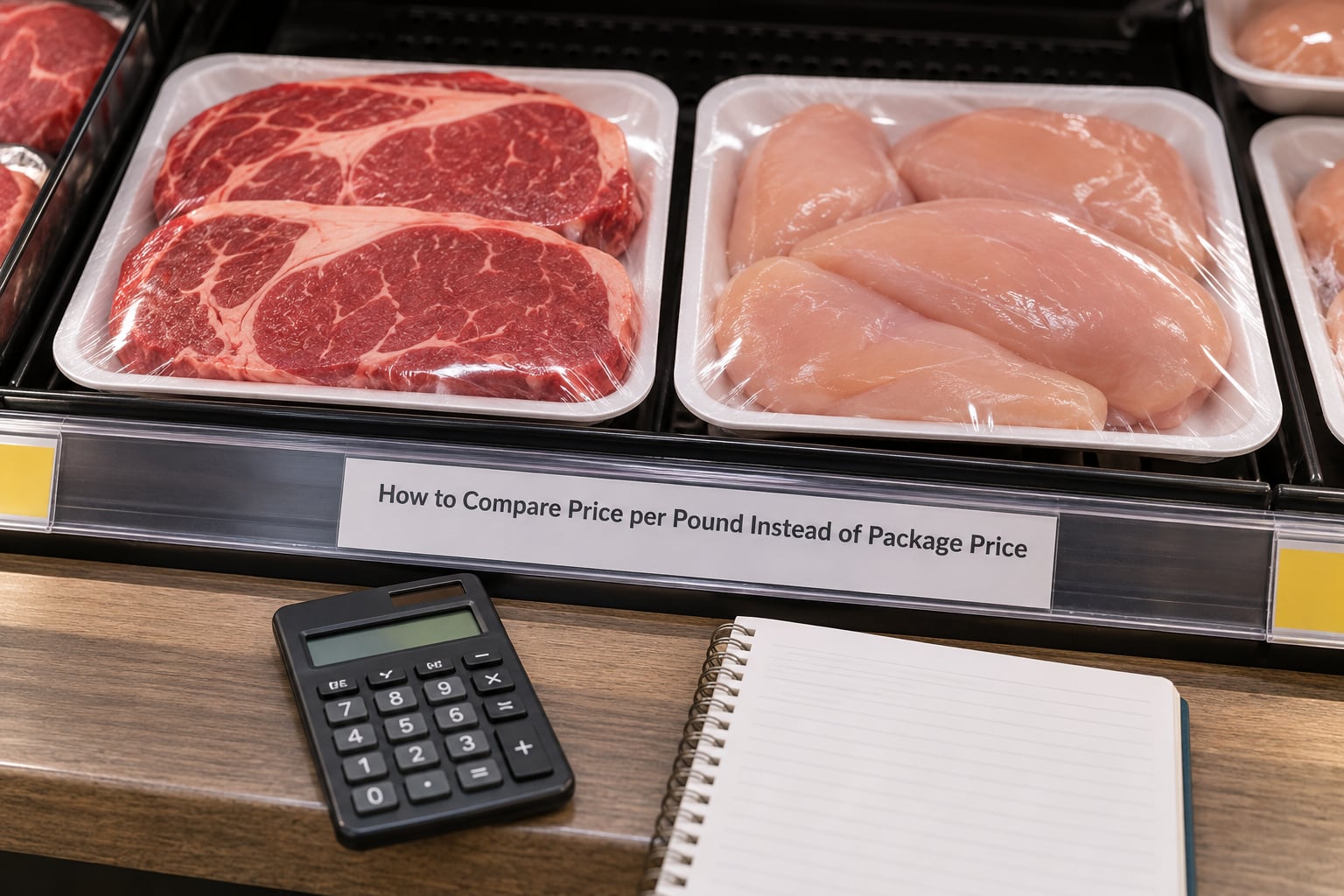
The unit price is the only number that lets you compare two different products. It is printed small on the shelf tag, and it is also the fastest way to see through a fake sale.
The calculation is simple: divide the package price by the total weight, then divide by 16 to get the price per ounce if you want to compare a deli pack against a fresh cut.
Here is how it plays out in practice. A 3.5 pound package of ground beef sitting next to a 1.25 pound roll often has the higher sticker price and the lower cost per pound. A 12 ounce vacuum pack of pre-sliced steak frequently costs more per pound than a whole strip loin sitting three feet away, because the slicing and the vacuum packaging get priced in.
That last example is where the biggest single saving sits. Buying uncut and slicing it at home is the cheapest way to buy steak, and a sharp chef’s knife and about fifteen minutes of free time are the entire requirement.
A rib roast can be cut into ribeyes, a whole tenderloin into steaks and tenderloin strips, and a strip loin into New York strips. Mark the cut lines with a knife before you start, slice across the grain, and keep premium cuts at an inch thick or thicker so they stay tender.
Read the tag before you pick up the package. The total price is on the front and the per-pound figure is on the small label at the bottom or on the shelf rail, and a markdown that only takes the sticker price off while the unit price stays flat is not the deal it looks like.
For a per-meal view of the same habit, we broke down whether cooking and slicing your own lunch meat actually costs less.
Choose Cuts and Formats That Work Hard
Cheap meat is not a mystery item. It is muscle that needs time and moisture, and it comes from parts of the animal that nobody wants at a dinner party.
Beef: chuck roast, bottom round, top sirloin, flank steak, skirt steak, beef shank, and tri-tip are all budget cuts. Brisket is cheap for what it is, since a packer who sells you the point cut wants the flat out of it anyway.
Pork: pork shoulder, pork butt, country-style ribs, and picnic shoulders cook low and slow and turn into pulled pork, stew, and chili. Fresh ham and pork tenderloin are mid-range, and the shoulder is where the real savings sit.
Chicken: thighs, drumsticks, and bone-in pieces cost less per pound than boneless skinless breasts and have more flavor. Wings and leg quarters are cheap, and leg meat shreds beautifully into sandwiches and salads.
Ground meats: regular ground beef for burgers and chili, ground turkey for a lighter version, and ground pork when you want more flavor for the same cost. Store brands usually win here on price per pound, and the difference is hard to taste in a heavily seasoned dish.
That said, some upgrades earn their cost. A good thick steak cooked properly beats a thin cheap one every time. Prime and Choice beef carry more marbling than Select, and you pay for that fat. If the cut gets seared and served plain, the grade is worth noticing; if it goes into a slow braise with onions and peppers, Select is plenty.
Here is roughly where budget options sit against each other on cost per pound:
| Protein | Budget-friendly cut | Relative cost per pound | Best use |
|---|---|---|---|
| Beef | Chuck roast, bottom round, beef shank | Lowest of the beef options | Pot roast, stew, chili, braised dishes |
| Beef | Top sirloin, flank, skirt steak | Low to mid | Stir-fry, fajitas, sliced sandwiches |
| Beef | Rib roast or strip loin bought uncut | Mid | Slice into steaks at home |
| Beef | Tenderloin or ribeye bought pre-cut | Highest of the beef options | Special occasions |
| Pork | Shoulder, butt, picnic shoulder | Lowest of the pork options | Pulled pork, chili, stew |
| Pork | Country-style ribs, leg of pork | Low to mid | Slow roasting, roasting dinner |
| Chicken | Thighs, drumsticks, leg quarters, wings | Lowest of the chicken options | Roasting, braising, sheet pan meals |
| Chicken | Boneless skinless breasts | Highest of the chicken options | Quick weeknight meals, meal prep |
| Ground | Store-brand ground beef or turkey | Lowest overall | Burritos, chili, meat sauce, meatloaf |
| Ground | Premium branded ground beef | Highest of the ground options | Burgers where texture matters |
Two more format choices change the price fast. Vacuum-sealed and cryovac-packed cuts usually cost less per pound than the same cut in a foam tray, because you are not paying for a tray and a film. And ground meat bought in bulk tubes is almost always cheaper per pound than the pre-ground tray, even after you account for the cost of grinding it yourself.
Home grinding large cuts is the standard answer on budget cooking forums, and it pays off quickly. Grinding also lets you set the fat content instead of guessing at it.
Buy the Right Amount and Avoid Waste
The cheapest meat is the meat you eat. Buying a bulk package for one recipe is where savings evaporate.
Estimate servings before you buy: a quarter pound of boneless meat per adult per meal is a workable planning number, more for active households, less for children and for dishes served over rice or vegetables. Multiply by the number of meals, then round up a little rather than a lot.
Buy smaller packages when you are unsure about freshness or when the household is one or two people. Two small packages of chicken thighs usually beat one large tray, and the size of a family should not change how you shop.
For bigger buys, portion before freezing rather than freezing one solid block. Separate it into bags or wrap sized to the meals you cook, because a frozen roast only gets used if someone planned a meal for it. A note about our comparison of pre-packaged and deli-counter lunch meat makes the same point about convenience and cost.
Cooked meat has a second life. A roast that feeds four on Sunday becomes sandwiches on Monday, stir-fry on Tuesday, and soup on Wednesday, and each of those servings costs less than a fresh package would have.
Use Sales, Store Brands, and Seasonal Deals
A sale only saves money if you would have bought the item anyway. Freezer space turns a real markdown into a genuine discount, and impulse purchases turn it into spending.
Store meat is marked down for predictable reasons. Meat reaches the end of its display window, a case was over-ordered for a holiday weekend, or a truck arrived warmer than planned. Markdowns cluster late in the week and late in the day, with Sunday afternoon and Monday morning the pattern shoppers report most often. Low-traffic stores clear faster than busy ones.
Yellow clearance tags on meat have shown up in shoppers’ photos at half the original amount, which tells you two things: steep discounts exist, and you find them in the case, not on the shelf. Walk the whole case before you decide.
Store brands are usually the cheapest option on meat, and the gap is largest on ground meats, chicken thighs, and pork shoulder. Compare the unit price per pound rather than the sticker, and skip the brand comparison entirely for cuts destined for a slow cooker.
Season matters too. Grilling season promotions, holiday weekends, and the January clearance after New Year are when prices dip most. We buy extra in January, portion it, and cook our way through it by March.
Use the store app and the weekly circular before you go, not in the aisle. Prices vary by region and change often, so check two or three stores and compare the unit price for the same cut. If a warehouse club is an option, the annual membership fee matters only after you compare its per-pound price against your supermarket for the same week.
Store Meat So Your Savings Last
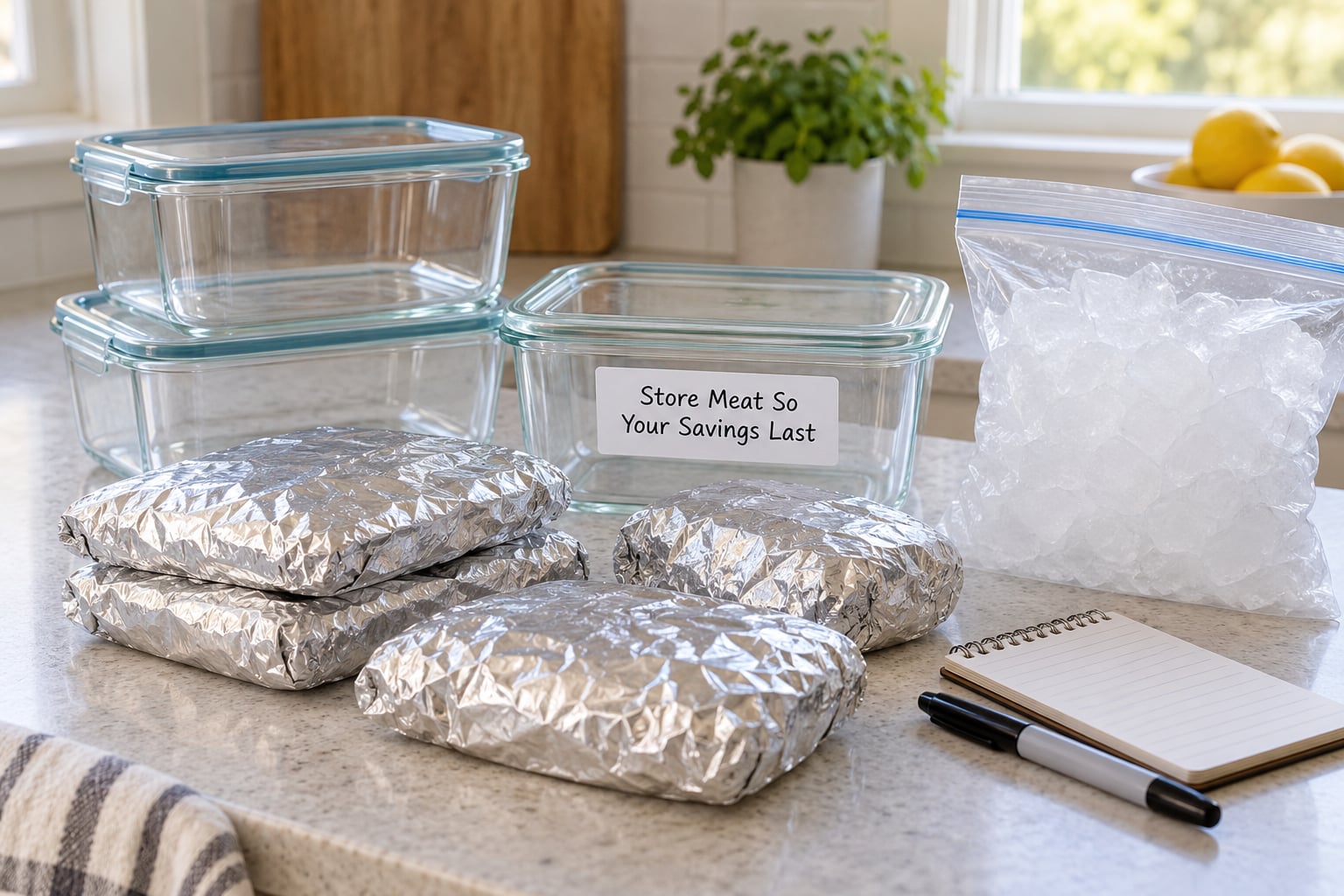
Storage is where budget meat gets wasted. Get this right and a sale buy is genuinely cheap; get it wrong and you pay full price for freezer-burned meat you throw out.
Refrigerate promptly. Keep fresh steaks, chops, and roasts one to two days in the coldest part of the fridge. Ground meat and poultry also get one to two days. Raw meat always goes on the bottom shelf in a tray or pan so nothing drips onto other food.
Freeze in portions. Seal out the air, flatten the package so it stacks, and write the cut and the date on it with a marker. Squeeze the air out of a freezer bag or use a vacuum sealer, and double-wrap before a second layer for anything fatty.
People ask constantly whether foil or plastic wins, and the answer is that both work when air is removed. Plastic freezer bags are cheap and clear, which makes dates easy to see. Heavy foil is airtight and handles oddly shaped cuts better. Wax paper and parchment alone are not airtight enough on their own; they work as a layer inside a sealed bag. Vacuum sealing gives the longest storage life, and press out the air by hand if you do not own a machine.
Quality holds up best in the first three months and stays good for most cuts up to about twelve. Ground meat is the one to use first.
Thaw in the refrigerator. Plan about a day per steak or chop and two to three days for a thick roast. Cold water in a sealed bag works if you cook the meat straight away, and the counter is not an option, because the outside warms into the food-safe zone long before the center thaws.
Cook to a safe temperature. Poultry reaches 165F, ground meat reaches 160F, and whole cuts of beef, pork, lamb, and fish reach 145F with a three-minute rest. Use a thermometer. It is the cheapest tool in the kitchen and it takes the guesswork out of the exact cooking time that every other tip here depends on.
Before freezing a large buy, trim and separate: bones into a bag for broth, usable trim into the ground meat, and fat into a jar for cooking. Nothing goes to the bin, and the broth alone can cover the cost of the roast.
Common Mistakes
These six mistakes cost more money than any single tactic on this page saves.
Shopping without a list. The fix is the list, written before the door. One practical rule: only buy meat on the list or on a written markdown find, and if it is not on the list, it does not go in the cart.
Judging value by package price. A cheaper sticker can mean a worse deal. Divide by the weight every time, and ignore any sale that does not lower the unit price.
Buying bulk too early. A freezer full of meat with no plan is a cash investment you never cashed out. Buy bulk when you have two or three meal ideas already written for it.
Freezing meat in its store packaging. This is the single most common freezer-burn mistake, and shoppers and butchers both name it. Repackage or repurpose the tray once you get home, on the same trip.
Reading use-by dates as a safety warning. On most raw meat, the date is about quality and freshness, not safety. Judge safety by smell, temperature, and how you handled it, and cook or freeze markdown meat promptly rather than letting it sit.
Buying every sale. If the item was not on your list, the sale is a spending event, not a saving. The coupon does not care what you needed.
A couple of smaller traps worth naming: paying for a bone-in cut when you will debone it yourself anyway and discarding the bone, and buying a full family-size package in a one or two person household. Both are easy to avoid once you know they are happening.
Frequently Asked Questions
Is buying meat in bulk always cheaper?
Usually, but only when you already have the freezer space and a plan to eat it. Bulk pricing is lower per pound because the butcher and retailer both save handling and packaging. If you buy a bulk package without meals already planned, the higher unit price is offset by whatever you end up throwing away. Bulk buys make sense after a markdown, with a chest or deep freezer, and for a household that cooks several meat meals a week.
How can I tell which meat package is the best value?
Read the unit price on the shelf tag and divide the package price by the total weight. Compare that figure across packages, stores, and cuts rather than the sticker price. Weight matters too: vacuum-sealed and cryovac packs cost less per pound than the same cut on a foam tray. A rough guide for a family of four is that a raw whole cut priced per pound usually beats the equivalent pre-sliced package.
Is frozen meat cheaper than fresh meat?
Frozen meat is often the better value, mostly because it is sold in larger packages and does not get marked down for spoilage the way fresh meat does. Store-bought frozen cuts usually hold their quality for about twelve months if air is sealed out, and best quality lands in the first three months. Buy it on sale, portion it into single-meal packs, and thaw it in the refrigerator rather than on the counter.
What is the most affordable meat for regular meals?
Ground meats are the cheapest per pound, and store-brand ground beef or turkey is usually the lowest-cost option for weeknight meals. For whole cuts, look at bone-in chicken thighs and drumsticks, pork shoulder and picnic shoulder, and beef chuck roast, bottom round, and beef shank. These are cheap because they need slow cooking, so pair them with a pressure cooker, a slow cooker, or a long oven braise.
How should I store groceries to prevent meat from spoiling?
Refrigerate raw steaks, chops, and roasts on the bottom shelf for one to two days, and keep ground meat and poultry on the same schedule. Freeze bulk buys in single-meal portions with the air squeezed out, labeled with the cut and date. Thaw only in the refrigerator, about a day per steak or chop. Cook poultry to 165F, ground meat to 160F, and whole cuts to 145F with a rest.
Should I buy meat on sale or wait for a lower price?
Buy on sale when the item is already on your list and you have freezer space for it. Regular sales come around on a predictable rhythm, and markdown meat shows up late in the week and late in the day, with Sunday afternoon and Monday morning the most commonly reported windows. For items you rarely eat, waiting usually wins. For a cut you buy every week, the sale is the better move.
Start with the unit price this week. It costs nothing, it applies to every cut in the case, and once you start dividing by weight you will notice the difference in the first trip.
Then write down the three meals you are most confident about cooking, and buy meat that fits them instead of meat that looks good. Most of the money saved in our own shopping comes from that one change.
Everything else on this page, the markdown timing, the freezing, the grinding, the bones into broth, works on top of those two habits. Skip the first two and the rest is just tidying up.