
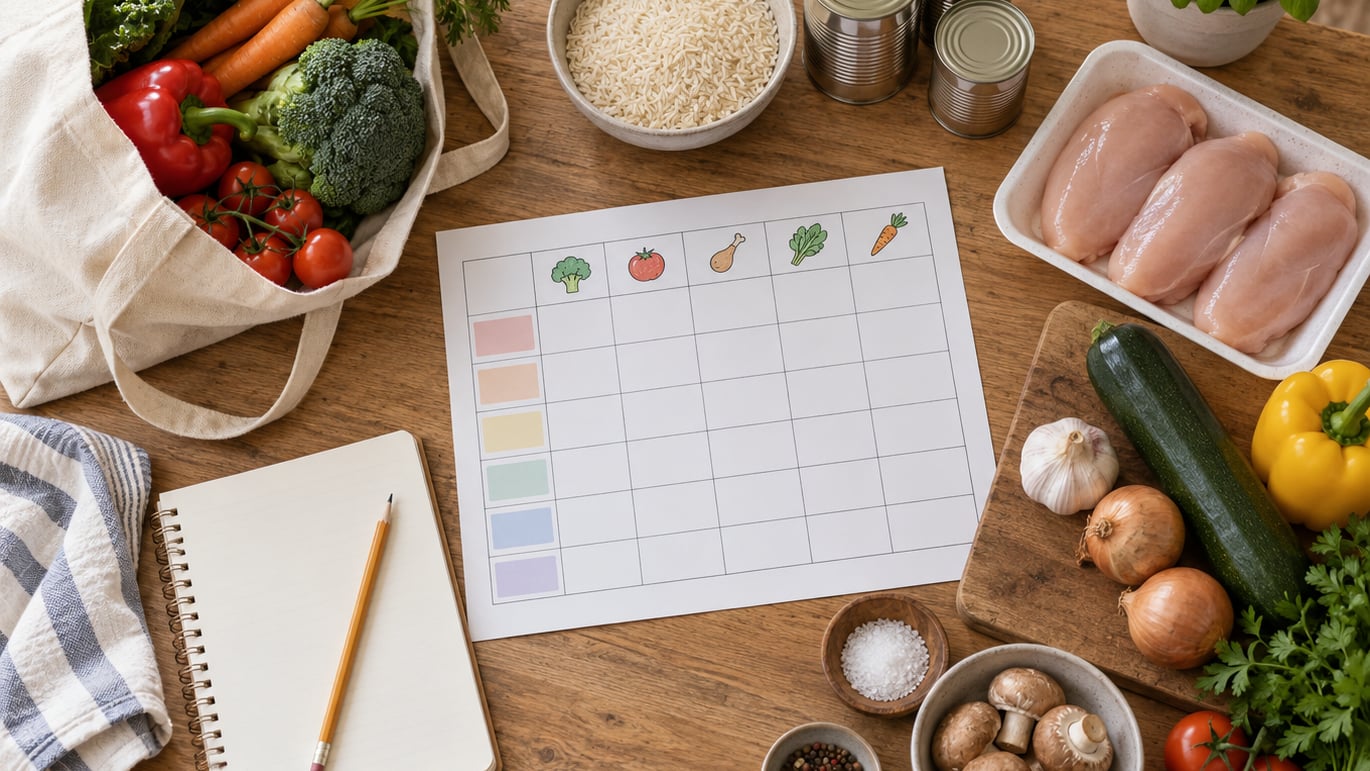
A weekly meal plan is a written schedule of what you’ll eat for breakfast, lunch, and dinner across seven days, plus one grocery list that covers every ingredient it needs. Learning how to make a weekly meal plan takes roughly half an hour: check the week ahead, check your pantry, choose meals that share ingredients, and write them down.
That last part is the whole trick. People don’t fail at meal planning because they lack recipes. They fail because the plan lives in their head, gets built at 6pm on a Wednesday, and assumes a calm hour of cooking that a Tuesday with a late meeting doesn’t have.
The method below takes about 30 to 45 minutes, most of it on a Sunday or a quiet Saturday morning. It works for a household of one or a family of six, and it assumes you’ll mess up at least one dinner a week, because you will.
You can see the method at work in our best meal-prep lunches that don’t get boring by Thursday and in how we handle meal prep sandwiches for the week without soggy bread. Lunches are where most plans quietly fail, because dinner leftovers only cover so many days.
Table of Contents
What You Need
Nothing here requires an app or a paid planner. A phone note and a pen do the same job. What you need is honest information about your week.
- Your household’s actual schedule. Every commitment that lands between 5pm and 9pm: practices, appointments, shifts, pickups, travel.
- Dietary and preference notes. Allergies, medical restrictions, the one kid who won’t eat anything green, the athlete who needs more protein.
- A budget ceiling. A rough number, not an exact one. It keeps the plan from quietly drifting into two extra restaurant nights.
- Your real cooking time on a weeknight. For most homes that’s 20 to 35 minutes from counter to table.
- A look inside the pantry, fridge, and freezer. Include the half-open bag of rice and the freezer bag of unidentified chili.
- Somewhere to write the plan. A paper calendar, a whiteboard, a notes app, a dedicated meal planner. Whatever you’ll actually look at.
- A grocery list that follows the store’s layout. Same order as the aisles means you walk the store once.
If you only do one thing before planning, do the inventory. Planning meals around food you already own is the single cheapest way to cut both waste and the grocery bill.
Step-by-Step
Step 1: Set the Week’s Priorities
Count the people you’re feeding, then mark the calendar. Which nights are genuinely full, which are open, and which one night a week you want to leave completely unplanned for takeout or leftovers from someone else’s cooking.
Then decide how much time you can realistically spend cooking on a weeknight. Answering honestly matters more than answering generously. If your honest answer is 20 minutes, every meal on the plan needs to come together in 20 minutes, and slow cooker or pressure cooker meals count as effort because they still need chopping.
Pick your priorities before you pick recipes: what has to be homemade for allergy reasons, what needs to happen for a cultural or religious reason, and what is simply flexible.
Step 2: Choose a Meal Template
Most successful weekly meal plans are the same shape, which is why they take five minutes to build: a protein, a vegetable, a grain or starch, a sauce or seasoning, and one side. Write that formula on the template, then fill in from a short rotation of meals you already know how to cook.
Build repeatable patterns rather than new recipes. Three breakfasts you rotate between, three or four lunches, and five or six dinners will carry a week comfortably. If a meal is new to you, cap it at one a week. Two new recipes in the same week is how people end up ordering pizza on Wednesday and resenting the plan.
The plate method is useful while you’re filling it in: roughly 40 percent vegetables, 40 percent carbohydrate, 20 percent protein is a common split for weight-conscious households. It’s a guide, not a law, and it works best as a check on meals that are drifting toward all starch.
Step 3: Build a Flexible Meal Calendar
Place meals across the week by reuse, not by recipe excitement. Cook a large batch of something Monday and it becomes Tuesday’s lunch; roast two chickens and Thursday is already handled.
Deliberately schedule two flexible slots: one night for leftovers, one night that’s a fallback. A fallback is a short list kept on the fridge — rotisserie chicken with bagged salad, eggs and toast, take-and-bake pizza, a tin of soup and a sandwich. It costs you nothing and it is the thing that keeps a bad Tuesday from turning into a wasted week of groceries.
Leave one night unplanned on purpose. People who plan every single meal quit the plan within a month.
Step 4: Make Your Shopping List
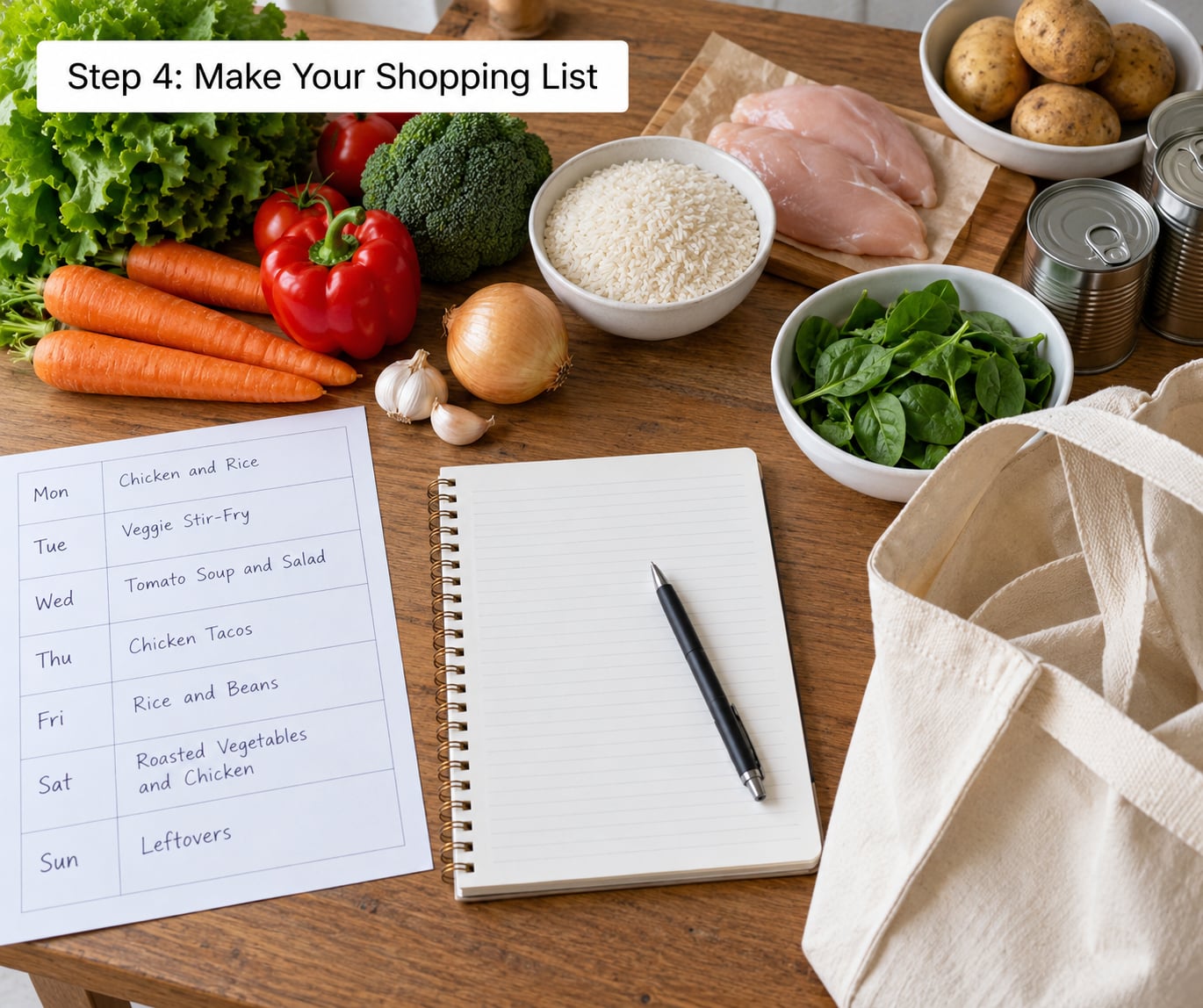
Turn the calendar into a list of ingredients, not a list of meals. Every carrot in three recipes becomes one entry with a number next to it, not three entries.
Then sort the list into the order you’ll walk the store: produce, bakery, deli, meat and seafood, dairy, dry goods, canned, frozen, household. Check the pantry again before you leave the house, not in the middle of aisle six.
Watch the store’s weekly ad while you’re at it, and shift one or two meals toward whatever is genuinely marked down and something you’d eat anyway. Checking the circular before you shop also tells you whether the ingredient you need is even coming, which saves a second trip for a single item.
Step 5: Prep Only What Helps
Useful preparation saves time at the moment of cooking. Washing greens, chopping vegetables, measuring seasonings into small jars, cooking a pot of grains, and portioning proteins into containers ahead of time all make a 30-minute dinner into a 15-minute one.
Skip preparation that creates a second dish to wash or spoils faster than you’d like. Peeling thirty potatoes the night before is not a time saver; it’s a chore moved earlier in the week. The same goes for anything that goes soggy sitting uncovered for two days — those meal prep containers that don’t leak matter more than people expect, because a leaked lunch never gets eaten.
The habit that pays best is the night-before reset: take the chicken out of the freezer, put the slow cooker on the counter, set the cutting board out. Ten minutes the night before removes most of the friction the next evening.
Step 6: Protect Food Safety and Freshness
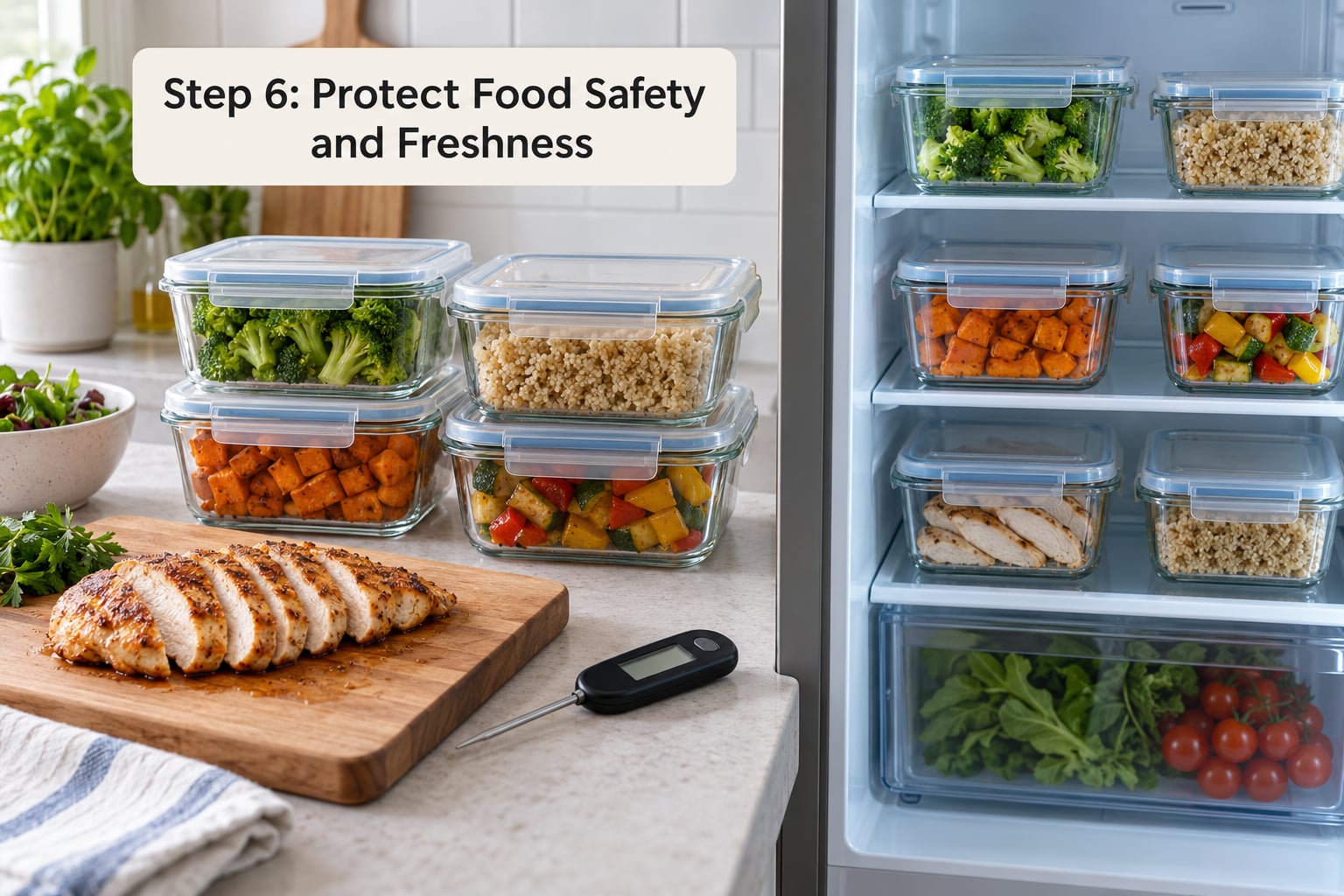
Cooked food belongs in the refrigerator within two hours, and refrigerator temperatures should stay at or below 40°F (4°C). Cooked leftovers keep about three to four days in the fridge, so plan which two or three leftovers you’ll eat early and which one goes in the freezer.
For reheating, aim for 165°F (74°C) for leftovers, and check with a thermometer rather than guessing. Safe minimum internal temperatures are 165°F (74°C) for poultry, 160°F (71°C) for ground meat, and 145°F (63°C) for whole cuts of meat and fish.
Raw poultry and raw ground meat belong on the bottom shelf of the refrigerator, in a tray if you can manage it. Thaw in the refrigerator or under cold running water, never on the counter, and move frozen meat to the front of the plan so it has time to thaw.
Cooked grains and roasted vegetables keep three to four days. Deli meat and opened hot dogs last three to five days after opening. Freeze anything you know you won’t eat within that window and label it with what it is and the date.
Step 7: Review and Reset Your Weekly Meal Plan
On the last day of the week, spend five minutes noting what actually got eaten. Note the meals that worked, replace the ones nobody touched, and note which ingredients sat unused so you buy less of them next time.
Carry leftovers forward deliberately. This week’s roasted chicken and rice become next week’s sheet pan dinner if you planned the extra portion on purpose, rather than discovering three lonely containers in the fridge on Monday and treating them as a problem.
Week two should be faster than week one. After a month you have a rotation you trust, and planning drops to fifteen minutes because you’re rearranging known meals instead of searching for new ones. That’s the whole method working as intended.
Common Mistakes
Planning seven brand-new recipes. Fix: cap new meals at one per week. Familiar meals you can cook on autopilot are what make the plan survive Wednesday, and nobody has ever been impressed by a Tuesday sheet pan dinner they had to look up.
Shopping before you plan. Fix: reverse the order every time. A list written from the plan is short and specific; a list written from hunger in the store is long, expensive, and half forgotten in the fridge door.
Ignoring leftovers. Fix: write leftover nights onto the calendar as real meals with real slots. If they’re not scheduled, they compete with something else and get skipped.
Making every night identical. Fix: vary one dimension, not all of them. Three dinners can all be grain bowls and still feel different if one has roasted chicken, one has chickpeas, and one is whatever’s left in the crisper.
Storing food without labeling it. Fix: label the dish and the date the moment it goes in, using a strip of tape or a masking pen. Unlabeled leftovers turn into an archaeology project within three days, and people throw out food they’d eat if they knew what it was.
Sizing recipes for four people when there’s one. Fix: cook the base and season per serving, or freeze the extras flat on the day you cook. Three days of the same dinner is what makes people quit a plan, and a recipe written for four is the usual reason a single person ends up eating the same thing Thursday through Saturday.
Forgetting the flexible meal. Fix: keep one night empty and one fallback list visible. Systems that assume the week will hold are the ones that fail hardest in the middle, and the fix is planned for in advance.
Frequently Asked Questions
How long does meal planning take each week?
Budget 30 to 45 minutes for the first few weeks, then 15 to 20 minutes once you have a rotation of meals you trust. Most of that time goes to writing the calendar and building the grocery list. The shopping trip and any prep cook are separate, and adding another 60 to 90 minutes on Sunday for batch cooking gets you most of the week done.
How many meals should I plan for a week?
For one or two people, five to six dinners and three to four lunches is usually right, since that’s roughly what a package of protein or a bag of rice actually produces. For a family of four or more, seven dinners and five lunches works well because leftovers scale up. Add one flexible night you don’t plan at all, or the plan will feel like a failure the first time life happens.
Should I plan breakfast, lunch and dinner?
Plan all three if you eat breakfast at home most days, which is most people. Breakfast is the easiest slot to repeat, so two or three rotation options written once cover the week without extra effort. Lunch is the slot most plans skip and then abandon, because there is nothing to make a sandwich with. Planning dinner only and improvising lunch is the most common reason a plan stops working.
Do leftovers count as part of the meal plan?
They should. Leftovers are planned meals that already exist, so schedule them in a real slot on the calendar with a real portion rather than treating them as whatever happens to be in the fridge. Cook one or two dinners in a larger batch on purpose, eat half that night, and box the rest for later. Unused extras that were never scheduled are the single biggest source of food waste in a weekly plan.
What is the 3-3-3 rule for meal planning?
The 3-3-3 rule is a simple way to size a week’s meals: three breakfasts, three lunches, and three dinners per person, giving you nine planned meals in a household of one or a nine-meal rotation in a household of three. It’s a starting point rather than a law, and most households adjust it. The useful idea is having a number to scale your recipe and grocery quantities against instead of guessing.
What should I do when the meal plan falls apart?
Fall back instead of starting over. Keep a short list on the fridge of meals that need almost no cooking, such as rotisserie chicken with salad, eggs and toast, take-and-bake pizza, or soup with a sandwich, and use it without guilt. Eat the perishables first and freeze whatever won’t be touched in three or four days. A single rescued night costs nothing; abandoning the plan on day two is what wastes the whole week’s groceries.
Start tonight with the smallest possible version: check the calendar for next week, look inside the fridge, write down five dinners that reuse the same three or four ingredients, and build the list while you’re still thinking about it. Fifteen honest minutes beats a perfect plan you never get around to making. And put a fallback list on the fridge right now, before the week that needs it arrives.
Last updated October 2026.