
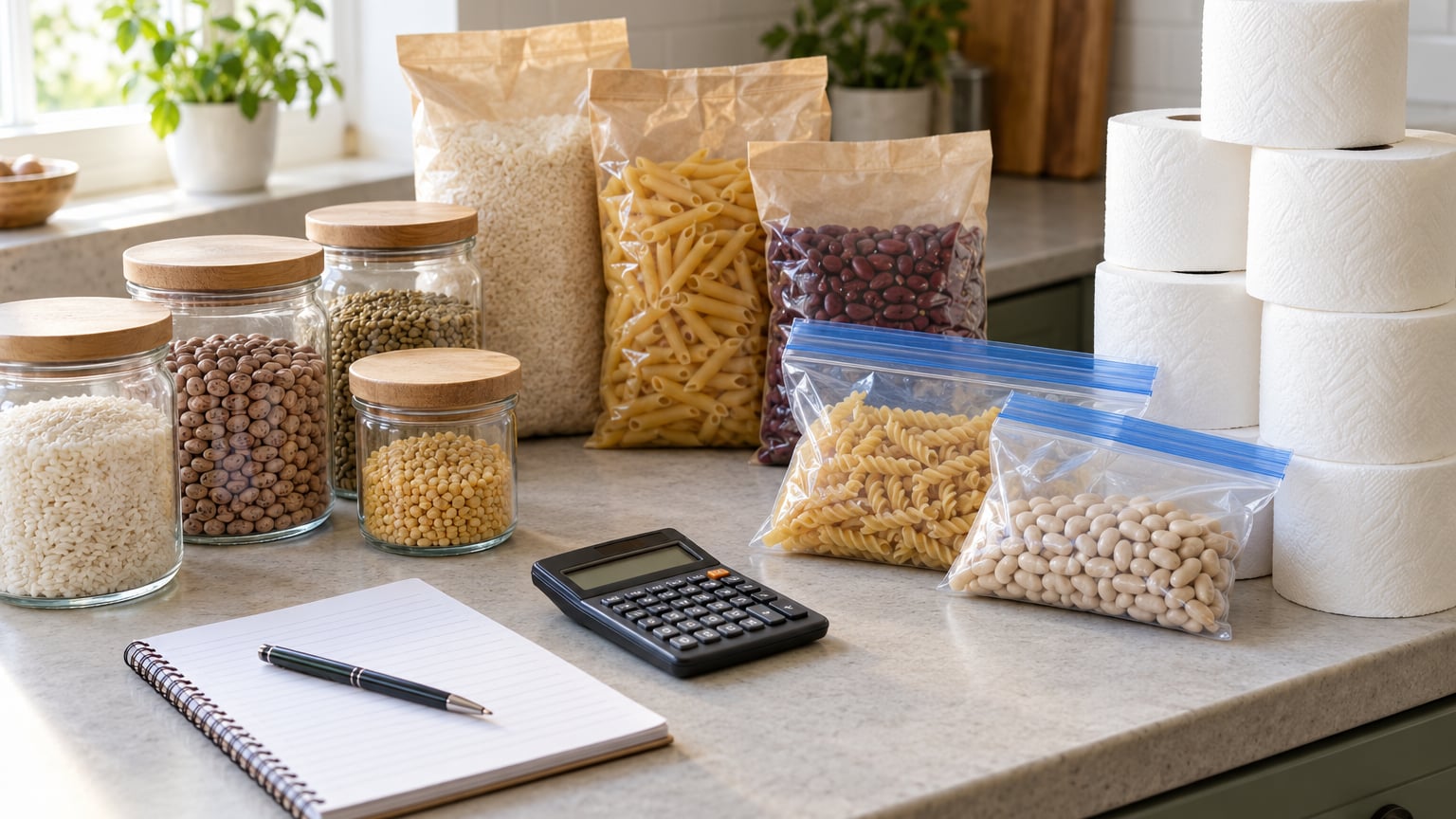
Bulk buying only saves money when you finish what you buy. The system that works is simple: know your real weekly use, compare unit prices instead of package totals, buy the smallest size that covers your cycle, and store it so it stays usable. Here is how to buy in bulk without wasting money, one step at a time.
I wasted three months of coffee beans in a single overbuy of pasta before I started writing down what we actually ate. Once the numbers came out of my head and onto a list, buying big stopped being a gamble. Most people do not need a bigger pantry. They need a smaller guess.
Table of Contents
What You Need
You do not need a spreadsheet template, a special membership, or a basement. You need six honest answers and about fifteen minutes. Here is the list.
- A spending ceiling for the trip. A single number for the whole basket. If you cannot name it, the basket will name it for you.
- A two-week inventory. Look in the pantry, the freezer and the fridge. Write down what you already own. This is the step people skip, and it is the reason most bulk hauls end in a landfill.
- Your real storage limits. Number of freezer bags you can lay flat, shelf space that does not double as a landing zone, and how many pantry containers you own.
- A list of regulars. The items you buy every single week or every single month with no hesitation. Those are your bulk candidates. The things you buy occasionally are not.
- A unit price calculator. The one on your phone is fine. Paper works too.
- Containers and labels. Reusable bags, glass jars, freezer bags, and a marker pen. Dividing one bulk purchase into smaller portions is what turns a large package into a monthly supply.
That is the whole kit. If you have those six things, you are ready to start the process.
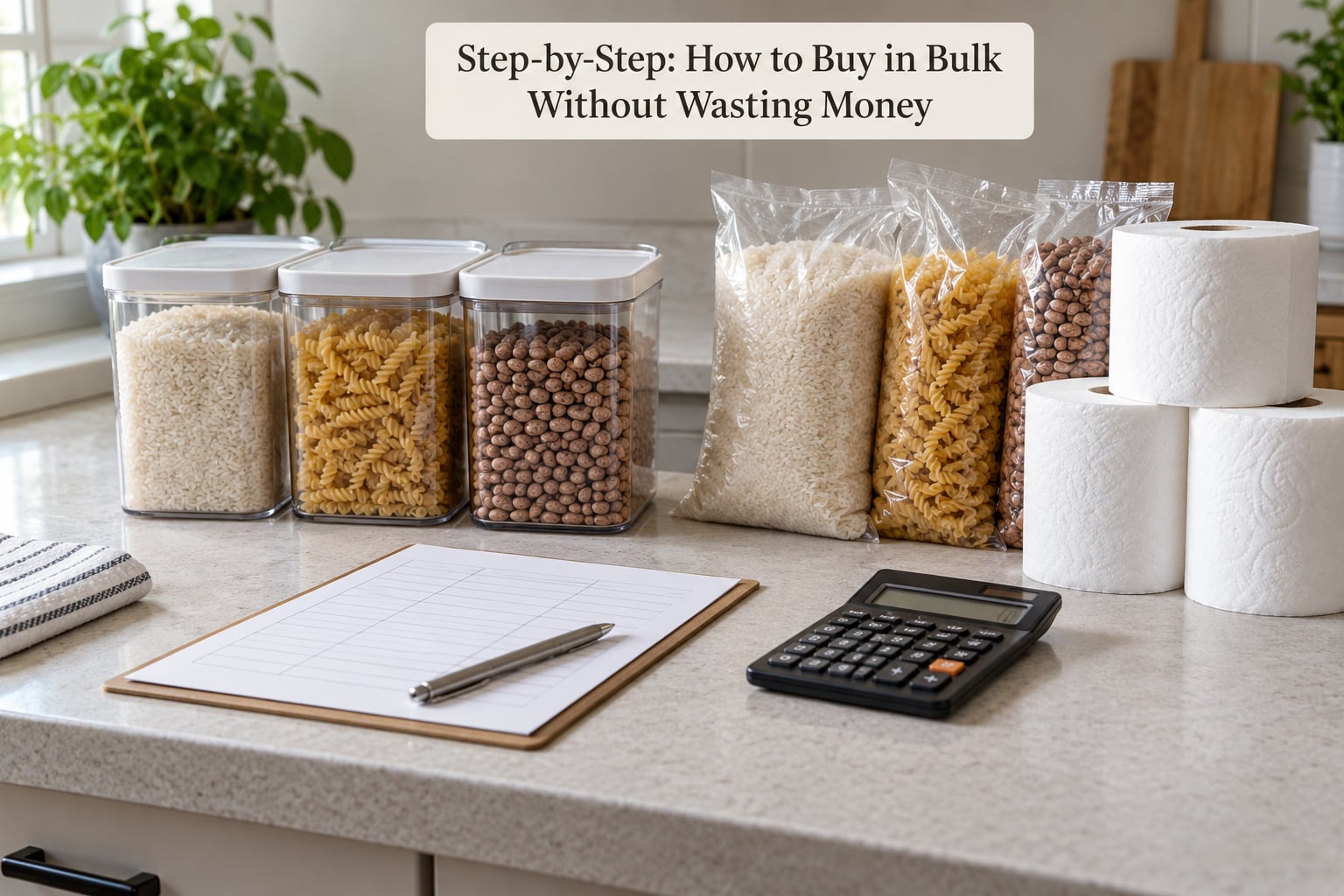
Step-by-Step: How to Buy in Bulk Without Wasting Money
Step 1: Calculate Your Real Household Needs
Start with what you already consume, not what you could theoretically consume. Pick five staples you buy every week — pasta, rice, canned beans, cooking oil, coffee — and count the units in the packages you currently buy. A family of four eating pasta four nights a week goes through roughly two standard boxes a month, so that is your number, not eight.
Now divide by time. Two boxes a month means one box every two weeks, so a family-size box that covers six weeks is two weeks past your cycle. That is the amount that quietly turns into leftovers. Your target quantity is your real monthly use plus about 20 percent, not a round number that feels generous.
How to buy in bulk without wasting money starts here, because every later decision depends on this estimate. Two weeks is the minimum tracking window I trust. Write down each purchase with the date and the quantity, then check the count at the end of the window. Households of one or two should track a full month instead, since their consumption is slower and a bad bulk purchase sits around much longer.
If your meals are planned in advance, your estimate gets sharper fast. Working out how to meal prep sandwiches for the week without soggy bread gives you a real number of portions a week, which is exactly the kind of data this step needs.
Step 2: Set a Budget and Choose Bulk-Friendly Items
Decide the ceiling before the cart moves, and hold the line even when the display looks too good to pass up. I use one number for the entire trip rather than a per-item budget, because per-item budgets turn into a dozen tiny justifications.
Next, sort your staples into three buckets. Frequent and shelf-stable items — rice, pasta, dried beans, oats, canned tomatoes, toilet paper, laundry detergent, trash bags, foil — are bulk-friendly. Frequent and perishable items — milk, fresh bread, ground meat, salad vegetables — are not, unless you freeze or use them within days. Occasional items — holiday baking ingredients, specialty snacks, bulk condiments — are where overbuying hides.
Large packages are not automatically the cheap option. They are cheaper only when the unit price drops and the quantity matches your cycle. A large bottle of shampoo is a genuine saving if everyone in the house uses it and the bottle is not bigger than your shower caddy. If you switch formulas often or travel light, the multipack is dead weight.
Build your list from the first bucket only. If the basket at the end of the trip contains anything from the other two, that is where the money goes.
Step 3: Compare Unit Prices Before You Buy
Unit price is the whole game, and it is one division. Take the total cost and divide by the number of usable units: ounces, pounds, rolls, servings, or loads of laundry. A 20-pound bag of rice is 320 ounces. Divide the cost by 320 and you have a number you can compare against any other bag, size, or store, regardless of what the label says.
For items you buy by weight, remember the tare weight. Most stores weigh your container first and subtract it, but the printed price per pound still counts every ounce inside, so ask for the tare or check that the scale offers it. For packaged goods, the unit price is printed on the shelf tag — it is the small line at the bottom, not the big price.
Three things that break the comparison:
- Membership fees. Divide the annual fee by the number of trips you realistically make. A fee you pay once and amortize across four planned runs a year changes the math on small baskets.
- Storage and handling. Anything you will not finish is not cheaper at any unit price.
- Quality differences. A store-brand version may have a lower unit price and a shorter open life. If the shorter open life means waste, the saving is fictional.
Write the two unit prices side by side before you decide. The one you will actually finish wins, even when the number is not the lowest on the shelf.
Step 4: Buy Only What You Can Finish
Here is the rule I use: buy the largest package your cycle finishes with a one-month cushion. Anything past a month of cushion needs a second plan — splitting it with someone, or dividing it into portions on the day you get home.
Portioning is the move that changes the math for small households. Divide a bulk bag of chicken or cheese into freezer bags sized for one or two meals each, and write the date on the bag with the marker. A ten-pound bulk pack becomes ten separate decisions instead of one impossible commitment. The same applies to dry goods: portion rice and beans into jars you will actually reach for.
Splitting works too, and it is more common than people admit. Neighbors and siblings on the same warehouse club order divide frozen meat, paper goods and cleaning supplies with a quick group text and a fixed pickup time. The rule is simple: agree on who picks up, when, and who pays before anyone loads the cart. If you plan crispy bacon for BLTs in bulk, that is the same idea — buy once, then freeze in single-meal packs rather than storing the whole slab.
If nobody can split it and you cannot freeze it, buy the smaller size. That is not a failure of the system. That is the system working.
Step 5: Store Everything for Maximum Freshness
Food safety guidance comes from the USDA, and it is worth following closely because bulk buying multiplies the cost of a mistake.
- Pantry goods — unopened dry goods such as rice, pasta, flour, canned beans and unopened oil generally keep for a year or more in a cool, dry, dark cabinet. Once opened, use dry pasta and rice within about six months and flour within a year.
- Nuts, seeds and oils — these are the quiet waste risks. Nuts and seeds go rancid in a few months at room temperature, and oils smell off long before they taste bad. Buy them in quantities you can use inside that window, and store them somewhere cool and dark.
- Refrigerated items — keep raw poultry, ground meat and seafood at or below 40°F / 4°C and use them within one to two days of purchase, or freeze them the day you shop.
- Frozen items — freeze at 0°F / -18°C and label every package with the date you froze it.
- Cooking temperatures — cook poultry to 165°F / 74°C, ground meat to 160°F / 71°C, and whole cuts of meat and fish to 145°F / 63°C, measured with a thermometer in the thickest part.
Then do the unglamorous part. Label and date everything, put older packages in front of newer ones, and use a first-in-first-out rule on the shelf. Clear containers beat labeled ones here, because you can see what is inside without opening six jars.
For a full breakdown of realistic storage times by category, see how a weekly system beats daily spending in a different corner of the budget — the same reset rhythm applies to the pantry.
Step 6: Run a Weekly Reset and Waste Check
Spend ten minutes on the same evening each week. Look at what is about to run low, what is about to expire, and what you are actually eating more of than planned. That last one is the useful signal — if you use one jar of salsa a week, your next purchase is one jar, no matter how the promotion is worded.
Write the quantity of what you consumed on your list. Over a few months your estimates stop being guesses and start being your household’s actual consumption rates, which is the number that makes bulk buying predictable instead of stressful.
Split the trip across months when you can. A bulk purchase that lands as one large hit on a single budget cycle feels expensive even when the annual math works out. Dividing the cost across the months you will consume it is the honest way to look at a grocery budget, and it stops the paycheck cycle from dictating your pantry.
At the end of each month, look at what got thrown away. Two or three repeat items mean your quantity estimate is off for those specific products, not for bulk buying as a whole. Adjust those and leave the rest alone.
Common Mistakes
Buying because the unit price looked good. A deal per ounce means nothing if the ounces sit in a cabinet for a year. Fix: multiply your monthly use before you compare anything.
Shopping a warehouse aisle without a list. Warehouse stores are built for impulse buying, and the deals are designed to pull you toward the biggest size. Fix: shop the list first, walk the aisle second, and leave anything that was not on the sheet.
Ignoring your storage space. A bulk purchase you cannot stack or freeze becomes trash in the kitchen. Fix: measure your freezer in flat bags and your pantry in shelf feet before you decide a quantity.
Confusing a lower package total with real savings. Spending more at once feels like saving, but it is only saving if the unit price is lower and you finish the package. Fix: divide by units every single time.
Forgetting the membership fee and travel time. A fee plus fuel plus parking plus impulse adds can eat a savings plan that looked good on paper. Fix: total the fixed cost of a trip, then divide it by the number of items you will genuinely use.
Not rotating what you already own. New packages get placed in front, old ones slide to the back, and both get forgotten. Fix: older packages move to the front, always.
Bulking up perishables you cannot freeze. Fresh meat, dairy and leafy greens do not tolerate the same cushion as dry goods. Fix: buy these in quantities your fridge holds and your week consumes.
Frequently Asked Questions
Does buying in bulk actually save money?
It does when three things line up: the unit price is genuinely lower, the quantity matches your household’s real consumption rate, and you finish the package before it spoils. Bulk shoppers who overestimate how much they use end up discarding more than frequent shoppers, which erases the discount entirely. Measure your use first, then buy big.
What are the best items to buy in bulk for a small household?
Non-food staples are the safest bets: toilet paper, paper towels, trash bags, laundry detergent, foil, zip bags, batteries and toothpaste. In the kitchen, choose dry, shelf-stable items with long open times such as rice, pasta, canned beans, oats and unopened oil. Single people and couples should freeze meat in single-meal portions and skip anything they cannot portion.
How much can you save by buying in bulk?
Savings vary widely by category and household, so treat any fixed percentage as suspect. Some shoppers report saving roughly a quarter to a half on heavily used staples like toilet paper, cleaning supplies and dry goods, and far less on perishables. The reliable move is to compute cost per ounce, roll or use yourself and compare it against your regular size each trip.
What foods should you not buy in bulk?
Skip anything perishable that will not freeze, anything with a short window after opening, and anything your household does not eat weekly. Nuts, seeds and cooking oils go rancid faster than most people expect, so large quantities are risky. Fresh produce, dairy, bread and ground meat belong in quantities your refrigerator holds and the week consumes.
How do I track bulk purchases that span several months?
Split the cost across the months you will actually consume it instead of charging the whole basket to one cycle. On your tracking sheet, record the date, quantity and total, then subtract a monthly portion each time you use it. That keeps a large one-time purchase from distorting a single week’s grocery numbers or your sense of how much you actually spend on food.
Is a warehouse club membership worth it for one or two people?
It can be, if you have storage and a small group to split with, and it often is not if you shop alone with limited space. Divide the annual fee by the trips you will realistically make and compare the result to the savings on the specific items you buy most. For most small households, buying a few staples on sale and portioning them beats the fee.
What to Do First
Do the boring part first: spend fifteen minutes counting what is already in your pantry and freezer, then write down how much of five staples your household uses in a month. That single sheet is what makes everything else work. Next trip, buy one item in a larger size — a shelf-stable staple you eat weekly, with storage you actually have — and track whether you finish it.
Repeat that one item for a month before expanding. Bulk buying is not a personality trait. It is a measurement you keep making.