
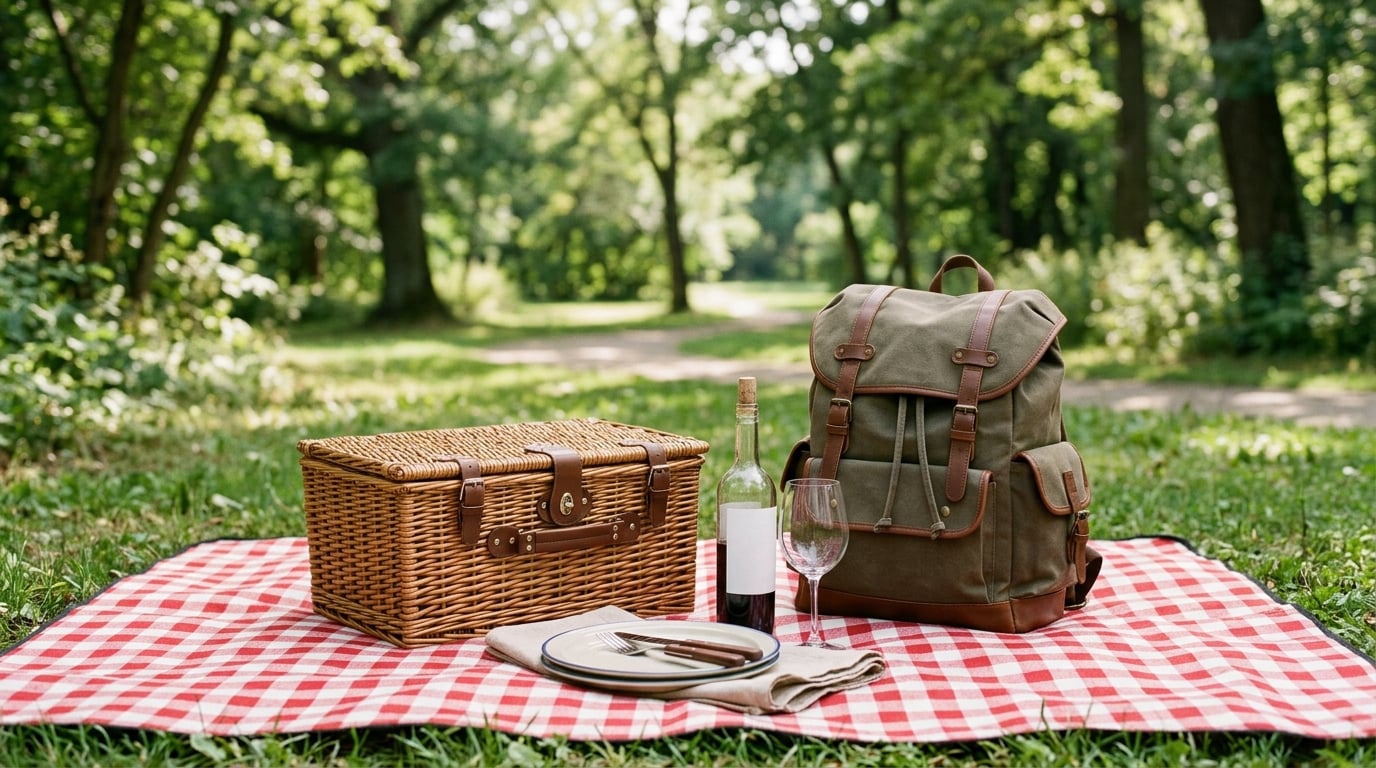
The best picnic baskets and picnic backpacks solve the same problem in two very different ways. A basket stays put on your blanket and arrives looking like a spread worth photographing; a backpack goes on your shoulders and carries the whole meal across a meadow, a car park or a sandy beach. Pick the carrying method first, then the capacity, and everything else gets easier to judge.
Most people get this backwards and start with the accessories, or with the look of the basket on a shop page. The single question that decides everything is how far you have to walk with it. Twenty metres from the car? A traditional wicker hamper wins. Three hundred metres across rough parkland with four plates in the load? A backpack wins, and it is not close.
I’ve packed into enough carriers to know where each one gives out, and forum threads on Mumsnet about styling picnics with older children make the same point from the other end: the elegant basket looks wonderful in a photo and weighs a lot by the third field.
Table of Contents
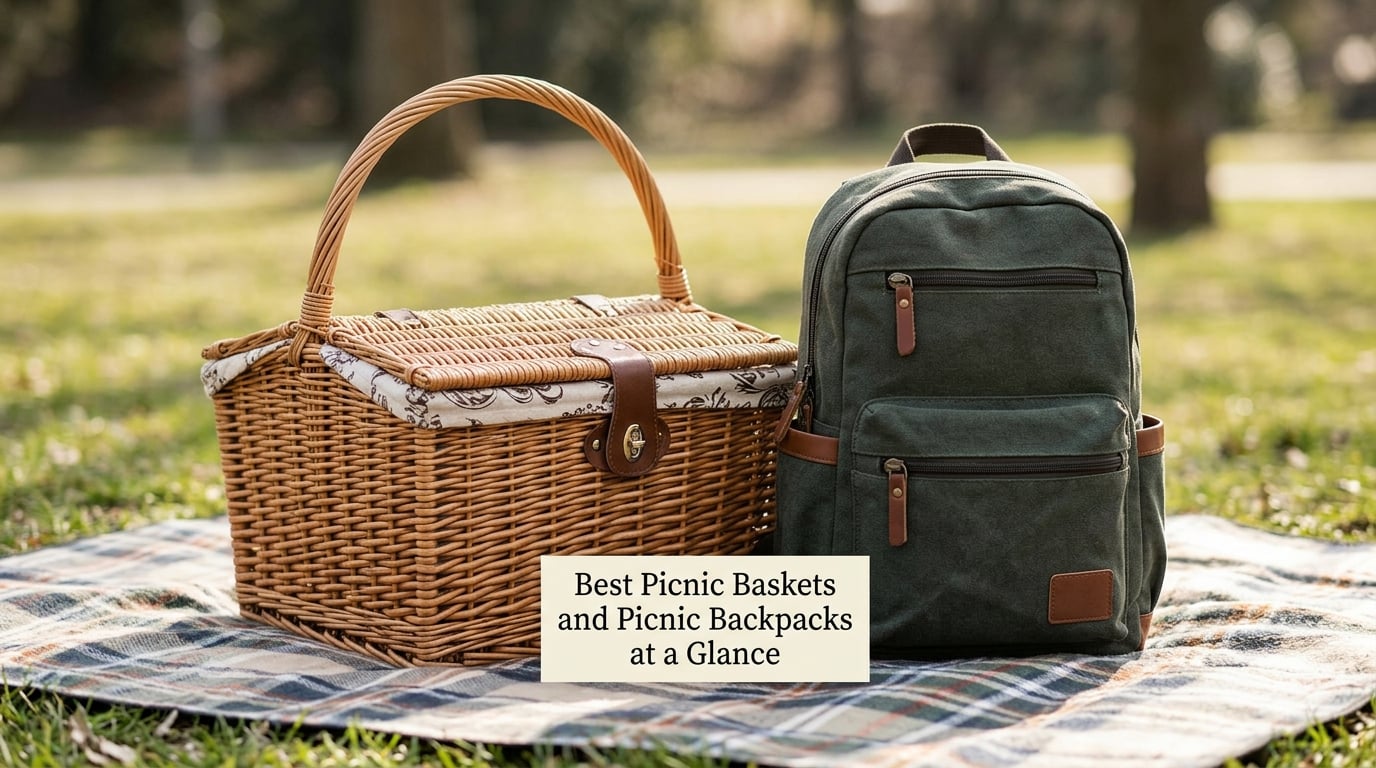
Best Picnic Baskets and Picnic Backpacks at a Glance
| Criterion | Picnic basket | Picnic backpack |
|---|---|---|
| Carrying style | Two short handles, carried in the hand or on the forearm | Padded shoulder straps, worn on the back |
| Typical capacity | Service for 2 to 4, often with a separate wine compartment | Service for 2 to 4 in a taller, boxier cavity |
| Comfort over distance | Poor beyond a short walk; weight pulls on the wrist | Good; load sits close to your back |
| Storage organisation | Fixed dividers and strapped pouches for plates and cutlery | Multiple zippered pockets, bottle sleeves, utensil slots |
| Food protection | Insulated liner, less vulnerable to tipping when set down | Insulated compartment, but only while worn upright |
| Portability | Bulky; wicker will not fold or nest | Folds or compresses, stores between outings |
| Cleaning | Wipe the shell, wash the liner, air-dry wicker fully | Wipe or hose the shell, machine-wash the liner |
| Best for | Stationary picnics, hosting, gifting | Walking, travel, families, beaches, festivals |
Read that table as a decision, not a scorecard. Every row where a basket wins is about how the picnic looks and how the food is presented. Every row where a backpack wins is about distance, storage and the weather.
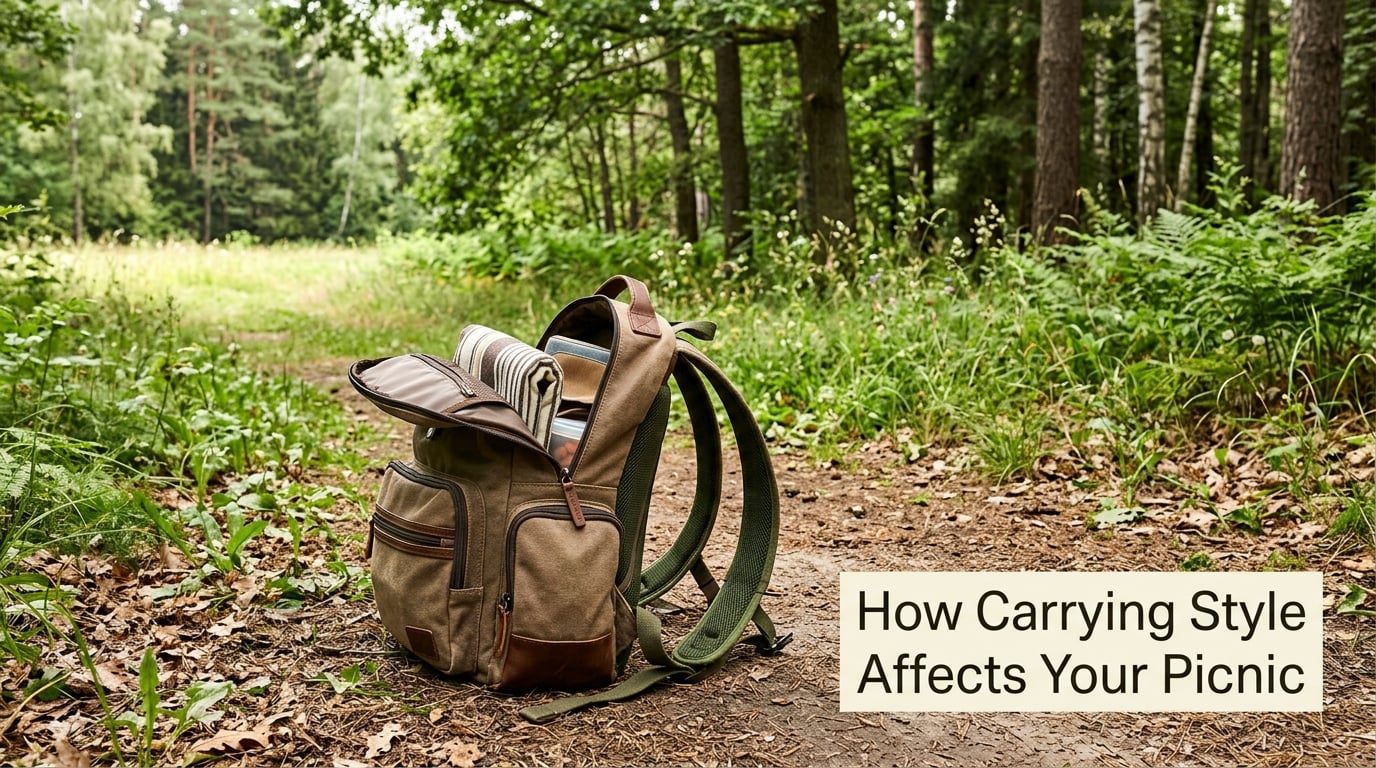
How Carrying Style Affects Your Picnic
A picnic basket is furniture. It has a base, a shape, and an opinion about where it should sit, and once it is down on the blanket that is where it stays for the afternoon. That is a real feature when you want a proper table-height place for plates, a level surface for a cutting board, and a lid that hinges open to reveal a lined interior.
A picnic backpack is luggage. It is designed to absorb movement: a bumpy path, a set of steps, a boardwalk, a boat deck. The straps put the weight on your shoulders and your back rather than your hands, which is exactly what you want when the load includes a full set of plates, a bottle and someone’s leftover sandwiches.
When the walk is short
Park-and-picnic spots, back gardens, formal lawns at a wedding, and fairgrounds with a car park close to the pitch. Here a basket wins on presentation. You set it down once, open the lid, and everything stays visible and reachable for the whole meal.
When the walk is long
Riverside meadows, clifftop paths, woodland car parks with a fifteen-minute approach, beach access across shingle, festival fields. These are backpack situations. The difference is not subtle: a loaded basket over uneven ground swings, tires you, and makes you put it down every hundred metres to rest your hands.
When you move more than once
A wedding reception on a lawn, a day at a festival with a car at the other end, a boat that leaves you somewhere else. A basket means two car trips or a trolley. A backpack means one walk. It also means you are not carrying an empty-handed partner’s handbag through a crowd.
Mumsnet users planning picnics with elderly relatives and small children describe the same trade-off in less polite terms: the wicker basket is the pretty option, and the pretty option is the heavy one. If someone in the group has a bad back or shaky hands, the carrying method is a care decision, not a style one.
Capacity and Storage: Which Fits Your Outing?
Capacity is the easiest spec to misread. “Service for 4” describes plates, not volume, and a four-person backpack often holds the same meal as a two-person basket with a wine compartment taking up a third of the space.
Reading the compartment layout
Look at the shape of the cavity rather than the number printed on the box. A wide, shallow basket holds plates flat and gives you room for a bottle laid on its side; a tall, narrow backpack holds a bottle upright and stacks plates vertically. Both are sensible, but they suit different food. A long baguette or a big baguette-style sandwich needs the wide version.
Count the fixed pouches. Four strapped plate slots and a cutlery sleeve means a two-person set with room to spare. Two plate slots and a large undivided centre means you are meant to build a table at the picnic site rather than serve from the carrier.
Drinks, bottles and ice packs
Baskets typically reserve one section for a bottle with an insulated sleeve, sometimes detachable so you can carry it separately. Backpacks tend to add external bottle pockets along the sides, which is faster to reach but means the bottle sits outside the insulated liner and warms up sooner.
Ice packs are worth planning for. A full-size flat pack fits a basket base neatly; in a backpack it eats the volume of one plate, so you are realistically trading a serving for an hour of cold food.
Room for the rest of the outing
A basket that already holds four covers has no space for a blanket, spare clothes or a child’s outdoor kit. A backpack is designed with an external compartment for a folded blanket and side pockets for exactly that overflow. If your outing involves anything beyond sandwiches and a bottle of water, that space matters more than the insulated lining.
As a rough rule: a service-for-2 basket suits a couple’s afternoon. A service-for-4 basket suits a family that stays put. A service-for-2 backpack, despite the label, usually fits four people’s food if you drop the plates and eat from containers.
Comfort, Versatility, and Outdoor Use
Empty weight tells you almost nothing. What matters is the loaded weight, and it is worth doing the sum before you pack: a full dining set for four, plates and glasses, a bottle, cool packs and food typically lands somewhere between 12 and 18 pounds. That is the number your hands and shoulders will be dealing with, not the two pounds on the product listing.
A wicker hamper in that range is a serious carry over 300 metres. Leather or padded handles help with the first hundred metres and then become a problem in heat. A backpack with padded, adjustable shoulder straps and a sternum strap spreads the same load across both shoulders and, more importantly, leaves your hands free for uneven ground, a child’s hand or a dog lead.
Surface adaptability is the quieter advantage. A basket needs a flat, dry patch: grass, sand under a blanket, a picnic table. A backpack can be carried onto a boat, along a stony riverbank or across a festival field without being set down once.
Stability works the other way round. On level ground a basket is hard to tip; a backpack tips toward your back if you set it down badly or crouch while wearing it, and anything in an upper pocket slides down. Load heavy, dense items at the back against your spine, and use a compartment divider if one is included.
There is also the storage-between-trips question that gets overlooked. A wicker basket is a fixed volume of air that will not fit in a hall cupboard. Collapsible baskets fold to a few inches thick, and most backpacks compress or have a side release. If you have small living space, that decides the answer before style ever enters it.
Food Protection and Cleaning Compared
Food protection splits into two jobs: holding temperature, and keeping the container itself dry. Baskets are generally better at the first, backpacks at the second.
Insulation
An insulated liner in a basket sits in the base and wraps the food, so temperature survives being set down, tilted slightly and opened for twenty minutes. Backpack liners are often a single padded panel on the back wall, which works well while the bag is upright against you and less well if it is lying on damp grass.
Insulation slows warming; it does not stop it. If you need food to stay genuinely cold past three or four hours, pre-chill the liner in a freezer overnight, freeze your bottles and add a block of ice. That beats any marketing claim about hours of cool.
Water resistance
Wicker is not waterproof, and anyone who tells you otherwise is describing a coating, not the material. A spill or a rain shower can leave a stain, swell the fibre and dull the finish permanently. Treat a wicker basket as a dry-weather carrier and keep a roll of plastic sheeting in the car if rain is forecast.
Canvas, polyester and Oxford fabric backpacks with a coated or leak-proof lining handle drizzle far better. The fabric itself will stain and eventually hold a smell, but it dries rather than warps, and it can be scrubbed.
Cleaning and maintenance
Baskets need more care. Remove the liner and wash it on a cool cycle or by hand, wipe the shell with a damp cloth, and let wicker air-dry fully and out of direct heat. Wicker that is put away damp develops a musty smell and, over time, mould in the weave. Keep the open lid and end panels up on a rack rather than stacking anything inside.
Backpacks are quicker to reset. Shell off, liner into the machine, straps checked for grit. A backpack that has carried wet sandwiches or beach sand benefits from a hose or a wipe-down, then a night hanging open to dry.
A few habits keep both going. Keep raw meat in a sealed container above ready-to-eat food, and never put a leaking jar directly on the base; a tight-lidded container inside a bag catches the problem one layer earlier.
Style, Durability, and Value
A wicker picnic basket is an object you leave out on a sideboard. It is the reason a basket is a common anniversary and housewarming gift, and it is the reason the classic checkered liner has survived for a century. If the occasion matters more than the walk, that is not a frivolous reason to buy one.
Traditional construction varies more than shoppers expect. Handwoven willow and rattan are lighter and have irregular character. Woven woodchip fibre is denser, heavier and more uniform, and it usually carries a harder shape. Wicker quality shows in the weave: tight and even, no exposed wire ends, and a rigid rim that holds its shape when empty.
Backpacks trade elegance for engineering, and their durability lives in the parts that fail: strap stitching, zip pulls, buckle material and the foam in the shoulder padding. Sewn-through webbing and metal hardware outlast glued stress points. Check that the straps are adjustable and the back panel is padded, not just printed to look padded.
How picnic baskets and picnic backpacks age differently
A wicker basket that stays dry can last decades, and it patinas rather than wears out. The usual damage is a broken handle mount or a snapped weave near a hinge, and both are usually unfixable, which is why lifetime replacement guarantees on long-established basket brands are worth reading about. Wicker that has been rained on or stored damp tends to fray at the rim within a season or two.
Fabric backpacks have a shorter life and a cheaper one, but they are more repairable. A strap can be re-stitched, a buckle swapped, a zip replaced. What ends most of them is abrasion on the base and a delaminated foam panel after a few seasons of being put down on gravel.
What the extra spend actually buys
At the entry end you are buying a shell, a liner and a printed cutlery set. Mid-range money typically buys a real insulated liner, stainless or melamine tableware instead of thin plastic, a genuinely wipe-clean lining and a blanket that is actually waterproof and sandproof. Higher up, you are paying for weave quality, a lifetime guarantee, better hardware and a more complete dining set, which is also why baskets are the popular gift.
The accessory check is the fastest way to judge quality. Plates that are melamine rather than brittle plastic, flatware with some weight to it, and a blanket that stays dry on wet grass all tell you what the manufacturer thinks you care about. Kit made of thin plastic with painted handles is where a carrier quietly falls apart in year two, and it is a good reason to skip a listing entirely.
One more value note: for a family that picnics weekly, a mid-range backpack usually costs less over a couple of seasons than a basket replaced after one downpour. For two picnics a year, the reverse is true, and a traditional basket is the better buy on every measure except the walk back.
Which Should You Choose?
Choose a picnic basket when the picnic happens where you park, when you are hosting or presenting, and when the container is part of the occasion. It is also the right answer for a wedding, anniversary or housewarming gift, where a durable, good-looking object outlives the outing. Accept that you will carry it to the blanket, not across the field, and keep a sheet in the car for rain.
Choose a picnic backpack when distance, storage or company decides the day. Families walking to a spot, couples on a long coastal walk, solo hikers carrying lunch to a quiet place, beach trips where sand and shingle rule out a level table, and festival days all suit a backpack. Pick one with padded adjustable straps, a leak-proof lining, a compartment divider and a side pocket for a blanket, and put the heavy items against your back.
Some people keep both, which is the practical answer for anyone who picnics in mixed conditions. Several forum users describe a dedicated picnic box that lives in the car trunk alongside a separate backpack for the walk in, and that habit removes the compromise entirely.
If you are still torn, answer two questions. How far is the nearest flat spot from the car? And who has to carry it? The distance picks the format; the person who cannot easily hold a heavy load decides it for you.
Frequently Asked Questions
Are picnic backpacks better than picnic baskets for walking?
For anything beyond a short walk from the car, yes. Padded shoulder straps spread the loaded weight across both shoulders and leave your hands free for uneven ground, whereas a wicker basket pulls on the wrist and tires quickly when full. Baskets still win on a level site where you unload once, so measure the walk rather than the object.
What size picnic backpack is best for a family?
A service-for-4 backpack works for most families of four eating simple food, and a service-for-2 backpack fits a couple plus a child’s portions. Judge the cavity rather than the label: check for two or four plate slots, a cutlery sleeve, a bottle compartment and an external pocket for a blanket. Add vertical space for drinks and you will manage more than the printed number suggests.
Can a picnic basket keep food cold?
An insulated liner slows warming considerably, and a well-insulated basket will hold cool food for most of an afternoon. Insulation does not stop warming, so pre-chill the liner overnight, freeze your bottles and add a block of ice for longer outings. Always keep raw meat sealed and separate from food that will be eaten cold.
Which picnic option is easier to clean?
Picnic backpacks, without much doubt. The fabric shell wipes or hoses clean and the liner usually goes in a washing machine. Wicker needs more care: wash the liner separately, wipe the shell with a damp cloth and let the weave air-dry fully and away from direct heat, or a musty smell and mould will follow.
Are wicker picnic baskets suitable for beaches?
Not really. Wicker is not waterproof, and sand plus salt plus damp will fray the weave and dull the finish in a single outing. If the beach is your regular spot, choose a backpack with a coated, leak-proof lining and a sandproof base panel, or use a wicker basket only as a serving container that stays on a dry towel.
What should I look for when buying a picnic basket or backpack?
Work through four things in order. Carrying method first: handles for a fixed spot, straps for distance. Then capacity for your real number of people, then insulation and a removable washable liner, then material and hardware quality. Check whether the blanket is genuinely waterproof, whether tableware is melamine or steel rather than thin plastic, and whether the liner comes out for cleaning.
Conclusion
The decision is simpler than the number of specs suggests. A basket wins where presentation matters and the walk is short; a backpack wins where distance, storage, weather and company decide the day. Capacity, insulation, hardware and cleaning all follow from that first choice rather than competing with it.
Start with how you will carry the picnic, then pick the capacity for your actual number of people, and only then compare the extras. That order gets you the right carrier the first time, which is a better outcome than a beautiful basket at the back of a cupboard.