
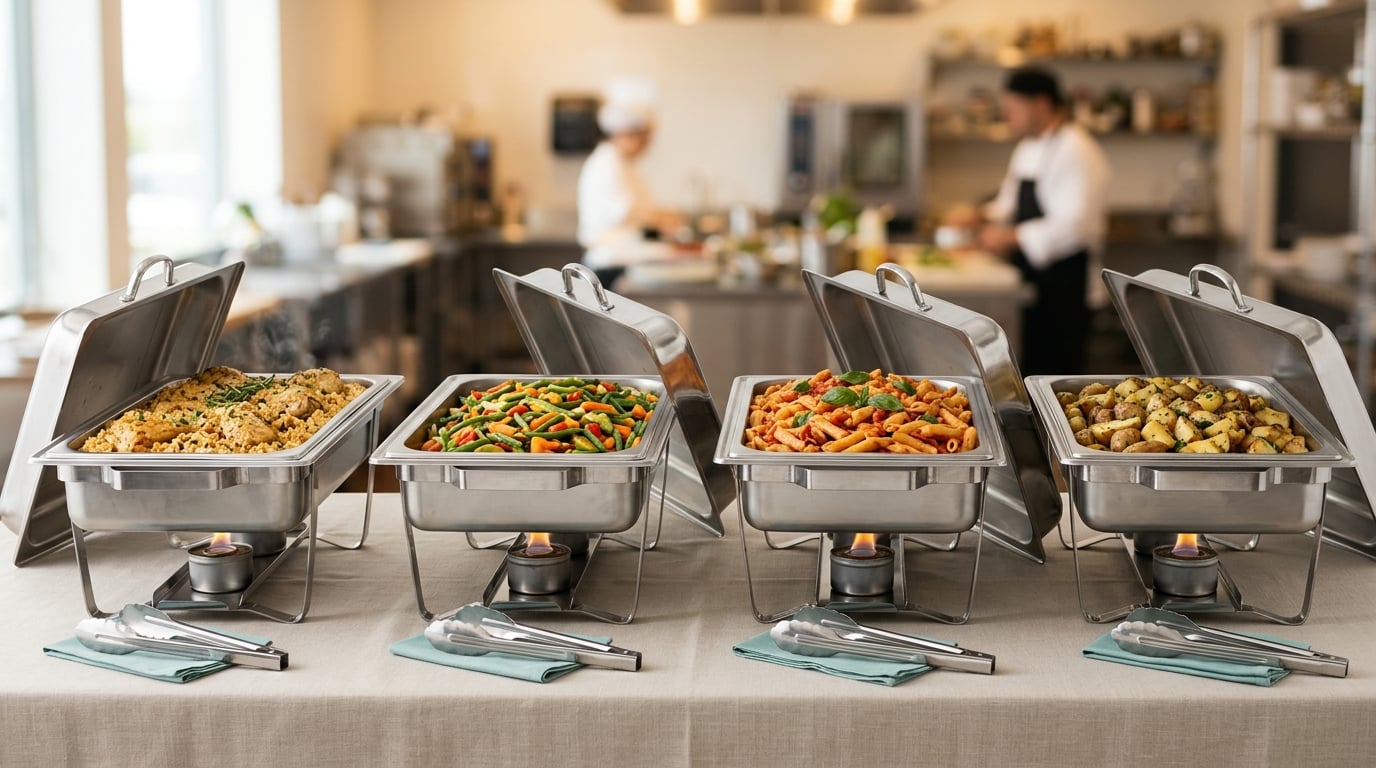
A chafing dish set is a portable buffet warmer: a folding frame, a fuel holder, a water pan, a food pan and a lid. A small flame or an electric element heats water, and the food pan sits above that water, holding heat in rather than cooking the food.
The best chafing dish sets for home catering come down to three things: honest quart capacity, a fuel that lasts longer than your service window, and parts you can wash in a real sink. Pick those right and a backyard table looks like a wedding hall. Pick wrong and you get cold lasagna at 7pm.
We ran buffets off these ten categories for years, mostly for holiday dinners, church fundraisers and the occasional 60-guest birthday. Here is what actually holds up, why it holds up, and where each category falls apart.
Table of Contents
- Best Chafing Dish Sets for Home Catering at a Glance
- 1. Best Overall Stainless-Steel Chafing Dish Set
- 2. Best Chafing Dish Set for Large Buffets
- 3. Best Budget Chafing Dish Set
- 4. Best Portable Chafing Dish Set for Travel
- 5. Best Chafing Dish Set for Easy Cleanup
- 6. Best Chafing Dish Set for Overnight or Long Events
- 7. Best Chafing Dish Set for Side Dishes and Appetizers
- 8. Best Chafing Dish Set with Solid Fuel Compatibility
- 9. Best Premium Chafing Dish Set for Frequent Entertainers
- 10. Best Electric Warming Set for Home Catering
- Frequently Asked Questions
- Conclusion
Best Chafing Dish Sets for Home Catering at a Glance
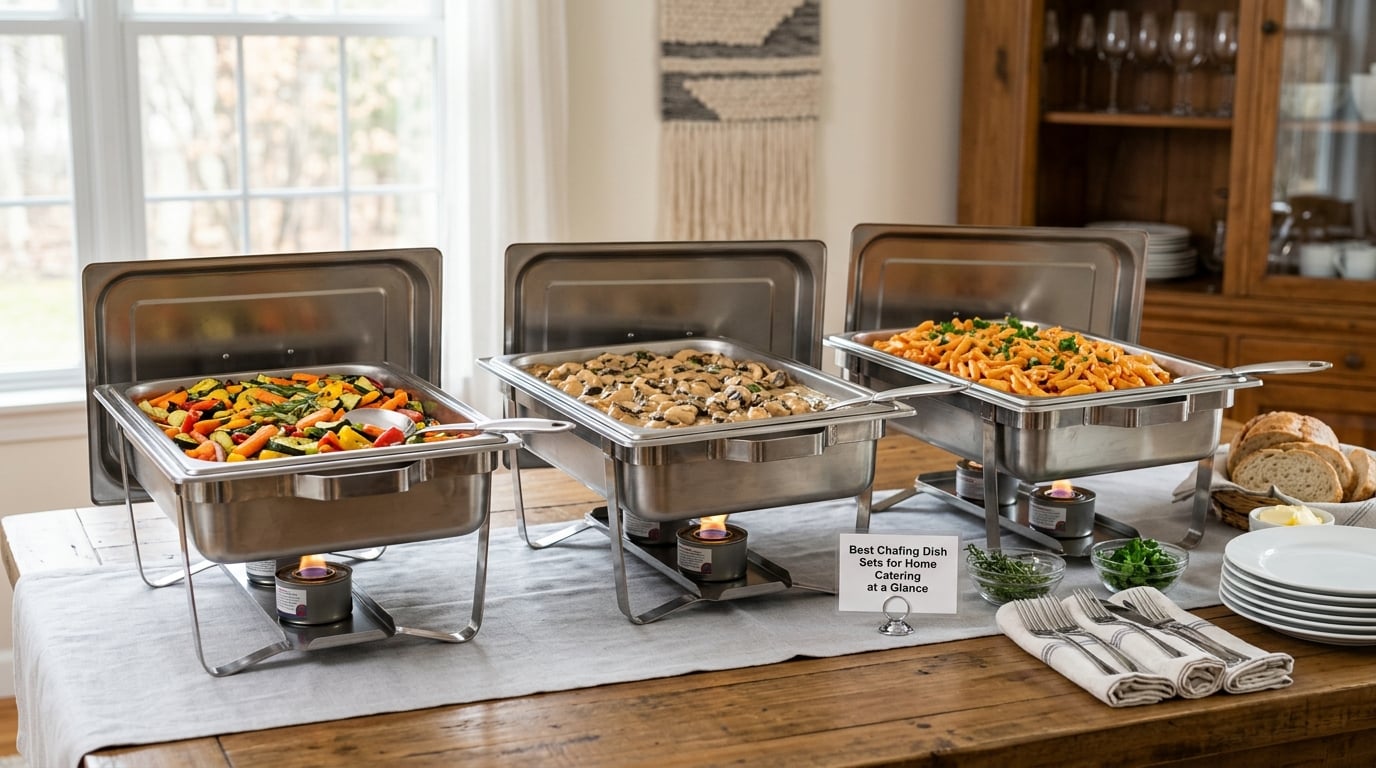
The fastest way to narrow this down is to match the set to the event. Most hosts only need one category: the stainless all-rounder for an ordinary party, the fuel-compatible round unit for a holiday table, or the electric warmer for an indoor buffet where an open flame is a problem.
| Set category | Typical capacity | Heat source | Best for | Watch out for |
|---|---|---|---|---|
| Stainless steel all-rounder | 4 to 9 quarts | Solid fuel cans | Everyday parties, 20 to 50 guests | Heaviest option to carry |
| High-capacity rectangular | 9 to 12 quarts | Dual solid fuel holders | Buffets of 60 to 100 guests | Takes table space fast |
| Budget coated steel | 4 to 6 quarts | One or two fuel holders | One or two events a year | Coating scratches and dulls |
| Portable folding unit | 4 to 6 quarts | Solid fuel cans | Tailgates, picnics, church halls | Light; tips on uneven ground |
| Easy-clean set | 6 to 8 quarts | Solid fuel cans | Hosts who wash up right after | Crevices around the burner box |
| Long-burn unit | 6 to 9 quarts | 4 or 6 hour fuel | Receptions, all-day fundraisers | Taller frame, more table height |
| Multi-pan appetizer set | Three 2.5 qt pans | Two or three holders | Sauces, rolls, vegetables | Small pans empty fast |
| Round fuel-compatible set | 6 quarts | Sterno-style cans | Holiday dinners, carve stations | Will not fit hotel pans |
| Premium commercial-grade | 8 to 12 quarts | Dual fuel holders | Side-gig caterers, repeated use | Heavy and expensive to store |
| Electric warming set | 6 to 9 quarts | Electric element and dial | Indoor buffets, rentals, patios with outlets | Cord, outlet access, warm-up time |
Two things never show up in the marketing copy. First, a chafing dish holds heat, it does not add it. Second, most of these sets are sold as “complete” when they are really just a frame and a lid. Check the box contents before you pay for a set you will still need to finish.
1. Best Overall Stainless-Steel Chafing Dish Set
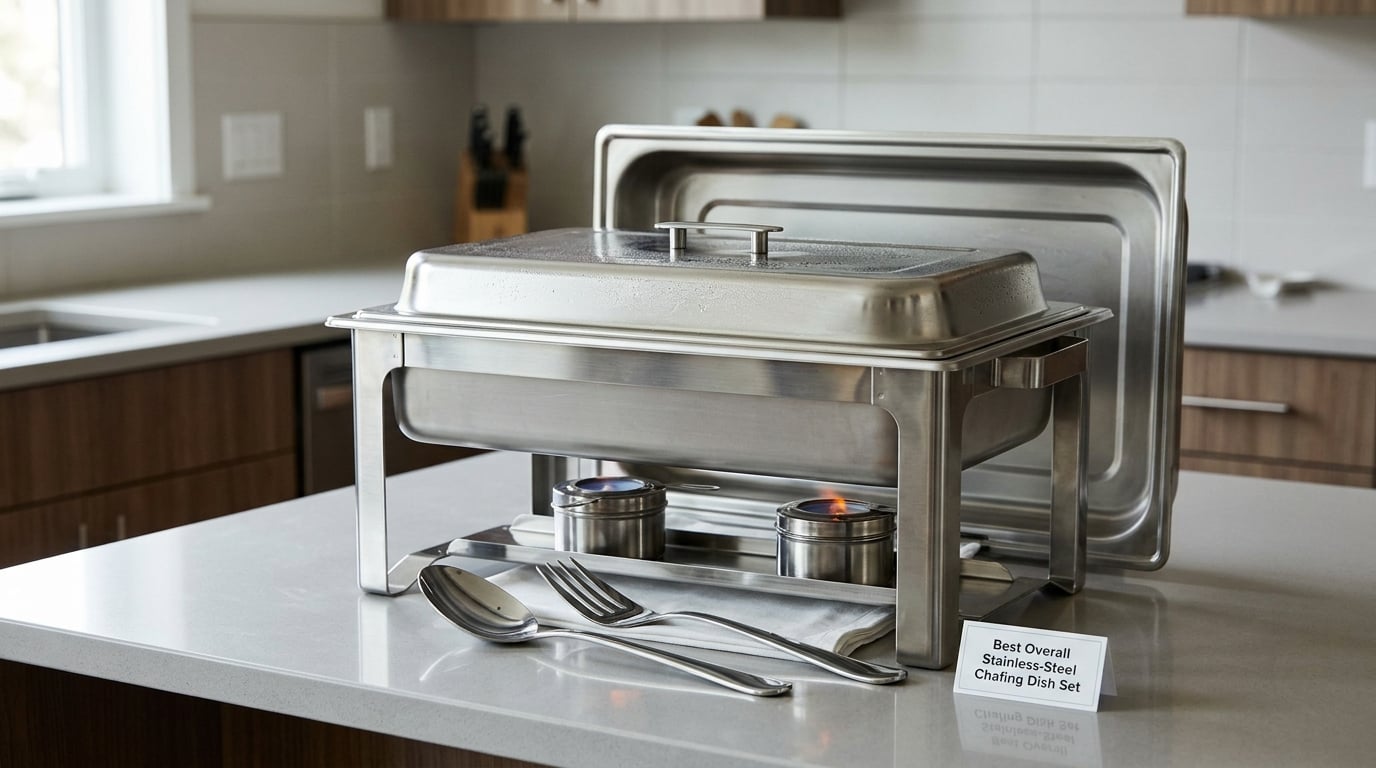
The best overall pick is a straight-sided stainless rectangular chafer in the 4-to-9 quart range, sold with both pans, a lid, and at least two fuel holders. It is the least exciting purchase in this guide and the one you will reach for most.
Stainless holds its shape, takes a beating from fork drops, and does not carry a food smell into the next meal. Aluminum warps; coated steel chips. For a host doing four or five buffets a year, that difference decides how long the set survives in a closet between events.
What counts as a complete chafing dish set
A genuinely complete set has a frame, a water pan, a food pan, a lid, two fuel holders, and a pair of serving utensils. Sets that ship with one fuel holder force you to run a can out or improvise a second burner, which is the single most common mid-service failure people report.
Look for 18/8 stainless, which is the 304 grade used in restaurant kitchens. It will not rust in a damp garage and it survives the dishwasher cycle without the coating flaking. Cheaper imports sometimes use a magnetic lower-grade alloy that dulls within a season.
Rectangular models that accept full-size hotel pans are worth extra money for a specific reason: the pans swap out with pans you already own. Buy the fuel tray once, keep buying the pans you can replace anywhere, and you are never waiting on a single supplier for a replacement part.
Heat control is modest by design. Most fuel chafers put out a gentle, even heat, not a burner you can turn down. That is fine for holding; it is useless for cooking, and buying a chafer expecting a slow cooker is the most expensive mistake in this category. Cook your food to temperature first, then load it: poultry to 165F, ground meat to 160F, whole cuts and fish to 145F, and every pan at 140F or hotter before it goes into the water bath.
Maintenance is a fifteen-minute job. Wash the food pan and water pan while warm, wipe the burner box, dry everything before the frame goes back in the closet. Fuel residue left in a burner tray turns to a sticky varnish that no dishwasher will shift.
2. Best Chafing Dish Set for Large Buffets
For 60 to 100 guests, buy capacity and dual fuel holders rather than more small units. A single 9-to-12 quart rectangular set fed by two burners holds a full sheet-pan-sized main, and two burners means one dead can does not end your service.
Large-capacity frames stand taller, often with an adjustable-height frame, so check that your table plus the guests on the other side still works. A chafer that pushes hot steam at chin level over a dessert table is a service problem nobody enjoys.
Stability matters more than people expect. A 12-quart set full of potatoes is heavy and top-heavy, and buffet tables get bumped. Sets with cross-braced legs and a wider base hold steady; lightweight folding frames do not.
How many chafing dish sets for home catering do you need?
Count your menu items, not your guests. Most home buffets run two to three hot dishes plus one or two sides, and each dish needs its own pan. A single set can hold two full-size hotel pans side by side, which is why one big set often beats four small ones.
| Guests | Hot menu items | Sets to plan for | Pan layout |
|---|---|---|---|
| 20 | 2 to 3 | One to two 4-to-6 qt sets | One dish per pan, sauce in a small insert |
| 50 | 3 to 4 | Two to three full-size sets | Main plus sides, dessert on a separate table |
| 100 | 5 to 6 | Four or more full-size sets | Two mains, two sides, one sauce, one starch |
A rough serving rule that holds up in practice: one full-size pan of a main serves about 25 to 30 people, a side serves 30 to 35. Plan a little above your guest count and you will not run the line dry, which is what makes hosts complain.
Do not overcrowd the table. Three sets in a row on a six-foot table leaves no room for platters, bread, or the person filling them. Back-of-house caterers space stations roughly 30 inches apart for a reason, and the same spacing keeps traffic moving in a home hallway.
3. Best Budget Chafing Dish Set
The best budget option is a coated or lighter-gauge stainless set with a single fuel holder, in the 4-to-6 quart range. It does one job well for the price, and the compromises are predictable before you buy.
Coated steel scratches visibly, and once the coating breaks, the bare metal underneath stains. The lid fit is usually looser, so condensation drips onto your table linen. Frame hardware is where cheap sets fail first: a stripped wing nut that will not hold a pan level is the reason a set gets retired early.
Budget sets usually ship with one fuel holder and sometimes no lid. Plan on buying a second holder and a spare lid, which erodes the savings more than the sticker suggests.
Replacement parts are another honest question. There is no warranty network for a no-name budget chafer, so a bent frame or a missing hinge is a total loss. If your answer to “how many events a year” is one, that is acceptable. If it is five, buy stainless.
What you give up is weight and finish, not function. A budget rectangular chafer holds food just as hot as an expensive one, because the heat comes from the fuel and the water, not from the steel gauge.
4. Best Portable Chafing Dish Set for Travel
For picnics, tailgates and events where the car is a long way from the table, buy a folding-frame unit in the 4-to-6 quart range with a lid that locks in the closed position. Flat-packing, not weight, is the feature that decides this category.
Most portable frames fold to about the height of a large casserole dish and lock with a sliding pin. Check the pin yourself. A folding leg that creeps open mid-service tips a hot pan, and that is both a food safety problem and a burn risk.
Portable sets usually use thin-gauge steel, so expect to carry them with two hands when full. Set the unit up on a solid surface before you light it. Grass, gravel and folding tables all wobble, and a pan of gravy wobbling at a tailgate is a genuine hazard.
Weight, when the set is empty, is the number that predicts your experience carrying it from the trunk. Empty weight is often barely printed anywhere, so check the listing specs and treat anything under a pound and a half as a sign you will be doing the two-handed carry.
Wind is the other outdoor issue. A flame in an enclosed burner box is stable, but a strong breeze cools the water pan fast and eats fuel. Outdoors, in cold or windy weather, more heat is lost, so a longer-burn can buys you margin.
5. Best Chafing Dish Set for Easy Cleanup
Easy cleanup comes down to removable parts, smooth seams, and a burner tray that lifts out. Hunt for sets where the water pan, food pan and lid all lift free with no clips or soldered fittings, and where the frame is a simple tube rather than a welded box.
Food pans and water pans that are true stainless take a dishwasher cycle without complaint. Anything with a coating or a printed surface should be hand-washed, and a set that mixes both in the same box makes the job slower than washing everything by hand.
Creases around the burner box are the real grease traps. Run a chafer that has been serving buttery vegetables for three years without a good scrub and you will find a varnish of hardened fat where the fuel tray meets the frame. A shallow, removable fuel tray keeps that surface flat enough to wipe.
Preheat matters for cleanup too. A chafer filled with food that has congealed overnight requires a knife and a soak. Running the water bath hot before you load it means you can wash the food pan while the water is still hot, with no soak cycle at all.
Hosts who cook a lot of sauces and cream dishes should skip any set with a narrow burner box and a shallow tray. Grease finds every corner, and a wide flat tray with a raised lip is worth more than a polished finish.
6. Best Chafing Dish Set for Overnight or Long Events
For services that run four hours or more, choose a set with deep fuel holders that accept 4-hour or 6-hour cans, and enough vertical clearance under the water pan to keep a full can from touching the frame.
A 6-hour can costs more and delivers steadier heat than two 2-hour cans, and it avoids the swap you might fumble while guests are watching. The water pan is a buffer that smooths the burn, which is why a well-vented, deep tray holds temperature more steadily than a shallow one.
Keep water in the pan. This is the number one long-event failure: the water boils away, the pan hits the flame directly, and the fuel burns out. Someone has to check it. If nobody can be assigned that job, an electric unit with a thermostat is the safer choice.
Refueling mid-service is not hard, but do it properly. Extinguish the old can completely, let the burner box cool, swap in a fresh can, and light the new one before relighting anything else. Never pour liquid fuel into a hot burner tray, and never add fuel to a can that is still warm.
For genuinely long windows, two burners beat one. It is redundancy you rarely notice and are always grateful for.
7. Best Chafing Dish Set for Side Dishes and Appetizers
For sauces, rolls, vegetables and appetizers, buy multi-pan configurations rather than one large set. Three or four small pans on a single frame let you run one burner for a whole side station instead of three separate sets.
Multi-pan appetizer sets typically run two 2.5-quart and one 4-quart pan, or four equal 2.5-quart pans. Small pans are the right call for items people take in one or two bites, and they waste less fuel than a big pan of the same total volume.
The limitation is refills. A 2.5-quart pan of meatballs disappears at a 40-guest party faster than you expect. Hosts serving passed appetizers should plan small pans and frequent refills rather than one large pan that will sit in the danger zone while guests help themselves.
Rolls and bread warm beautifully in a dry water pan, with little or no water, which saves fuel and avoids soggy bottoms. Sauces and cream dishes want a full water bath for gentle heat and less scorching on the bottom of the pan.
Pastries should not go in a chafer at all. Butter and shortening go rancid within a couple of hours over direct heat, and the pastry goes greasy long before it goes unsafe. Warm them just before guests eat, or serve them at room temperature.
8. Best Chafing Dish Set with Solid Fuel Compatibility
For solid fuel compatibility, buy a set with standard Sterno-style can wells sized for common fuel cans, and make sure the tray depth matches the can height so the can cannot tip or sit too high to transfer heat.
| Fuel type | Typical burn time | Flame behaviour | Works best for | Fails when |
|---|---|---|---|---|
| Wick fuel can | 2 to 3 hours | Small, mostly invisible flame | Short parties, indoor tables | A four-hour service runs dry |
| Gel fuel | 2 to 3 hours | Taller, steadier flame | Carving stations, cold rooms | Used in a wick-style tray it scorches |
| Diethylene glycol can | 4 to 6 hours | Low, very steady heat | Long services, receptions | Fluid is toxic if swallowed |
There are three fuel families. Wick fuel burns on a wick and lasts hours with almost no visible flame. Gel fuel uses a pressurized gel and gives a steadier, taller flame. Diethylene glycol cans are the commercial standard and burn longest, but the fluid is toxic if swallowed, so treat any leak as a reason to discard the can.
Burners are engineered for one fuel format. Gel fuel in a wick-style tray burns hotter and faster than the tray was designed for, and it can scorch the water pan. Stick to the fuel type the set was built for, and read what is printed on the tray.
A deeper fuel tray gives a steadier burn and better airflow. Shallow trays are the budget compromise and they are usually why people report an uneven flame or a burner that sputters.
Handling rules are simple and non-negotiable. Store cans upright, away from heat, and never light a can in a closed frame. Keep a spare can per set, plus a lighter and a long-handled lighter, in a metal bucket away from the table. Fuel that has leaked or crystallised around the wick goes in the trash, not back in the tray.
9. Best Premium Chafing Dish Set for Frequent Entertainers
If you cater a handful of events a month, buy commercial-grade: a heavy-gauge stainless body, a full-size hotel pan well, dual fuel holders and a roll-top or hinged glass lid. The weight is the feature, not a flaw.
Thicker steel means the pan does not flex when you lift a full hotel pan of rice out of it, and the frame hardware holds its tension over years of folding. Look for rolled edges, welded joints and a hinge that closes with two fingers, one-handed, while the other hand holds a hot pan.
Roll-top lids let you check a pan without lifting the whole lid, which reduces heat loss and drips. Glass lids show the food without opening anything at all, which guests appreciate, because the lid lifting constantly is what makes a buffet look untidy.
Spare parts decide whether a premium set is worth it. A manufacturer that sells replacement pans, hinges, fuel trays and legs separately turns a broken component into a ten-dollar fix rather than a dead appliance. That availability is the clearest dividing line between premium and budget.
Heat distribution is steadier in heavier pans because there is more thermal mass. If you ever move to serving gravy or a large roast, you will notice the difference on the burner side of the pan.
The honest downside is storage. A premium 4-pack fills a closet shelf, so plan where it lives before it arrives. Side-gig caterers report the same frustration on forums: the equipment works perfectly and the house does not have a room for it.
10. Best Electric Warming Set for Home Catering
An electric warming set wins when open flame is a problem: a rental hall, an apartment balcony, a venue with a strict no-flame policy, or a table near a window that a gust reaches.
The best electric units have a temperature control dial rather than a single on-off switch, which is the difference between holding a sauce at 140F and cooking it at a simmer. A probe or built-in thermostat also stops the unit from sitting at full heat for four hours, which is a fire and energy concern in an unattended room.
Electric is quiet, which sounds trivial until you picture a buffet beside a sleeping baby or a conversation table. There is no flame, no smoke smell, and no fuel to buy. Startup is the trade: electric warmers take 15 to 30 minutes to reach a holding temperature, so light them before the food is done, not after.
Electrical safety comes first. Use a listed unit, keep cords out of walkways, and do not run an extension cord under a tablecloth or through a doorway. Never use an electric warmer in the rain, and give it a dry surface with airflow on all sides. Keep it away from water pans, since spills are the most common accident.
Cord management is the part hosts underestimate. Plan a cable route, tape cords to the table leg, and confirm the outlet is on the same circuit as anything else running hot. An electric set is the right answer for indoor events, and the wrong answer for a field with no power.
Frequently Asked Questions
What size chafing dish do I need for catering?
Match the pan to your menu, not your guest count. A 4-quart set suits 2 to 3 dishes for about 20 guests, a 6-quart set suits sides and stews, and a 9-to-12 quart rectangular set holds two full-size hotel pans at once. One full pan of a main serves roughly 25 to 30 people.
How many chafing dishes do I need for 100 guests?
Plan for five or six hot dishes, which usually means four full-size sets. For a main plus two sides plus a starch and a sauce, four 9-to-12 quart sets keep the line from running dry. Space stations about 30 inches apart and put dessert on its own table.
How long does a chafing dish keep food hot?
A correctly set chafer holds serving temperature for as long as the fuel burns, and four- and six-hour cans are what make long services possible. The real limit is your food, not the dish. Chafers retain heat rather than add it, so anything below 140F when it goes in will cool below that.
What is the difference between rectangular and round chafing dishes?
Rectangular units accept standard full-size hotel pans, which you can buy and replace anywhere and which scale to large buffets. Round units hold 4 to 6 quarts, suit stews, pasta and carving, and are cheaper, but they will not fit a hotel pan and they take more table space for the same food.
What are the most common chafing dish mistakes?
Loading food that is not already hot, letting the water pan boil dry, buying 2-hour cans for a three-hour event, and lighting a can in a closed frame. Preheat every pan to 140F or above, keep the water topped up, match can burn time to service length, and light the burner outside the frame.
Should I buy or rent chafing dishes?
Rent if you are hosting one or two events a year, since rental rates and deposits are charged per event and a set in a closet does not pay for itself. Buy if you host four or more times a year; a stainless rectangular set that accepts hotel pans keeps its value and becomes useful with pans you already own.
Conclusion
Start by measuring the table space you have, counting the hot dishes on your menu, and deciding between fuel and electric. Narrowing the best chafing dish sets for home catering down to one or two categories on this page usually takes less than a minute.
For most home hosts, the stainless rectangular all-rounder is the right buy: it handles a 20-guest dinner and a 50-guest party without changing anything. Add a second fuel holder per set, buy burn time that matches your longest service, and preheat every pan before it goes into the water bath. That preparation does more for your buffet than any feature on the spec sheet.