
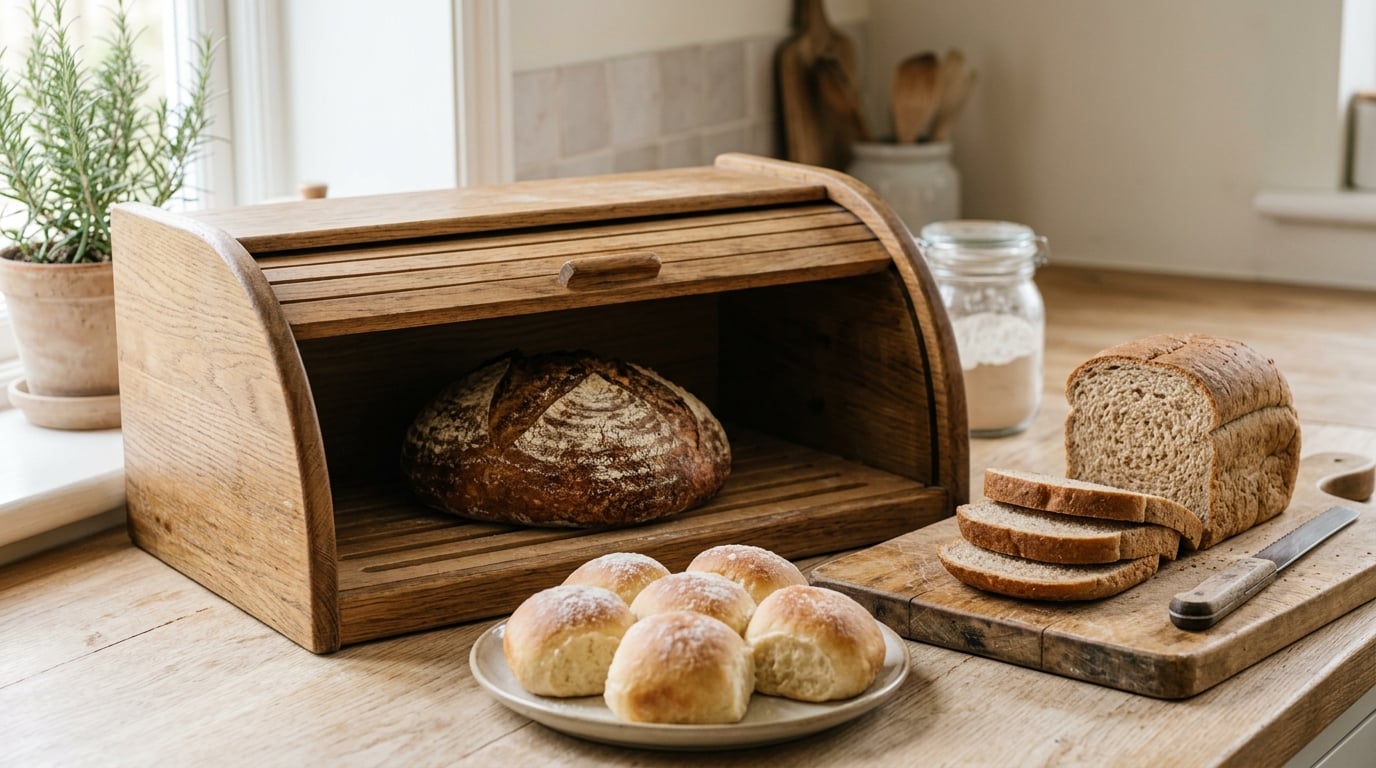
A bread box keeps bread fresh longer than a plastic bag, but only by a few days, and it is the seal that does the work rather than the material. A box with a tight door and one small vent hole holds humidity around the loaf, so the crust stays pliable roughly two to three extra days compared with bread sitting out on a board. Past about day four, nothing on the counter beats the freezer.
The best bread boxes to keep bread fresh longer for an everyday kitchen are the ones that match the bread you actually buy. A tall country loaf needs vertical room, dinner rolls need a wide shallow cavity, and a two-tier box earns its counter space only if your household really does empty two loaves a week. Those distinctions matter far more than whether the shell is bamboo or brushed steel.
Table of Contents
- Best Bread Boxes to Keep Bread Fresh Longer at a Glance
- 1. Classic Wooden Bread Box
- 2. Stainless Steel Bread Box
- 3. Bamboo Bread Box
- 4. Ceramic Bread Box
- 5. Roll-Top Bread Box
- 6. Airtight Plastic Bread Box
- 7. Bread Box with Built-in Roll Tray
- 8. Large Two-Tier Bread Box
- 9. Wall-Mounted Bread Box
- 10. Minimalist Countertop Bread Keeper
- How to Choose a Bread Box for Maximum Freshness
- How to Store Bread in a Bread Box
- Frequently Asked Questions
- Conclusion: Choose the Box That Fits Your Bread
Best Bread Boxes to Keep Bread Fresh Longer at a Glance
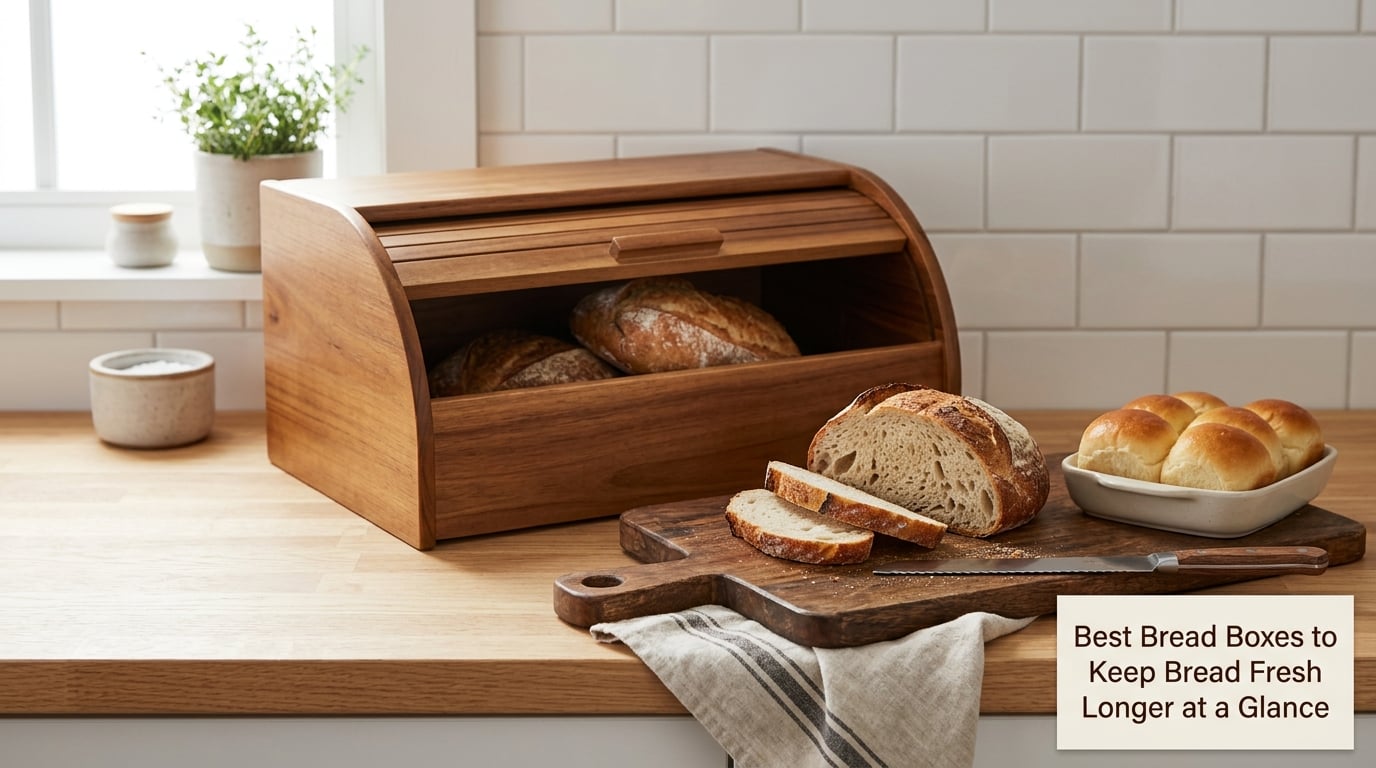
Start here if you want the short version. Every box below works by slowing air exchange, so read the airflow and seal columns first and treat capacity as the deciding factor.
| Type | Ideal bread type | Airflow approach | Capacity | Cleaning convenience | Who should consider it |
|---|---|---|---|---|---|
| Wooden roll-top | Artisan loaves, boules | Vented lid, slow exchange | One large loaf or several rolls | Wipe only, occasional oiling | Bakers who want a warm farmhouse look |
| Stainless steel | Any shape, tall sourdough | Tight seal with small vent | One to two loaves | Wipe or rinse, no rust worry | Durability first, seal tightness |
| Bamboo | Sliced bread, rolls, bagels | Partly porous walls | One loaf, often two tiers | Hand wash, dry standing up | Value shoppers and lighter kitchens |
| Ceramic stoneware | Display loaves, rolls | Varies, often minimal | One loaf | Dishwasher often fine | Presentation and gifting |
| Roll-top any material | Sliced bread, baguettes laid flat | Adjustable opening | Medium, depends on depth | Crumb tray catches mess | People who want to see inside |
| Airtight plastic | Soft white sandwich bread | Sealed, minimal exchange | One loaf, freezer safe | Dishwasher safe usually | Budget buyers and small kitchens |
| Built-in roll tray | Sandwich bread, buns | Rack lifts loaf off base | One loaf plus rolls | Removable tray helps | Anyone cutting bread every morning |
| Two-tier | Multiple loaves, baguettes | Vent holes per tier | Two loaves or loaves plus rolls | Two surfaces to wipe | Families and frequent bakers |
| Wall-mounted | Sandwich bread, rolls | Door vent or side holes | One loaf, slim depth | Interior wipes, mount stays put | Small kitchens with tight counters |
| Minimalist keeper | Sandwich bread, rolls | Simple closure, small hole | One loaf | Fully wipeable | People who want function over style |
1. Classic Wooden Bread Box
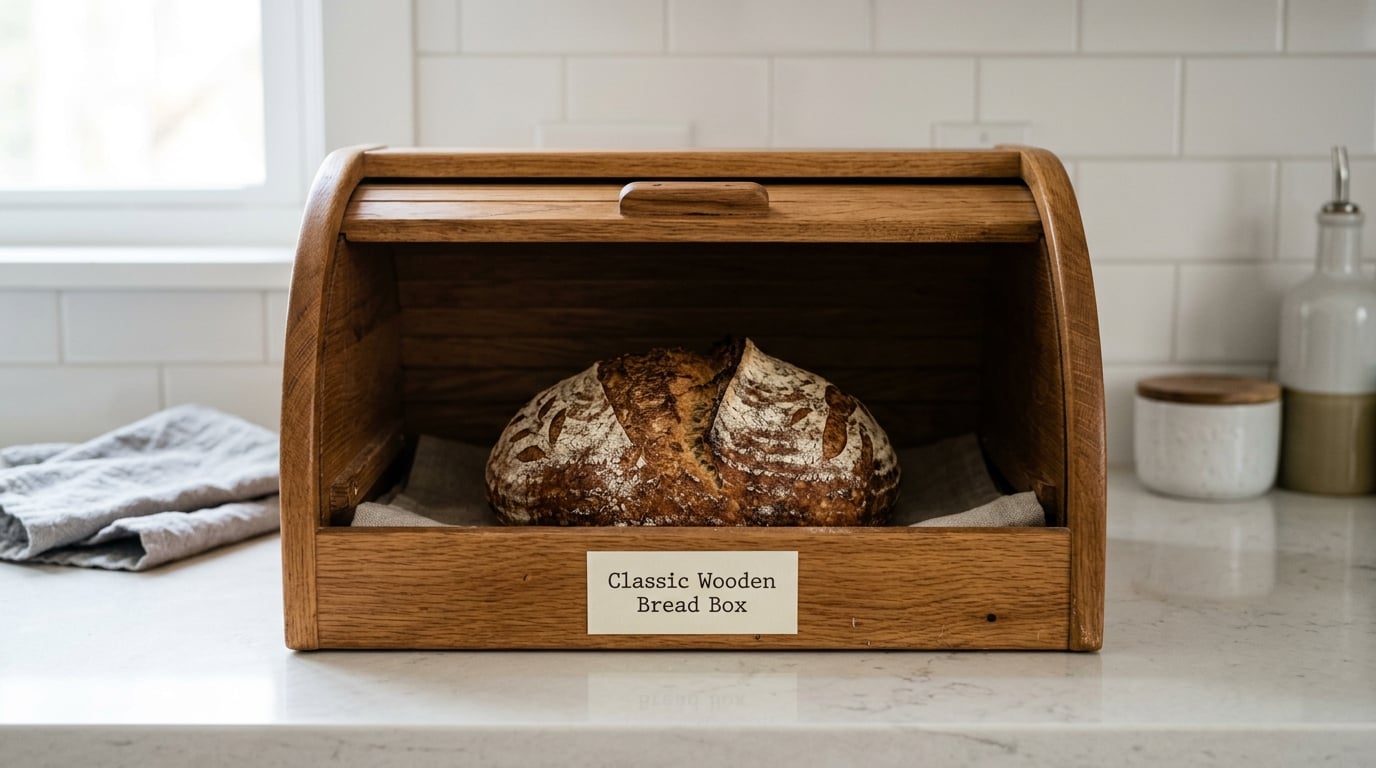
The classic wooden bread box is the reason bread boxes became a kitchen staple in the first place. A vented roll-top lid lets a slow trickle of air pass while keeping the rest of the moisture in, which is exactly the balance a loaf wants. Buy one with a real vent hole, a back panel that resists damp, and a door that closes without gaps.
A wooden box suits a round boule or a country loaf better than anything else, because the cavity is usually deep and square and the wood insulates against kitchen drafts. Maintenance is light: wipe the interior, keep the finish dry, and rub in a little food-grade oil once or twice a year.
Drawbacks are honest ones. Solid wood is heavier than the alternatives, cheaper versions arrive with veneers that chip at the edges, and a warped door means a poor seal. Buy from a maker who lists interior dimensions, since an undersized wooden box quietly crushes a tall loaf.
2. Stainless Steel Bread Box
Stainless steel is the material that wins on seal quality, and seal quality is what keeps bread fresh. Brushed steel walls do not absorb moisture, they do not swell in a humid kitchen, and a steel door can be shaped to meet the body with almost no play. That tight closure is the reason metal boxes usually hold a soft loaf a day or two past what wood manages.
Cleaning is the other reason people gravitate to steel. The interior wipes down with a damp cloth, crumbs rinse straight out, and there is no warping risk and no finish to strip. Fingerprints are the one complaint, and a fingerprint-resistant brushed finish largely solves that.
When you shop, look for a seal strip or gasket around the door, one or two vent holes near the top, and a flat top you can use as extra counter storage. Brands that show up consistently in current shopping listings include Brabantia, Home-It, Bodum and Eva Solo.
3. Bamboo Bread Box
Bamboo hits the middle of the market: warmer looking than steel, lighter and cheaper than solid wood, and widely available in roll-top and hinged-door shapes. Bamboo is slightly porous, which means the interior humidity settles on its own instead of needing a perfect seal, and that forgiving quality is exactly why so many bamboo boxes keep a loaf soft for a reasonable stretch.
Capacity is where bamboo tends to win. Common two-tier bamboo boxes hold a sandwich loaf downstairs and dinner rolls or bagels upstairs, which suits most households buying one bag of bread a week. Look for a clear or frosted window if you want to check a loaf without opening the door.
The catch is care. Bamboo should be hand washed, dried standing upright, and kept away from the sink edge where splashes raise the grain. A box stored wet will swell at the joints, and that is where the seal fails and the one-star reviews come from.
4. Ceramic Bread Box
Ceramic, usually glazed stoneware, is the decorative end of the range and it does look good sitting on a counter with a loaf inside. Stoneware holds temperature well, wipes clean, and is frequently dishwasher safe. If you buy one as a housewarming gift, this is the material people are happiest to receive.
The tradeoffs are weight and sealing. A stoneware box is heavy enough that moving it means using both hands, and it chips or cracks if knocked off the counter. Many ceramic designs also rely on gravity rather than a latch, so the door does not close as tightly as a steel or bamboo hinge.
Emile Henry stoneware is the name that shows up most often in the ceramic category, and owner reviews centre on attractive presentation and solid construction, with recurring gripes about weight, a door that is not fully airtight, and premium pricing. Judge it on how it looks and how it handles, not on peak freshness.
5. Roll-Top Bread Box
A roll-top lid is the most adjustable closure on the market, and adjustability is useful. Open the front a crack and bread breathes; close it fully and the loaf sits in stable humidity. It also lets you check on a loaf without pulling a hinged door wide open and letting the air out.
Pick a roll-top with a crumb tray at the base. Sliced bread sheds crumbs constantly, and a model that lifts out for cleaning saves you from shaking the box over the sink. Deep enough for a full sandwich loaf with space at one end is the useful size for most homes.
Rolled lids can feel stiff on cheap models, and a loose roller that no longer holds position is the first thing to fail. Press and hold the lid closed for a few seconds after closing; if it creeps open on its own, the seal will not improve with age.
6. Airtight Plastic Bread Box
A sealable plastic bread box is the right answer for soft white sandwich bread and for anyone who wants a container that goes in the dishwasher and the freezer without thinking. Plastic models are the cheapest way to get a real gasket, and a tight-fitting lid with a silicone seal does an excellent job of blocking odors from a nearby spice shelf or a bag of onions.
Condensation is the risk with any airtight container. Moisture from warm bread seals inside, beads on the walls, and wets the crust, so let the loaf cool completely on a rack before you close the lid. If your kitchen runs warm, leave the vent crack open for the first few hours.
Also worth knowing: plastic boxes are usually the only bread boxes that are genuinely freezer safe, which is the deciding factor for anyone whose household eats a whole loaf every three or four days.
7. Bread Box with Built-in Roll Tray
A box with a built-in roll tray or wire rack lifts the loaf off the base so air can move underneath it, and that gap is what keeps the bottom of the crust from going soggy. These are designed around sliced bread and buns, so they work well for a family that eats a half loaf every morning for breakfast.
The tray doubles as a serving aid: lift the rack out and you have a board with the loaf sitting on it, ready to cut without sliding it off a flat base. Where the tray is removable and dishwasher safe, cleaning is quick, and where it is fixed, crumbs hide in the corners.
Capacity is usually one loaf plus a small side cavity for rolls. Check the interior height against your tallest loaf, because shallow tray models are built for sandwich bread and will not clear a country sourdough.
8. Large Two-Tier Bread Box
A two-tier bread box is the answer to a real problem forum bakers describe constantly: one loaf of sourdough, one bag of sandwich bread, and a bag of hoagie rolls all needing somewhere. Two compartments mean each loaf sits at its own height with no stacking and no crushing, and the lower tier usually has a crumb-catching drawer underneath.
The recurring question is whether the top shelf squashes the loaf below. In well-made models it does not, because the upper tier sits on rails rather than on the lid and the interior heights differ. Cheap two-piece versions do squash, so look for a single-piece body with separated tiers.
Expect a wide footprint. A two-tier box needs real counter space, and ventilation has to exist on both tiers or the upper compartment will fog. If your counter is under thirty inches of usable width, measure before you commit.
9. Wall-Mounted Bread Box
A wall-mounted bread box trades counter space for wall space, and in a small kitchen that is a good trade. The box hangs on a cabinet side or between two studs, which frees the work surface entirely and turns the loaf into something you reach up for rather than step around.
Installation is the deciding factor. Some models are screw-in and need a stud or an anchor; others hang from the underside of a cabinet with supplied brackets. Check the load limit before you fill it, because a box holding a dense sourdough plus rolls is heavier than it looks at arm’s length.
Shallow depth is the trade. Wall boxes hold a sandwich loaf and a stack of buns, but they are not tall enough for a boule and rarely long enough for a full baguette. A vent hole or two near the top matters more here than usual, since warm air rises into a wall cavity.
10. Minimalist Countertop Bread Keeper
The minimalist bread keeper skips decoration entirely: one material, one clean closure, one small vent hole, and a footprint smaller than most cutting boards. If your objection to bread boxes is that they look like decor, this is the version that solves the pile of bread bags on your counter and nothing more.
Simplicity tends to help freshness in a modest way. Fewer seams and fewer moving parts mean fewer places for air to leak, so a well-made plastic or slim metal keeper with a proper closure can seal better than a decorative wooden box with a swinging door.
Choose these for sandwich bread, buns and rolls in a small kitchen. They are lightweight, wipe clean in seconds, and easy to move when you need the counter for something else. They are not the right answer for a tall artisan loaf or a two-loaf household.
How to Choose a Bread Box for Maximum Freshness
Ask four questions before you buy anything: what shape is my bread, how much do I eat in a week, how much counter space is genuinely free, and how much humidity does my kitchen hold. Everything else is finish.
The best bread boxes to keep bread fresh longer start with the seal, not the shell
Press the door closed and hold it. If it stays put for a few seconds, the seal is doing its job; if it springs back open, no material will save it. Next, look for at least one vent hole near the top. A box with no ventilation traps steam, condenses it onto the crust, and creates the mold complaints that push people back to plastic bags.
Match the interior to the loaf, and measure before you order
A tall country sourdough often stands nine or ten inches, so it needs an interior at least that tall with room to lay it down. A round boule wants depth rather than height. Baguettes need a long interior, and bagels and dinner rolls want width and a low profile. Listings that give only exterior dimensions are hiding the number you actually need.
Decide ventilation versus airtight before the material
A partly vented box suits crusty loaves and a humid kitchen. A near-airtight seal suits soft sandwich bread and a dry, air-conditioned room. Reversing those two choices is the most common reason a bread box disappoints, and it is also why a sealed plastic box outperforms an open wooden one in the wrong climate.
Match capacity to your household’s actual loaf count
Single-compartment boxes handle one loaf plus a few rolls. Two-tier models are worth it when two loaves a week is realistic, and pointless when one loaf lasts a week. Stainless steel and ceramic are the easiest to wipe down, bamboo needs hand washing and careful drying, and plastic is the only material that reliably goes in the dishwasher and the freezer.
How to Store Bread in a Bread Box
Technique matters at least as much as the box. Bread stored warm traps its own steam, condenses on the walls, and goes damp and then moldy faster than bread sitting open to the air.
- Cool the loaf completely on a wire rack first, usually one to two hours, before closing any lid.
- Store unsliced loaves on their cut side down when possible, which keeps moisture in the crumb longer.
- Keep sliced bread in the box with the door cracked slightly for the first few hours so residual moisture can escape.
- Clear crumbs every week; a crumb layer holds moisture against the base and is where mold starts.
- Refresh a stale loaf in a 350F oven for five minutes, or in a toaster with a slice of damp paper towel for a few minutes.
- Wipe the interior dry every couple of weeks, and air the box out to keep any musty smell from settling in.
Baguettes and rolls do best in the same box with the door cracked, because their crusts need a little air. Bread with high moisture content, like a very fresh sourdough, can go from good to moldy inside five days, so keep that loaf for eating now and freeze the second one.
| Storage method | Days at room temperature | Best bread type | Notes |
|---|---|---|---|
| Open cutting board or cloth towel | 1 to 2 | Same-day eating only | Crust dries out fast |
| Plastic bag with a clip or twist tie | 2 to 3 | Soft white sandwich bread | Nearly as good as a box for soft bread |
| Bread box, well sealed and vented | 4 to 7 | Most loaves and rolls | Holds humidity without going wet |
| Beeswax wrap or cloth bag | 2 to 3 | Partly eaten artisan loaves | Breathable, low capacity |
| Ceramic keeper such as a ProKeeper | 3 to 5 | Part loaves, cut sides down | Grounded shape holds moisture |
| Freezer, wrapped in slices or a bag | 2 to 3 months | Everything, including sourdough | Best answer past day four |
The pattern is clear: the counter buys you four to seven days, and the freezer buys you three months. Many households end up using both, putting the loaf they are eating now in the box and freezing the rest on the day it cools.
Frequently Asked Questions
Do bread boxes actually keep bread fresh longer?
Yes, but modestly. A bread box slows air exchange around the loaf, so the crust gives up moisture more slowly and stays pliable roughly two to three days longer than bread sitting in an open plastic bag. It does not reverse staling once it has started, and it does not stop mold. Past about day four, freezing beats any bread box.
Which bread box keeps bread fresh the best?
The tightest seal wins. Stainless steel roll-top and fall-front models usually hold humidity best, because the door meets the body with very little play and a small vent hole releases steam. Material matters far less than the seal: a bamboo box with a real gasket can outlast a ceramic one whose door rocks shut. Measure the interior before you buy.
Which is better, a wood or metal bread box?
For freshness alone, metal edges ahead because it seals tighter and shrugs off humidity swings. Wood looks warmer and fits a farmhouse kitchen better, and its slightly porous interior is not a real disadvantage at bread-box humidity levels. Pick metal for durability and seal quality, pick wood for the look, and do not expect a large freshness gap between them.
Do bread boxes prevent mold?
No. A bread box slows mold, it does not prevent it, and a poorly vented box can make mold worse by trapping moisture. Cool the loaf fully on a rack, keep the vent hole open, wipe crumbs out weekly, and discard any bread that smells musty. In a hot or humid kitchen, freezing daily is the safer habit.
How long does bread stay fresh in a bread box?
Plan on four to seven days for most loaves, compared with one or two days for bread in a plastic bag or on a board. Dense sourdough and whole-grain loaves keep a day or two longer, while soft white sandwich bread loses quality fastest. Frozen bread wrapped in slices stays usable for two to three months.
What size bread box do I need for tall sourdough?
Buy for interior height, not exterior height. A tall country sourdough often stands nine or ten inches, so look for an interior of at least that with room to lay the loaf down. Wide boules need depth rather than height, and baguettes need a long interior. Under-cabinet boxes are often nine inches inside and will not clear a high-hydration loaf.
Conclusion: Choose the Box That Fits Your Bread
Pick a tight-sealing stainless steel roll-top or fall-front model if you bake tall loaves and want the longest possible counter life. Choose bamboo when you want the best balance of capacity, appearance and value, and ceramic when the box is going on display or into a gift. Households running through two loaves a week should step up to a two-tier box, and small kitchens can get the same protection from a wall-mounted or minimalist keeper.
Before you buy anything, measure the free counter space and check the interior dimensions against your tallest loaf. Then buy the one with the better seal, because that is what separates the best bread boxes to keep bread fresh longer from the merely decorative ones. This guide was checked against current retailer listings in 2026.