
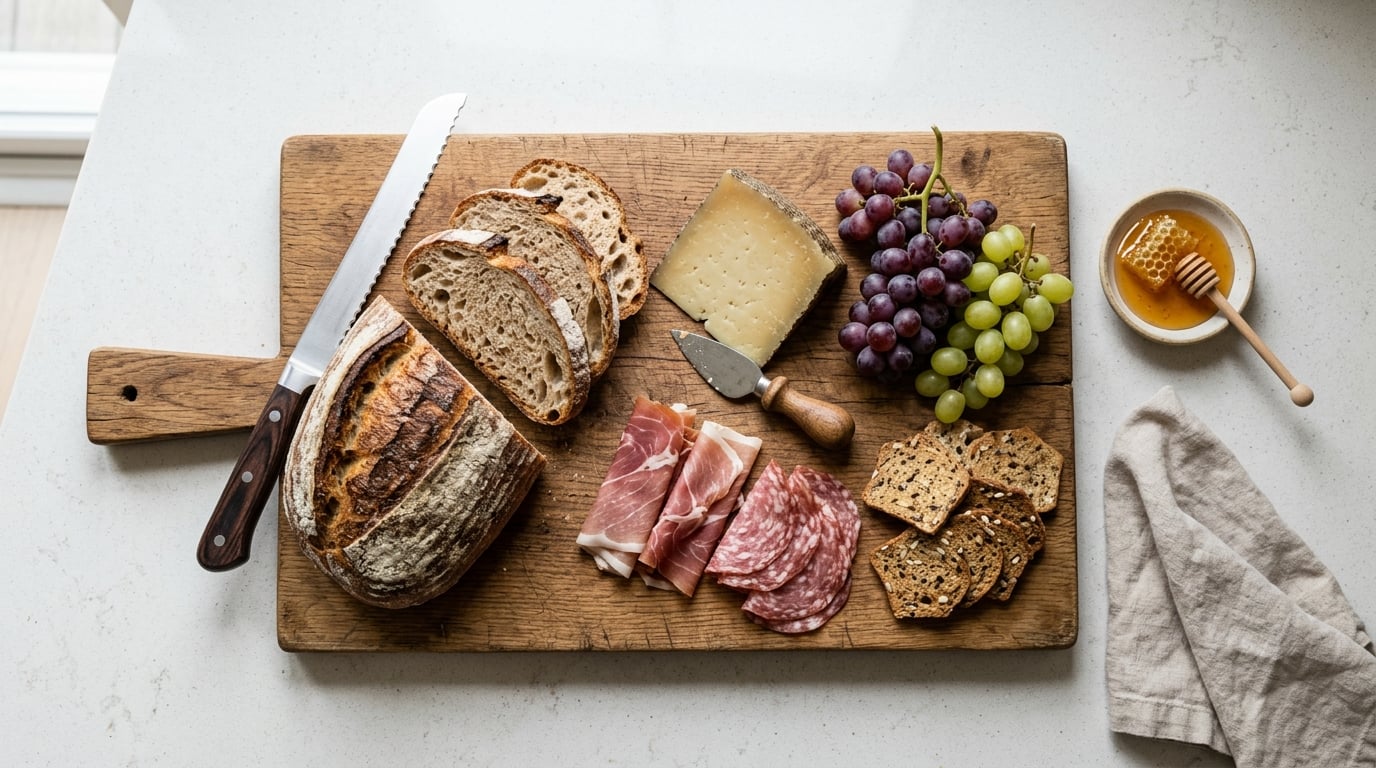
What kind of cutting board is best for bread? A thick, stable hardwood board at least 18 inches long, with a groove or tray to catch crumbs, that is easy to scrub and has no finish you cannot refresh. Bread wants a flat surface that will not rock under a serrated knife. Charcuterie wants room to spread out, a way to keep wet cheese brine away from crackers, and a surface that looks good on a table. One board can do both jobs if you pick for size first and material second.
I host a lot, and my kitchen counter is not big. So I stopped buying a separate slicing board and a separate serving platter, and I started looking for one piece that does both jobs. That is what this list covers: the best cutting boards for bread and charcuterie, broken down by the way each one is built and the kind of hosting it handles best.
Two things to know before you read. First, the difference between the two jobs. A cutting board is built for prep, so it wants to be hard, stable, and kind to a knife edge. A charcuterie board is built for presentation, so it wants depth, handles, wells, and looks. Boards sold as charcuterie sets are often soft, thin, and heavily sealed, which makes them poor slicing surfaces. Second, size does more for you than material does. A 12 inch board that fits your sink will beat a beautiful 24 inch board you refuse to wash.
Table of Contents
- Best Cutting Boards for Bread and Charcuterie at a Glance
- 1. Large Maple Wood Board
- 2. Olive Wood Serving Board
- 3. Walnut Board with Groove
- 4. Bamboo Slender Bread Board
- 5. Acacia Wood Board
- 6. Charcoal-Finished Composite Board
- 7. Portable Handle Board
- 8. Reversible Small-and-Large Board
- 9. End-Grain Teak Board
- 10. Reclaimed Wood Rustic Board
- Frequently Asked Questions
- What is the best cutting board for bread and charcuterie?
- Is wood or bamboo better for cutting bread and cheese?
- Do cutting boards need a juice groove for charcuterie?
- How large should a cutting board be for charcuterie?
- How do I clean a wooden cutting board used for meat and cheese?
- Can one cutting board be used for bread and raw meat?
- Conclusion
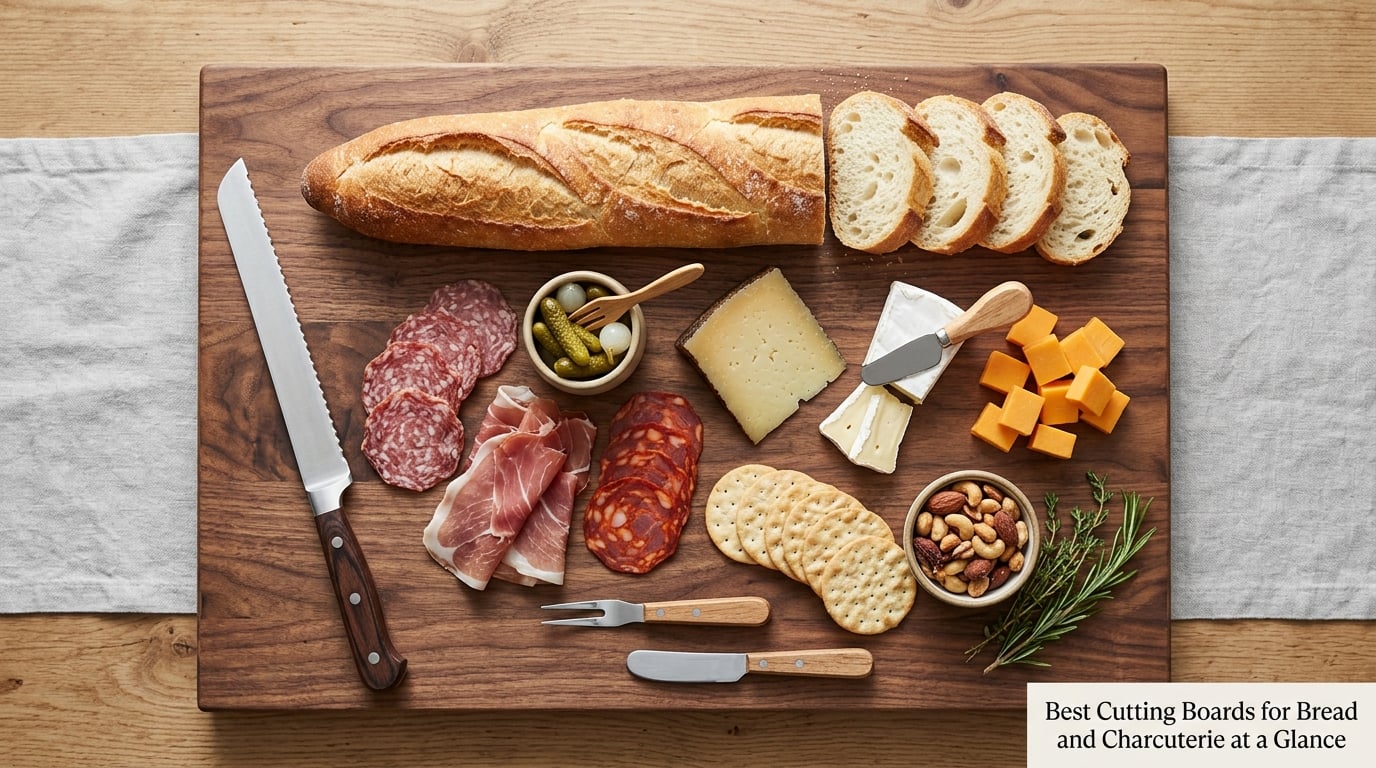
Best Cutting Boards for Bread and Charcuterie at a Glance
| Board | Best for | Material | Approx. size | Main benefit | Choose it if |
|---|---|---|---|---|---|
| Large maple board | Everyday bread and charcuterie | Hard maple, edge or end grain | 18-20 by 12-14 in | Stiff, flat, kind to knives | You want one board for everything |
| Olive wood board | Dinner party presentation | Olive wood, oiled | 16-20 by 10-14 in | Strong grain, warm color | The board will be seen before it is used |
| Walnut board with groove | Messy wet and dry foods together | Black walnut | 18-24 by 12-16 in | Juice groove contains brine and crumbs | You serve soft cheese next to crackers |
| Bamboo slender board | Baguettes and small loaves | Laminated bamboo | 16-18 by 8-10 in | Narrow footprint, easy to store upright | Counter and storage space are tight |
| Acacia board | Mid-sized gatherings | Acacia | 16-18 by 11-13 in | Warm tone, takes moisture well | You want character without a dark wood |
| Charcoal composite board | Frequent heavy use | Composite with charcoal finish | 18-20 by 12-14 in | Washable, holds an edge well | You cook and host most weekends |
| Portable handled board | Carrying food to another room or event | Acacia, walnut, or teak | 18-22 by 10-12 in | Side handles and a hanging hole | You move the spread from kitchen to table |
| Reversible board | Prep and serve in one piece | Maple, walnut, or bamboo | Two faces, 14-18 in | One side for cutting, one for serving | You hate washing two boards |
| End-grain teak board | Heavy knife work | End-grain teak | 20-24 by 14-16 in | Self-healing, dense, water resistant | You slice daily and host often |
| Reclaimed wood board | Rustic gatherings | Reclaimed hardwood | 18-24 by 12-16 in | One of a kind, high visual impact | The board is the centerpiece |
Nothing in this list is a single brand recommendation, because the same wood behaves differently depending on how it is cut and how it is finished. Judge the piece in front of you on grain direction, thickness, flatness, and finish instead.
How much board do you actually need?
Map the board to the number of people, not to the amount of food. These are the sizes that work in practice:
- 8 by 12 inches: one or two people. Fine for a small loaf and a cheese portion, useless for a spread.
- 12 by 18 inches: two to four people. Enough for a baguette plus three cheese portions.
- 18 by 24 inches: six to ten people. This is the size most hosts land on, and the size I recommend for the best cutting boards for bread and charcuterie combined use.
- 20 inches and up: twelve guests or a grazing table. Plan where you will store it before you buy.
The 3-3-3 rule is a good loading guide once the board is the right size: three cheeses, three cured meats, three accompaniments such as crackers, fruit, or nuts. On an 18 by 24 inch board that spread fills about two thirds of the surface, which leaves room for bread and for people reaching across each other.
What each surface job demands
Bread slicing wants a long, flat, stable surface. A serrated knife rocks if the board flexes, and a board that rocks is how you end up with a torn crumb and a compressed heel. A groove set into the board catches crumbs, and a shallow tray along one edge keeps the counter clear.
Charcuterie wants separation. Brine from a soft cheese, rendered fat from prosciutto, and sticky dried fruit will all wander across a flat surface and onto your crackers. A perimeter groove or a set of shallow wells gives that juice somewhere to go.
1. Large Maple Wood Board
Hard maple is the workhorse of the list, and if you are buying one board for bread and charcuterie, start here. It is dense, stiff, and pale enough that a sliced loaf and pale cheese look good together on it.
Why it works for bread: maple barely flexes, so a long serrated knife tracks straight across a full sourdough loaf. The surface is closed grain, so it resists soaking in crumbs and moisture the way open-grain woods do.
Why it works for charcuterie: the light color stays neutral under cheese, and a wide board lets you run meats along one long edge and cheeses along the other. If you buy edge grain, you get a flat, stable, traditional surface. End grain is gentler on a knife edge and shows scars faster, which matters if the board is also decorative.
Care: hand wash, dry standing on its edge, and coat with food-grade mineral oil or board cream when the surface looks dry. Paper towels leave a fine film; a lint-free cloth is better.
The catch: plain maple is visually plain, and pale wood shows a red wine ring immediately. If appearance is your priority, look at walnut or olive instead.
2. Olive Wood Serving Board
Olive wood is the board people notice before they touch it. The grain runs in dramatic dark streaks through light tan, and no two pieces look the same, so it reads as a serving piece first and a tool second.
It is a hard, dense wood that holds a sliced edge cleanly, and it takes oil to a deep finish that makes the figure pop. The grain is more open than maple, which means it will take on stains over time.
Watch for cracking. Olive is the one wood on this list where reviewers repeatedly report boards checking or splitting after a few months of use, often when a board was dried out near a heat source or soaked and left standing. Buy from a seller that names the wood and the finish, and keep it away from the oven and the dishwasher.
Best use: date nights, holiday tables, anything where the board stays on the table long enough to be admired. It is heavier than maple, so hauling it to a picnic is a stretch.
3. Walnut Board with Groove
A walnut board with a groove routed around the edge solves a specific problem: everything that runs off food ends up in the channel instead of on your table. That includes cheese brine, meat juices, and bread crumbs, which is why this is one of the best cutting boards for bread and charcuterie when the two are on the board at the same time.
Walnut is dense, moderately hard, and dark enough to make pale cheese and light crackers pop. The color also hides knife marks better than maple, which is a real advantage for a board that gets used for bread slicing with a serrated knife every week.
Size matters here more than usual. A groove is only useful if the channel has room to hold liquid without spilling, so buy 18 by 24 inches or larger if you are buying for a group.
Keep five things off a walnut charcuterie board if you want it to look good at the table: standing pools of brine, sticky dried fruit like figs and dates, tomato slices that leave acid rings, raw onion, and a hot pan set down for a second. Most of those are fine on the prep side of the board. The list is about the moment the board goes to the table.
The catch: walnut is soft enough among hardwoods that heavy chopping leaves visible divots. Keep it for slicing and serving rather than for breaking down a whole chicken.
4. Bamboo Slender Bread Board
A narrow bamboo board is the answer when your real problem is horizontal space. A typical one runs about 16 to 18 inches long and 8 to 10 inches wide, which is exactly the shape of a baguette or a small round loaf, and it slides into a narrow cabinet or stands on its end in a gap beside the fridge.
Bamboo is hard and takes a fine edge-resistant surface well. Laminated bamboo is also dimensionally stable, so it moves less with humidity than solid wood and is less likely to warp around a sink.
Where it falls short is width. A slender board is great for slicing straight down a loaf, then rotating the loaf and slicing crosswise, because the loaf fits. It is not great for a charcuterie spread, because there is no room to keep crackers away from a soft cheese. Use it as the bread station and keep a larger board for the spread.
Scratching is the other complaint. Bamboo is harder than most hardwoods, so a sharp knife can mark it, and reviewers report visible scoring sooner than with maple or walnut. Bamboo also cannot be repaired the way a solid wood board can be sanded and re-oiled.
5. Acacia Wood Board
Acacia is the middle option that a lot of people never consider. It is mid-density, mid-priced, and warm reddish brown, with enough grain variation that two boards from the same maker do not look identical.
For bread, acacia is solid. It is firm enough that a full-size loaf will not flex the board, and it is not so hard that it hammers a knife edge. For charcuterie, the warm tone sits nicely under pale cheese, and the boards are often sold with a shallow groove or a handle already routed in.
Moisture is where acacia earns its place. It tolerates repeated dampness better than many closed-grain hardwoods, which makes it a good workhorse for a host who washes a board between bread prep and cheese service.
Watch for the finish. Many acacia boards arrive sealed with a lacquer or food-safe coating that looks great and cannot be refreshed. Buff the surface with a cloth and water; if it beads up, it is sealed, and you are living with that finish. An unfinished board that feels slightly dry to the touch is the better buy.
6. Charcoal-Finished Composite Board
Composite boards are resin and fiber pressed into a slab, and the charcoal-finished ones are the dark, matte, modern look. They are the practical answer for someone who wants one surface for everything and does not want to think about oil.
The case for it: the surface is dense and non-porous, it survives a trip through the dishwasher on most models, it does not absorb odor from garlic and onion the way open-grain wood can, and it stands up to heat better than wood. Rinse, dry, done.
For bread it works well. The surface is flat and stiff, and a serrated knife tracks cleanly. For charcuterie it works well because it wipes clean, which matters when you are moving from cured meat to soft cheese to fruit on the same board.
The catch, and it is a real one for anyone who cares about knives. Composite is harder than most hardwoods, so it is less forgiving on an edge, especially a thin slicing knife or a Japanese-style edge. If your bread knife is a serrated and your cheese knife is a thin straight, expect to sharpen more often than you would on walnut or maple. Reviewers who own good knives tend to keep a wood board for prep and use composite as a serving surface.
Also check the weight. Dense composite slabs in the 20 inch range are heavy, and getting one in and out of an upper cabinet is a two hand job.
7. Portable Handle Board
A board with routed side handles and a hanging hole is built around a specific moment: the food is ready and the board has to travel from the kitchen counter to the table, or from your car to someone else’s door.
The handles are usually cut from the same board or attached, and they turn a flat slab into something you can carry level with both hands. That is the difference between arriving with an intact spread and arriving with a lap full of crackers. A hole drilled near one end lets the board hang on a wall hook instead of leaning against the backsplash, which is the usual home for oversized boards.
Look for a board that is deep enough for the load. Twelve inches of width is comfortable for a date night spread. Ten inches works if you are running with crackers, two cheeses, and one meat.
The catch: handles add edges to clean, and some are shallow enough that a wet board still slips. Wipe the underside dry before you lift, and do not carry a loaded board by a single handle if the board is longer than about 20 inches.
8. Reversible Small-and-Large Board
Some boards give you two working surfaces in one piece: a larger face for chopping and slicing, and a smaller face set aside for serving, or a shallow recess on the reverse that acts as a tray. For a host who hates washing two boards, the reversible board is the quiet winner.
Use the big face for bread. The full length matters more than the pattern, because it lets you slice a loaf in one pass without cutting it on the diagonal. Flip the board for the spread and you have a clean surface that has not touched the cutting side of your kitchen.
The other pattern worth knowing is the one with shallow wells. Two or three routed wells give a soft cheese, a dollop of mustard, and a pot of honey somewhere to sit without sliding into the crackers. It is a small design choice that makes a board look planned rather than assembled.
The catch: reversibility cuts both ways. You are not getting twice the surface area, you are getting one good surface and one secondary surface, and the two are rarely the same size. Boards with a recess are also harder to clean in the channel, so a narrow brush helps.
9. End-Grain Teak Board
End grain is the construction to understand here. The short pieces of wood are turned so their cut faces point up, creating a surface made of thousands of small blocks. Marks that appear in one block are cut away when you plane or sand it, which is why end grain boards heal over time instead of collecting permanent scars.
Teak is dense, oily, and naturally water resistant, which makes it a good end grain choice for someone who washes a board daily. It takes oil well, smells faintly of nothing at all, and does not pick up odors the way some open-grain woods do.
For bread, end grain is kind to a knife edge. The surface has give, so a sharp serrated works without bouncing. For charcuterie, a large teak board is the standard restaurant-adjacent look, and a groove is easy to route into the edge.
Two drawbacks. Teak is heavy, and a 24 inch end grain slab is a real object to lift. And oiliness that makes teak water resistant also makes it slower to take an oil finish, so if it looks dry, give it time and several coats rather than one.
Teak is a little softer than hard maple, so it treats an edge more like a dense hardwood than like a composite. That middle position is exactly the tradeoff: excellent for knives and moisture, heavy in the hand.
10. Reclaimed Wood Rustic Board
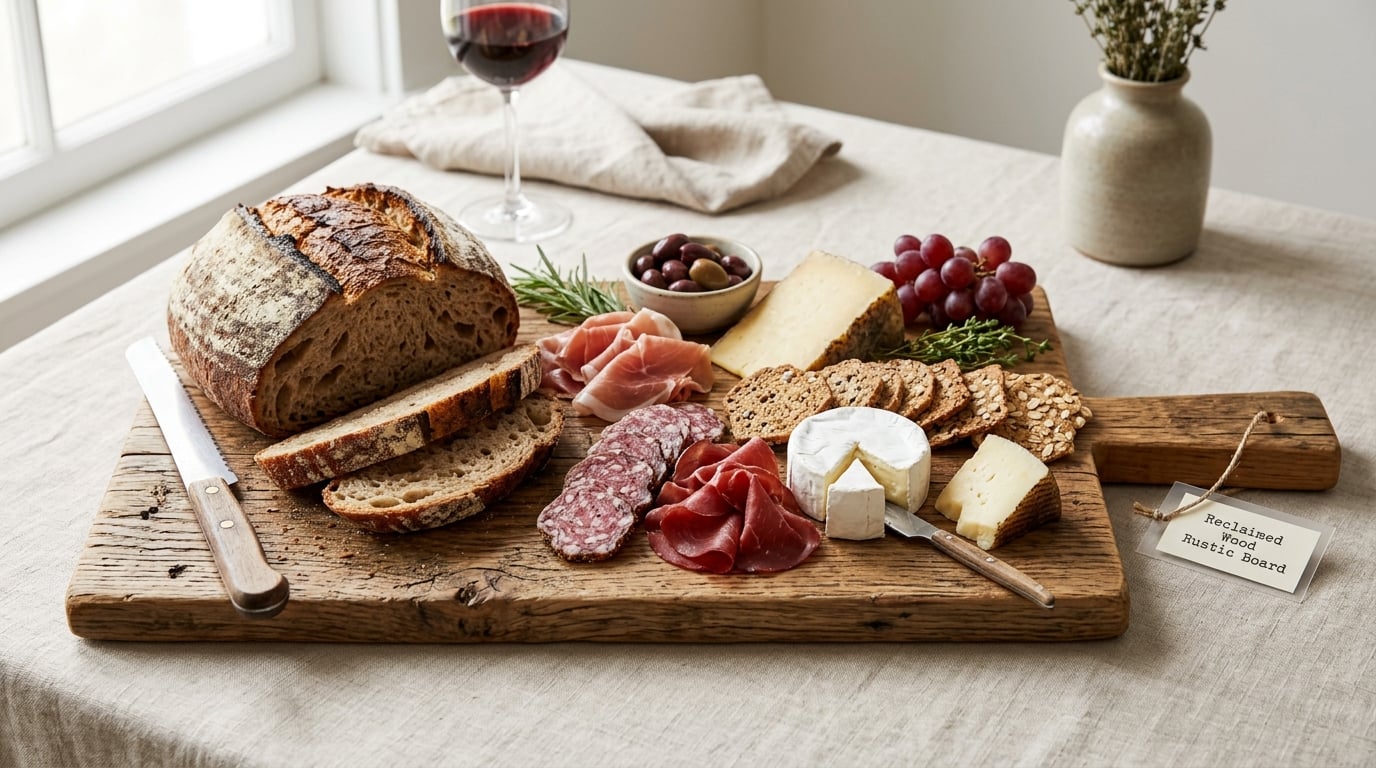
Reclaimed boards are made from old beams, floors, and crates, and they are the most visually distinctive thing you can put on a table. Nail holes, saw marks, uneven color, and old patina show through. For a rustic gathering, nothing else on this list does what one of these does.
Functionally, the variation is the point of caution. Reclaimed wood is often old-growth hardwood, which means it is hard and stable, but boards assembled from short pieces can have slight low spots between the seams, and a live edge is never perfectly flat. Check it on your counter with a straightedge or a level before you commit. A board that rocks will ruin a bread slice no matter how beautiful it is.
Also check the finish. Old lumber may have been treated, painted, or glued. Skip anything with a paint layer, a strong chemical smell, or a deep glue seam, and look for a maker who states the wood species and that it is food safe.
For cleaning, treat it like any wood board but more gently. Scrub with a brush along the grain, rinse briefly, dry standing on its edge, and never soak it. Do not put a reclaimed board in the dishwasher.
The catch: no two are alike, so defects are not returnable in the way a factory-milled board is. Buy from a seller who shows you the actual board, not a stock photo.
Frequently Asked Questions
What is the best cutting board for bread and charcuterie?
A large end-grain or edge-grain hard maple board around 18 by 24 inches, with a juice groove on the perimeter and a food-safe finish you can refresh with board oil. Maple is stiff enough that a full loaf will not flex it, the surface is kind to a serrated knife, and the pale color stays neutral under cheese. A walnut board of the same size works just as well if you prefer a darker look and can accept more visible knife marks.
Is wood or bamboo better for cutting bread and cheese?
Solid hardwood is better for both jobs, mostly because it is repairable. A scored end-grain or walnut board can be sanded flat and re-oiled, which a laminated bamboo board cannot. Bamboo is denser, cheaper, and holds its shape well in humid kitchens, so it is a reasonable choice in a small space. For serving, hardwood wins on looks and on the way a board handles oil and stain over years.
Do cutting boards need a juice groove for charcuterie?
No, but a groove solves a specific problem: brine from soft cheese, fat from cured meat, and bread crumbs all migrate across a flat board and onto your crackers. A perimeter groove or shallow wells give that liquid a place to collect. If you only ever serve hard cheese and dry crackers, a flat board works fine. The groove earns its place as soon as a washed-rind cheese or a ripe Brie goes on the board.
How large should a cutting board be for charcuterie?
Plan on 6 square inches per guest for a small spread, and more if bread is served on the same board. That works out to 12 by 18 inches for two to four people, 18 by 24 inches for six to ten, and 20 inches or larger past twelve guests. A loaded board should stay under about two thirds full so people can reach without moving each other’s cheese. Measure your cabinet before buying something over 20 inches.
How do I clean a wooden cutting board used for meat and cheese?
Scrub both sides with hot water, dish soap, and a brush, working along the grain so the open pores do not trap residue. Rinse, then dry standing on its edge or in a dish rack so air moves on both faces. Do not soak, do not run a wood board through the dishwasher, and do not let it sit wet on the counter. Once fully dry, wipe on a thin coat of food-grade mineral oil and let it soak in overnight.
Can one cutting board be used for bread and raw meat?
You can use one board for bread, cured meat, and cheese, but do not put raw poultry, raw ground meat, or raw seafood on a board you will then serve from. If you do, clean and sanitize the board fully and dry it before it goes back into bread service, and keep raw meat prep on a separate plastic board. Cured meats like prosciutto and salami are not raw, so they do not carry that risk, and wood itself is a good surface because it is not porous like a worn plastic board becomes.
Conclusion
Start with size and material, not with the finish. For most kitchens, an 18 by 24 inch hard maple or walnut board with a perimeter groove covers both jobs and stays knife friendly. Go end grain in teak if you slice daily and want a surface that heals. Go slender bamboo if storage is the constraint. Choose olive or reclaimed wood when the board is going to sit on the table and be looked at, and pair either with a separate small plastic board for raw meat prep.