
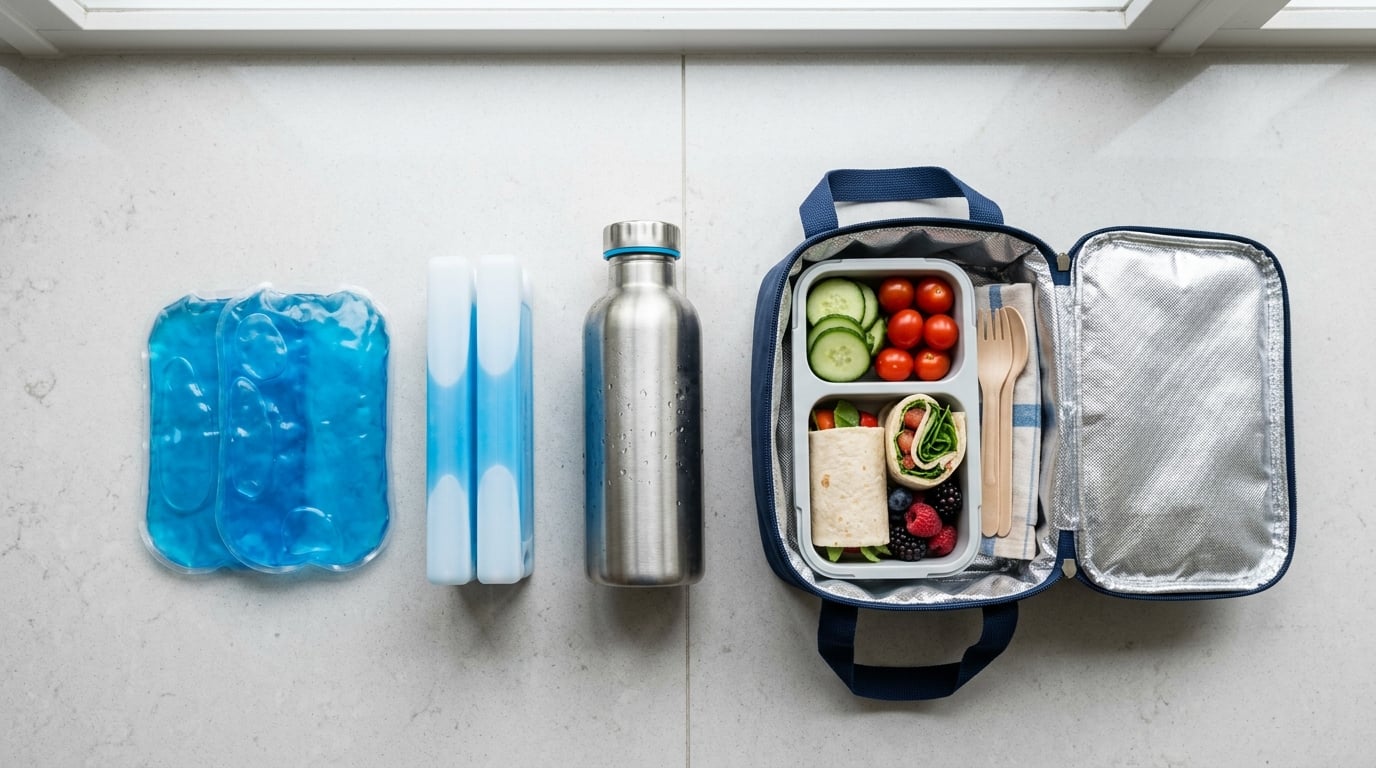
A packed lunch that sits at room temperature for four hours is a food-safety problem, not just a soggy one. The best ice packs for lunch boxes are the sealed, reusable kinds you freeze overnight and set beside the food: a flexible gel pack for everyday school lunches, a hard plastic brick when you want the longest cold-hold, a slim pack when the bag is too narrow for anything else, and a stainless-steel bottle when the drink and the cold source can be the same object.
Which type stays cold the longest? A hard plastic brick holds the coldest temperature for the most hours because it carries the largest mass of phase-change material in the shape that fits a lunch box. A flexible gel pack follows close behind because it makes better contact with the food, and a slim pack trails both since less mass means less cold to give away.
Everything below assumes you freeze the pack flat and solid overnight. A pack frozen on Sunday will not carry a Tuesday lunch.
Table of Contents
- Best Ice Packs for Lunch Boxes at a Glance
- 1. Flexible Gel Ice Pack
- 2. Slim Reusable Plastic Ice Pack
- 3. Hard Plastic Ice Pack
- 4. Stainless-Steel Ice Bottle
- 5. Phase-Change Ice Pack
- 6. Insulated Ice-Pack Sleeve
- 7. Lunch Box with Built-In Ice Pack Compartment
- 8. Reusable Ice Cubes or Ice Sticks
- 9. Leak-Resistant Gel Pack With Zip Closure
- 10. Compact Insulated Ice-Pack Set
- Frequently Asked Questions
- Which type of ice pack stays cold the longest?
- How long does an ice pack stay cold in a lunchbox?
- Should the ice pack go on top or bottom of the lunch box?
- How long is a sandwich safe in a lunch box without an ice pack?
- Are reusable ice packs better than loose ice?
- How do I keep a lunch cold when the room is hot or there is no fridge at school?
- Conclusion
Best Ice Packs for Lunch Boxes at a Glance
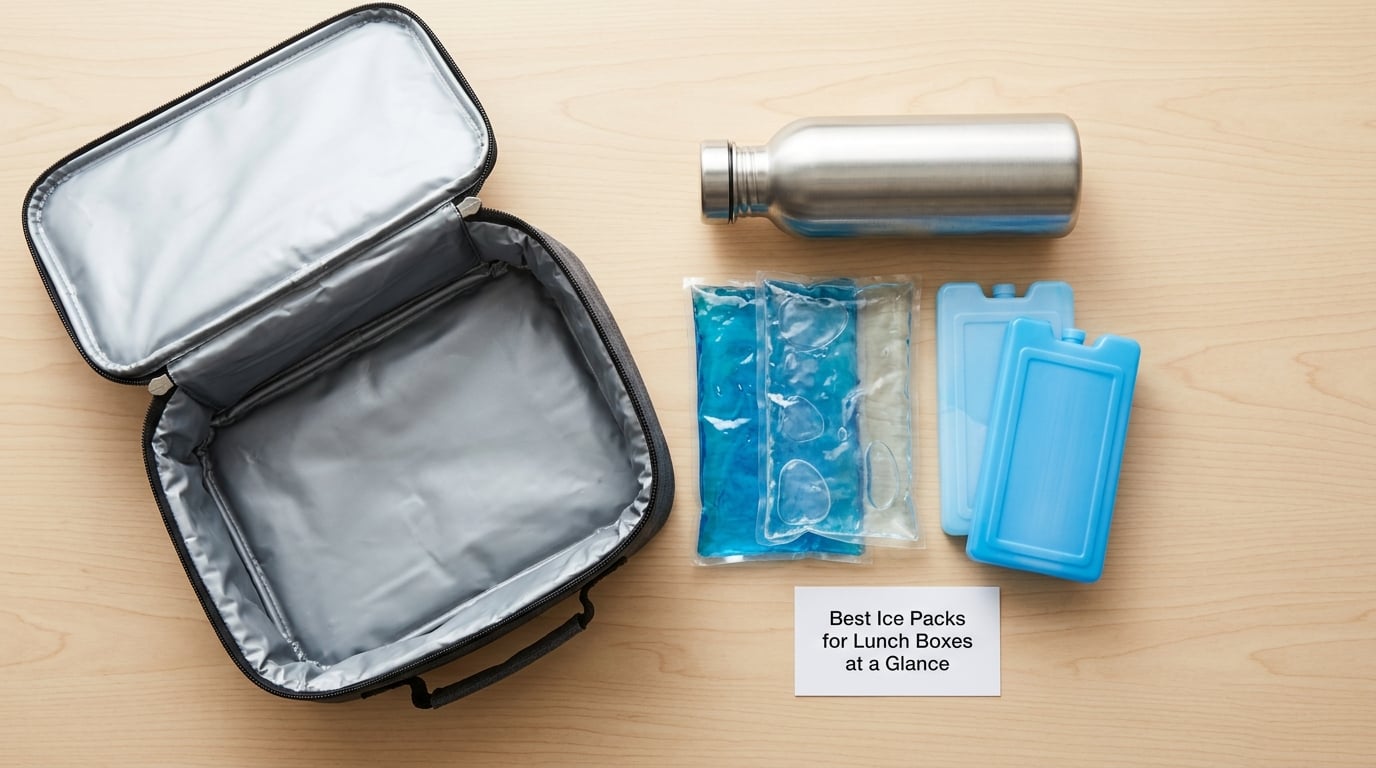
The table below maps the ten pack types in this guide to the job each one does well. Cold-hold figures are realistic numbers for an ordinary insulated lunch bag in room temperature, not laboratory conditions.
| Pack type | Best use | Typical cold-hold | Bag fit | Leak resistance | Ideal user |
|---|---|---|---|---|---|
| Flexible gel pack | Everyday school and work lunches | 4 to 6 hours | Fits most bag sizes | Very good | Anyone packing one lunch a day |
| Slim reusable plastic pack | Narrow bento bags and slim totes | 3 to 4 hours | Excellent, thin profile | Very good | Small bags and compartment trays |
| Hard plastic brick | Long days, no ice at school | 6 to 8 hours | Good if it matches the cavity | Very good | Kids with long afternoons or field trips |
| Stainless-steel ice bottle | Cold drink plus cold source | 5 to 7 hours | Needs a bottle pocket | Excellent, no gel to leak | Adults, commuters, gym bags |
| Phase-change pack | Steady temperature, less freezing | 4 to 6 hours | Fits most bag sizes | Very good | Delicate items and medication transport |
| Insulated sleeve | Extending a standard pack | Adds 1 to 2 hours | Bulkier, wraps the pack | Inherits pack seal | Anyone already losing the 11am battle |
| Built-in compartment box | Set and forget packing | 5 to 7 hours | Designed to match | Good | Families avoiding a morning pack step |
| Reusable ice sticks or cubes | Adjustable cold, light packing | 3 to 4 hours | Fits tight cavities | Good if undamaged | Small portions and short days |
| Zip-seal gel pack | Commuting, bags that tip in a stroller | 4 to 6 hours | Fits most bag sizes | Best of the ten | Travel, commutes, stroller bags |
| Compact multi-pack set | More cold capacity, two-bag days | 6 to 8 hours combined | Heavier, needs room | Good | Meal preppers and long days out |
What cold-hold time actually means
Cold-hold time is the window a frozen pack keeps your food safely chilled inside an insulated bag, starting from a solid overnight freeze. It is not the time the pack stays visibly frozen, and it is not a manufacturer specification, because almost nobody publishes one. Every number in this guide is a practical expectation, and a hot car or an un-air-conditioned classroom will cut into it.
How to size a pack to your bag
Measure the widest flat area inside your bag and subtract about half an inch for clearance. A preschool tote with a 7 by 5 inch interior wants a pack around 6 by 4 inches. A slim bento tray wants something no thicker than 1.5 inches, or it eats the compartment it is supposed to chill.
If the pack rattles in a small bag, cut a flat cardboard shim from a cereal box and wedge it against the side wall. It costs nothing and stops the pack bouncing, which is what knocks loose ice and punctures gel packs.
The food-safety number that matters
The USDA puts the food safety danger zone at 40F to 140F, and the two-hour rule says perishable food should not sit in that range for more than two hours, or one hour when the air is above 90F. A lunch packed at 7:30am and eaten near noon is a five-hour gap, so something has to be actively cold for most of it. That is the whole job.
Why packs go warm by 10am
Three things cause it, in order of frequency. The pack was not frozen solid. The bag was never pre-chilled, so the food and the air dump their heat into a cold-but-empty cavity. And the pack is too small for the mass of food beside it, which means the food itself outlasts the cold source.
The advice that comes back most often in school-lunch groups is not about gel percentage or brand. It is about fit. Small hard bricks get recommended for the unglamorous reason that they physically fit inside a particular lunch box, and thin packs get recommended for the same reason when they tuck under a bento tray. Fit beats volume at lunch-box scale, and it is the opposite of how you shop for a cooler.
1. Flexible Gel Ice Pack
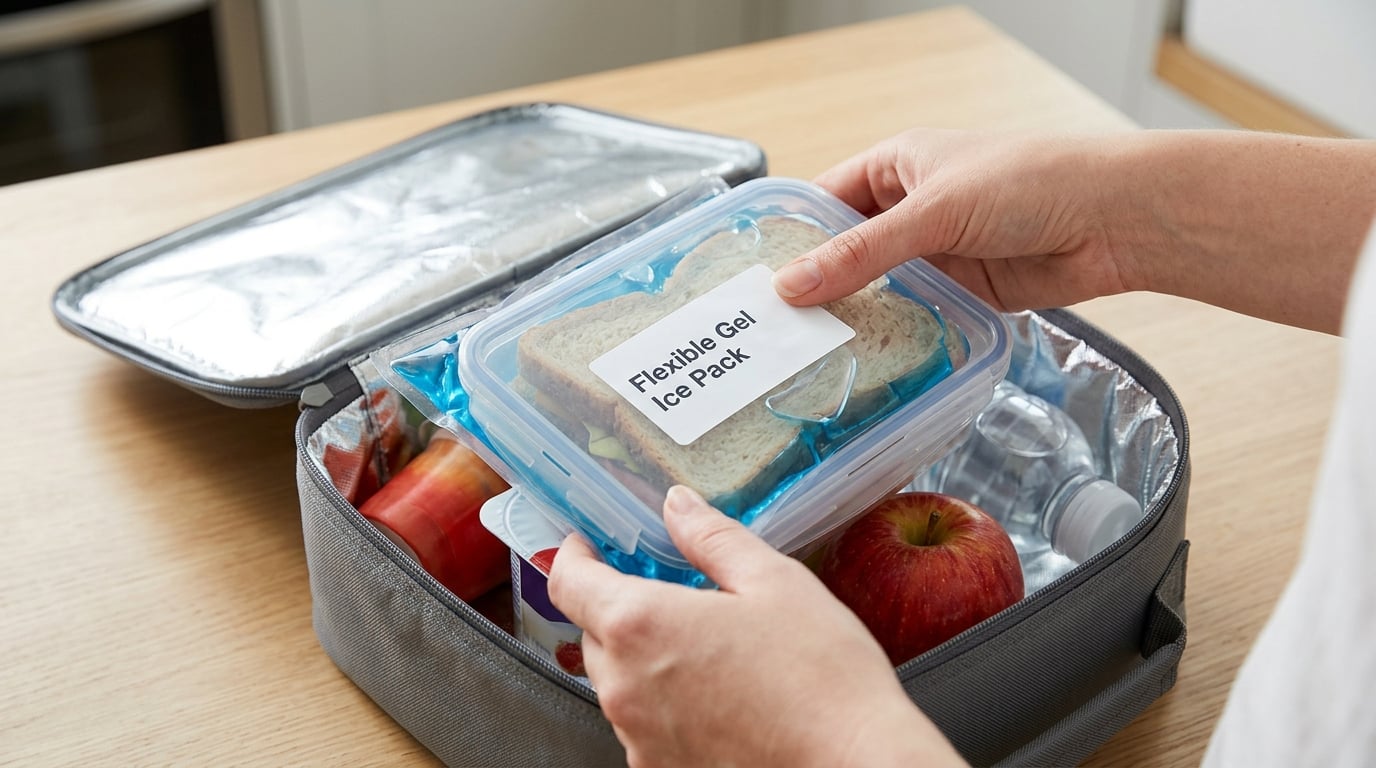
The flexible gel pack is the most versatile everyday choice, and for most families it is simply the one to buy first. The soft shell bends around a Tupperware, a yogurt pot, or a bento tray instead of sitting beside it like a brick, so more of the cold surface actually touches the food.
That contact matters more than people expect. Air is a poor conductor, and a hard pack that touches only one face of a container leaves a warm gap. A gel pack that molds to the corners pulls that gap down.
Expect four to six hours of useful cold from a full-size flexible pack in a decent insulated bag. Freeze it flat, overnight, in the position it will sit in the bag. Gel packs that freeze in a curled shape freeze unevenly, and the bent section thaws first.
Two details that get missed. First, gel pack contents are not for human consumption, so a leaky pack in a child’s lunch is a reason to throw the food out, not a reason to wipe the container and reuse it. Second, soft packs are more vulnerable to puncture than hard ones because the shell stretches, so keep the sharp corners of a bento tray away from it.
Best for: school lunches, work lunches, anything with mixed containers that you want one pack to handle.
2. Slim Reusable Plastic Ice Pack
The slim reusable pack solves a very specific problem: a narrow bag where a full-size pack leaves no room for food. Think a flat bento sleeve, a slim tote, or a compartment tray. A pack one inch thick can sit under the tray and chill the whole cavity without stealing the space where the sandwich goes.
The trade-off is honest. Less mass means less cold, so three to four hours is a realistic window rather than six. In a bag that holds cold well and a day shorter than that, a slim pack is the right call. In a hot car in July, it will not be enough on its own.
Slim packs also freeze faster than bricks, because there is less liquid to pull heat out of. That makes them convenient in a rotation system where a pack needs to be ready again the same evening.
Check the stated freeze time on any slim pack you consider, and test it flat on a level shelf. A pack that froze against a wire rack develops thin spots that thaw first and shorten the whole day.
Best for: narrow and compartment bags, short days, and anyone packing a bento with fixed dividers.
3. Hard Plastic Ice Pack
The hard plastic brick, usually a rigid tray of frozen gel or brine, is the endurance pick. It holds a colder temperature and gives it up more slowly than a soft pack of the same size, which makes it the one to reach for when lunch is eaten late or there is no fridge at school at all.
Durability is the other argument. A hard shell does not flex, so it does not crack from being sat on, dropped in a backpack, or frozen into a coil. Small hard bricks are still the pack type most parents settle on, and it comes down to the same two reasons: they hold cold, and they fit.
The limitation is space. A brick needs a cavity sized to it. In a soft-sided tote that compresses, a brick that fits on Monday may fight the zipper on Tuesday, and that fight is where punctures happen.
Measure the cavity before you buy, and if the bag is soft-sided, choose a pack slightly smaller than the cavity. A pack that has to be forced in is a pack that gets punctured.
Best for: long school days, field trips, and bags where the cold source is not getting used at lunch.
4. Stainless-Steel Ice Bottle
The stainless-steel ice bottle is the one that gets a double vote. Frozen, it is a cold source. Thawed at lunchtime, it is the drink. Nothing melts into the food, nothing can gel-leak into a bag, and the whole thing rinses out in seconds because stainless steel has no seams to trap yogurt.
Cold retention sits between a gel pack and a brick, typically five to seven hours, and there is a good reason: the metal conducts heat better than plastic or gel, pulling warmth out of the air inside the bag while the water inside holds the cold.
Weight is the cost. A filled bottle is the heaviest item in most lunch bags, and it needs a bottle pocket or a tall side compartment. In a flat tote with no pocket, it will lie down and stop working as a cold source for whatever is under it.
The frozen water bottle also works for anyone who wants a zero-cost approach. Fill a reusable bottle, freeze it solid, and put it in the bag. It is the same object, minus the price tag.
Best for: adults, commuters, gym bags, and anyone who wants a drink and a cold source in one.
5. Phase-Change Ice Pack
A phase-change pack is a sealed pack of material designed to change from solid to liquid at a set temperature, and that is the whole mechanism. Instead of just being cold, it holds a specific temperature while it changes state, so the air inside the bag sits near that temperature rather than slowly warming.
That makes phase change useful where steady temperature matters more than raw cold hours. A phase-change pack is the better pick for delicate items, for carrying medication that has a storage range, and for a lunch box that will be opened and closed repeatedly, because each opening warms the air less.
There is a caveat. Because the material is engineered to switch at a particular point, some phase-change packs are not as cold as a standard gel pack in their frozen state, which can mean fewer hours of protection for perishable food. Check what the pack is rated for, and use a regular gel or brick if the priority is simply keeping dairy cold for six hours.
For a packed sandwich lunch, phase change is a refinement rather than a requirement. It earns its place when the contents are delicate, or the day is unusually long and the bag gets opened often.
Best for: temperature-sensitive contents, frequent opening, and delicate items that should not freeze against the container.
6. Insulated Ice-Pack Sleeve
An insulated sleeve is a cover that goes around a standard pack, usually a foam or neoprene wrap with a zip or hook-and-loop closure. It does not add cold. It slows the rate at which the pack loses what cold it has, and on a marginal afternoon that is the difference between food being safe at lunch and food being at 55F by 11am.
It is a corrective tool rather than a first purchase. If a good pack in a good bag is already getting through the day, adding a sleeve is wasted bulk. If the lunch is routinely warm by mid-morning, the sleeve buys you one to two hours, which is often the margin you need.
Bulk is the real downside. The sleeve adds thickness to the pack, so in a narrow bag it will not fit at all. It also adds a second layer to wipe down after every use, and a closed sleeve that traps moisture against the pack surface is a slow leak waiting to happen.
One tip: put the pack in the sleeve only after it is fully frozen, and dry the outside first. Trapped water between sleeve and pack thins the effective wall and cuts cold-hold.
Best for: anyone already losing the 10am battle, and bags with enough room to spare for the extra thickness.
7. Lunch Box with Built-In Ice Pack Compartment
Some lunch boxes are designed around a freezing compartment rather than for a loose pack. A flat freezer disc lives in a recess at the base, or a freezable bag has gel in the lining itself, so the box is the cold source. This is the pattern behind the freezable-wall bags and the bento boxes with a disc slot that many parents see recommended.
The benefit is a missing morning step. There is no separate pack to freeze, no pack to find, no question of whether it was frozen overnight. Parents describe this as the reason the freezable-wall design became a daily driver for them, and it is the single most effective fix for the most common complaint, which is a lunch that is warm by mid-morning.
Weight distribution is the underrated advantage. A disc at the base puts the mass low in the bag, and a low bag is a bag that stands up and holds its shape when carried. An unbalanced bag with a heavy pack on top tips open.
Not every design is equal, though. A bag with thin foam and a small compartment will not match a bag with a full gel lining, and a disc-sized cavity limits you to discs. Check whether the compartment is genuinely freezable and whether the whole box survives a night in the freezer without the hinges warping.
Best for: families tired of a separate pack step, and anyone who wants a self-contained cold chain.
8. Reusable Ice Cubes or Ice Sticks
Reusable ice sticks are the lightest option and the most adjustable. You decide how many go in, so on a mild day you use two and on a hot one you use five, without buying a second pack. They are soft-sided, so they bend into narrow cavities that a brick will not fit.
Cleaning is their best feature. Twist, rinse, and stand them upright to drain. No seam traps yogurt the way a hard tray does, and a stick that starts to leak is a stick you retire rather than a bag you have to scrub.
Freezing takes less time than a full brick, which is what makes a two-stick rotation workable if you pack late. Cold retention is the limitation, typically three to four hours, because a stick simply does not carry much mass. Keep them out of direct contact with bread, since condensation on a cold surface is how a good sandwich turns damp by lunchtime.
Comparing the three ways to get cold into a bag:
| Cold source | Cold-hold | Wetness risk | Cleaning | Best for |
|---|---|---|---|---|
| Loose ice cubes | 1 to 2 hours | High, melts into the food | None, just melts | Nothing, this is the one to avoid |
| Sealed gel pack | 4 to 6 hours | None unless it leaks | Wipe down | Everyday lunches |
| Frozen water bottle | 5 to 7 hours | Condensation on the outside | Rinse and refill | When the drink and the cold source are one |
Loose ice is the weakest option by a wide margin. It melts into the food, wets the bread, and leaves a warm lunch behind an hour later. Parents looking for a cheap fix often start there, which is why soggy sandwiches come up so often in packing threads.
Best for: short days, small portions, and adjustable cold in a bag with no spare room.
9. Leak-Resistant Gel Pack With Zip Closure
A burst gel pack is the failure parents describe most often, and the aftermath is worse than a warm lunch: gel in the lining, a stained bag that never quite comes clean, and a sandwich that has to be thrown out. Leak resistance is usually the first deal breaker in school-lunch groups for that reason.
A zip-seal or screw-seal closure is the most reliable design, because the seal is mechanical rather than a welded seam. It also gives you a way to check the pack, which matters: a pack that feels hard all over, with no soft spot anywhere, is frozen properly. A soft patch means it will not carry the day.
Inspect before packing. Look for a split seam, a cloudy bulge, or a pack that has gone slack when it should be rigid. Skip it, and put the spare pack in the bag instead. That is the entire reason to run two.
Wrapping is the other safeguard. A thin towel around the pack, or a sleeve, keeps condensation off the sandwich and stops a sharp edge from finding the gel. A cardboard shim in a small bag stops the rattling that causes most punctures in the first place.
If a pack does burst, take the food out, throw away anything that touched gel, and wipe the bag inside and out with hot soapy water before it dries. Gel that sits in a lining for a week is a smell that gets into the foam and stays there.
Best for: commutes, stroller bags, and any bag that gets tipped, jostled, or dropped in transit.
10. Compact Insulated Ice-Pack Set
A multi-pack set is the answer when one cold source is not enough. Two or three slim packs distributed around the food cool a large lunch far better than one large pack in a corner, because each one is closer to something that needs chilling. It is the same logic as the flexible gel pack, applied to a bigger cavity.
There is a cost. Three packs are three times the mass, and a bag loaded with ice is a bag a child will resent carrying, especially on the walk from a car to a classroom. The size of the cold source crowds out the food and, in a small kitchen freezer, crowds out the actual groceries.
The set makes most sense for adult meal prep and long days out, where the bag has a shoulder strap and the lunch is genuinely large. For a preschool tote holding a sandwich and a yogurt pot, one well-sized pack does the same job.
Run it as a rotation. Keep two packs and alternate them: one in the freezer, one in tomorrow’s bag, swapped when you empty the bag at night. The second pack is the spare for the morning a pack has sprung a leak, which is the morning you will be glad you have it.
Best for: large lunches, adult work bags, and anyone packing for road trips, hiking, or long picnic days.
Frequently Asked Questions
Which type of ice pack stays cold the longest?
A hard plastic brick holds cold the longest, typically six to eight hours in an insulated lunch bag, because it carries the largest mass of phase-change material in a shape that fits a lunch-box cavity. A flexible gel pack follows at four to six hours and makes better contact with the food. A slim pack lasts three to four hours. A stainless-steel bottle sits between a brick and a gel pack at five to seven hours.
How long does an ice pack stay cold in a lunchbox?
Most sealed packs hold useful cold for four to six hours in a properly insulated bag, starting from a solid overnight freeze. A hard plastic brick runs longer, six to eight hours, and a slim pack runs shorter, three to four hours. These are practical figures, not lab numbers, and a hot car or an un-air-conditioned room will shorten them. A bag with no pack at all is effectively a tote within about two hours.
Should the ice pack go on top or bottom of the lunch box?
Underneath, or directly beside the item that needs it most. Cold sinks, so placing the pack low in the bag creates a cool layer that air settles into, and putting it on top leaves a pocket of warm air over the food. In a compartment box, tuck the pack under the tray so it chills the whole cavity. Either way, wrap it so condensation never sits on bread.
How long is a sandwich safe in a lunch box without an ice pack?
The USDA places the food safety danger zone at 40F to 140F, and perishable food should not sit in that range for more than two hours, or one hour when it is above 90F. A sandwich with deli meat, cheese, or mayonnaise packed at 7:30am and eaten near noon is a five-hour gap, so it should be treated as unsafe without a real cold source for most of that window. Shelf-stable fillings such as whole fruit or unopened nut butter are a different matter.
Are reusable ice packs better than loose ice?
Yes, by a wide margin. Loose cubes melt in one to two hours, leak water into the food, and leave a damp sandwich behind. A sealed gel pack holds four to six hours and never touches the food. A frozen water bottle is the best-value alternative, giving five to seven hours of cold while also serving as the drink. If you keep one of the two, keep the sealed pack.
How do I keep a lunch cold when the room is hot or there is no fridge at school?
Add thermal mass rather than relying on one pack. Use a hard brick or two slim packs instead of a single soft gel pack, put the bag in the shade or carry it in an insulated tote for the trip, and pack a pre-chilled drink as a second cold source. For a genuinely hot environment, a freezable-wall lunch bag that freezes as a whole removes the problem at the source.
Conclusion
For a standard school or work lunch in a normal insulated bag, a flexible gel pack is the one to start with. It conforms around containers, keeps food cold for four to six hours, and wipes clean.
When the bag has a bottle pocket or a narrow cavity, the choice flips. A stainless-steel bottle handles narrow vertical compartments and doubles as a drink, while a slim pack is the only thing that fits a flat bento sleeve without stealing the food space.
For long days, a hot car, or no fridge at all, go bigger rather than clever: a hard brick, a second pack, or a freezable-wall bag that freezes as one unit. If your bag already has gel in its own walls, skip the pack entirely and save the freezer shelf.
Whichever you pick, freeze it flat and solid overnight, put it underneath the food, and keep a second pack in the freezer for the morning something goes wrong. Last updated for October 2026.