
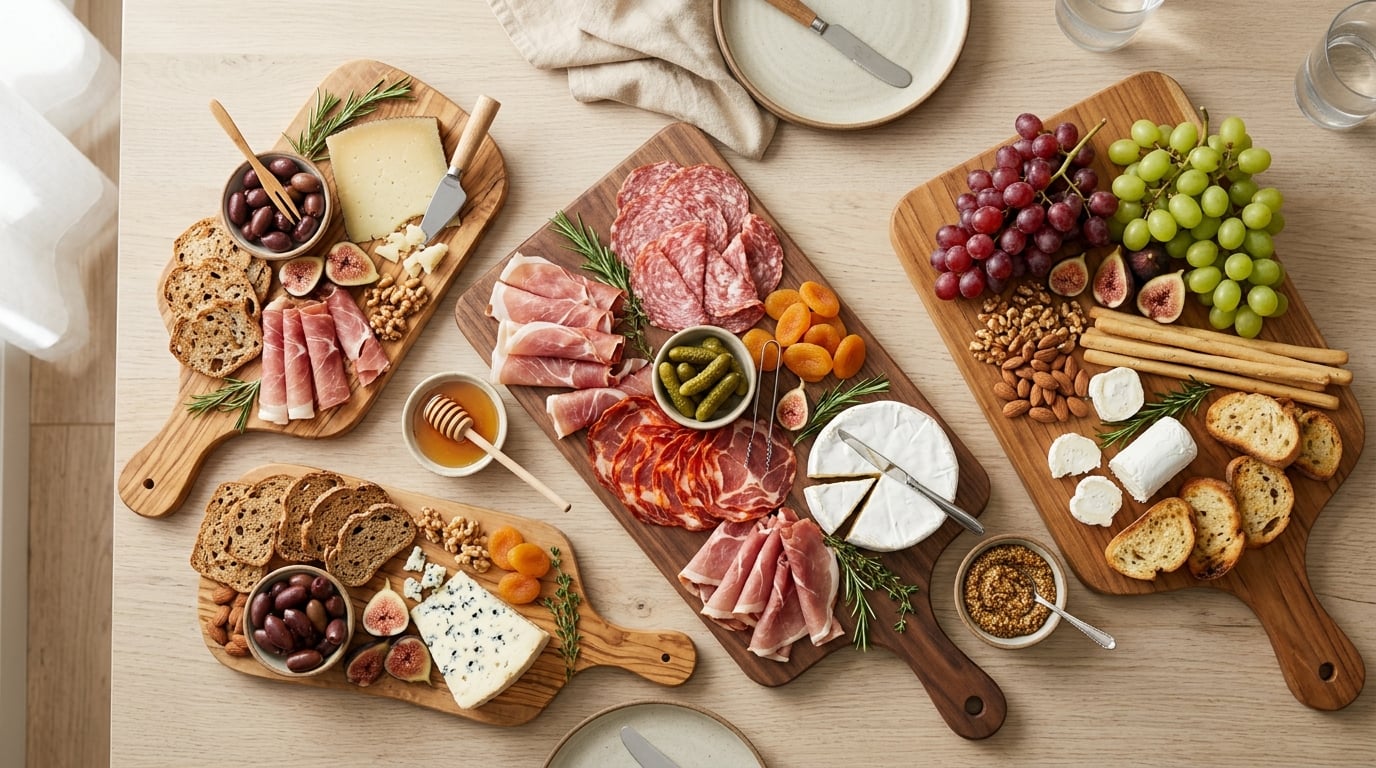
A board that photographs beautifully collapses into a pile the moment 30 people start reaching for it. Choosing the right charcuterie boards and serving platters for parties is mostly a math problem: surface area per guest, food per guest, and how much cleanup you want to do at midnight.
This guide covers ten board styles and materials ranked by what they handle best, from a broad acacia spread for 8 to 12 people to a lazy susan that stops guests reaching across each other. Sizing tables and a portion framework are included, so you can pick with your headcount instead of guessing.
Last updated for 2026. Sizes, portion math, and care notes here reflect what hosts actually report after a full party, not showroom styling.
Table of Contents
- Best Charcuterie Boards and Serving Platters for Parties at a Glance
- 1. Large Acacia Wood Charcuterie Board for Gatherings
- 2. Slate Serving Platter for an Elegant Display
- 3. Olive Wood Board for a Rustic Party Theme
- 4. Marble Platter for a Luxe Charcuterie Spread
- 5. Bamboo Board for an Eco-Conscious Host
- 6. Expandable Serving Board for Flexible Portions
- 7. Lazy Susan Charcuterie Board for Crowd-Free Reaching
- 8. Ceramic Platter for Easy Cleanup
- 9. Portable Bamboo Board with Handles for Party Hosts
- 10. Minimalist Serving Platter for Modern Gatherings
- How to Choose the Right Size for Your Party
- Wood, Slate, Marble, Ceramic, or Bamboo: Which Material Fits Your Party?
- How to Set Up a Charcuterie Board for a Party
- Frequently Asked Questions
- How large should a charcuterie board be for a party?
- What material is best for a reusable party serving platter?
- How do you keep a charcuterie board safe and fresh for more than two hours?
- Can I use a wooden charcuterie board outdoors?
- What is the easiest way to clean a wood or slate serving board?
- How should I arrange charcuterie for a large group without overcrowding the platter?
- Conclusion
Best Charcuterie Boards and Serving Platters for Parties at a Glance
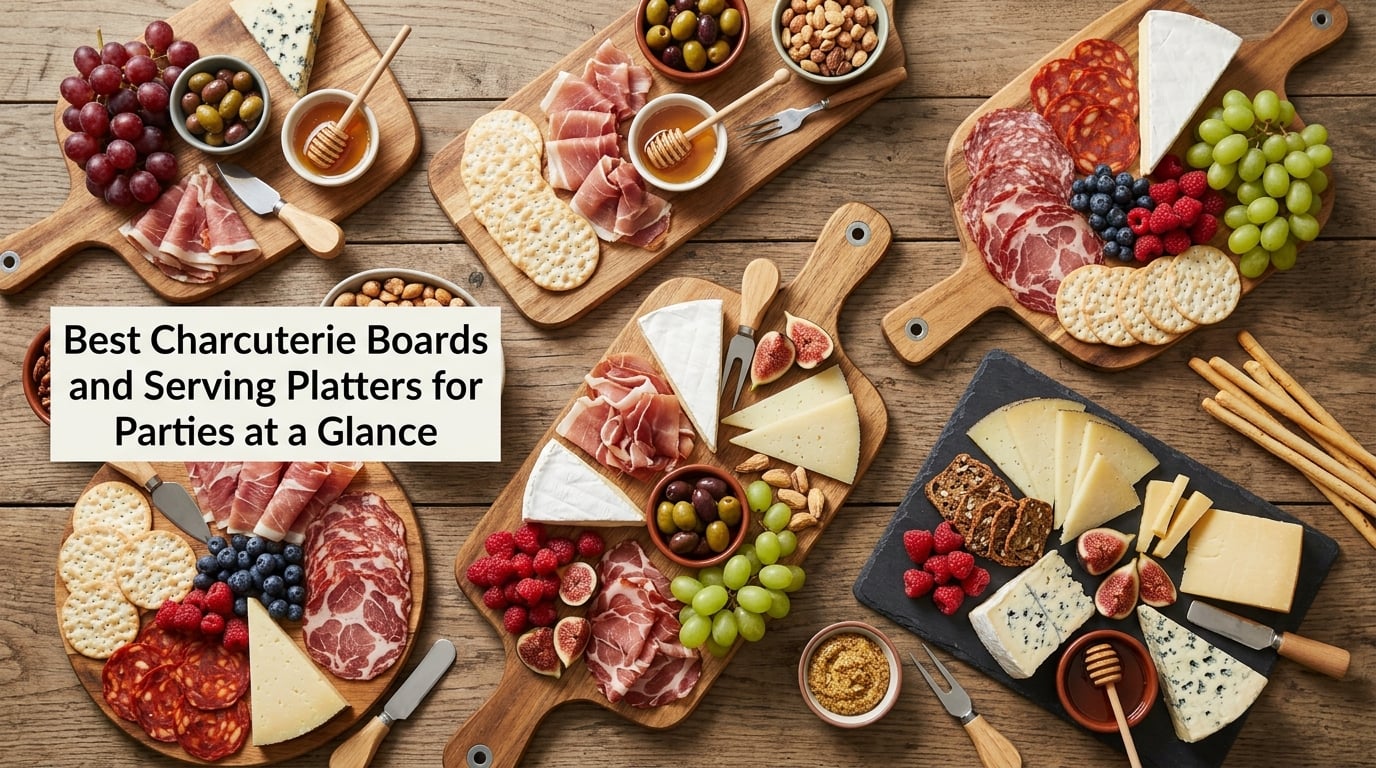
The short answer: acacia wood for most home parties, ceramic for the group that wants an easy rinse, a lazy susan for a round table, and two or more boards once you pass 20 guests. Here is how all ten compare.
| Pick | Material | Best for | Party size | Practical advantage |
|---|---|---|---|---|
| Large acacia board | Acacia wood | Communal spreads and buffets | 8 to 12 guests | Warm grain, broad surface, hides knife marks |
| Slate platter | Slate | Dressed-up evening events | 6 to 10 guests | Stays cold, dramatic contrast with pale cheese |
| Olive wood board | Olive wood | Rustic and Mediterranean themes | 6 to 10 guests | Distinctive grain, no two pieces alike |
| Marble platter | Marble | Formal, stationary displays | 6 to 8 guests | Cool surface, weighty and stable |
| Bamboo board | Bamboo | Light handling, sustainable sourcing | 6 to 8 guests | Light to carry, quick to wipe down |
| Expandable board | Usually wood or bamboo | One host, varying headcounts | 4 to 12 guests | Removable leaves add or subtract space |
| Lazy susan board | Wood or slate base | Round and buffet tables | 8 to 12 guests | Turns the spread, kills the reaching |
| Ceramic platter | Ceramic | Casual parties, easy cleanup | 8 to 12 guests | Nonporous surface, dishwasher friendly |
| Portable handled board | Bamboo or acacia | Patios, picnics, office events | 8 to 12 guests | Handles and a secure grip for transport |
| Minimalist platter | White ceramic or light wood | Modern, restrained décor | 6 to 10 guests | Clean lines, styling without fuss |
1. Large Acacia Wood Charcuterie Board for Gatherings
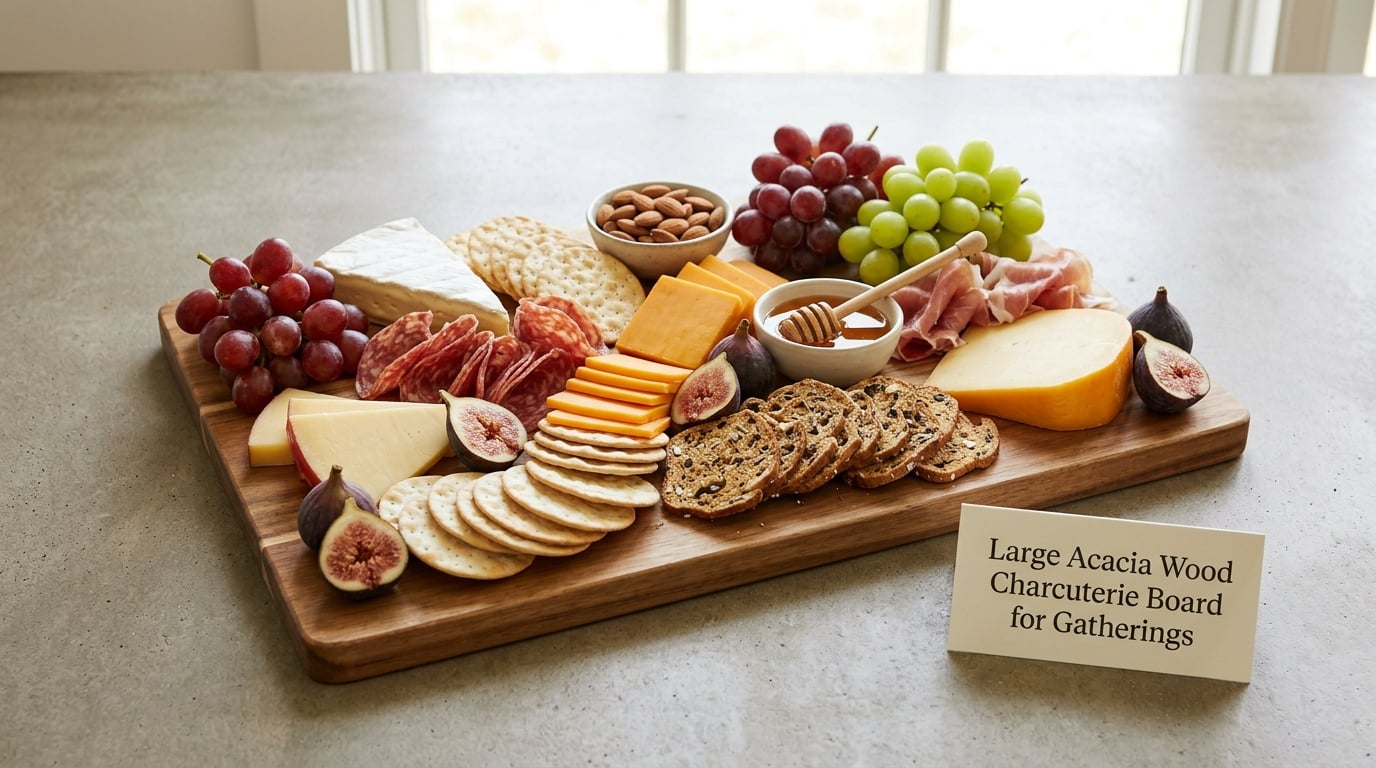
Acacia is the workhorse of party hosting because it is broad, warm-toned, and forgiving. The grain runs caramel to deep brown, which sits comfortably with almost any table setting, and small knife scars from a crowded party blend into the pattern instead of standing out.
Serve eight to twelve people from a single board around 24 by 16 inches: one hard cheese cut into batons on one end, a soft cheese with a spoon in the middle, salami folded into rosettes on the other end, then grapes, figs, crackers, and a bowl of marcona almonds filling the gaps. Guests can see everything from across the room and serve themselves without anyone running a knife over the same wheel.
What to watch: acacia is hardwood, so it needs hand washing and a light oil every few months. It is not a dishwasher material, and standing water will warp it.
2. Slate Serving Platter for an Elegant Display
Slate is the one material that makes a spread look like it came from a restaurant. The matte black background makes white cheese, pale crackers, and bright fruit pop in a way no wood board can match, and slate stays cold, which slows down soft cheese and fresh figs on a warm day.
The trade-offs are real. A good slate platter is heavy, which is a virtue on a table and a nuisance in your hands, and the edges can be sharp enough to draw attention around a table full of children and serving tongs. Position it at the far end of a table or on a sideboard rather than in the middle of a play area.
Seal it once a year with food-safe board oil, wipe it with a damp cloth rather than a soaked one, and expect faint ghosting of oils over time. That is normal, not a defect.
3. Olive Wood Board for a Rustic Party Theme
Olive wood has a swirling, marbled grain in cream, honey, and dark brown that no two boards share, and it reads instantly as Mediterranean, farmhouse, or rustic holiday. It is a natural centerpiece for a summer table, a Tuscan-themed dinner, or a harvest gathering where the food is the styling.
Keep the food simple so the grain stays visible: a few cheeses, one cured meat, crackers, olives, and a bunch of grapes. Olive wood is smaller than most acacia boards in the same price bracket, so plan on a 6 to 10 guest load rather than a dozen.
Care is the same as any hardwood, with one caution: reviewers on r/CharcuterieBoard mention olive boards cracking along the grain when they are soaked or dropped. Hand wash, dry standing on its edge, and oil it when the surface starts to look dry.
4. Marble Platter for a Luxe Charcuterie Spread
Marble is the right call when the event has a dress code and the board will be photographed. The veining gives a plain arrangement depth, the surface stays noticeably cool, and the weight means nobody slides it around while serving themselves.
It also has real limits. Marble is porous enough to stain if you leave wine, oil, or berry juice sitting for hours, it is heavy to move between rooms, and a dropped knife or a hard knock can chip it. Treat it as a stationary display: set it up before guests arrive, serve from it, and do not plan to pass it around a room.
Wipe spills promptly with a damp cloth and mild dish soap. No dishwasher, no acidic cleaners, and keep it off the edge of a table where a sleeve catches it.
5. Bamboo Board for an Eco-Conscious Host
Bamboo grows quickly, so a bamboo board is an easy sustainability story for a guest who asks. It is also light in the hand, which matters when you are the one carrying a full spread from the kitchen to the table while someone else holds the door.
The grain is fine and pale, so it works with bright, high-contrast styling: dark grapes, red salami, pale crackers. A bamboo board around 16 by 12 inches serves six to eight people comfortably.
Bamboo is harder than most people expect but more sensitive to water than hardwood. Wash it promptly, never soak it, and keep it out of the dishwasher, where the heat cycle dries the glue joints and splits the board. Reviewers also flag that a very light bamboo board feels flimsy when it is loaded with a full party spread, so pick a thicker one if you are serving eight or more.
6. Expandable Serving Board for Flexible Portions
An expandable board is a center panel with removable leaf sections that slot into the sides. Pull the leaves out and you have a compact board for a weeknight cheese plate; push them in and the surface grows by nearly half, which is how one board handles a casual dinner and a party with twice the guests.
Use the sections on purpose rather than letting everything blur together: one leaf for sliced cured meats, one for cheeses, one for bread and crackers, and a small tray in the center for olives, dried fruit, or condiments. Those removable pieces are the real advantage, because you can carry meat in from the fridge and stage it in the last ten minutes instead of an hour before.
Mind the seams. Sliced cheese bridges the joins well; loose grapes and crackers fall into the cracks, so tuck a small bowl over any section gap you can see.
7. Lazy Susan Charcuterie Board for Crowd-Free Reaching
A lazy susan is a turntable on a bearing, and it solves the one problem no flat board can: hands crossing over each other. Guests reach to a section, spin it toward themselves, take what they need, and the food in front of them changes. On a round table it also uses the space better than a rectangle, since there are no corners to waste.
Balance matters more than size. A turntable carrying more weight on one side will bind or drift, so distribute cheeses, meats, and heavier crackers around the circle evenly before you start filling it. If the base has a lock, engage it during service so the whole board stops turning when someone leans on the rim, and leave a finger of clearance around the edge for the spin.
Hosts on r/Cooking recommend the lazy susan specifically for round dining tables, and it is the single most useful pick here for eight to twelve guests. Skip it for fragile items like crackers stacked high or thin breadsticks, which fly off a moving surface.
8. Ceramic Platter for Easy Cleanup
Ceramic is the answer when cleanup is the part of hosting you want to delete. The surface is nonporous, so it does not absorb odors or juices the way wood does, and most glazed platters go straight into the dishwasher once the sticky stage is over.
A large white ceramic platter also gives you a neutral background that makes food color look deliberate without any styling effort. Serve eight to twelve guests: block cheeses at one end, sliced meats at the other, crackers and bread in the middle, and small ramekins of mustard or dipping oil so nothing is spooned directly onto the platter.
Two cautions. Ceramic fails if it goes from a cold fridge to a hot oven or a sudden temperature swing, so keep perishable food on it at room temperature rather than sliding a chilled platter under a heat lamp. And confirm the piece is labeled food-safe, since decorative and some artisan pieces are fired at lower temperatures.
9. Portable Bamboo Board with Handles for Party Hosts
Handled boards are built for the walk from the car to the table. Cut-out handles on either end give you two hands of control, which matters far more than it sounds when you are carrying a loaded board around a garden, through a venue door, or along a patio with no spare arm free.
For a buffet, set the board on a stand or trivet and rest utensils in a small crock rather than lying them on the food, where they roll and slide. Transport is easier if you build the food on arrival: bring the board, crates, and bowls empty, then fill at the venue, so nothing tips on the way.
Realistic limits: no board is level over grass, and wet or fragile items such as washed grapes, cut fruit, or thin crackers will slide or break in transit. Carry those separately in a lidded container and add them once you arrive.
10. Minimalist Serving Platter for Modern Gatherings
A minimalist platter is the one you buy when you want the table to look considered without hiring a stylist. Clean lines, a single material, usually white ceramic, pale wood, or a matte finish, with no wells, grooves, or visible hardware competing with the food.
The arrangement does the work. Use negative space, leave a wide empty margin around the outer edge instead of filling it, and group color into two or three deliberate blocks rather than scattering ten ingredients evenly. A line of pale crackers, a wedge of soft cheese, and a tight cluster of red grapes reads as intentional; the same items spread across the whole platter reads as leftovers.
This is the pick for contemporary apartments, catered office lunches, and any event where you would rather talk to your guests than fuss over garnish. Skip it if your party has a theme, since a plain platter gives you nowhere to go.
How to Choose the Right Size for Your Party
Size to surface area, not to guest count alone. A comfortable rule is roughly 24 square inches of board per guest for appetizer-style spreads, where food is one part of the party, and closer to 36 square inches per guest when the board is meant to hold people for a while.
Sizing charcuterie boards for parties of 20 to 50 guests
Here is the sizing math no roundup on the search page gives you. Multiply up from the base board and add boards as the headcount grows, because one very large board empties faster than two medium ones and always looks picked over by the end of the night.
| Guests | Board size to buy | How many | Total food per guest |
|---|---|---|---|
| 6 to 8 | 16 by 12 inch | 1 | 2 to 3 oz |
| 8 to 12 | 24 by 16 inch | 1 | 2 to 3 oz |
| 12 to 20 | 18 by 18 inch or two 20 by 14 inch | 2 | 2 to 3 oz |
| 20 to 35 | Three 20 by 14 inch boards or one 48 inch table runner | 3 | 3 to 4 oz |
| 35 to 50 | Five 20 by 14 inch boards, or a dedicated grazing table | 5 or 1 table | 3 to 5 oz |
| 50 to 100 | Two grazing tables, staged along a wall and restocked as you go | 2 tables | 5 to 8 oz |
These are starting points, not guarantees. A seated dinner drinks more than a standing cocktail hour, a holiday party runs longer than a birthday, and one of your guests will eat three times what the rest of them will. If your event sits at the high end of any range above, buy up a tier.
The 3-3-3 rule for party boards
The 3-3-3 rule is a simple starting formula: three types of cured meat, three types of cheese, and three accompaniments such as crackers, fruit, nuts, or dips. It appears in both of the People Also Ask clusters for this topic, and it works because variety comes from contrast, not from piling on more items.
For a party, scale the rule rather than repeating it. Two or three smaller boards each carrying 3-3-3 gives you more visual interest than one enormous board with nine items crammed together, and it lets you place a meat-only board away from a nut-heavy one for allergy reasons. Hosts on r/CharcuterieBoard describe exactly this setup, walking the room with boards rather than pointing everyone at a single platter.
On portions, five independent sources converge on the same range: 2 to 3 ounces of food per person when cheese and charcuterie are an appetizer alongside other food, and 6 to 10 ounces when the board replaces a meal. For 50 guests at the appetizer end that is 100 to 150 ounces total, split roughly 1.5 ounces of cured meat, 2 ounces of cheese, 6 to 8 crackers, and 2 ounces of produce per person.
| Item | Appetizer style, per person | Meal style, per person |
|---|---|---|
| Cured meat | 1.5 oz | 3 to 4 oz |
| Cheese | 2 oz | 3 to 4 oz |
| Crackers or bread | 6 to 8 pieces | 10 to 12 pieces |
| Produce | 2 oz | 1/2 cup |
Wood, Slate, Marble, Ceramic, or Bamboo: Which Material Fits Your Party?
For most home parties, acacia or walnut wood gives the best balance of warmth, durability, and forgiving maintenance. Slate wins on presentation and cool surface, ceramic wins on cleanup, bamboo wins on weight and sustainability, marble wins on formality, and everything else is a tradeoff against handling.
| Material | Appearance | Durability | Maintenance | Handling risk |
|---|---|---|---|---|
| Acacia wood | Warm caramel grain | High, hides knife marks | Hand wash, oil occasionally | Low |
| Olive wood | Swirled cream and brown | High if kept dry | Hand wash, oil often | Low |
| Bamboo | Pale, fine grain | Moderate, scratches | Wipe promptly, never soak | Low, can feel light when loaded |
| Slate | Matte black | High, resists staining | Damp cloth, seal yearly | Sharp edges, heavy |
| Marble | Cool veined white | High, chips if dropped | Wipe spills fast, no acids | Heavy, breakable |
| Ceramic | Glossy or matte white | High, chips if dropped | Dishwasher friendly | Thermal shock |
By event type: casual family get-together, choose acacia. Elegant evening or wine night, choose slate. Outdoor patio or picnic, choose bamboo or a handled board so it survives being carried. High-traffic buffet or a caterer’s kitchen, choose ceramic, because it survives a sink full of plates better than anything else. Formal seated dinner, choose marble and accept that it stays on the table.
How to Set Up a Charcuterie Board for a Party
Set up the board in about fifteen minutes once the food is out, and stage it in the right order so the platter still looks full when the first guest walks in.
- Pick the surface first. Choose the board for the table you are using, not the food you want to serve. Test it where it will sit and leave room around the edge for elbows and serving hands.
- Anchor the layout. Place the largest items first, usually cheeses and meat, on the outer thirds. Leave the center open so you can add and adjust without shifting everything.
- Add contrasting color. Fruit, crackers, and nuts go in the gaps, grouped by color rather than spread evenly. Green and red against pale cheese is what makes a board look styled.
- Protect the board. Keep wet items in small bowls, tuck crackers into grooves or along an edge, and set the olives in a ramekin so the oil does not pool into the wood.
- Place the utensils. Give every category its own pair of tongs or fork, and rest them on a small dish rather than on the food. Shared knives transfer cheese flavor into the fruit.
- Chill and time the perishables. Keep meat and cheese refrigerated until about 20 minutes before service. Under USDA guidance, perishable food should not sit out longer than two hours, or one hour if it is above 90 degrees outdoors.
- Refill rather than overfill. For events past 30 guests, put out a little of everything and restock as it disappears. A replenished board beats a beautiful board that is picked clean in 40 minutes.
One last thing that matters more than any board choice: separate allergen items. Nuts, gluten-heavy crackers, and dairy-heavy cheeses go on their own small board or in a clearly separate corner, and using separate tongs keeps one guest’s serving spoon out of someone else’s food.
Frequently Asked Questions
How large should a charcuterie board be for a party?
For a party of 8 to 12 people, aim for a board around 24 by 16 inches. The working rule is roughly 24 square inches of surface per guest for appetizer-style spreads, rising to about 36 square inches when the board is the main event. Past 15 to 20 guests, use two or more medium boards instead of one oversized one, since a single platter empties fast and looks picked over.
What material is best for a reusable party serving platter?
Acacia wood is the best all-round choice for home hosting: it is durable, forgives knife marks, and needs only hand washing and an occasional oil. Pick ceramic if cleanup speed matters most, slate if presentation and a cool surface matter most, and bamboo if you want something light to carry. Whatever you choose, confirm it is labeled food-safe before serving on it.
How do you keep a charcuterie board safe and fresh for more than two hours?
Keep the perishable food cold and the board moving. Build cold meats and cheeses in trays that you set out just before guests arrive, rest on ice packs in cool weather, and swap in a fresh tray every 60 to 90 minutes for a long event. Under USDA guidance, perishable food should not sit out longer than two hours, or one hour above 90 degrees. Small bowls also keep juices off the board.
Can I use a wooden charcuterie board outdoors?
Yes, with care. Grass and uneven patios make a flat board tip, so rest it on a folding stand or trivet and avoid laying it directly on a tablecloth. Carry the food empty and assemble on site, keep wet fruit in lidded containers until the last minute, and expect the surface to pick up dust and outdoor marks. Hand wash it and dry it standing on its edge rather than flat.
What is the easiest way to clean a wood or slate serving board?
Scrape off food, wash with warm water and a little dish soap, scrub with a soft sponge, and dry it standing on its long edge so air reaches both faces. Skip the dishwasher, bleach, and steel wool, which dry out wood and dull slate. Oil wood boards when the surface looks pale or dry, and never soak a board, a slate platter, or a tray with glued joints.
How should I arrange charcuterie for a large group without overcrowding the platter?
Use more boards rather than one bigger one, and give each board a job: meats on one, cheeses on another, crackers, fruit, and dips on a third. Fill each to about two-thirds so there is room to add food later, group colors in blocks instead of scattering them, and place serving utensils in a small crock rather than on the food. Hosts on r/CharcuterieBoard report that walking the room with boards beats parking one platter in the center.
Conclusion
Start with size, because it is the one choice you cannot resize later. Eight to twelve people fit on a single 24 by 16 inch board, and past 20 guests you should be adding boards rather than enlarging one. Then pick the material to match the venue and your tolerance for cleanup: acacia for most home parties, ceramic when the sink is part of the plan, slate for an evening that needs to look formal, marble when the board stays put, and a handled bamboo board when you are carrying everything to the patio yourself.
Whatever you choose, buy the food by the numbers above, keep cold items cold until close to service, and set out smaller amounts than you think you need. A board that is refilled reads far better at the end of the night than one that is bare.