
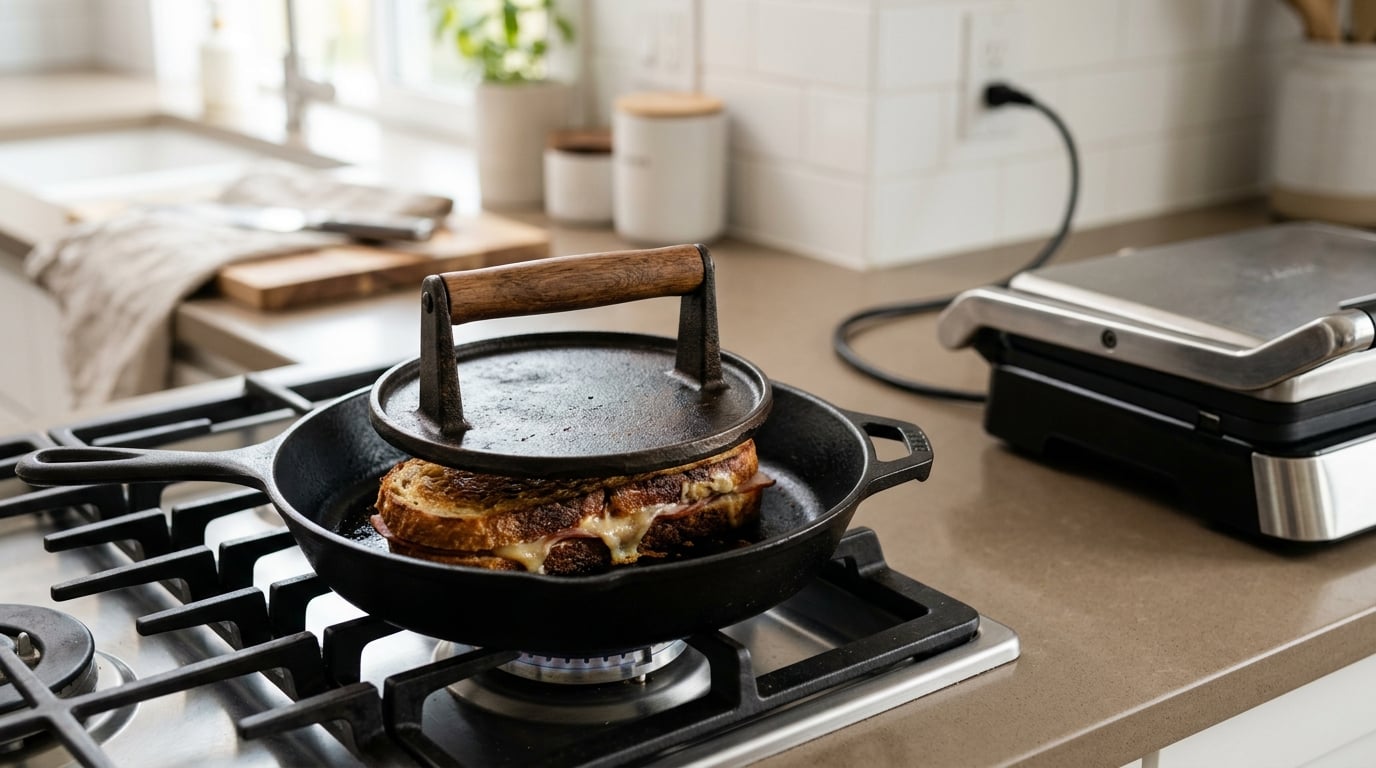
A cast iron sandwich press is a heavy, flat disc of iron with a handle that you set on top of a sandwich or a burger to flatten it, seal the bread and cook both sides at once. If you want grill marks and a hard sear without plugging in an appliance, the stovetop press is the tool; if you want the fastest countertop sandwich with nothing to monitor, an electric contact grill wins. Most home cooks who already own a cast iron skillet get more out of the cast iron version, because it works as a second cooking surface for smash burgers and bacon too.
I keep two of each on hand and use them for different jobs, which is really the whole argument in this guide. There is no single best cast iron sandwich press, only the one that matches your stovetop, your hands, and how much fussing you want to do between the bread and the plate.
Below are ten options, seven cast iron and three electric, with the tradeoffs in heat, size and convenience spelled out. I also flag the complaints that come up again and again from home cooks, especially the size-versus-listing-photo problem, which is real and worth planning around.
Table of Contents
- Best Cast Iron Sandwich Presses and Grill Presses at a Glance
- 1. Lodge 10.25-Inch Cast Iron Grill Pan
- 2. Lodge 12-Inch Cast Iron Skillet
- 3. Lodge ProChef 10.25-Inch Cast Iron Griddle
- 4. Lodge 10.25-Inch Square Cast Iron Grill Pan
- 5. AmazonBasics 10.25-Inch Cast Iron Grill Pan
- 6. Cuisinart Griddler GR-5A Contact Grill
- 7. Cuisinart Griddler GR-8 Professional Contact Grill
- 8. George Foreman Classic 7-Serving Contact Grill
- 9. T-fal Griddle Pan 10.5-Inch Cast Iron Grill Pan
- 10. OXO Good Grips Stainless Steel Sandwich Maker
- Frequently Asked Questions
- Is a cast iron sandwich press better than an electric panini press?
- Why do my sandwiches squish out when I use a grill press?
- Do I need to season a new pre-seasoned cast iron press?
- Can I use a cast iron sandwich press over a campfire or on a griddle?
- How hot should a cast iron grill press get before cooking?
- What size grill press fits a standard griddle or skillet?
- Conclusion
Best Cast Iron Sandwich Presses and Grill Presses at a Glance
Cast iron wins on heat retention and browning. Electric contact grills win on speed and hands-off cooking. Here is the short version before the detail.
| Option | Cooking method | Best for | Shape and size | Heat source | Notable feature |
|---|---|---|---|---|---|
| Lodge 10.25-inch grill pan | Ridged cast iron on the stove | Grilled cheese and panini | Round, 10.25 inch | Gas, electric, induction | Ridged surface, doubles as a skillet |
| Lodge 12-inch skillet | Bare cast iron on the stove | Two sandwiches at once, thicker fillings | Round, 12 inch | Gas, electric, induction | Largest cooking area in the round group |
| Lodge ProChef 10.25-inch griddle | Flat cast iron on the stove | Smash-style sandwiches and pressed bread | Round, 10.25 inch | Gas, electric, induction | Flat surface, browning not grill marks |
| Lodge 10.25-inch square grill pan | Ridged cast iron on the stove | Square sandwiches, compact portions | Square, 10.25 inch | Gas, electric, induction | Corners for diagonal bread slices |
| AmazonBasics 10.25-inch grill pan | Ridged cast iron on the stove | First cast iron press on a budget | Round, 10.25 inch | Gas, electric | Low entry cost, simple seasoning |
| Cuisinart GR-5A contact grill | Electric hinged plates | Quick panini on a small counter | Compact, single plate width | Mains power | Adjustable temperature control |
| Cuisinart GR-8 contact grill | Electric hinged plates | Two sandwiches per batch | Wide, double plate width | Mains power | Removable plate surfaces |
| George Foreman Classic 7-serving | Electric hinged plates | Weeknight meals, leaner cooking | Full-size countertop unit | Mains power | Nonstick plates, grease drain channel |
| T-fal 10.5-inch grill pan | Ridged cast iron with a lid | Pressed sandwiches with less fuss | Round, 10.5 inch | Gas, electric | Fitted lid, compact to store |
| OXO Good Grips sandwich maker | Manual press, no heat source | Light one-handed pressing | Compact, stainless steel | None, uses pan heat | Fast cleanup, no seasoning |
Everything in the first five rows and the ninth row needs a stovetop. The three electric rows need a counter and an outlet, and give that up in exchange for not having to stand over heat.
1. Lodge 10.25-Inch Cast Iron Grill Pan
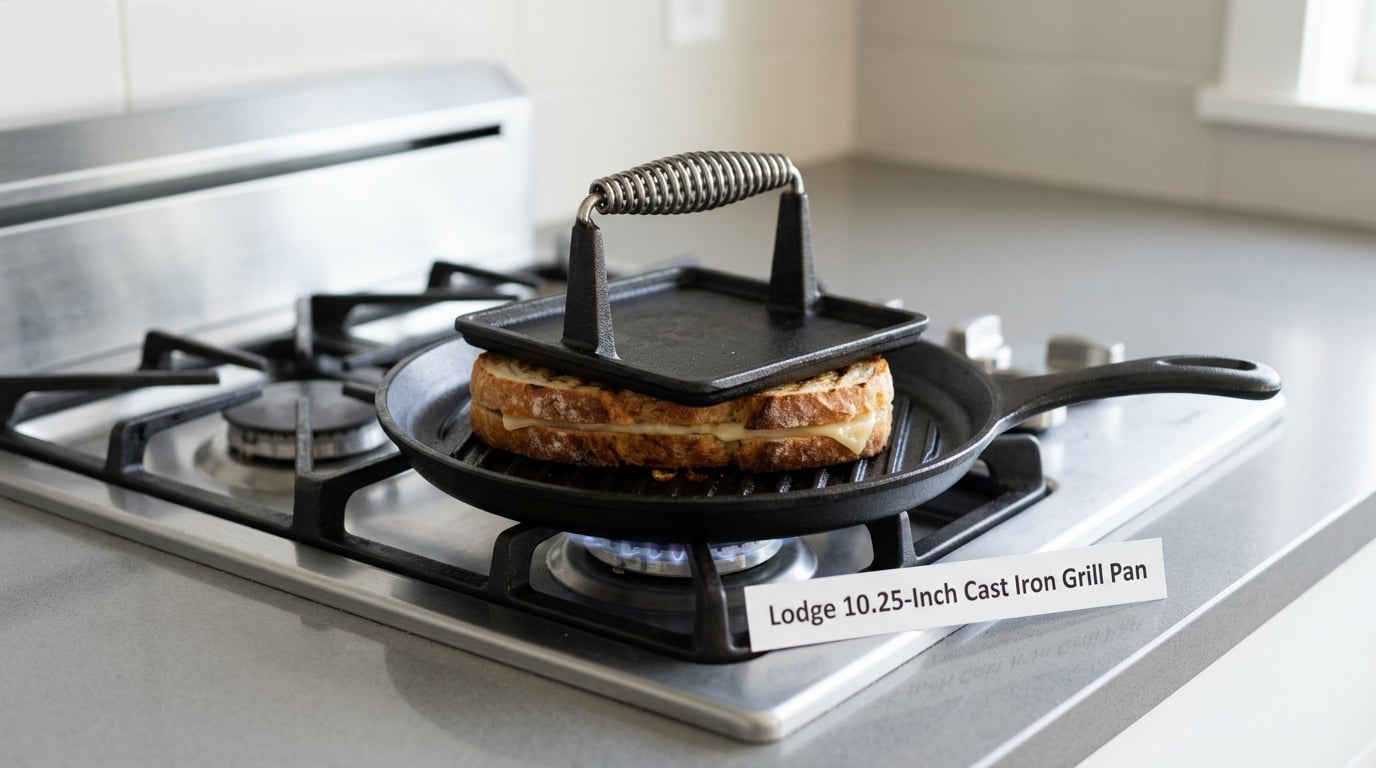
This is the one I reach for first, and the closest thing to a default answer to the question of which cast iron sandwich press is best for home cooks. The ridges give you a real grill-mark pattern, the 10.25-inch diameter comfortably holds a standard square sandwich, and the whole thing is a working pan when you are not pressing anything.
Why a 10.25-inch round grill pan works as a cast iron sandwich press
Ten and a quarter inches is the sweet spot between two sizes that frustrate people. Smaller presses around 8 inches leave the corners of a sandwich hanging over the ridges, so they never get pressed flat. Larger ones waste preheat time on empty iron around a single sandwich. At 10.25 inches, a diagonally placed sandwich sits entirely on the ridged surface with a little iron left at the edges to catch drips.
The press does two jobs at once, and that is the part people miss. Its flat underside is a second cooking surface, so the top of your bread toasts while the bottom cooks against the griddle. Set it on, walk away for ninety seconds, and you have a sandwich that is genuinely toasted on both sides rather than merely flattened and reheated.
Limitations are real. A heavily filled sandwich, especially one with a thick layer of cheese and wet tomato, will squirt out the edges before the press does much useful work, and the pan is not big enough for a double-decker or a focaccia slab. Reviewers also mention that the bare metal handle gets hot enough that you need a towel on it, which is just cast iron being cast iron.
Seasoning on the pre-seasoned version is already fine for most people, but a thin coat of oil and fifteen minutes in a hot oven the first week makes the ridges release a griddled sandwich cleanly instead of tearing the crust off.
2. Lodge 12-Inch Cast Iron Skillet
Choose the 12-inch skillet when one sandwich is never the actual amount of food you are making. Two sandwiches at once, a row of vegetables along the edge, or a thick chopped sandwich that would collapse in a smaller press all fit comfortably here. The extra 1.75 inches of diameter is not dramatic on paper, but it changes what you can put under the press without improvising.
Because it is a plain skillet rather than a ridged grill pan, the surface gives you even, all-over browning instead of stripe marks. That is a feature when you are pressing a sandwich that has cheese and deli meat on it and you want uniform color, and a mild drawback when you specifically want the look of a grill pan.
The weight matters here. A 12-inch skillet has enough mass to flatten a stubborn sandwich on its own, so you can rest the sandwich in the pan, lower the press on top, and skip the extra weight most people add. The tradeoff is handling: it is heavy to lift when full, and the handle still needs a mitt or a folded towel.
If your stovetop is small or your burners are on a flat cooktop where a 12-inch pan crowds everything else, this is the wrong pick. Measure the burner first. A skillet that cannot sit flat on the burner gives you uneven heat, and uneven heat is the one thing that ruins a pressed sandwich.
3. Lodge ProChef 10.25-Inch Cast Iron Griddle
The ProChef griddle is the same 10.25-inch footprint as the ridged grill pan with a flat cooking surface instead of ridges, and that single change shifts what it is best at. This is the one for pressed bread with maximum browning, and for smash-style sandwiches where you want the whole face of the bread to crisp against metal rather than sit in a groove.
Flat also means faster and more even heat transfer across the surface, because there is no ridge network to create slightly cooler channels. If your complaint about pressed sandwiches has been pale stripes and doughy spots, this is the shape of pan that fixes it.
What you give up is the grill mark. A flat surface browns like a griddle, not like a barbecue grill, and if the visual of dark parallel lines is part of why you want a grill press, look elsewhere. For a kid’s grilled cheese or a deli sandwich cut in half, the difference does not matter at all. For a plate you are trying to make look like restaurant food, it does.
It is also the more useful of the two Lodge pans for non-sandwich work, since a flat top is closer to a griddle for eggs and smash burgers. I like having one of each: ridged for looks, flat for the real work.
4. Lodge 10.25-Inch Square Cast Iron Grill Pan
The square version answers a specific problem with round presses: what to do with bread that is not square. A standard sliced loaf cut diagonally gives you a triangle that overhangs the round pan on two sides, and that overhang is exactly where the sandwich stays pale and squashed. The square pan has corners, so a diagonal triangle sits flat and gets pressed evenly along its whole length.
It also cuts cleanly. Press a sandwich in a round pan, and the finished sandwich is round or oddly clipped when you slice it. Press it in a square pan and a knife goes straight down through four square portions, which is what you want for a lunchbox, a party, or a plate of four smaller servings rather than one large one.
Square geometry maximizes usable area, which matters more than it sounds. Circles waste the corners of the bounding box. A square pan of the same stated width gives you a noticeably larger usable cooking surface for small sandwiches, and that is a real gain if you are pressing sliders or small roll sandwiches.
The catch is that square pans sit less comfortably on a round burner and on a round griddle, and they occupy more cabinet and counter footprint for the same stated size. If your cooking surface is circular, check that it will sit flat before committing.
5. AmazonBasics 10.25-Inch Cast Iron Grill Pan
This is the entry point. If you have never owned cast iron and you are not sure you will keep using it, a budget pan at the same 10.25-inch size as the Lodge grill pan lets you find out without a big commitment. The design is deliberately conventional: a round ridged surface, a single handle, a fairly standard pre-seasoned finish.
Expect the two things reviewers consistently mention. First, preheating takes longer than people expect, because a thinner, lighter casting stores less heat, and the ridges do not crisp quite as evenly as they do on a heavier pan. Give it a solid five minutes on medium heat before you put anything on it, and do not rush that with a high flame.
Second, care matters more in the early months. If you soak it, put it in the dishwasher, or leave it wet on the counter, the seasoning that the ridges need in order to release a sandwich will start to go. Dry it on the burner, wipe it with a little oil, and it will behave like any other cast iron piece.
There is also a weight difference from the pricier options, and cast iron enthusiasts argue about weight for its own sake, not just performance. My take: for a first press, less weight is a feature. You get it on and off the burner without both hands and a towel.
6. Cuisinart Griddler GR-5A Contact Grill
The GR-5A is on this list as a deliberate contrast rather than a cast iron recommendation, because the honest answer for some kitchens is that a stovetop press is the wrong shape of tool. This is a compact contact grill: hinged plates, an indicator light, and a dial that lets you set the temperature instead of guessing with a burner knob.
That dial is the real feature. A stovetop press is heated by whatever the burner is doing, and burner dials are notoriously imprecise. A contact grill with temperature control holds a consistent plate temperature through the whole cook, which is why a panini comes out uniformly golden rather than dark at the edges.
It also heats fast, has a small footprint that stores vertically or in a cabinet, and does not need any seasoning at all. If you only make one sandwich a week and you do not want to think about iron, this solves the problem cleanly.
You are trading away a lot, though. The plates are nonstick-coated, and the cheap versions of that coating are the single most common complaint among electric press owners: they flake, they warp under high heat, and they cannot take a scrape of cast iron or a metal spatula. The small plate width also means one sandwich at a time, and the cast iron press you would get for a grill pan goes into an oven and onto a fire, which this cannot.
7. Cuisinart Griddler GR-8 Professional Contact Grill
The GR-8 is the wide version of the same idea, and the reason it appears here is capacity. The plate area is large enough for two sandwiches side by side, which changes the equation for a household cooking weekday lunches rather than cooking one adult’s dinner. One button press, two sandwiches, no babysitting the second while the first goes cold.
Removable plate surfaces are the practical part of the design. You can soak and scrub them without attacking the hinge or the heating element, and cooking a lot of fatty food on a fixed plate is how electric grills get permanently greasy. Take the plates out, clean them, put them back.
Compared with the cast iron presses earlier in this list, the GR-8 wins on storage and cleanup and loses on durability and heat. Cast iron outlasts electric grills, usually by a lot. The heating element and the coating are wear items, while a seasoned cast iron pan is effectively maintenance-free for a working lifetime.
It also needs its own counter space permanently, and the wide hinge means it does not go away easily. If you have a small kitchen and already own a good skillet, a stovetop press that lives in a cabinet is the more honest purchase.
8. George Foreman Classic 7-Serving Contact Grill
This is the most recognizable name in the category and the one most people mean when they say grill press. The angled, hinged plates and the sloped nonstick surface with a grease drain channel are the design, and the channel is genuinely useful: rendered fat runs down and away from the food instead of pooling under the sandwich and steaming the bottom crust.
For quick indoor meals it is hard to argue with. It heats, you press, you wait a few minutes, and the plates are nonstick enough that a delicate egg or a piece of fish comes off without a fight. That is a different cooking experience from cast iron, where everything is delicious and nothing is particularly forgiving.
For sandwiches specifically, the angled surface spreads filling outward rather than trapping it, and a nonstick plate releases a browned bread without tearing. Seven servings is a real plate area, so two or three sandwiches fit at once depending on size.
Where it disappoints is heat. It is built for leaning, lower-temperature contact cooking rather than for a hard sear, so you will not get the crust or the lacy edges you get from cast iron on a ripping-hot burner. The nonstick plates are also the thing most likely to fail, and on this category of appliance that wear tends to start sooner than the marketing suggests. If your idea of a grill press is smash-burger crust, this is the wrong appliance.
9. T-fal Griddle Pan 10.5-Inch Cast Iron Grill Pan
The T-fal’s distinguishing feature is the lid. It is a cast iron grill pan with a fitted cast iron cover, and that cover does two useful things: it traps steam and heat so the top of the sandwich cooks while the press flattens it, and it makes the pan a self-contained unit that stores in one stack rather than as two loose pieces of iron.
For pressed sandwiches, the lid means less babysitting. With a bare press you have to guess whether the top is done. With a lid you set it on, cover it, and check at the end. It also means the pan works as a covered griddle for things that need trapped heat, like a thick burger with cheese melting underneath a bun.
At 10.5 inches it sits in the same size class as the Lodge grill pans, so a standard square sandwich fits fine. The grooves do the grill-mark work and the surface is broad enough that a square sandwich plus a hot dog or a slice of pineapple is a realistic single pan.
It is heavier than its size suggests, because you are now lifting a lid and a pan rather than one piece, and that is the honest trade for the convenience. If you have limited cabinet space and hate the idea of a loose cast iron disc rattling around a cupboard, the covered design is worth the extra weight. If weight and handling are your main concerns, a bare single-piece press is easier.
10. OXO Good Grips Stainless Steel Sandwich Maker
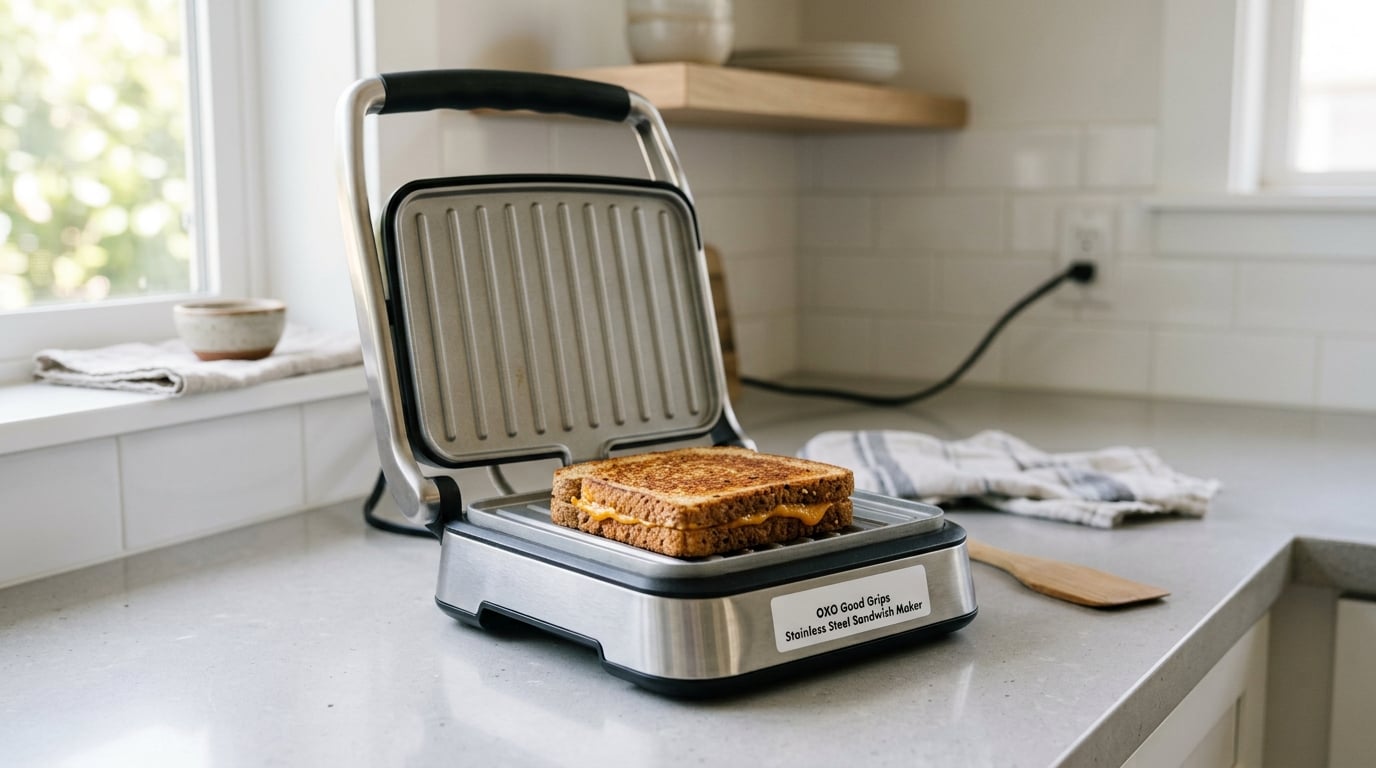
Last in the list but the one to consider if cast iron is not going to happen for you. The OXO Good Grips sandwich maker is a stainless steel press that sits in your pan, presses the bread, and gives you a flat toasted sandwich without any seasoning, any preheat beyond the pan, or any heavy lifting.
Because it works with the heat of a pan you already own, it is far more flexible than a contact grill. Put it in a skillet, in a saute pan, in a griddle, and it does the same job. It is also light, dishwasher-friendly in practice, and stores in a drawer rather than claiming a burner or a counter.
What you give up is heat. Stainless steel conducts far less than cast iron and holds almost none of it, so the press top gets hot only because the pan below it is hot and the sandwich is trapped under it. You get good browning on the bottom and decent flattening. You do not get the hard sear, the fast cook, or the steak-through-the-top effect that a cast iron press delivers.
For a lighter alternative it is a good tool. I would reach for it on a weeknight with a thin sandwich, and reach for cast iron when I want the bread to taste like a grill pan.
Frequently Asked Questions
Is a cast iron sandwich press better than an electric panini press?
It depends on what you are optimizing for. Cast iron gives hotter, steadier contact heat, better browning, no electricity, and it works over a fire or on a griddle. An electric contact grill heats faster, holds a set temperature, needs no seasoning, and is more compact and easier to clean. Cast iron is the better buy for browning and durability; electric is the better buy for a small kitchen and hands-off cooking.
Why do my sandwiches squish out when I use a grill press?
Almost always pressure combined with a wet or soft filling. Press gently at first, add weight only after the bread starts to crisp, and leave a margin of bread around the filling. Very wet ingredients like sliced tomato release liquid under heat, so drain them or pat them dry. A press set on too early and too heavy squeezes the filling out before the bread has any structure.
Do I need to season a new pre-seasoned cast iron press?
Not strictly. Factory seasoning is usually good enough for a first few cooks, though cooking fatty things like bacon first can help it along. Once the seasoning looks patchy or a sandwich sticks to the ridges, scrub gently, dry on the burner, wipe a very thin layer of cooking oil over the whole surface, and heat it in the oven or on the stove until it just stops smoking.
Can I use a cast iron sandwich press over a campfire or on a griddle?
Yes, and it is one of the main reasons cast iron presses stay popular. The heat retention that makes a stovetop press hard to control indoors is exactly what you want over live fire, because a regular pan cannot hold that much heat away from the coals. Work over the edge of the fire rather than straight in the flame, use a long-handled press or gloves, and expect to let the iron get very hot before cooking.
How hot should a cast iron grill press get before cooking?
Medium heat, with a longer preheat than most people give it, about five minutes on a gas burner. Cast iron stores heat slowly and releases it evenly, so a pan that feels ready to touch is usually not ready to cook on. High heat is fine for smash burgers and steak, where you want a hard sear fast, but it burns bread before the filling warms through.
What size grill press fits a standard griddle or skillet?
A 10 to 12 inch press is the range that matches most home cooking surfaces and most standard sliced bread. Below about 8 inches, sandwich corners hang over the cooking area and stay pale. Above 12 inches, you are preheating a lot of iron for one sandwich. Measure your burner or griddle plate first, and check that a round press will sit flat on it, because a pan that rocks means uneven heat.
Conclusion
If you already own a cast iron skillet or griddle, buy the stovetop press. It costs you nothing but counter space, it sears the way an electric press cannot, and it still works as a pan on the days you are not making sandwiches. A 10 to 12 inch round model covers most people, and the square version is worth it if you eat diagonal-cut bread.
If you have a small kitchen, no interest in seasoning iron, or you want to walk away from the stove while it cooks, an electric contact grill is the sensible buy. Pick the wide one if you cook for more than one person.
First step either way: preheat the cast iron pan for five full minutes on medium heat before your first press, and give the bread a chance to crisp before you add any extra weight on top. That single habit fixes more disappointing sandwiches than the model choice does.