
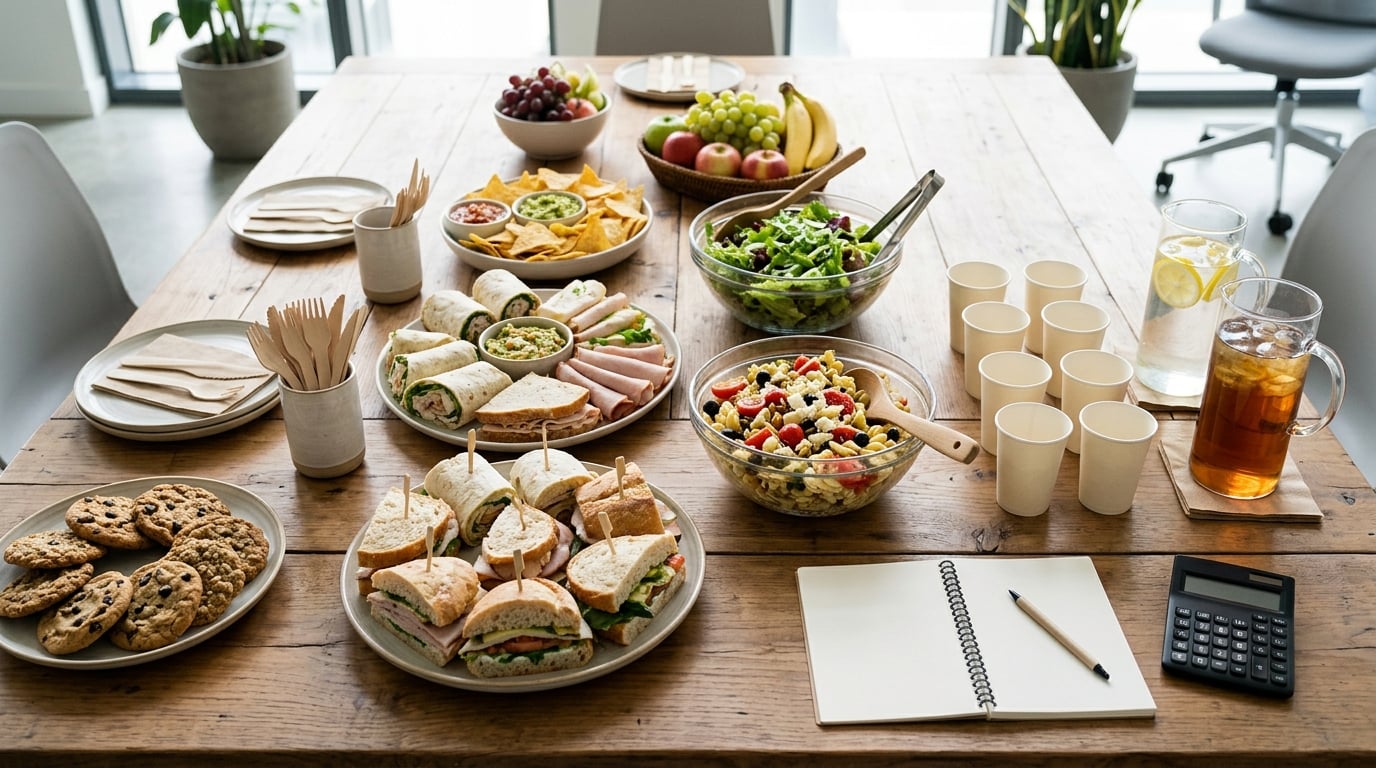
Plan about 1.5 to 2 sandwich pieces per person for a standard office lunch, or 2 to 2.5 pieces if the meal is meant to hold attention through a long meeting. Add one side, one sweet and one drink per head, then bump the total up 5 to 10% when your headcount is a guess. That ratio scales cleanly from a 10-person team lunch to a 200-person all-hands, and it is still the simplest way to answer how much food to order for an office lunch in 2026.
The awkward part is rarely the math. It is deciding what a person actually eats when they can see the whole table, grab a second chip, and skip lunch entirely because a deadline landed at noon.
Table of Contents
- Office Lunch Quantities at a Glance
- How to Calculate Food by Headcount
- How Much Food to Order for Sandwiches, Wraps, and Salads
- Sides, Snacks, and Drinks
- How Much Food for a Buffet-Style Office Lunch?
- Adjusting for Dietary Needs and Mixed Preferences
- Add a Buffer Without Overordering
- Order for Delivery, Pickup, or On-Site Catering
- How to Keep Office Lunch Food Safe
- Frequently Asked Questions
- Start With the Headcount, Then Adjust
Office Lunch Quantities at a Glance
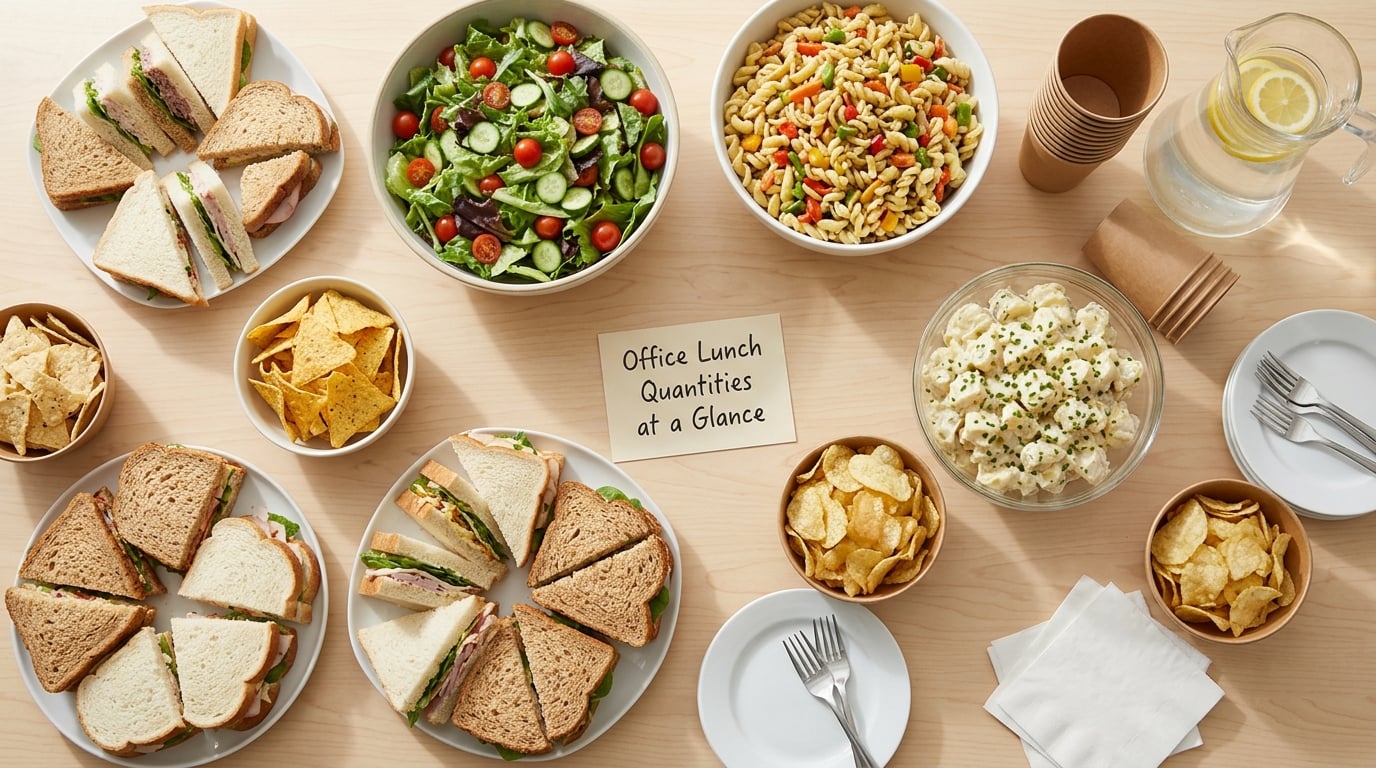
These are the per-person figures most catering kitchens plan against. Use the standard column for a working lunch where people arrive at their desks, and the generous column when the food replaces a proper meal or the group is hungry by 11:45.
| Food category | Standard serve | Generous serve | What the number means |
|---|---|---|---|
| Sandwich pieces, halves or triangles | 1.5 to 2 per person | 2 to 2.5 per person | The baseline for any sandwich-led lunch |
| Full-size sandwich platters | 1 per 5 to 6 people | 1 per 4 people | A full platter holds roughly 8 to 10 pieces, or 6 to 8 triangles |
| Salad or fruit cup | 1 cup per person | 1.25 cups per person | Salad is a side in a sandwich order, a main at a buffet |
| Chips, crackers or a side | 1 to 1.25 servings per person | 1.5 servings per person | One small bag roughly feeds 3 to 4 people |
| Cookies, brownies or pastries | 2 pieces per person | 3 pieces per person | Drop to 1 to 1.5 if lunch is the main meal |
| Cold drinks | 1.25 per person, plus 1 extra per 10 guests | 1.5 per person | Every second refill and one dropped bottle, covered |
| Ice for a drinks station | 1 to 1.5 lb per person | 2 lb per person | Only needed if people are serving themselves |
| Buffet total, all foods | 1 to 1.25 lb per adult | 1.5 lb per adult | Excludes dessert and drinks |
Two rules sit under every row. Self-serve service inflates portions because nobody is watching the serving spoon, and a table of eight people takes noticeably fewer sandwiches than a table of three.
How to Calculate Food by Headcount
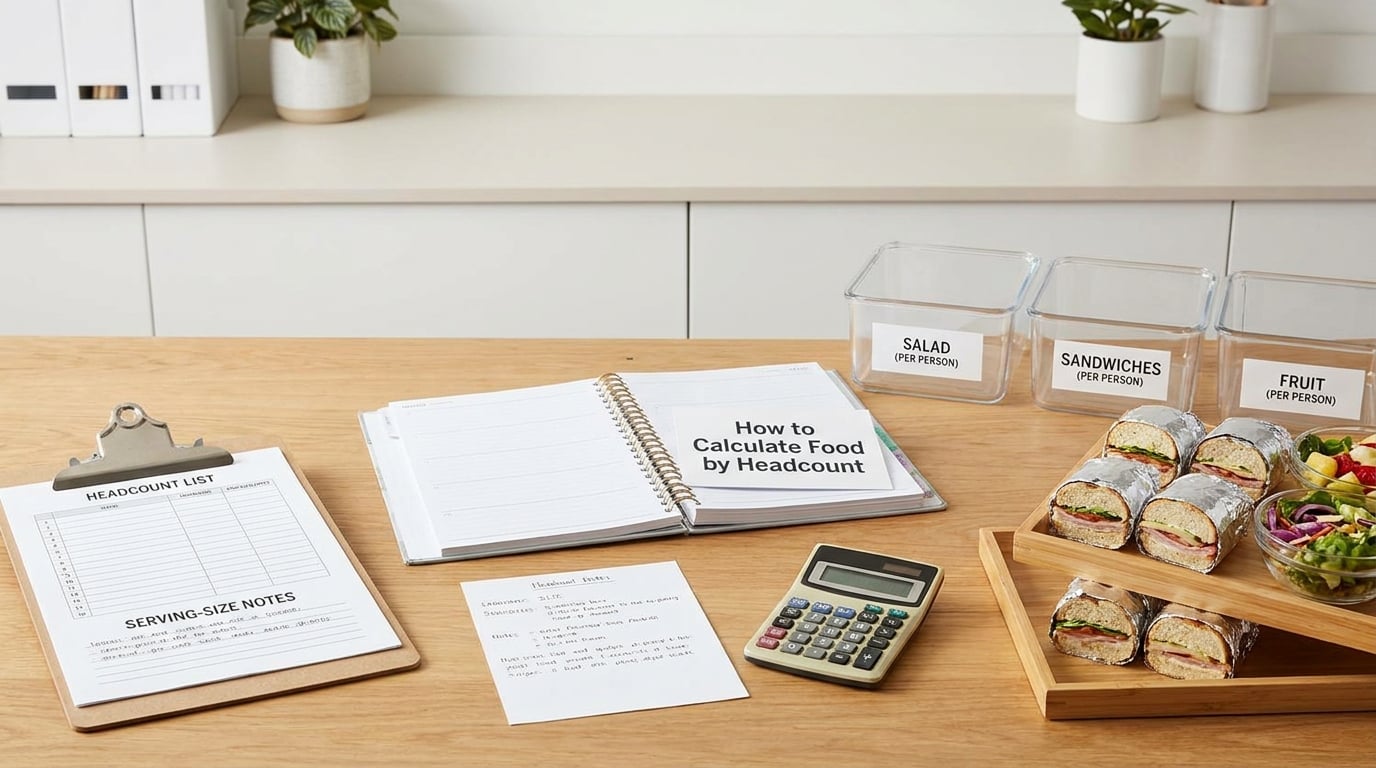
Here is the method for a crowd of any size, from a quarterly all-hands to a Friday team lunch that grew by six people overnight.
- Lock the headcount. Count firm RSVPs, then add the people who attend most weeks even if they did not reply. A calendar invite list is a better source than memory.
- Choose the format first, because it sets the portions. Boxed meals and platters use different per-person numbers, and so does buffet service.
- Apply the per-person factor to every category, not just the mains. Food runs out on the sides and drinks long before the sandwich platters are empty.
- Round up to what a vendor actually sells. Half platters, quart salad bowls and tray sizes of 8 to 10 servings are the real unit, not the single portion.
- Add your buffer. Five percent on a hard RSVP count, ten percent when the invite is open or the meeting is optional.
- Confirm the delivery window before you place the order, then adjust quantities if the vendor suggests a different tray size.
Here is the same math written out as a headcount table, so you can find your number without doing arithmetic at your desk.
| People | Sandwich pieces | Full platters | Side servings | Sweet pieces | Cold drinks |
|---|---|---|---|---|---|
| 10 | 20 | 2 | 13 | 25 | 14 |
| 15 | 30 | 3 | 19 | 38 | 20 |
| 20 | 40 | 4 | 25 | 50 | 27 |
| 25 | 50 | 5 | 32 | 63 | 34 |
| 30 | 60 | 6 | 38 | 75 | 41 |
| 40 | 80 | 8 | 50 | 100 | 54 |
| 50 | 100 | 10 | 63 | 125 | 68 |
| 60 | 120 | 12 | 75 | 150 | 81 |
| 75 | 150 | 15 | 94 | 188 | 101 |
| 100 | 200 | 20 | 125 | 250 | 135 |
| 150 | 300 | 30 | 188 | 375 | 203 |
| 200 | 400 | 40 | 250 | 500 | 270 |
These rows use the standard serve column, and they exclude the buffer. If your 50-person all-hands is optional rather than mandatory, plan 10 to 15 sandwich pieces above that row rather than a fifth platter.
How to figure food amounts for large crowds over 75 people
Past about 75 guests, one mistake costs you real money, so split the order across two vendors or two delivery windows instead of one enormous drop. Ask each supplier to label platters by type and number them in the order they should be set out, and assign one person to open boxes and fill water pitchers while the rest of the team keeps working.
Office food disappears faster than most people expect. A midday delivery is usually gone in about 20 minutes once the meeting breaks, so a second small wave an hour later often beats ordering double upfront.
How Much Food to Order for Sandwiches, Wraps, and Salads
Sandwich platters are the default for an office lunch because they travel well, need no utensils beyond a napkin, and nobody has to sit down. Start at 1.5 to 2 pieces per person and work from the headcount table above.
Platter math that actually adds up
A full platter holds about 8 to 10 sandwich pieces or 6 to 8 triangles. At 1.5 to 2 pieces per person, that covers 5 to 6 people. Odd numbers are where orders go wrong, so for 25 people ask for four full platters plus two half platters rather than five platters and a hope.
Wraps and rolls behave differently from sliced bread. A wrap cut into halves gives two pieces, so a wrap platter of 8 halves covers 8 servings rather than 4. Tell the vendor it is a working lunch, not a party, and they will size the platters accordingly.
Build-your-own stations need more, not less
A build-your-own table lets people take a second roll or extra filling, so plan on 2 pieces per person and raise it to 2.5 when the group skipped breakfast or the lunch runs long. Provide two breads rather than one. People make choices, and a table with a single bread option turns into a queue.
Salads and combination platters
Salad is a side in a sandwich order, so 1 cup per person with a light extra. Add a quart bowl, which usually covers 8 to 10 people, for every 10 guests. A combination platter with a sandwich half, a small salad and a cookie is closer to a full meal, so drop the separate side and sweet.
Boxed lunches, platters, or wrapped meals?
Boxed lunches become the sensible choice when names and diets matter more than cost. Individual meals are also the fallback many offices use when per-person ordering gets expensive at scale, and box lunch orders commonly start around 10 meals with a range that scales to large workplace groups.
| Format | Best for | Portion basis per person | Watch for |
|---|---|---|---|
| Individual boxed meals | Hybrid teams, labeled diets, all-hands with attendance tracking | 1 box per person, plus 5% spare boxes | Runs higher per head because nobody shares, and everyone takes a box they may not finish |
| Sandwich platters | Teams of 20 to 100 eating at their desks | 1.5 to 2 pieces per person | Platter labels cover food type, not individual allergens |
| Wrapped or sealed meals | Meetings where people eat while the session runs | 1 sealed meal per person | Fewer choices, and no seconds for a hungry group |
| Buffet or self-serve | All-hands, training days, events with a break | 1 to 1.25 lb per adult, plus dessert and drinks | Serving utensils, chafing dishes and a plan for the rush |
Sides, Snacks, and Drinks
Sides are where an order quietly fails. A sandwich order sized perfectly still disappoints if the potato salad is gone by 12:20, and nobody complains about the missing sides, they just stop eating.
- Chips and crackers: 1 to 1.25 servings per person. One small bag covers roughly 3 to 4 people, so a 30-person lunch needs 8 to 10 bags.
- Fruit: 1 cup of cut fruit or 1 piece per person. Whole apples travel without a knife and do not need a plate.
- Cookies and brownies: 2 pieces per person, 3 for a generous spread. Ask for boxes rather than trays so the extras are easy to hand out later.
- Pastries and morning tea items: 1 to 1.5 per person for a mid-morning break, and 0.5 per person if lunch is also on the table. People do not need two sweet events in one morning.
- Water: 1 bottle or 1 glass per person, plus coffee and tea if the meeting runs past an hour. Put the drink station away from the food so the queue does not block the trays.
- Ice: 1 to 1.5 lb per person for a self-serve cooler. Bagged ice also doubles as the cold pack for anything delivered warm.
- Condiments: one set of mayo, mustard and dressing packets per table of 8 to 10 people, plus 10 extra sets.
For a light meeting meal, shorten the list. A working lunch that runs 45 minutes needs sandwiches, one side and drinks. Sweets and chips belong to the 2 to 3 hour sessions where people skip breakfast.
How Much Food for a Buffet-Style Office Lunch?
Buffet service needs about 10% more food than plated or boxed service, because portions are self-selected and generous. The working standard is 1 to 1.25 lb of food per adult, excluding dessert and drinks, and 1.5 lb when the meal is meant to replace a full meal.
Capacity is the part most planners miss. A hotel pan of a casserole or a side dish serves about 8 to 10 people. That is the number to work from, not the recipe size, and it decides how many pans you need before anyone talks about variety.
Scale the number of options with the group, so the line keeps moving:
- Under 25 people: 3 mains and 2 sides. Too much choice at a small table just slows everything down.
- 25 to 75 people: 4 mains and 3 sides, with a separate dessert and drinks station.
- Over 75 people: 5 mains and 4 sides, and run two identical lines rather than one long one.
To avoid an empty table at 12:30, hold back a reserve pan and send someone for it the moment you see a dish drop below a third. Ordering that reserve upfront is cheaper than a second emergency delivery after the meeting ends.
Adjusting for Dietary Needs and Mixed Preferences
Dietary counts fail when they are collected once and forgotten. Ask in the invite, keep the list somewhere shared, and order above what people tell you, because restrictions are under-reported by habit.
- Count each restriction separately. Vegetarian, vegan, halal, kosher, gluten-free and allergy needs are six lists, not one.
- Add 10% to each count. Reports run low, especially gluten-free and halal, and the people who forget to reply are the same people who forget to tell the caterer.
- Label at the level of the individual where you can. A sticker on a boxed meal with a name and a diet removes the guesswork at the table.
- Keep allergy meals separate and sealed. A sandwich cut on a shared board is not a gluten-free sandwich, whatever the label says.
- Use a supplier who can document certification for halal and kosher orders rather than a verbal assurance.
There is no need for a separate meal for everyone. The usual pattern is a standard option for the group, one clearly labeled vegetarian or vegan option in the same portion size, and a small number of individually labeled meals for allergies and specific diets.
Add a Buffer Without Overordering
How much food to order for an office lunch when RSVPs are still open
When the headcount is still moving, multiply by 1.05 for a firm RSVP list and 1.10 for an open invitation or optional meeting. Below 10 people, add 2 extra meals rather than a percentage, because percentages get silly at small numbers. Assistants planning regular lunches frequently order 5 to 10 headcount above the RSVP count for exactly this reason: a spare sandwich gets eaten, and a shortage gets remembered.
Round the buffer up to the nearest thing a vendor sells. Two extra sandwiches you cannot buy are worth less than one extra half platter you can.
Some leftovers are useful and some are not. Boxed meals, unopened chips, sealed drinks and wrapped cookies keep and can go into the next Friday lunch or a colleague’s desk. An open salad bowl or a tray of cut fruit does not, and that is the portion worth trimming from your buffer.
For recurring weekly orders, track who actually collects food rather than who replied yes. After three or four weeks, your real headcount is usually 5 to 10% lower than your invite list, and that is where the permanent saving lives.
Order for Delivery, Pickup, or On-Site Catering
Where the food comes from changes the planning more than the menu does. Each format has its own packaging, timing and supply requirements.
Delivery
Ask for a delivery window that lands 15 to 30 minutes before the meeting starts, so the food is fresh without a delivery crew walking in mid-sentence. Confirm who will receive it, since many buildings require a front desk handoff and a signature. A standard office lunch usually needs 24 to 48 hours notice; large all-hands orders and anything with hot food need three to five days.
Pickup
Pickup is the simplest option for a team already leaving the office at lunch. Check that trays are sealed for transport, that hot items are in insulated carriers, and that the vehicle has room for a full order. Pick one named person to collect, and give them a cart.
On-site catering
On-site service buys you fresh hot food and a built-in clean-up crew, and it needs space you may not have. Find out in advance whether a buffet line, chafing fuel, a water station and a place to refill hot trays are included. Ask for the serving staff arrival time, not just the food arrival time.
Whichever route you take, request plates, cups, napkins, serving spoons and a bag for extra food in the same order. Vendors will often include them, and a lunch that runs short on forks is a lunch people eat standing up.
How to Keep Office Lunch Food Safe
Perishable food should not sit out at room temperature for more than two hours, or one hour if the room is above 90°F. Office lunch is the worst case for this rule, because trays often land early and nobody starts until the meeting ends.
- Hot holding: keep hot food at 140°F or above, which means chafing dishes with fuel or an electric unit, not a buffet tray on a table.
- Cold holding: keep cold food at 40°F or below, on ice or inside a refrigerated truck until it comes out.
- Arrival temperature: poultry must reach 165°F, ground meat 160°F, and whole cuts of meat and fish 145°F. If a delivery arrives without a temperature reading, ask before you serve it.
- Storage times: refrigerate anything perishable within two hours, use it within 3 to 4 days, and reheat leftovers to 165°F. Discard anything that sat out past the limit rather than shifting it to the fridge.
- Office fridges: give the delivery its own shelf, label it with the date, and remove the boxes at the end of the day.
Anyone with a severe food allergy should have their own sealed meal and know which table it is on. For an allergic reaction, seek emergency care rather than relying on an antihistamine.
Frequently Asked Questions
How much food to order for an office lunch?
Plan 1.5 to 2 sandwich pieces per person for a standard working lunch, or 2 to 2.5 pieces for a generous one. Add 1 side, 2 to 3 sweet pieces and 1.25 cold drinks per person, then add 5% for a firm RSVP count or 10% when the meeting is optional.
How many trays of food do I need for 30 people?
A full hotel pan or tray of a side dish serves about 8 to 10 people, so 30 people need 3 to 4 trays per side. For sandwich platters, order 6 full platters at 60 sandwich pieces. For a buffet main, budget 1 to 1.25 lb of food per adult, or about 34 lb across 30 guests.
How much food do I need to cater for 20 people?
For 20 people, order 40 sandwich pieces, which is 4 full platters or 3 platters plus 2 half platters. Add 25 side servings, 50 sweet pieces and 27 cold drinks, then cover optional attendees with 4 to 6 extra pieces. A boxed-meal order for 20 needs 21 to 22 individually labeled meals.
How many platters do I need for 40 people?
At 1.5 to 2 sandwich pieces per person, 40 people need 60 to 80 pieces. A full platter holds roughly 8 to 10 pieces, so that is 8 full platters at the 80-piece end, or 6 full platters plus 2 half platters at the 60-piece end. Add 2 more platters if the group will take seconds.
Should I order more food than my headcount?
Yes, by a small amount. Add 5% when you have a firm RSVP list and 10% when the invite is open or the meeting is optional. Under 10 people, add 2 extra meals instead of a percentage. Extra boxed meals, sealed drinks and wrapped cookies keep; open salads and cut fruit do not, so trim the buffer there.
How far in advance should I order office lunch?
A standard sandwich or boxed lunch order usually needs 24 to 48 hours notice. All-hands orders, hot buffet food, large platters and orders with labeled allergy meals need three to five days, and holiday-season lead times run longer. Confirm the headcount and dietary list with the vendor again 24 hours before delivery so nothing is missed.
Start With the Headcount, Then Adjust
Here is the short version. Confirm who is actually coming, pick one format, and apply 1.5 to 2 sandwich pieces per person plus one side, two to three sweets and 1.25 drinks. Round everything up to whole platters and trays, because that is how food gets ordered.
Then make three adjustments and stop: add 5 to 10% for a soft headcount, add a labeled option for every diet on your list, and plan a delivery window that lands just before the meeting. Do that and the quantity question takes about ten minutes instead of an afternoon of second-guessing.