
Collect everyone’s dietary restrictions once in a reusable list, sort them by severity (medical allergy, religious requirement, or preference), then choose a catering format that keeps the most serious needs physically separate from the rest of the food. Most of the work happens before you ever call a caterer, and the whole thing takes a few hours spread across a week of lead time.
The reason this trips people up is that a label describes a product, not a kitchen. “Gluten-free wrap” tells you something about the wrap. It tells you nothing about the cutting board, the toaster, or the tongs that just handled a wheat-based burrito.
Office managers posting in r/ezcater and r/AdminAssistant describe the same loop repeatedly: re-asking the same dietary questions before every order, arriving without a real list, and sorting unlabeled trays on arrival. A standing list kills the first two problems. The rest of this guide handles the third.
Table of Contents
- What You Need Before Ordering Catering
- Step-by-Step: How to Order Catering for a Team with Dietary Restrictions
- Common Mistakes When Ordering Catering for Dietary Restrictions
- Tips for a Smooth Catering Experience
- Frequently Asked Questions
- What information should I give a caterer about dietary restrictions?
- How do I ask a caterer whether food is safe for someone with a severe nut allergy?
- Are substitutions enough when a teammate has celiac disease?
- How much food should I order per person for a team lunch?
- Should I choose buffet or boxed lunch for a team with mixed dietary needs?
- What do I do if a dietary restriction comes up after the order is placed?
- Where to Start
What You Need Before Ordering Catering
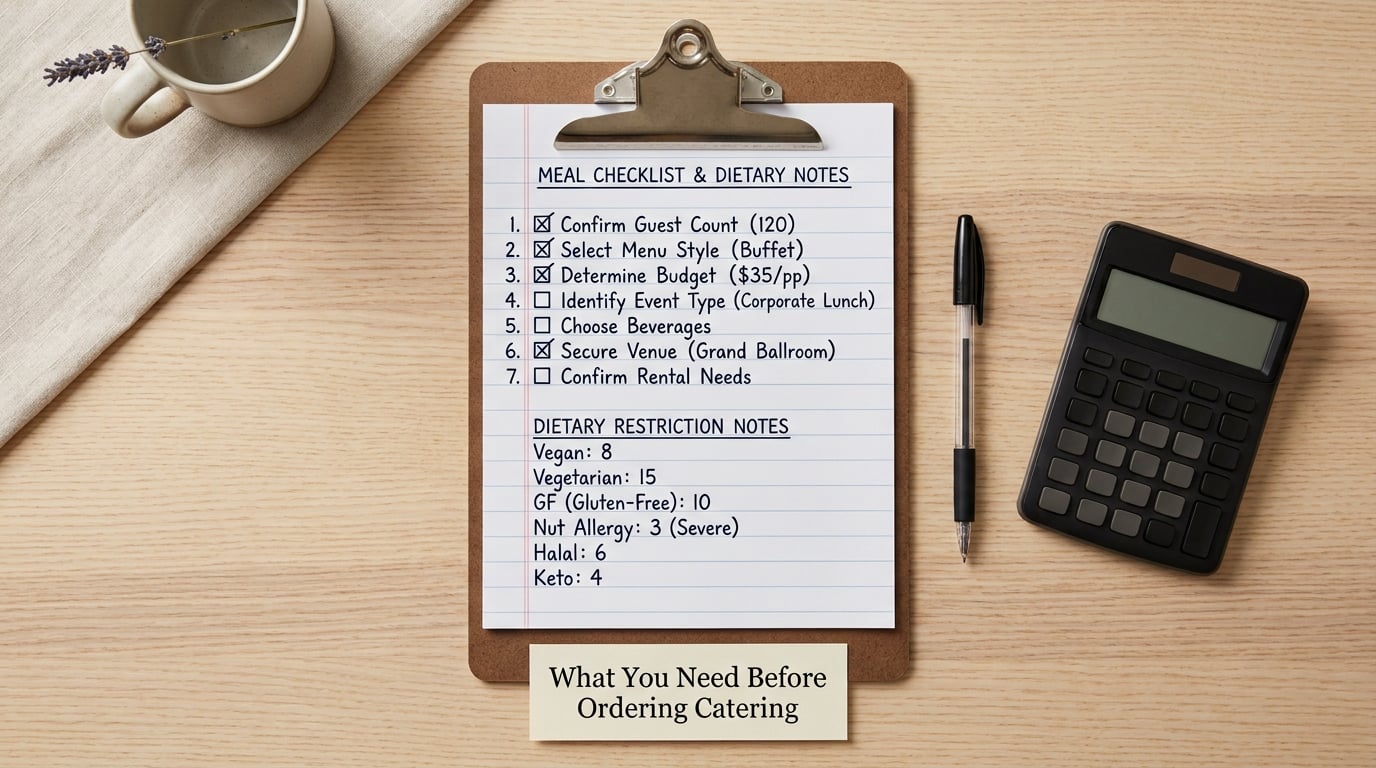
You need nine things before the first caterer call, and about two of them require anyone else. The rest you can assemble in ten minutes.
- Headcount. Confirmed attendees, not invited. A group RSVP is the number you plan around; a group RSVP plus regulars is the number you order for.
- Date and service time. Delivery window matters as much as the date. Mid-morning delivery for a noon meeting is a different order than noon delivery for a 1 p.m. meeting.
- Meal format and time of day. Breakfast, lunch, dinner, snacks, or an all-day meeting. This drives portion size more than headcount does.
- Service style. Drop-off trays, a staffed buffet, boxed meals handed out individually, or a self-serve build-your-own station.
- Dietary restrictions, in writing. Per person, not “a few people have restrictions.”
- Allergen specifics. Which person has which allergen, and how severe it is.
- Budget range per person. A range is fine. A number is better. Decide it before you compare menus.
- Delivery address and logistics. Floor, elevator, parking, loading dock, kitchen access, and whether someone will be there to receive it.
- The person who confirms. One named human who answers the vendor on delivery day. Two people means two versions of your instructions.
Write these down somewhere the whole team can see. The list, not the conversation, is what the caterer works from.
Step-by-Step: How to Order Catering for a Team with Dietary Restrictions
Six steps, in this order. Each one removes ambiguity that would otherwise come back to you as a problem.
1. Define the Meal and Guest Requirements
Start with the headcount, not the menu. Confirm who is attending, lock the service time, decide whether this is breakfast, lunch, dinner, or an all-day event, and set your per-person range.
The distinction that matters most here is meal occasion versus event. A working lunch is a lighter portion than a lunch with cake afterward. An all-day offsite needs breakfast, a substantial midday meal, and an afternoon snack, and those three are ordered separately rather than as one number.
2. Create a Clear Dietary Restriction List
Build this once and reuse it. Keep it in a shared doc or a short form that anyone can update, and reconfirm it a week out and again 48 hours before delivery. People join teams, change diets, and forget what they told you last quarter.
Copy this template straight into a form or document:
DIETARY INTAKE — [Team or Event Name] — [Date]

Name: ____________________  Email: ____________________

Please check everything that applies to you:
[ ] Vegetarian      [ ] Vegan          [ ] Pescatarian
[ ] Gluten-free / celiac      [ ] Dairy-free / lactose-free
[ ] Halal           [ ] Kosher
[ ] Nut allergy (which nuts: ______________)
[ ] Soy allergy     [ ] Egg allergy     [ ] Shellfish / seafood allergy
[ ] Low-sodium      [ ] Diabetic-friendly
[ ] Other restriction: ____________________________________

How serious is it? (choose one)
[ ] Medical — an allergy or diagnosed condition. A mistake could make me ill.
[ ] Religious — I do not eat this. Please don't offer me a substitute.
[ ] Preference — I'd rather not, but it is not a safety issue.

Do I need anything special to keep this safe?
[ ] Separate utensils   [ ] Sealed/lidded container   [ ] Dedicated preparation area
[ ] Labeling with my name

Anything the kitchen should know: ____________________
The severity field is the part people skip, and it is the part that changes your order. Here is how each category changes what you do:
| Restriction type | Category | What changes in the order |
|---|---|---|
| Severe nut, shellfish, or sesame allergy; celiac disease | Medical | Vendor must confirm a dedicated preparation area or documented cross-contact procedure. Expect a separate or sealed item, and consider sourcing that one meal separately if the vendor cannot answer clearly. |
| Lactose intolerance, soy sensitivity, low-FODMAP | Medical or managed | Ingredient-level question rather than a kitchen-level one. Ask what is in the sauces and dressings, not just the main dish. |
| Halal, kosher | Religious | Certification matters more than substitution. Ask whether the food comes from a certified supplier; a meat-free chicken is not the same as halal-certified chicken. |
| Vegetarian, vegan | Preference or ethical, sometimes medical | Usually satisfied by a well-designed menu with two or three compatible options. No separation required. |
| Low-sodium, keto, paleo, diabetic-friendly | Preference or clinical advice | Best handled by per-person selection, not by a restricted sub-tray. |
Sort by that table, then count each category. The counts are the whole input to every decision that follows.
3. Ask Caterers About Menus and Cross-Contact Controls
Cross-contamination is the transfer of an allergen into food through shared surfaces, utensils, oil, storage, or transport. Cross-contact is the same idea. A dedicated preparation area means a physical part of the kitchen where allergen-free food is handled with its own tools, surfaces, and storage, rather than a shared bench that gets wiped down.
Ask for ingredient information per item, and ask specifically how foods are prepared, stored, handled, and transported. Listen for specifics. “We can do gluten-free” is not an answer; “our gluten-free items are assembled at a separate station with dedicated utensils and packed in sealed containers” is.
Request the full list of these questions in writing before you commit:
- Can you provide an allergen sheet listing the major allergens in each menu item?
- Do you have a dedicated preparation area for allergen-free items?
- What cross-contact controls do you use for shared fryers, toasters, and cutting surfaces?
- Can you provide ingredient lists for every dish, including sauces, dressings, and marinades?
- Can gluten-free or allergy-friendly items be prepared, sealed, and transported separately?
- Is any of your food prepared in a facility that also handles peanuts, tree nuts, or shellfish?
- Can you accommodate halal or kosher requirements, and is that food sourced from a certified supplier?
- Will meals or trays be labeled at packing time with names or dietary tags?
- What is your lead time for a modified or individually labeled order?
- What is your minimum order, and what are the cancellation terms once the order is placed?
Office managers tend to trust the vendor who plainly says what it cannot do. A candid “we share a fryer, so a nut-free guarantee isn’t something I can give you” is worth more than an unqualified promise, because you can plan around it.
4. Compare Options Against the Needs
The four main types of catering are plated meal service, buffet, family-style or food stations, and boxed or drop-off service. Office teams mostly choose among buffet, boxed, group order, and build-your-own station, and those four behave very differently once dietary restrictions enter the picture.
Quantities and formats, side by side:
| Format or meal | Per person | Worked example | Dietary separation |
|---|---|---|---|
| Boxed meal, sandwiches or wraps, lunch | 1 to 1.5 sandwich portions, or 1 portion plus 1 side | 20 people: 20 to 30 sandwich portions, or 20 boxes plus sides | Strongest. Each box is made for one person and is not handled again. |
| Group order where employees pick their own | 1 entrée plus sides, self-selected | 30 people, 8 choose online: 30 selections, no guessing | Strongest, because each person resolves their own meal. |
| Drop-off trays, self-serve | 1.5 to 2 portions per person when trays are the only food | 20 people: about 30 to 40 portions across 4 to 5 platters | Moderate. Needs setup discipline and separate serving utensils. |
| Buffet with a staffed line | 1.25 to 1.5 portions per person | 40 people: about 50 to 60 portions, 6 to 8 platters | Good, if restricted items are placed first in line and staffed. |
| Build-your-own station | 2 to 3 components per person | 30 people: 60 to 90 components across 5 to 6 containers | Variable. The person assembling the bowl can reintroduce cross-contact. |
| Breakfast | 1.25 portions | 20 people: 25 pastries or breakfast sandwiches | Usually easy; watch shared toasters and yogurt toppings. |
| Afternoon snack | 3 to 4 small pieces per person | 20 people: 60 to 80 pieces, roughly 3 platters | Easy, unless nuts are on the menu at all. |
As a general sizing rule, plan for 90 percent of confirmed RSVPs plus a small buffer, and never order fewer restricted-diet items than you have people who said they need one. Over-ordering a substitute meal is far cheaper than watching a colleague go hungry.
Where safety is the issue rather than preference, prefer formats that resolve each meal before the food reaches the room. A labeled box is harder to contaminate than a buffet platter, because nobody touches a tray that is not theirs.
5. Confirm the Order in Writing
Before you pay, get written confirmation of: final headcount, the menu items, every dietary accommodation itemized by category, labeling instructions, delivery window, setup expectations, cancellation terms, and a named contact with a phone number.
Put the dietary instructions in the order notes themselves rather than in a separate email. One line that travels with the order, such as “2 halal meals sealed and labeled, 4 gluten-free boxed, 1 nut-free meal prepared at the dedicated station and sealed,” beats a paragraph in an inbox nobody reads at 6 a.m.
If the vendor cannot meet a restriction, here is the sentence to use: “I understand that. What can you do instead, and what can you not promise?” Then decide between sourcing that one or two meals separately from a specialist, ordering from a different vendor altogether, or covering the person who cannot eat safely by telling them plainly and early. Office managers on Reddit describe the separate specialist order as the option that scales when a group is genuinely too varied for one kitchen.
6. Arrange the Handoff and Meal Service
Plan the arrival before the order ships. Who receives it, where it goes, who labels it, and who watches the first ten minutes of service.
On arrival: keep restricted items separate from the general spread, check labels before serving, use a separate pair of tongs or serving spoon for every dietary category, and put restricted items at the front of the line so they are not handled repeatedly.
If a tray arrives unlabeled, do not guess. Set it aside, call the vendor, and compare the contents against the confirmed order. Ten minutes of sorting beats serving the wrong thing to the one person it matters most for.
For hot food, keep it out of the danger zone. Perishable food should not sit at room temperature for more than two hours, or one hour above 90°F. Poultry should reach 165°F, ground meat 160°F, and whole cuts and fish 145°F. If trays arrive early, refrigerate or hold them hot rather than leaving them on the table.
Common Mistakes When Ordering Catering for Dietary Restrictions
These are ordered by how much damage they do, not by how often they happen.
- Assuming a “free from” label covers the kitchen. A product free of an allergen says nothing about the fryer it was cooked in. Fix: ask the dedicated-preparation and cross-contact questions, and take a no as a no.
- Treating a preference like an allergy, or the reverse. Either you over-engineer the order and someone with a real allergy gets the same casual treatment, or you relax for a preference and exclude a person. Fix: use the severity field in the intake form and sort by it.
- Ordering with no list. “A few people have restrictions” is not something a kitchen can act on. Fix: get per-person answers with a deadline.
- Using shared utensils. One pair of tongs crossing from a general tray to a restricted tray is enough. Fix: one dedicated utensil per category, and never reuse a serving spoon mid-line.
- Labeling vaguely. “Salad box” tells a room nothing. Fix: name plus dietary tag, written before serving begins.
- Ordering too few restricted options. Fix: count heads, not invitations, and keep one unclaimed substitute on reserve for a late addition.
- Overlooking delivery timing. Food that arrives before anyone can receive it, or an hour after service starts, creates its own problems. Fix: name the arrival window and the person who receives it in the confirmation.
- Missing the hidden allergens. Gluten hides in soy sauce, marinades, and barbecue sauce. Nuts hide in cooking oils and some barbecue sauces. Soy hides in soy sauce, miso, and many nut butters. Fix: ask for the full ingredient list, not the headline description.
One more worth naming: a restriction disclosed after the order is placed. Do not quietly swap a tray. Add to the order, or source that meal separately, and tell the person either way so they are not counting on food that is not coming.
Tips for a Smooth Catering Experience
Set a hard deadline for dietary responses and treat a missing response as “no restrictions,” not as a follow-up task. Reconfirm at one week out and again 48 hours before, because that second pass is where late changes actually surface.
Choose a menu where several options are naturally compatible with the most common needs, so most people can eat from the main spread and only a small number of items are special. That is also how you avoid the compromise plate problem, where the person with the biggest restriction is handed a visibly different plate in front of everyone. The best version is a menu designed so several people are eating the same thing for different reasons, and nobody is on the sidelines.
For a recurring program, store the standing list once, rotate the cuisine, and change one variable at a time so you know what caused a complaint. If a complaint is about food, say so.
For distributed teams, order per site rather than centrally, and confirm each site’s list separately. For very large groups, keep a small reserve of a broadly compatible meal on hand for walk-ins and last-minute additions.
Finally, decide what happens to a meal nobody claims. Wasting a paid restricted meal is a small cost next to the alternative, but it is worth assigning one person to check at the end of service so the pattern shows up in your order counts.
Frequently Asked Questions
What information should I give a caterer about dietary restrictions?
Give a per-person list, not a summary. Include each person’s name, the restriction, whether it is a medical allergy, a religious requirement, or a preference, and any handling notes they gave you such as separate utensils or a sealed container. Add the confirmed headcount, service time, delivery window, and per-person budget range. Send it in writing and ask for the same information back in the confirmation.
How do I ask a caterer whether food is safe for someone with a severe nut allergy?
Ask whether they have a dedicated preparation area for allergen-free items, what cross-contact controls apply to shared fryers, toasters, and cutting surfaces, and whether any food is prepared in a facility handling nuts or shellfish. Then ask for the allergen content of every item by name, including sauces and desserts. A candid answer about limits is more useful to you than an unqualified guarantee.
Are substitutions enough when a teammate has celiac disease?
Not on their own. A substituted gluten-free item prepared on a shared toaster or cutting board can still contain gluten, and celiac disease involves damage from even small amounts. Ask specifically about dedicated equipment, separate storage, and separate transport. If the vendor cannot answer clearly, source that person’s meal separately from a provider that documents a gluten-free preparation process.
How much food should I order per person for a team lunch?
For a working lunch with sandwiches or wraps, plan on one to one and a half sandwich portions per person, or one portion plus a side. For drop-off trays as the only food, plan on one and a half to two portions. For breakfast, about one and a quarter portions. Buffets run slightly under tray counts because people return for seconds. So for 20 people, expect roughly 20 to 30 sandwich portions.
Should I choose buffet or boxed lunch for a team with mixed dietary needs?
Choose boxed meals when a medical allergy is involved. A labeled box is made for one person, is not handled again by the room, and removes the shared-utensil problem entirely. Choose a buffet when the needs are preferences, a religious requirement without certification needs, or a spread where several options are naturally compatible. Either way, order at least as many restricted items as there are people who need them.
What do I do if a dietary restriction comes up after the order is placed?
Do not swap trays yourself or improvise a plate. Call the vendor and add to the order if their cutoff allows, or source that meal separately from a specialist and deliver it alongside the main order. Tell the person either way, the same day, so they are not planning around food that is not coming. Then add the restriction to your standing list so it never catches you again.
Where to Start
If you do one thing from this guide, build the standing intake list today and get each person’s restriction and severity in writing. Everything after that, choosing the format, sizing the order, briefing the vendor, labeling on arrival, is arithmetic once the list exists.
Start with the most severe need rather than the most common one. If anyone on the team has a medical allergy or celiac disease, that requirement should pick the format, and the preferences can adapt to it.