
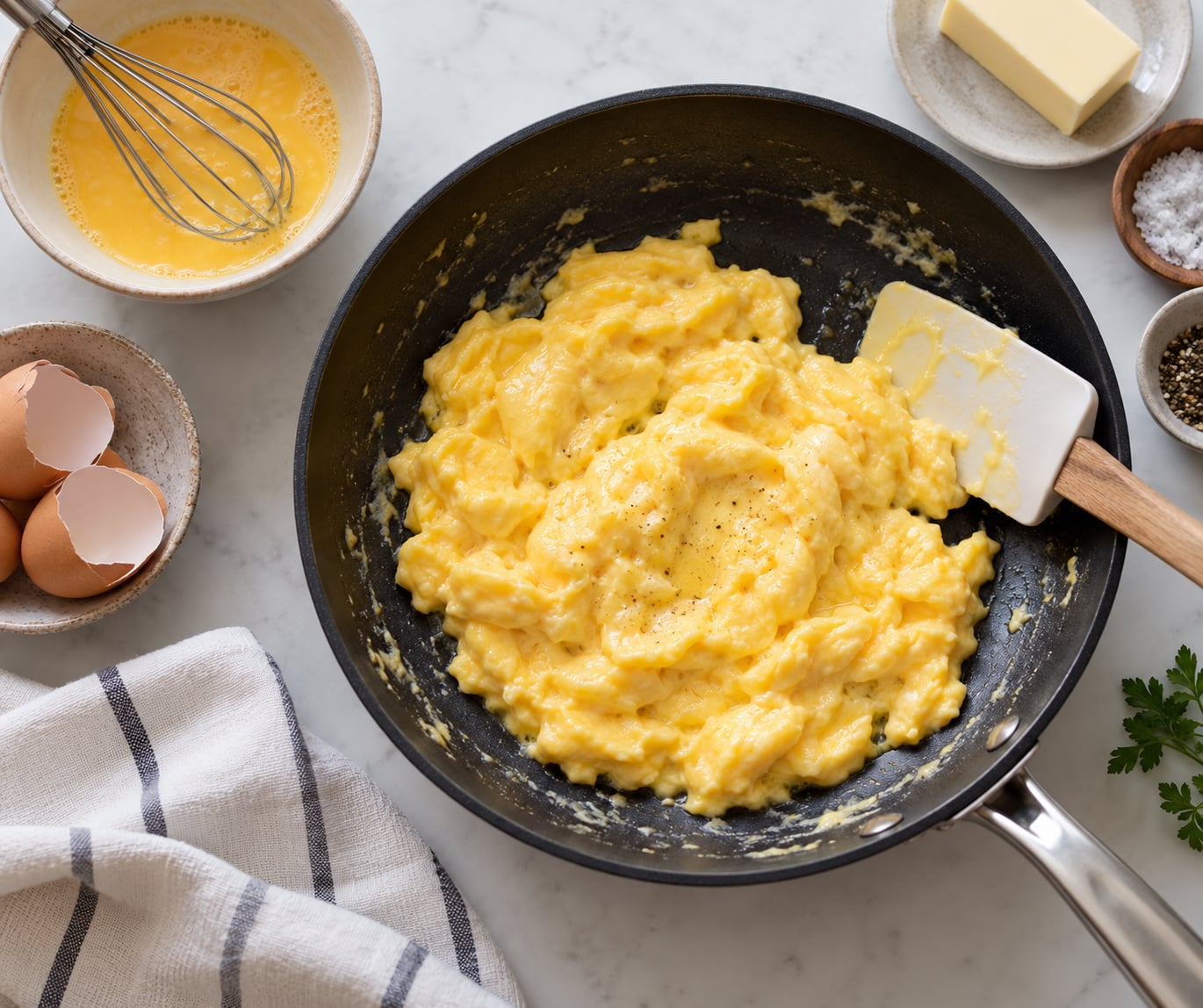
Fluffy scrambled eggs come down to three things: beat the eggs well without turning them into foam, cook them gently over medium-low heat, and pull the pan off the burner while the curds still look slightly wet. Start to finish the whole job takes about 10 minutes and needs no special equipment.
The reason restaurant eggs look pillowy is heat control, not a secret ingredient. Egg proteins unfold when heated and bond into a soft gel, and that bonding keeps going as long as the eggs stay hot. Salting early and stopping the cooking before the curds look done is what keeps them tender instead of rubbery.
Below is the method I actually use, the numbers that matter, and a troubleshooting table for the three problems that come up most: eggs that turn chewy, eggs that leak water onto the plate, and eggs that cook into tiny pebbly bits.
Table of Contents
What You Need
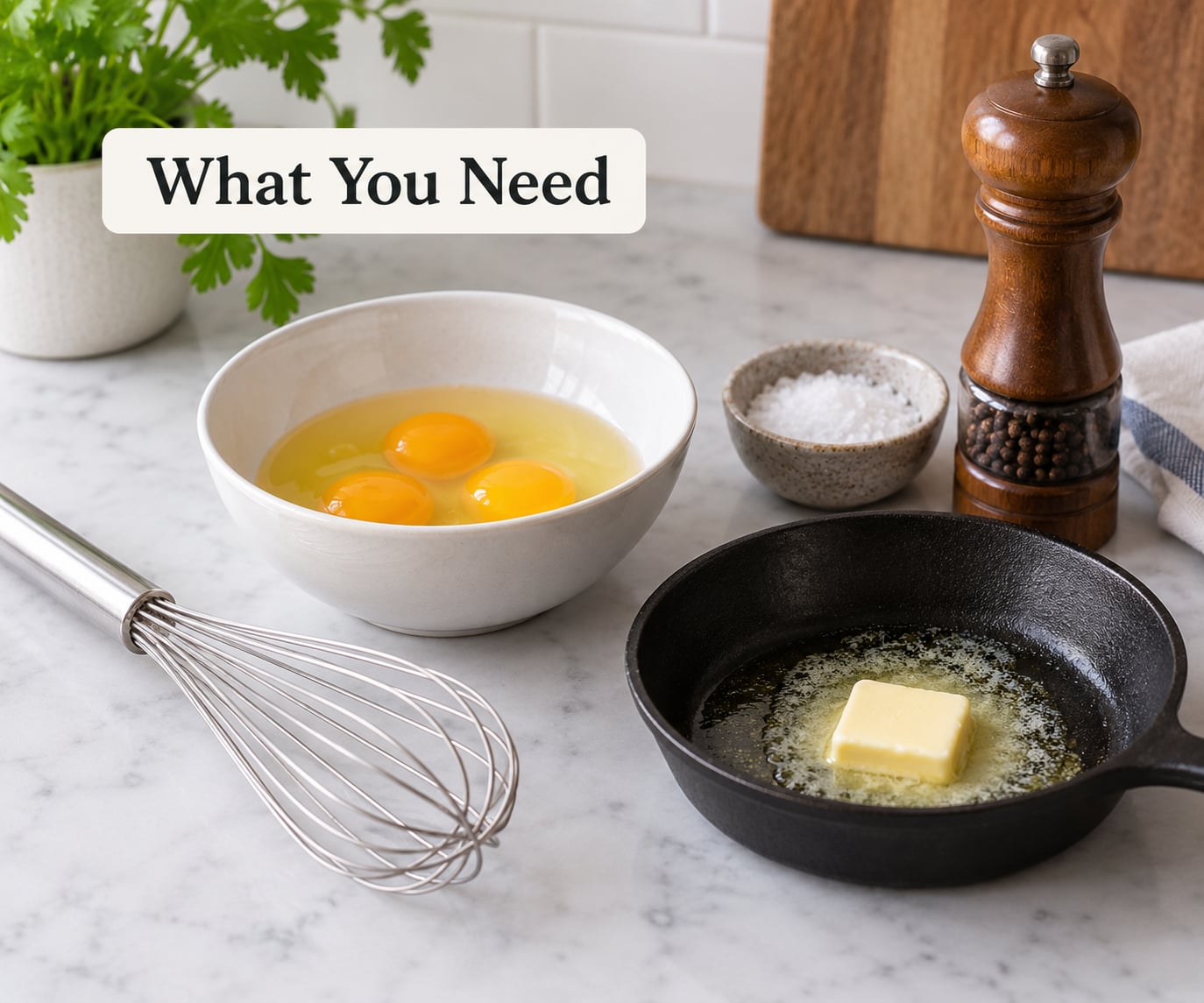
Ingredients for 2 servings
- 4 large eggs
- 1 tablespoon unsalted butter
- 1 tablespoon heavy cream, half-and-half, whole milk, or water
- 1/4 teaspoon kosher salt, plus flaky salt for finishing
- Freshly ground black pepper
Equipment
- A 10-inch nonstick skillet. A smaller pan gives you less surface area and forces you to stir constantly, which produces small curds.
- A heatproof spatula with a thin edge. A silicone spatula works; a thick wooden spoon scrapes too hard and tears the curds.
- A bowl and a whisk or fork. A fork is fine. A small fine-mesh strainer is optional and makes the texture more uniform.
What You Can Substitute
Butter can be swapped for a neutral oil such as avocado, canola, or grapeseed oil if you want less dairy, and ghee works well if you want the butter flavor with a higher smoke point. Olive oil is usable, but its flavor reads as a deliberate choice rather than a neutral cooking fat.
Eggs are the one ingredient you should not substitute. Two extra yolks stirred in with two whole eggs make the finished dish richer and more tender without making it wet, which is a useful trick when the batch is for someone who likes soft scrambled eggs.
Choosing Your Liquid: Water vs Milk vs Cream
All four liquids work, and they are not interchangeable. Water gives the lightest, fluffiest curds with no dairy flavor. Milk adds a small amount of body and mild sweetness. Heavy cream adds richness and slows the cooking slightly, which buys you more stirring time. Greek yogurt added off the heat adds tang and moisture but must not be cooked, or it will split.
| Liquid | Per 4 eggs | Effect on texture | Effect on flavor | Best for |
|---|---|---|---|---|
| Water | 1 tablespoon | Lightest, fluffiest curds | None, pure egg taste | Pillowy curds, kid breakfasts |
| Whole milk | 1 tablespoon | Slightly denser, creamier | Mild and faintly sweet | Everyday use |
| Half-and-half | 1 tablespoon | Silky, tender curds | Rounded, lightly rich | Brunch plates |
| Heavy cream | 1 tablespoon | Richest, most velvety | Full and creamy | Restaurant-style soft scramble |
| Greek yogurt | 1 tablespoon, stirred in off heat | Moist, tender | Tangy | Adding moisture to a finished batch |
Whichever you pick, measure it. The commonest liquid mistake is pouring in a heavy-handed splash, which thins the mixture and gives you curds that weep water once they hit the plate.
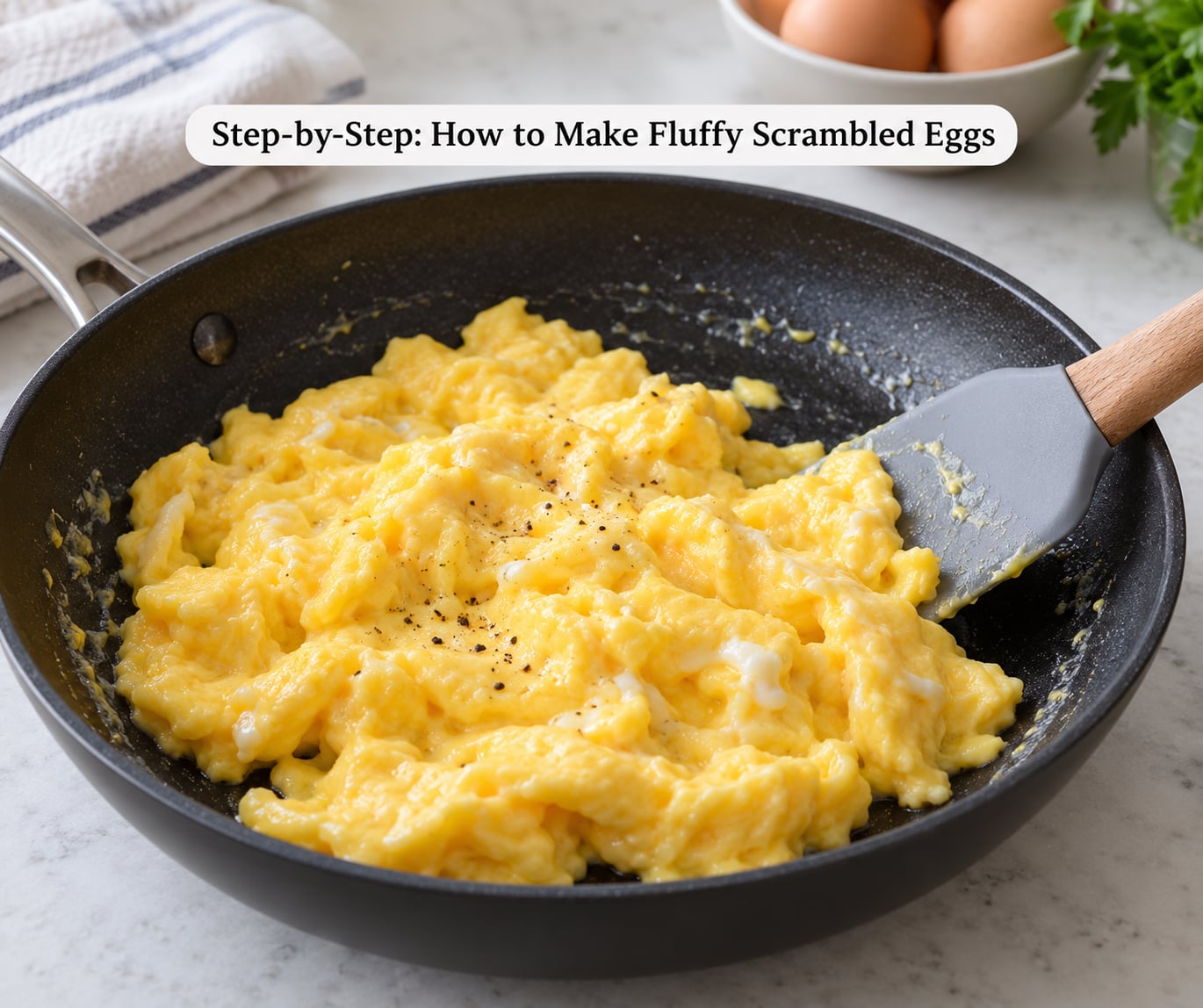
Step-by-Step: How to Make Fluffy Scrambled Eggs
- Beat the eggs. Crack 4 eggs into a bowl with 1 tablespoon of your chosen liquid and 1/4 teaspoon kosher salt. Whisk until no streaks of white remain and the mixture is uniformly yellow, about 30 seconds. Scrape the bottom and sides of the bowl so nothing gets left behind.
- Melt the fat. Put a 10-inch nonstick skillet over medium heat and add the butter. Wait until the butter foams and smells nutty, about 60 seconds, but pull it before it turns brown. If it browns, the eggs will taste bitter.
- Pour and wait. Add the eggs and swirl the pan once to spread them in an even layer. Then leave them alone for 20 to 30 seconds. This undisturbed window is what forms the first set.
- Fold with a spatula. Push the set edges toward the center in slow sweeps every 20 to 30 seconds. Use the flat edge of the spatula and lift rather than chop. Large curds come from few, gentle movements.
- Lower the heat. Once the curds look mostly set but still glossy on top, turn the burner down to low or move the pan to a cool burner. Give it another 30 to 60 seconds. The curds should look slightly underdone, like they still have wet shine in the creases.
- Pull the pan. Take the skillet off the heat completely. Residual heat keeps setting the eggs for another 30 to 60 seconds while you plate. Season with flaky salt and pepper and serve right away.
Total cook time for 4 eggs is roughly 3 to 4 minutes at medium-low heat. For food safety, cooked eggs should reach 160 degrees Fahrenheit at the center, which is the point at which the white is fully set and the yolk is no longer liquid; that stage is still tender, not rubbery.
How to Beat Eggs for a Fluffy Texture
Beat until the mixture is one solid color with no streaks, then stop. Over-whisking aerates the eggs into foam, and foam collapses into a tight, spongy texture rather than tender curds. Thirty seconds of steady whisking is more than enough.
Regarding how much liquid to incorporate, a tablespoon per four eggs is the range that works. That is enough to keep the proteins from bonding too tightly to each other, which is the whole point, and not enough to thin the mixture.
Season before cooking. Salt added at the start seasons the curds all the way through and slightly slows the coagulation, which buys you a longer stirring window. Salting at the end leaves you chasing uneven seasoning across every curd.
If you want a more uniform, diner-style scramble, strain the beaten eggs through a fine-mesh strainer. The thick strings that hold the yolk to the white are called chalazae, and straining breaks them up so the mixture cooks evenly. This tip circulates widely on r/Cooking, and it does make a visible difference in consistency.
How to Cook Fluffy Scrambled Eggs Gently Without Turning Them Rubbery
Heat is the whole variable. Medium-low is the default because it gives the eggs time to set into curds before water escapes. Medium-high works too, but it demands fast movement and produces smaller, firmer curds closer to a Chinese wok scramble.
Add the fat before the eggs, not after. Butter in a cold pan heats unevenly and can scorch before the eggs arrive, which is the usual reason a batch tastes bitter or greasy at once.
Stir every 20 to 30 seconds, sweeping from the edge to the center. Constant stirring is what breaks curds into small bits, so people chasing soft scrambled eggs often end up with something closer to egg paste. Fewer, slower pushes protect the curds you have already formed.
Recognize the finish by look, not by clock. Glossy curds with a faint wet look in the folds, and the whole pan still sliding when you shake it, mean the eggs are one step from done. That is the moment to pull.
| Method | Heat | Cook time | Curd size | Best for |
|---|---|---|---|---|
| Low and slow | Medium-low the whole time | 4 to 5 minutes | Large, soft, pillowy | Classic tender scramble, brunch for guests |
| Dual heat | Medium-high for 30 seconds, then low | 3 to 4 minutes | Large curds with lightly set edges | Speed plus tenderness |
| Hot and fast | Medium-high the whole time | 1 to 2 minutes | Small, firm, moist | Wok-style scramble, fried rice, tacos |
The dual heat method is my favorite for a weekday morning. Thirty seconds at medium-high sets the outer layer of each curd, then low heat finishes the middle without drying it out. It is the version most likely to produce the large curds people are after.
Common Mistakes and How to Fix Them
Egg proteins begin bonding somewhere around 140 degrees Fahrenheit and keep bonding as long as they stay hot. That is why overcooking is so unforgiving: there is no point where rubbery turns back into tender. Pull early and let residual heat finish the job.
| Symptom | What went wrong | Fix |
|---|---|---|
| Eggs are rubbery or chewy | Cooked too long, or heat too high | Pull the pan when curds still look glossy, then wait off heat |
| Water pooling under the curds | Too much liquid, or heat too high so water escaped | Measure liquid to 1 tablespoon per 4 eggs and drop to medium-low |
| Curds are tiny and pebbly | Stirring too often, or a pan that is too small | Stir every 30 seconds and use a 10-inch skillet |
| Eggs taste greasy | Too much fat, or butter burned before adding eggs | Use 1 tablespoon butter and pull it while it still foams |
| Browned or bitter edges | Pan was too hot, or butter went past golden | Start at medium, not medium-high, for the first 30 seconds |
| Seasoning is uneven | Salt added at the end | Season the beaten mixture before it hits the pan |
Two more habits worth building. Crack the eggs the night before and keep them sealed in the fridge if breakfast is a rush; room temperature eggs do not cook more evenly, contrary to a common belief, though a bowl of eggs sitting out for 20 minutes does lose nothing. If the real problem is a weekday morning with no time at all, my 10 best breakfast sandwiches to make ahead and freeze cover the same ground by doing the work ahead.
For serving, scrambled eggs shrink fast, so put them on warm plates. A spoon of thick yogurt or crème fraîche stirred through at the very end adds moisture without cooking, and toasted bread or a buttered English muffin is the fastest way to make the plate feel finished. When the eggs are one part of a bigger spread, my how to build a deli platter at home that looks catered gives you a low-effort center board so the plate does not have to carry the whole meal.
Frequently Asked Questions
Is it OK to add water to scrambled eggs?
Yes, and water is the best choice for the lightest texture. A tablespoon per four eggs keeps the proteins from bonding too tightly, which produces softer, fluffier curds than eggs cooked with no liquid at all. Too much water is the real problem, since excess liquid thins the mixture and gives you curds that release water onto the plate.
Should I add milk, cream, or water to scrambled eggs?
All three work, with different results. Water gives the lightest, fluffiest curds. Milk adds mild body and sweetness. Heavy cream is the richest and slows cooking slightly, which gives you more stirring time. Measure any of them to about 1 tablespoon per 4 eggs, and add it to the eggs before seasoning rather than pouring it into the pan.
Why do my scrambled eggs turn rubbery?
Usually heat and timing, not ingredients. Egg proteins bond as they heat and keep bonding while the eggs stay hot, so overcooking is one-way. Use medium-low heat, stir every 30 seconds instead of constantly, and pull the pan while the curds still look glossy and slightly wet. Residual heat will finish them on the plate in under a minute.
How do you know when scrambled eggs are done?
Look, not at the clock. The curds should be set but still glossy with a faint wet shine in the creases, and the eggs should move as one soft mass when you shake the pan. At that point take the skillet completely off the heat. They finish cooking on the plate within about a minute, and waiting for them to look fully dry in the pan costs you the tender texture.
Can I reheat scrambled eggs?
Yes, with low heat and patience. Scramble them again gently in a buttered skillet over medium-low, or microwave in short bursts of 20 to 30 seconds, stirring in between. Microwaved eggs often turn rubbery at the edges first, so the skillet gives a better result. Reheat only eggs that were refrigerated within two hours of cooking, and eat them within two days.
Start Here Tomorrow Morning
Whisk 4 eggs with a tablespoon of heavy cream and a quarter teaspoon of salt, melt butter in a 10-inch skillet over medium heat, and give the eggs 30 seconds undisturbed before you touch the spatula. Stir every 30 seconds, and pull the pan while the curds still shine. That single habit, cooking to glossy rather than to done, is the whole difference between how to make fluffy scrambled eggs that stay tender and a batch that turns chewy by the time it reaches the table.