
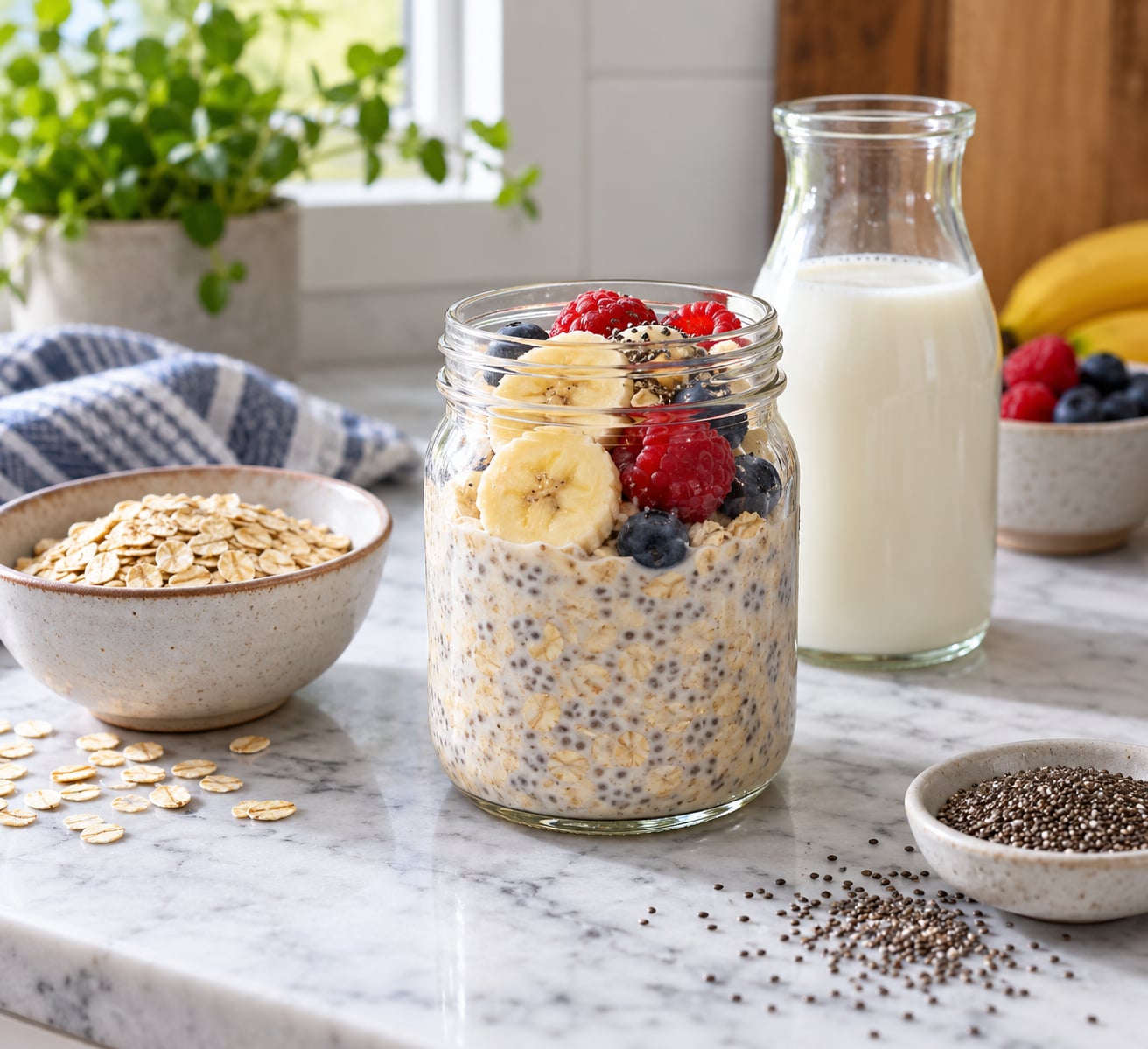
How to make overnight oats in a jar is mostly a ratio problem, and it takes about five minutes of work. Stir 1/2 cup rolled oats with 1/2 to 2/3 cup milk, 1 tablespoon chia seeds and 1 teaspoon of sweetener in a jar, seal it, and leave it in the refrigerator overnight. There is no cooking, and by morning the oats are soft enough to eat cold with a spoon.
Prep time is five minutes, hands-off time is four to eight hours, and one jar is one serving. The whole method below assumes a refrigerator at 40°F (4°C) or colder and a jar with a lid that seals properly.
Table of Contents
- What You Need
- Step-by-Step: How to Make Overnight Oats in a Jar
- Common Mistakes and Easy Fixes
- How Long Do Overnight Oats Keep?
- Frequently Asked Questions
- What is the best ratio of oats to liquid for overnight oats in a jar?
- Do overnight oats need yogurt or chia seeds?
- How long should overnight oats chill before eating?
- Can I use almond milk or another non-dairy liquid?
- How can I make overnight oats thicker or thinner?
- How long do homemade overnight oats last in the refrigerator?
- Conclusion
What You Need
The base formula for overnight oats is short enough to memorize, and every ingredient earns its place:
- 1/2 cup rolled oats (old-fashioned oats), about 40 g — they hold their shape and turn creamy without collapsing into paste.
- 1/2 to 2/3 cup milk, about 4 fl oz — dairy is creamiest, oat milk is the sweetest, and almond or soy milk sit in between.
- 1 tablespoon chia seeds, about 13 g — optional, but they thicken the mixture and add a slight gel texture.
- 1 teaspoon maple syrup, honey or agave nectar — a starting point; frozen fruit adds more sweetness on its own.
- 2 tablespoons plain Greek yogurt — optional, and it pushes the protein up and softens the texture.
- Pinch of salt — a small amount sharpens everything else and costs nothing.
The oats-to-liquid ratio matters more than anything else here. Most people who end up with soup are pouring roughly two parts liquid to one part oats, which is why the table below separates the oat types by how much they drink.
| Oat type | Oats to liquid | Soak time | Result |
|---|---|---|---|
| Rolled or old-fashioned | 1:1 to 1:1.25 | 4 to 8 hours | Creamy, keeps some texture |
| Quick oats | 1:1 | 2 to 4 hours | Softer, can turn pasty |
| Instant oats | 1:1 | 20 to 30 minutes | Very soft, almost pudding-like |
| Steel-cut oats | 1:1.5 | 24 hours | Nutty and chewy, never creamy |
For the base recipe, 1/2 cup oats (40 g) wants 1/2 cup (4 fl oz) of milk and becomes loose with 2/3 cup. If you like breakfast closer to pudding than to porridge, add a second tablespoon of chia or a couple more spoonfuls of oats rather than cutting the liquid.
Jars: any clean glass container with a screw-on or snap lid works, from a 8 oz jar to a 16 oz jar. A mason jar is convenient because the wide mouth takes a spoon, but it is not required. Leave a couple of inches of headspace, because oats and chia swell as they soak and a jar filled to the brim is hard to stir and can leak when you shake it.
Optional add-ins: a spoonful of nut butter smeared on the inside of the jar for richness, 1 teaspoon of cocoa powder, cinnamon, grated apple, a pinch of vanilla extract, or 2 tablespoons of shredded coconut. A spoonful of protein powder works too, mixed with a little liquid first so it does not clump.
For a five-jar Sunday prep: combine 2 1/2 cups rolled oats, 2 1/2 cups milk, 5 tablespoons chia seeds, 5 teaspoons maple syrup and a good pinch of salt in a large bowl or pitcher, then divide into five jars. Flavor each one differently, and keep fruit, nuts and granola out until serving time.
Step-by-Step: How to Make Overnight Oats in a Jar
1. Choose Your Jar and Ingredients
Pick a glass jar that holds roughly 1.5 times the volume of your dry oats. That headspace is what makes the difference between a jar you can stir on a chaotic morning and one that has oats welded to the lid. Measure the oats first, then pour the liquid until it sits about a quarter inch above the oat line; the oats expand as they soak.
Warm milk and cold milk both work. Cold is the standard, but a splash of warm liquid helps chia seeds hydrate faster and gives you a loose bowl you can eat after a shorter chill.
2. Mix the Oats and Liquid
Add the liquid to the oats and stir with a spoon, a small whisk or a fork until no dry oats sit on the surface and no chia clumps remain. Some people close the lid and shake the jar for ten seconds instead, which is faster and mixes more evenly, though it foams the mixture a little.
The signal that you are done is texture, not time: the mixture should look like thin cream or milky coffee, not like pancake batter. If it already has the body of yogurt before it chills, add a tablespoon of milk. If it looks like milk with oats floating in it, add a tablespoon of chia or two more spoonfuls of dry oats.
3. Seal and Refrigerate
Screw the lid on firmly, wipe the rim clean and set the jar in the refrigerator on a level shelf, ideally at 40°F (4°C) or below. Four hours is the practical minimum, overnight (six to eight hours) is the sweet spot, and up to 24 hours is fine for rolled oats, especially with steel-cut. Longer soaks with quick or instant oats tend toward paste, which is the usual reason people describe their jars as mushy.
Do not leave dairy-based oats at room temperature for more than two hours, and refrigerate them the same night you make them. That overnight chill is what does the work; a jar that sits on the counter all morning is not overnight oats, it is a warm bowl of wet cereal.
4. Add Toppings and Serve Your Overnight Oats in a Jar
In the morning, open the jar and look at the mixture. Properly made oats hold their shape briefly on a spoon and slump slowly. If the jar has gone stiff overnight, stir in a tablespoon or two of milk and wait a minute; if it is still loose than you like, let it sit out of the fridge for ten minutes or stir in more oats, which absorb without cooking.
Add your toppings now rather than at prep time: sliced banana, berries, a spoonful of peanut or almond butter, granola, chopped nuts, coconut, cocoa, or a drizzle of maple syrup. Fruit added on night one releases juice and softens the oats, and granola and nuts go soggy in the soak. For a hot breakfast, microwave the jar in short bursts or heat a portion in a pan with a splash of milk, since a cold jar straight from the fridge is the point for most people.
People on r/Oatmeal and r/fitmeals say the same thing about toppings: the base gets made ahead, the good stuff waits until the morning. It takes ten seconds and it is the difference between oats that taste like breakfast and oats that taste like a refrigerator.
Common Mistakes and Easy Fixes
How runny should overnight oats be is the question that comes up most, and the answer is a loose porridge that holds its shape for a second on the spoon. If it pours, it is too thin. Here is what goes wrong and how to correct it, whether you are starting over or eating the jar tomorrow.
| Problem | Why it happened | Fix | Too late to change the jar? |
|---|---|---|---|
| Too watery or soupy | Liquid was roughly double the oats, often with no thickener | Next jar: 1/2 cup oats to 1/2 cup liquid, plus 1 tbsp chia | Yes — stir in 1 tbsp chia, extra oats, or a spoonful of Greek yogurt |
| Too thick and gluey by morning | Too much chia, or an overnight plus morning soak | Use 2 tsp chia instead of 1 tbsp next time | Yes — stir in milk a tablespoon at a time |
| Mushy and pasty | Quick or instant oats, or a soak longer than 12 hours | Switch to rolled or old-fashioned oats | Partly — loosen with milk and serve as a porridge rather than a parfait |
| Not sweet enough | Fruit added at prep time has not released its sugar | Sweeten at serving, not before the soak | Yes — maple syrup or honey stirred in at the table |
| Sour or tangy | Too much yogurt, or the jar sat out past two hours | Cut yogurt to 1 tbsp, keep the chill | Discard it if it has been warm for hours |
| Bland | No salt, no vanilla, no spice | Add a pinch of salt, vanilla or cinnamon | Yes — all three work on a finished jar |
What not to add in overnight oats before the fridge:
- Fresh berries, which release juice and water down into the oats.
- Crunchy items such as granola, nuts or seeds, which soften and lose their crunch overnight.
- More liquid than the ratio calls for, in the hope that thick chia will save it. It will not.
- Produce that has not been washed, and dairy that will sit at room temperature longer than two hours.
For sweetness, start with half the sweetener you think you need. Maple syrup tastes mild cold but stronger once the mixture has soaked, and one teaspoon is plenty with banana or berries added later. If you like it genuinely sweet, honey and agave read sweeter than maple at the same volume.
For liquid, oat milk is naturally sweet and softens the oats fastest, dairy is the creamiest because of the fat, and almond or soy milk are the most neutral. Coconut milk works, but it is rich and firm, so use slightly less of it or expect a thicker, almost pudding-like result.
How Long Do Overnight Oats Keep?
Prepared overnight oats keep 4 to 5 days in the refrigerator, covered and stored at 40°F (4°C) or below. A Sunday batch covers Monday through Thursday, which is how most people use them. Past day five, discard the jar, and discard it earlier if it smells sour, if the surface has turned slimy, or if it sat on the counter for more than two hours at any point.
Portioning at prep time rather than scooping from one big bowl is what makes the window predictable: each jar is a separate serving, and a jar you have started to eat from has a shorter clock than one that is still sealed. Keep toppings separate for the same reason, since fresh fruit is usually the first thing to turn.
Freezing works well for the plain base. Freeze jars with a little headspace, leave the lid off or loose until solid, then cap and freeze for up to two months. Thaw in the refrigerator overnight, add toppings after thawing, and expect the texture to be slightly softer than fresh. Do not freeze a jar with banana in it, since thawed banana turns pasty and watery.
Frequently Asked Questions
What is the best ratio of oats to liquid for overnight oats in a jar?
Start with 1:1 by volume: half a cup of rolled oats to half a cup of milk or milk alternative, which is 40 g of oats to 4 fl oz of liquid. Go to 1:1.25 if you like a looser, more traditional porridge, and use 1:1.5 only for steel-cut oats, which need the extra liquid to soften. Too much liquid is the single most common reason a jar turns into soup.
Do overnight oats need yogurt or chia seeds?
No. Both are optional. Chia seeds act as a thickener, so they are what stops a higher liquid ratio from turning soupy, and they add a slight gel texture plus some fiber. Greek yogurt adds protein and richness and softens the mouthfeel, though too much of it can make the jar taste tangy. Rolled oats and milk alone will still work.
How long should overnight oats chill before eating?
Four hours is the practical minimum, and six to eight hours overnight is the sweet spot. Instant oats need only 20 to 30 minutes in the refrigerator, quick oats need two to four hours, and steel-cut oats need a full 24. Rolling past about 12 hours with quick or instant oats is what turns the texture to paste.
Can I use almond milk or another non-dairy liquid?
Yes. Any unsweetened plant milk works: oat milk is the sweetest and softest, almond is neutral, soy has more protein and behaves much like dairy, and coconut is rich and firm enough to thicken a batch on its own. Avoid sweetened varieties unless you plan to cut the added sweetener, and expect non-dairy jars to be slightly looser because there is no dairy fat.
How can I make overnight oats thicker or thinner?
To thicken, reduce the liquid on the next jar, add a tablespoon of chia seeds, stir in an extra two spoonfuls of dry oats, or add a spoonful of Greek yogurt. To thin, stir in cold milk a tablespoon at a time, or let the jar sit at room temperature for ten minutes. Small adjustments are easier than rebuilding the whole jar.
How long do homemade overnight oats last in the refrigerator?
Four to five days, covered, at 40°F (4°C) or below. Portion them into separate jars so each serving is sealed, and hold fruit, nuts and granola back until serving time. Discard a jar after day five, or sooner if it smells sour, looks slimy, or sat at room temperature for more than two hours.
Conclusion
Put 1/2 cup rolled oats in a jar, pour on 1/2 cup milk, add 1 tablespoon chia seeds and 1 teaspoon of sweetener, stir until the chia has no clumps, and seal it. That is the whole method behind overnight oats in a jar, and the chill does the rest. In the morning, loosen with a splash of milk if the jar firmed up overnight, then add fruit, nuts or nut butter right before you eat.
If you like the idea but want a breakfast you can hold in one hand, our guide to building a sandwich that still tastes fresh at lunch follows the same make-ahead logic, and breakfast sandwiches made ahead and frozen cover the freezer side of the same routine.