
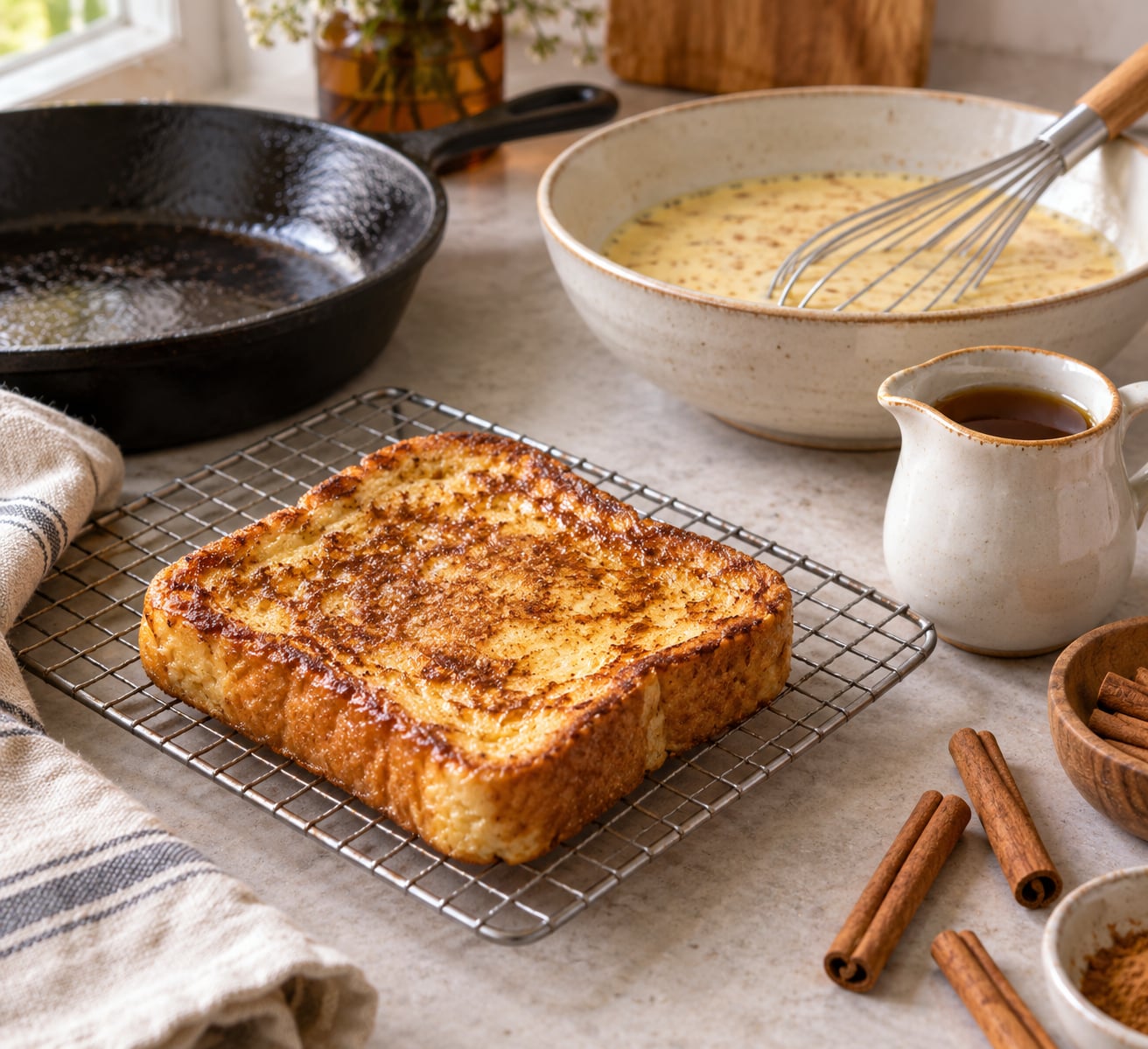
French toast turns soggy when the bread holds more liquid than the egg can set, so the extra moisture steams instead of evaporating. Learning how to make French toast that isn’t soggy is mostly a matter of three decisions: sturdy bread, an egg-heavy custard, and moderate heat. Get those right and the slice browns outside while the middle stays creamy, and it takes about 15 minutes start to finish.
Most soggy French toast I have eaten had one culprit: too much milk. The egg is the structure. Milk is only there to loosen the egg, and once you pour in more than the egg can bind, you have made a batter that leaves water behind in the crumb.
Table of Contents
What You Need to Make French Toast That Isn’t Soggy
The list is short, and only one item is non-negotiable.
- Bread: day-old white bread, brioche, challah, Texas Toast or a Pullman loaf, cut 1/2 to 3/4 inch thick.
- Eggs: 2 whole eggs plus 2 yolks for 4 thick slices.
- Milk or cream: 1 cup, and that is the ceiling, not the target.
- Sugar: 1 tablespoon, plus more to taste.
- Vanilla extract, cinnamon and a pinch of salt: salt is not optional, it sharpens everything around it.
- Butter and a neutral oil: butter for flavor, oil for heat that does not scorch.
- A shallow bowl or sheet pan deep enough to lay slices flat in one layer.
- A whisk or fork, a skillet or griddle, a thin spatula, and a wire rack.
A wire rack is the item people skip, and it is the one that stops a crisp slice from going soft on the plate. A flat sheet of parchment works in a pinch, but air has to move under the toast for it to stay crisp.
Step-by-Step
Step 1: Choose Bread That Can Handle the Custard
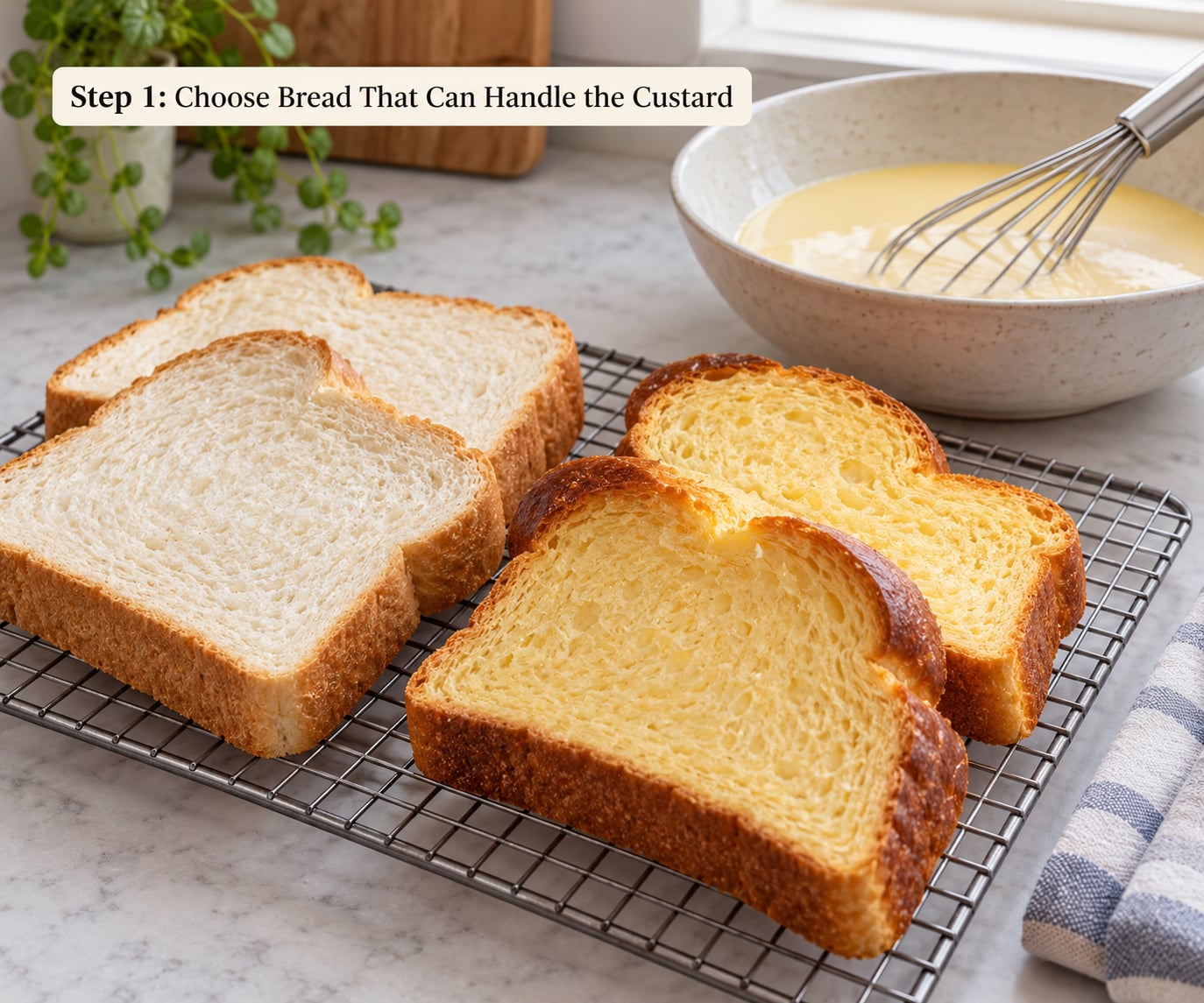
Soft sandwich bread collapses. It drinks the custard faster than it can hold it, tears when you lift it, and arrives in the pan as a saturated slab. Anything with an open crumb, a crust, or a day-old dryness is structurally better.
Thickness sets the soak time. A 1/2 inch slice from a fresh loaf needs 20 to 30 seconds a side. A 3/4 inch slice of Texas Toast needs closer to 2 minutes a side, or it will taste of plain bread in the middle. One and a half inches of brioche or pound cake wants a full soak, which is a different dish.
Pre-toasting is worth knowing about. A slice in the toaster or under the broiler for a minute before it hits the custard forms a crust that resists tearing and soaks less. The trade-off is real: the bread drinks less, so the center is less creamy, and the soak time drops by half.
Step 2: Mix a Thick, Not-Watery Custard
Whisk 2 whole eggs, 2 yolks, 1 cup of milk, 1 tablespoon of sugar, 1 teaspoon of vanilla, a pinch of salt and a dusting of cinnamon until no streaks of white remain. A splash of cream or half-and-half in place of some of the milk gives a richer set without adding more liquid.
Check the thickness before you use it. The mixture should run off a whisk in a slow ribbon and leave a visible coating on the bowl. If it pours like plain milk, it is too thin, and that is the whole problem in liquid form.
Dairy-free milk works, and oat milk behaves about the same as dairy. Thin almond milk is the one to avoid: it carries almost no protein and almost no structure, so the bread has nothing to set around it.
Step 3: Dry the Bread and Control the Soak
Lay the slices in the custard flat, not on top of each other, and flip them with a fork or the flat of a spatula. Never grab them with tongs at the middle, that is where they tear.
When the underside feels heavy and the top still looks pale, lift the slice out and let it drain for 15 to 20 seconds on the rack. Then squeeze it very gently between two fingers. If liquid beads and runs out, it has more custard than it needs, and that surplus is the raw material of a soggy slice.
Run a batch through the same bowl one at a time rather than dumping in eight slices at once. A crowded bowl soaks unevenly, the ones underneath soak twice as long as the ones on top, and by the time you get to the last slice the first one has gone past saturated.
Step 4: Cook It Slowly and Finish It Crisp
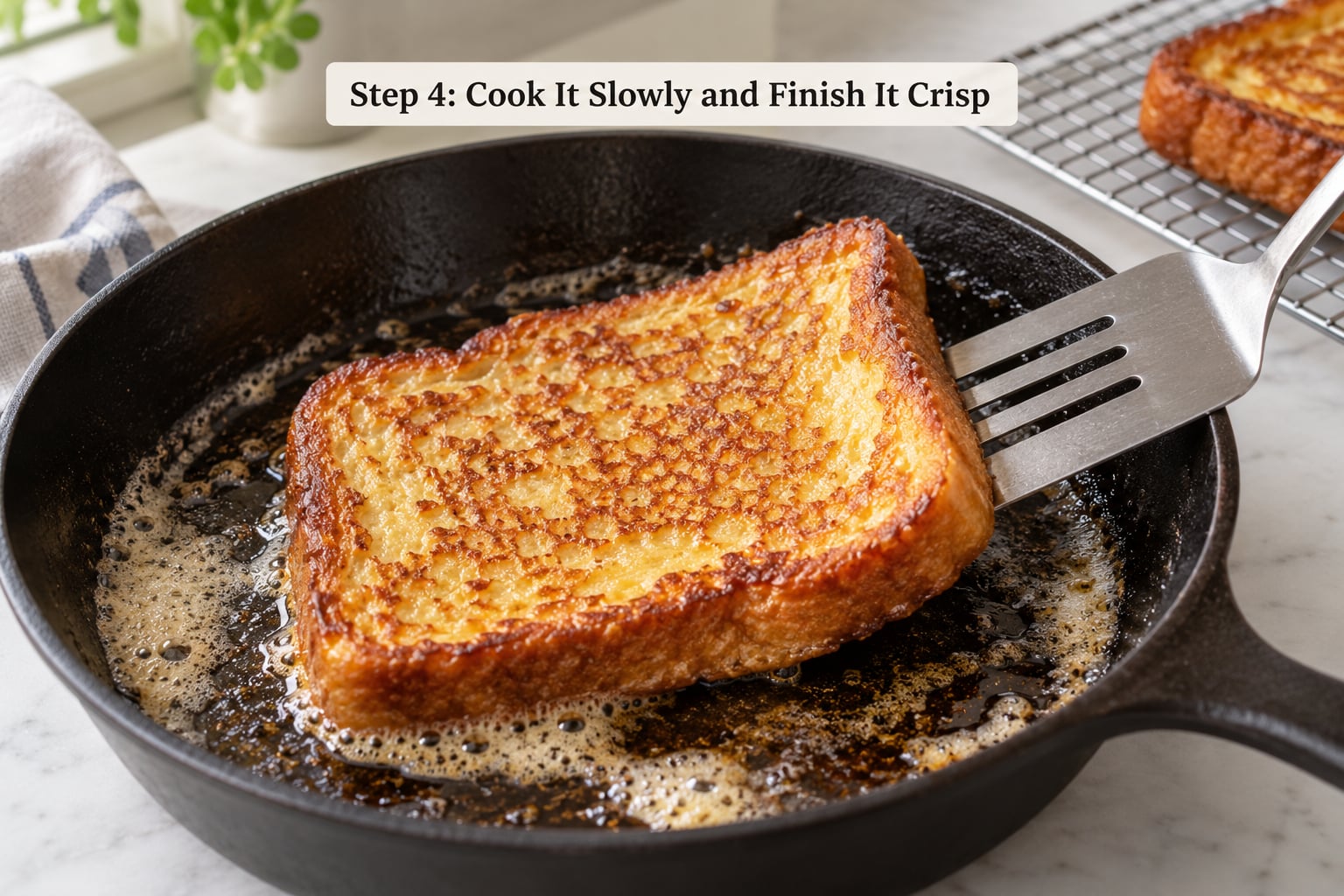
Set a heavy skillet or griddle over medium heat and add a knob of butter plus a slick of neutral oil. The combination matters: butter browns the surface, and the oil keeps the temperature from spiking when the cold custard hits the pan. A dab of the mixture should sizzle the moment it touches the fat. Silence means the pan is too cool, and a whisper means it is too hot.
Cook one slice at a time if you can. Two slices touching means steam gets trapped between them, and the underside steams instead of browning. Give each side 2 to 3 minutes on a half inch slice, longer for something thick, and look for an even golden brown rather than a dark patch.
Flip with a thin spatula, working from the edge inward. A sturdy pan and a confident hand matter more than technique here, because a soaked slice tears when you hesitate.
For thick cuts, finish in the oven. Move the browned slices to a parchment-lined sheet pan and bake at 350°F for 10 to 12 minutes. The gentle heat sets the center without scorching the crust, which is also the fastest route to feeding a crowd of six without stovetop batches going soggy as the pan cools.
Hold finished slices on the wire rack, never on a plate. A warm 300°F oven with the rack set to the middle keeps everything crisp for about 30 minutes. Loosely tented foil traps condensation, and that condensation is what turns a batch limp before anyone sits down.
Air Fryer, Casserole and Cornstarch
An air fryer at 375°F cooks a soaked slice in roughly 8 minutes, sprayed with a little oil, with the rack preheated for 3 minutes first. Space the slices apart or you will get the same trapped steam you get in a crowded pan.
For a bread-pudding style bake, the moisture logic reverses. There you want the custard to soak in over hours, and the fix for sogginess is a 300°F oven rather than 350, plus a crumb topping. That is a different dish, cooked on a different principle.
A teaspoon of cornstarch whisked into the custard dries the surface and crisps it further. It is an addition, not a fix, and it does nothing for bread that was already saturated before it hit the pan.
Common Mistakes
Almost every soggy slice traces back to one of these, and each has a straight correction.
- Soft fresh bread. It has no crust or open crumb to hold liquid. Switch to day-old bread, a loaf that has sat out overnight, or a naturally dense slice like brioche or challah.
- Too much milk in the batter. This is the number one error. Cut it back, add an extra yolk, and the slice will set instead of steam.
- Soaking past saturation. Two minutes per side is right for thick, dry bread and ruinous for fresh sandwich bread. Drain longer and squeeze before you cook.
- A crowded pan or bowl. Touching slices trap steam and soak unevenly. One layer at a time, every time.
- Heat that is too high. A screaming pan browns the outside before the inside sets, and you get the burnt-outside, wet-middle result people complain about most.
- Stacking finished slices. The bottom slice steams the one above it. A single layer on a rack is the whole fix.
- Holding under foil or in a sealed container. Trapped moisture has nowhere to go. Rack, or a low oven, never a pile.
The flip side of soggy is dry, tough, eggy toast, and that comes from a short soak on thick bread rather than a wet one. Pull a slice at 30 seconds and taste the cut edge; if the center is pale and bready rather than creamy, it needs longer in the custard, not more milk.
Frequently Asked Questions
What type of bread is best for French toast that won’t get soggy?
Day-old white bread, brioche, challah, Texas Toast and Pullman loaves all work because their open crumb and firm crust hold liquid without collapsing. Fresh soft sandwich bread is the one to avoid. Slice it 1/2 to 3/4 inch thick; thicker cuts need a longer soak, thinner cuts go soggy faster.
How long should I soak French toast before cooking?
It depends entirely on the bread. A 1/2 inch slice of fresh loaf needs 20 to 30 seconds a side, while a 3/4 inch slice of Texas Toast or day-old bread needs up to 2 minutes a side. The cues matter more than the clock: the surface should look wet all the way through and the slice should feel heavy, but no custard should be dripping off it.
Why is my French toast soggy in the middle?
A wet center means the custard went in deeper than the egg could set, and the excess water steamed inside the slice. Check three things in order. Your milk-to-egg ratio (2 eggs plus 2 yolks to 1 cup of milk), your soak time on thick bread, and your pan temperature, since a too-hot pan browns the crust before the middle cooks. A squeeze test before the pan tells you if the slice is already over-soaked.
Should I let French toast sit before cooking it?
Yes, but only long enough to drain. Let each slice sit on a wire rack for 15 to 20 seconds after it leaves the custard so surplus liquid falls away instead of finishing the soak in the pan. A longer rest of several minutes is helpful when you are cooking a whole batch, because it keeps the early slices from sitting on the heat while the later ones soak.
Can I make French toast ahead and reheat it without getting soggy?
Yes, if you keep the pieces separate and re-crisp them. Cook the slices fully, lay them on a rack, and refrigerate them uncovered or in a single layer so steam can escape. Reheat in a 350°F oven for 8 to 10 minutes or in an air fryer at 375°F for 4 minutes. A microwave softens the crust and reheats the moisture, which is the opposite of what you want.
Conclusion
Three things decide whether French toast comes out crisp: sturdy bread that can hold liquid, an egg-heavy custard you drain properly, and medium heat that browns the outside before the inside overcooks. Start with the plain version, cook one slice and taste it, then add sugar, toppings or sauces. A pile of whipped cream on a wet slice is still a wet slice, and it hides the problem instead of fixing it.
Running a whole batch at once is where moisture problems hide, so it helps to know how to build food that still tastes good at lunch. The same traps show up with tomatoes that make a sandwich soggy and with the best spreads to keep bread from getting soggy. Once you know what pulls water out of bread, you can spot it in any meal.