
Most people planning a food truck assume the number that matters is the sticker price of the truck. It isn’t. Realistically, how much does it cost to start a food truck? Plan on roughly $75,000 to $250,000 or more for a standard operation in 2026, with a lean used-truck build landing closer to $30,000 and a new custom build pushing well past $200,000.
The vehicle is usually only a third of it. The rest is the kitchen build-out, permits, insurance, opening inventory, and enough cash in the bank to survive the months before you turn a profit. Every figure below is a typical US range — real fees shift by region and change over time, so treat these as planning bands, not quotes.
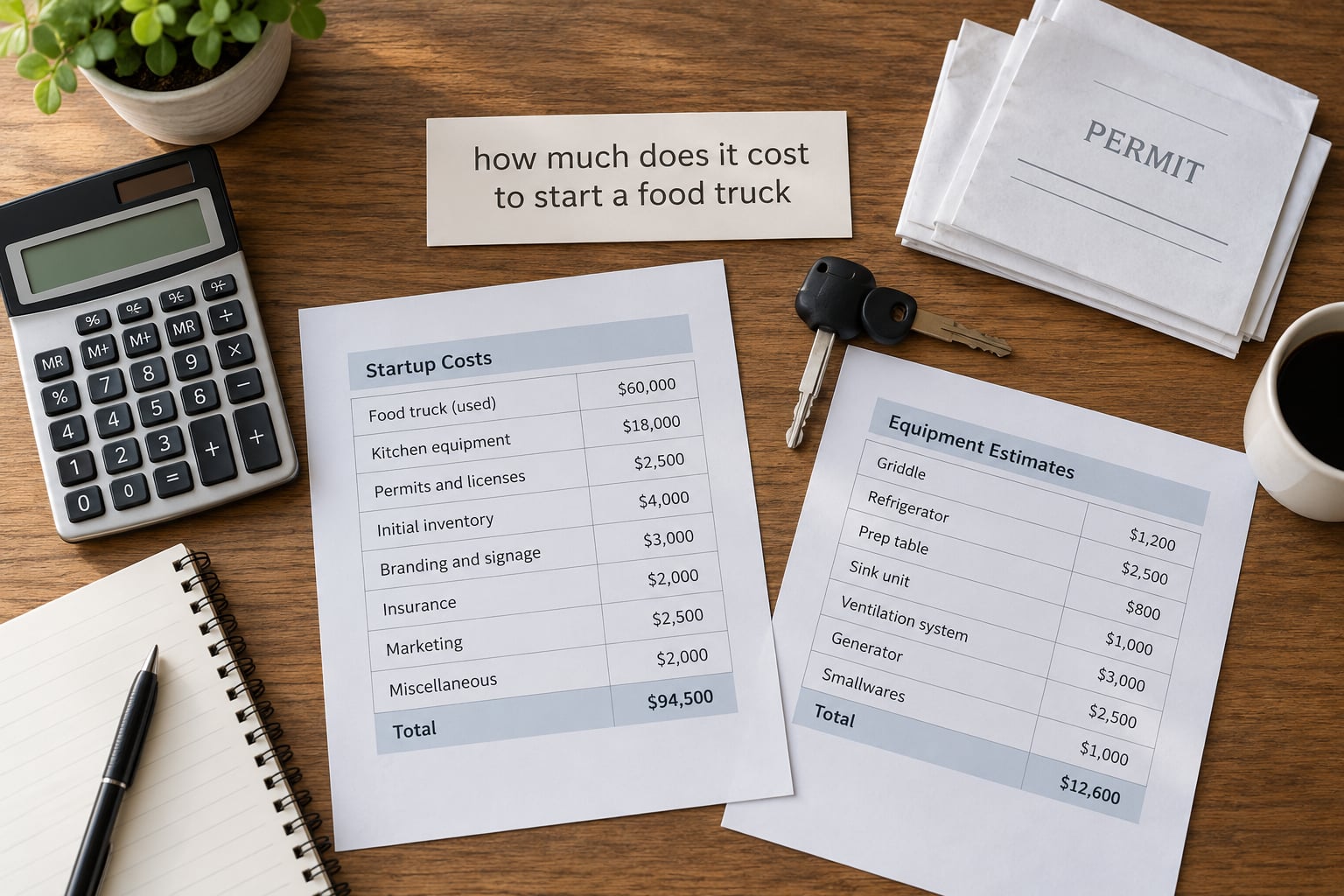
Table of Contents
How Much Does It Cost to Start a Food Truck? Startup Costs at a Glance
Three formats fall under the “food truck” label, and the format choice moves the total more than anything else you decide later.
| Format | Typical startup range | What it handles well |
|---|---|---|
| Food cart | $9,000 to $30,000 | Low food cost, quick permits, festivals and markets. No propane, no plumbing hookups, usually a limited menu. |
| Concession trailer | $25,000 to $85,000 | Full hot food capability with a towed unit. Needs a vehicle rated to pull it and somewhere legal to park overnight. |
| Food truck | $71,000 to $250,000+ | Self-contained kitchen, service volume, catering and evening brewery work. Highest cost and highest ceiling. |
Once you’ve picked a format, the money breaks into seven buckets. Here’s how much does it cost to start a food truck beyond the vehicle, by category:
| Category | Low | Typical | High |
|---|---|---|---|
| Vehicle and conversion | $30,000 | $90,000 | $175,000 |
| Kitchen equipment | $12,000 | $35,000 | $90,000 |
| Permits, licenses and fees | $1,500 | $5,000 | $20,000+ |
| Insurance (first year) | $3,600 | $6,500 | $12,000+ |
| Opening inventory and smallwares | $2,500 | $6,000 | $15,000 |
| Branding, POS and technology | $1,500 | $8,000 | $25,000 |
| Working capital reserve | $9,000 | $25,000 | $60,000 |
| Total | $60,000 | $175,000 | $400,000+ |
Working capital is the row first-timers leave out, and it’s the row that decides whether the business survives. Fixed bills — commissary space, parking, insurance, phone, payment processing — start the week you open, whether or not you sold a single sandwich. Budget three to six months of them.
Food Truck Vehicle and Build-Out Costs
A new custom build runs roughly $100,000 to $200,000 on the chassis alone before a single appliance goes in. Turn-key builders quote all-in packages in that same band, and the spread comes from box length, kitchen complexity and how much of the work you do yourself.
A used box truck or cargo van changes the math. Owners in r/foodtrucks report buying a used Chevy for about $20,000 and putting another $15,000 into finishing it, landing near $35,000 total instead of an $80,000 turn-key quote. The catch is time — the same owners describe a self-refurbishment that took close to seven months to bring the truck up to code.
What the build-out actually includes
- Hood ventilation: $3,000 to $12,000 depending on hood type and duct length. Health departments inspect this closely.
- Fire suppression system: $1,200 to $3,500, and required wherever grease and fryer oil are used.
- Plumbing, potable and grey water: $2,000 to $8,000 for fresh water tank, waste tank, hand-washing station and sink.
- Electrical and shore power hookup: $2,500 to $9,000 to run a dedicated load safely.
- Generator or battery bank: $3,000 to $10,000. Diesel gensets run quieter and longer than most inverters.
- Refrigeration: $2,500 to $9,000 for under-counter units plus a freezer.
- Propane system: $1,500 to $5,000 installed with tanks.
- Flooring, walls and service window: $4,000 to $15,000. Non-slip flooring is a code item, not a style choice.
Plan review happens before any of this work starts. Most jurisdictions want drawings and equipment specs up front, and a rejected plan means paying twice for the same sheet metal.
Kitchen Equipment and Initial Inventory Costs
Equipment is where a tight menu pays off. Every cooking line you add costs three times over: the appliance, the ventilation to match it, and the service counter space it eats.
What basic kitchen equipment does a food truck need?
- Cooking: flat-top griddle $800 to $2,500, commercial range $1,000 to $3,500, deep fryer $600 to $2,000, convection oven $1,200 to $3,500
- Holding and storage: hot holding cabinet $400 to $1,200, prep table $500 to $1,500, under-counter refrigerator $1,200 to $2,800, freezer $900 to $2,500
- Sanitation: hand-washing sink $300 to $900, three-compartment sink $800 to $2,000, sanitation supplies and test kits
- Service: ice machine $900 to $2,500, beverage dispenser, napkins, lids, to-go containers
- Safety gear: fire extinguisher, first aid kit, floor grease absorbent
Add smallwares — pans, knives, cutting boards, thermometers, storage bins — and a realistic kitchen equipment line lands between $12,000 for a simple menu and $90,000 for a truck running several cooking stations.
How much should you budget for opening inventory?
Set aside $2,500 to $15,000 for food and beverage on day one. That covers dry goods, proteins, produce, sauces, oil and the first round of disposables, plus enough depth on your two or three signature items that you never run out during a Friday rush.
If you serve lunch crowds in an office district, the same planning math shows up in our guide to how much food to order for an office lunch — headcount drives quantity, and the same logic applies to a fixed lunch location.
Food safety is not optional. Cook poultry to 165°F, ground meat to 160°F, and whole cuts and fish to 145°F, then hold and log temperatures the way your local health department expects.
Permits, Licenses, Insurance, and Other Fees
This is where the budget surprises people, because most of it is variable and none of it is negotiable. Divide it into two piles: one-time charges before you open, and recurring costs that never go away.
One-time costs
- Business registration and EIN
- Mobile food unit permit and plan review fee
- Food handler certification for you and anyone working the line
- Health department and fire department inspections
- Sales tax permit and resale certificates
- Commercial driver’s license, DOT registration and vehicle registration
- Logo, wrap and signage — one operator reported a wrap quote around $12,000
- POS, payment processing setup and online ordering
Real fee schedules vary widely. Texas, for example, sets mobile food unit tiers at $309 for Type I, $1,018 for Type II and $1,376 for Type III through its health department. A single operator reported spending about $3,000 a year on permits across several jurisdictions, with permits eating 3% to 5% of profit.
Recurring costs
- Commissary kitchen: many jurisdictions require you to prep, store and clean at a licensed shared kitchen. Shared kitchens bill roughly $13 to $24 an hour, which lands around $540 to $950 a month at 40 hours. This is a monthly bill, not a startup fee, and it catches new operators off guard.
- Parking and storage: overnight parking is often the constraint that decides your commissary choice.
- Permit renewals: annual, and per jurisdiction.
- Propane, fuel and maintenance.
Insurance
Four policies cover a food truck: general liability, product liability, commercial auto, and workers’ compensation once you have employees. Budget roughly $300 to $1,000 a month for the package, with a single-owner operation at the low end and a truck with a full staff at the high end.
If a word processor or accountant handles your taxes, this is individual advice territory — check with them about deductions like equipment, mileage and the vehicle itself. Rules differ by state and change often.
What Affects the Price
Two people can fill in the same total and be both right. These are the levers that move the number.
- Vehicle age and condition: a used box truck can hide expensive mechanical or code-compliance problems underneath.
- Menu complexity: fryers and griddles each drag in ventilation, fire suppression and gas lines.
- Service volume: lunch-only needs less refrigeration; evening taproom service needs more holding equipment.
- Local rules: some cities restrict parking, some states require commissary use, some charge by gross receipts.
- Build-out standard: cleanable stainless and NSF-approved surfaces cost more upfront and pass inspection faster.
- Labor availability: skilled conversion shops are booked months out in many regions.
- Financing: borrowed money adds interest and fees to a business that starts without revenue.
- Staffing: solo operation is the cheapest model, and the one most first-years actually run.
Seasonality matters as much as any line item. May through October carries the volume; November through February is slower, and your fixed bills arrive on schedule either way. If your reserve covers only the peak months, winter will take the business apart.
Ways to Save
The cheapest way to start a food truck is not to buy a new truck. It’s to buy the smallest setup that can serve your actual menu.
- Buy a suitable used vehicle and budget a professional inspection before you sign. The $35,000 self-build in the forum research beats an $80,000 turn-key quote, but it took seven months of the owner’s time.
- Phase your equipment. Start with one cooking line and add the second once you know your best sellers. Appliances are the easiest thing to buy month seven instead of month one.
- Keep the menu short. Ten items you can execute fast beat thirty you can’t. Forums are consistent on one point: commodity menus fail, and one signature, visual, shareable item carries the business.
- Compare three quotes on everything, including the wrap and the POS. It’s tedious and it’s the single most reliable saving available.
- Delay non-code spending. Interior styling, decals and a second menu board can wait a year.
- Hold a contingency of at least 20% on top of your line-item total. Plan review rejections, failed first inspections and equipment gaps all come out of that pot.
- Skip financing you don’t need. Interest on a business with no revenue is pure risk. If you must borrow, equipment financing on the appliances alone is usually easier to write than the whole vehicle.
Do the break-even math before you commit. At a $14 average ticket, roughly 21 customers a day covers about $8,800 a month in sales — close to what a two-person operation spends monthly. That is break-even, not profit, and it tells you exactly how many sold lunches you need on a good day. Thinking about fuel and parking for a service fleet? Our piece on best lunches for truck drivers covers the same crew from the driver side.
Frequently Asked Questions
How much money should I save to start a food truck?
Set aside enough to cover every startup line item plus three to six months of fixed bills. For a standard truck, that means roughly $100,000 to $200,000 in accessible cash, not including what you spend on your own draw. A lean cart-based start can be done for $30,000 to $50,000. If your reserve only covers peak-season months, plan for a slow winter from the start.
Is buying a used food truck a good way to lower startup costs?
It is the most common way to cut the largest line item, and owners regularly save $20,000 or more by finishing a used box truck themselves. The risk is hidden damage and code problems that only surface at inspection. Have a mechanic and a mobile food unit inspector look at it before you sign, and factor in seven months of build time rather than seven weeks.
Do I need financing to start a food truck?
Not always. Personal savings and owner contributions get you the cleanest start, with no repayment to make during a slow first season. If you borrow, equipment financing on appliances is usually easier to qualify for than a loan secured on the whole vehicle, and an SBA-backed lender or a community development financial institution may have food truck programs. Borrowing costs money in months you may not have revenue.
What is the difference between food truck startup costs and monthly operating costs?
Startup costs are one-time: vehicle, conversion, equipment, permits, initial inventory, POS and signage. Monthly operating costs are the bills that repeat — commissary kitchen access, parking, insurance, permits renewals, fuel, propane, maintenance, payment processing and food. The startup total is usually three to five times your monthly burn, which is why the reserve matters more than the equipment list.
What should I do before buying a food truck?
Start with the permit conversation, not the shopping. Call your city and state health departments to confirm mobile food unit rules, commissary requirements, parking rules and inspection timing in your exact service area. Then write your menu, cost each item, confirm your break-even number, and only then price vehicles and equipment. Buying first is the most common and most expensive mistake.
Conclusion
How much does it cost to start a food truck? For a standard operation in 2026, a realistic all-in number sits between $75,000 and $250,000, with a lean used-truck build starting near $30,000 and a new custom build running past $200,000.
Before you commit to anything, do these four things in order. Confirm your local permit, commissary and parking requirements. Lock a focused menu and price every item. Get real quotes on the vehicle, the build-out and the kitchen as separate line items. Then reserve at least 20% above your total so the first surprise doesn’t end the project.