
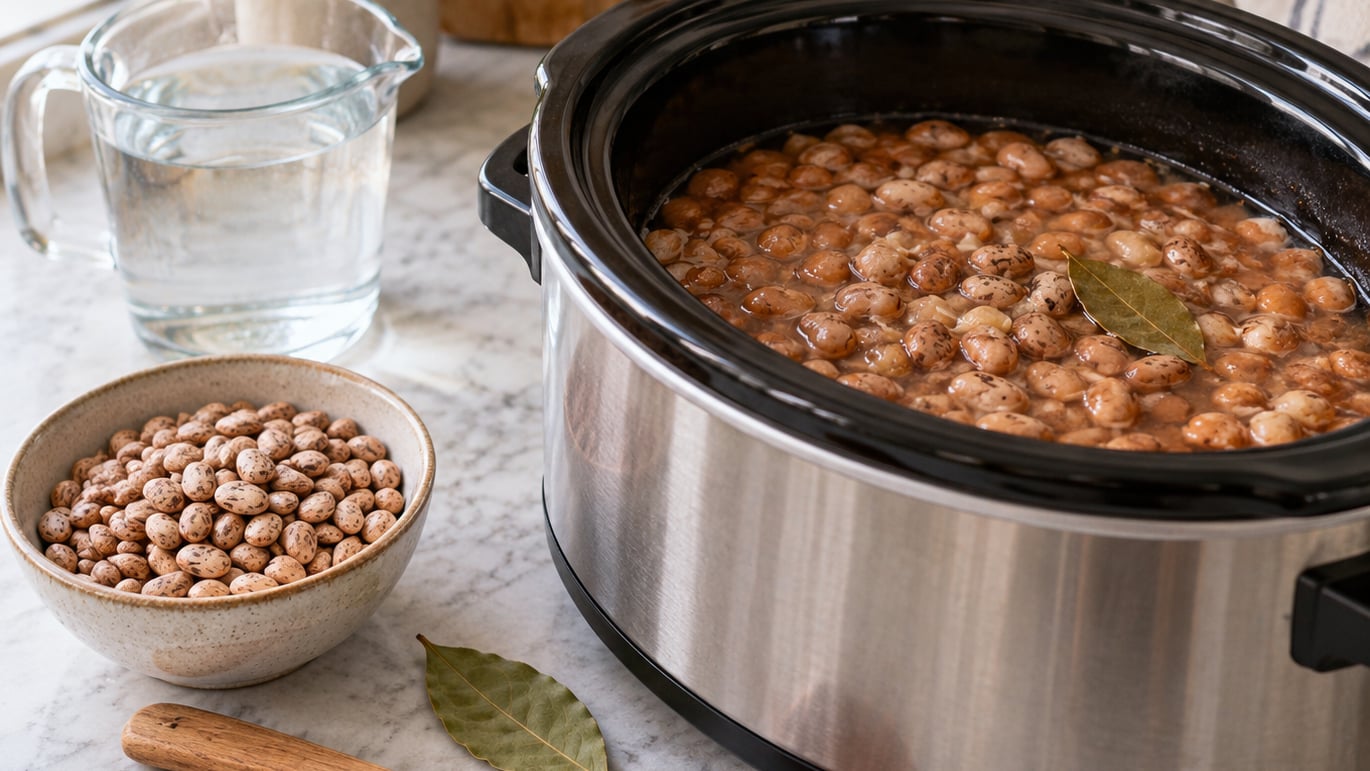
How to cook dried beans in a slow cooker comes down to four numbers: one pound of rinsed beans, 6 to 8 cups of water, high for 5 to 6 hours or low for 8 to 10. Cover the beans by about 2 inches, keep the lid on the whole time, and they turn creamy without any soaking at all.
You set it before breakfast and walk away. Updated for 2026, this is the version I keep coming back to because it has no steps you can get wrong, only quantities you can check.
Table of Contents
- What You Need
- Step-by-Step: How to Cook Dried Beans in a Slow Cooker
- Common Mistakes
- Frequently Asked Questions
- Do dried beans need to be soaked before slow cooking?
- What is the best liquid for slow cooker beans?
- What beans should not be cooked in a slow cooker?
- How much water do I need for a pound of beans in a slow cooker?
- Is it safe to cook dried beans in a crock pot?
- How long do cooked beans keep in the fridge and freezer?
- Conclusion
What You Need
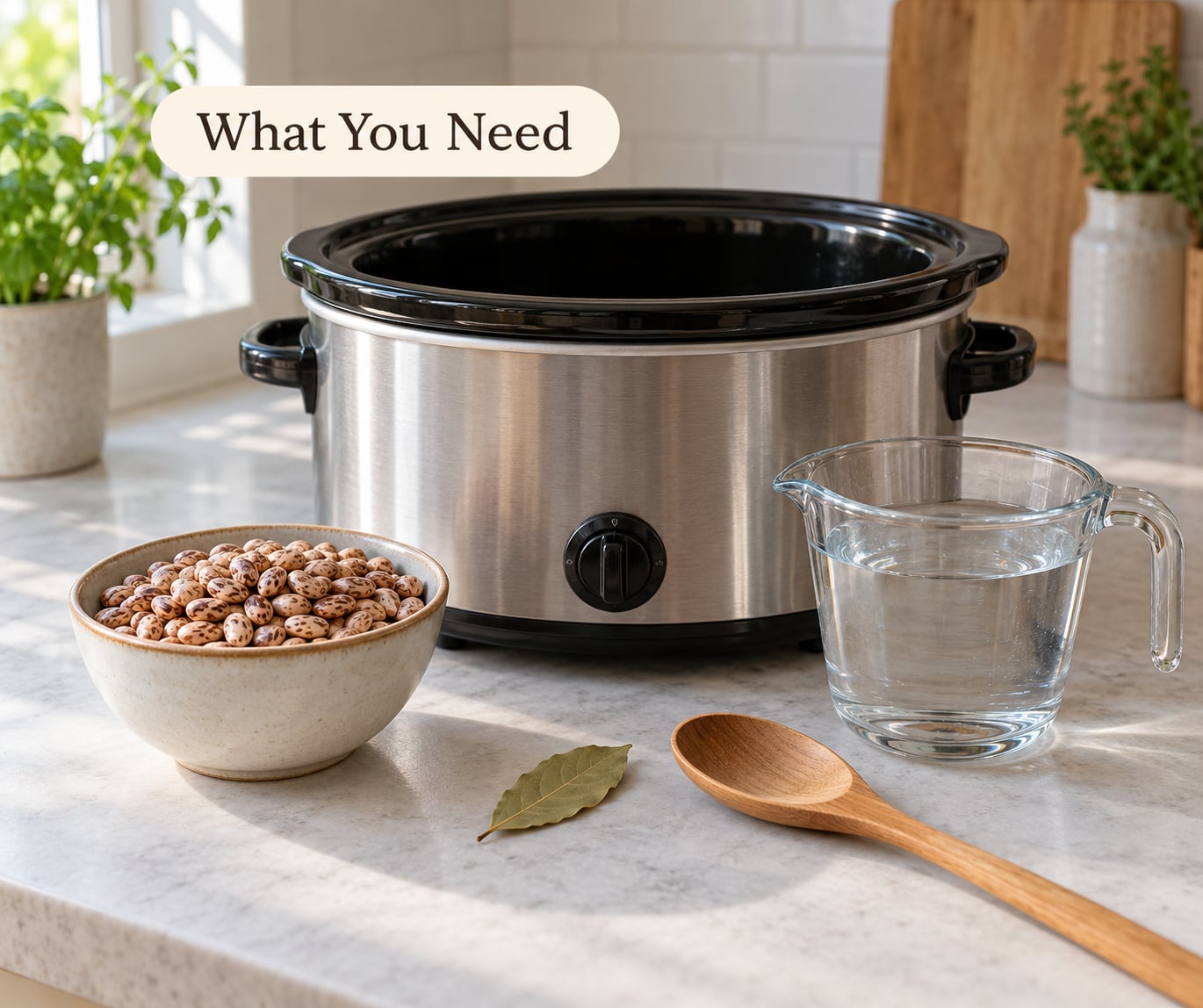
The equipment list is short: a slow cooker, a colander or fine mesh strainer, a wooden spoon, and a jar or container for finished beans. Any slow cooker from 3.5 quarts upward works, since the cooking method is the same at every size.
- 1 pound dried beans for a 3.5 to 4 quart cooker, 2 pounds for a 6 quart
- 6 to 8 cups water or broth, enough to sit 2 inches above the beans
- Salt, about 1 teaspoon per pound
- Aromatics, such as a bay leaf, a halved onion, several smashed garlic cloves, a smoked turkey leg or a ham hock
- Baking soda, optional, 1/4 teaspoon for the whole pound
Cook one variety at a time when you are new to this. Mixed beans finish at different rates, and the smaller ones turn to paste while the larger ones are still firm, which is the single most common complaint I hear about slow cooker beans.
No soaking is required. A slow soak buys you maybe an hour on the slow setting, and the crock pot does that work for free while you are at work.
One safety step before anything else: red kidney beans and cannellini beans must be boiled on the stove first. They carry high levels of phytohaemagglutinin, the kidney bean lectin that a slow cooker does not reliably destroy at its sub-boiling temperatures. Bring them to a full rolling boil for 10 minutes, drain, throw the water away, and only then start the crock pot. FDA and university extension food safety services both publish this guidance, and it applies even if your cooker reaches a bubbling simmer. Every other common bean, including pinto, black, navy, great northern and chickpeas, is fine straight from the bag.
Step-by-Step: How to Cook Dried Beans in a Slow Cooker
Step 1: Sort and Rinse the Beans
Spread the dried beans on a light-colored plate or a baking sheet and pick through them. You are looking for shriveled or broken seeds, small stones, and anything that looks like a bug.
Rinse the beans in a colander under cold running water until the water runs clear. This washes off packing dust and the starch residue from the bag, and it takes about a minute. Give the pot a rinse too if you used it for something savory last time.
Step 2: Add Beans and Liquid
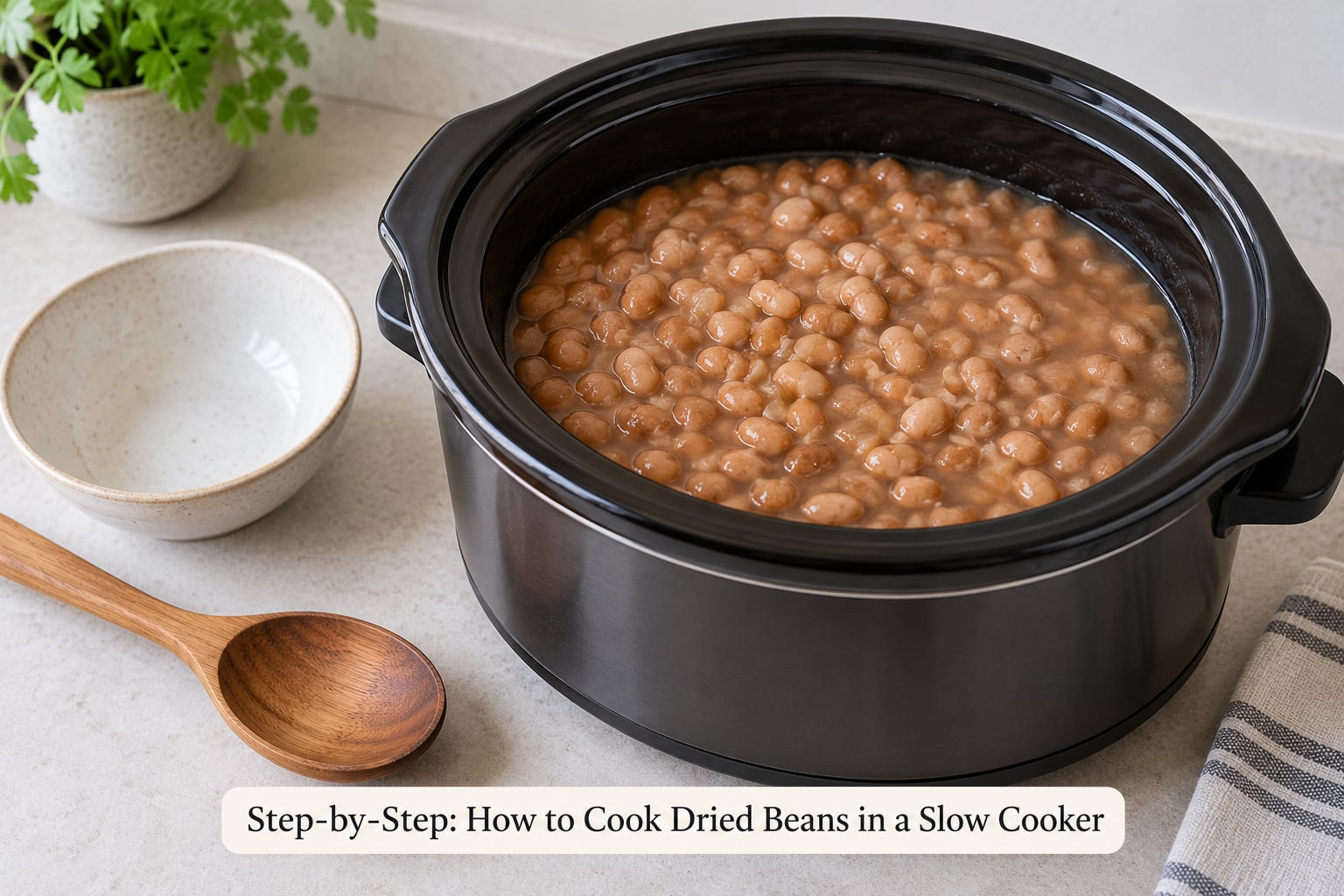
Put the beans in the stoneware, then add 6 to 8 cups of liquid per pound. If you want a number you can scale without guessing, that is roughly 8 cups per pound of water, or 6 cups if you plan to cook them down into a thick stew rather than serve them with liquid.
Check the depth, not just the volume. The liquid should sit about 2 inches above the top of the beans once they have settled, and you should be able to see the beans for most of the cook. Too shallow and they scorch on the stoneware; too deep and the batch takes a second longer than the recipe says.
Add the aromatics now: bay leaf, onion, garlic, and any meat. Hold the salt and the acidic ingredients back until the beans are soft, which is the subject of Step 4.
Do not fill the crock pot more than about two-thirds full. An overstuffed cooker plus the liquid around the beans is how people end up with a pot of thin watery broth instead of beans.
Step 3: How to Cook Dried Beans in a Slow Cooker Until Tender
Put the lid on and set it to high for 5 to 6 hours, or low for 8 to 10. Those ranges assume unsoaked beans in a cooker that actually reaches temperature. Older beans take longer, and a cool cooker takes longer, which is why the honest answer is a range and not a single number.
Start checking early rather than trusting the clock. Use the table below as a starting point for when to take the lid off the first time.
| Bean | Unsoaked, HIGH | Unsoaked, LOW | Soaked, HIGH | Start checking |
|---|---|---|---|---|
| Pinto beans | 2.5 to 3.5 hrs | 5 to 6 hrs | 2 hrs | 2 hrs on high |
| Black beans | 3 to 4 hrs | 6 to 7 hrs | 2.5 hrs | 2.5 hrs on high |
| Navy beans | 3 to 4 hrs | 7 to 8 hrs | 2.5 hrs | 2.5 hrs on high |
| Great northern beans | 3 to 4 hrs | 6 to 7 hrs | 2.5 hrs | 2.5 hrs on high |
| Cannellini and kidney beans | 2 to 3 hrs after the 10 min stove boil | 4 to 5 hrs | 2 hrs | 1.5 hrs on high |
| Chickpeas | 1 to 1.5 hrs | 2 to 3 hrs | 45 min | 45 min on high |
| Lentils | not recommended, use the stovetop | not recommended | n/a | n/a |
To test doneness, scoop out three beans of different sizes and press each one between your thumb and forefinger. Tender beans crush with almost no resistance and the skins split. Beans that are done but not overdone still hold shape when you press them, and they break apart when you chew.
Some beans need a nudge. If you have been at them for hours and they are still hard, see the first item under Common Mistakes, because the reason is almost never the cook time.
Step 4: Season and Adjust
Salt the beans when they are soft, not before. Salt added at the start pulls some of that hardening effect, and the beans can end up tough and undersalted at the same time. Scatter about a teaspoon per pound over the top, stir gently, and give it 20 minutes.
Acidic ingredients are the real culprit behind tough skins. Tomatoes, tomato sauce, vinegar, and lemon all slow the softening of the cell walls. Hold them until the beans are tender, then add them with a long simmer afterward.
For thinner beans, lift the lid and cook on high for 20 to 30 minutes so liquid evaporates. For thicker beans, mash a few against the side of the pot and stir them back in. The starch those beans release is what makes the broth cloudy and creamy on its own.
If you like a fuller flavor, add a quarter teaspoon of baking soda at the start of the cook. The mild alkalinity softens skins and shortens cook time by roughly 20 minutes, and it also makes the broth a little thicker. Use that much and no more.
Step 5: Store or Serve
Let the beans cool in the pot with the lid off for about an hour, then move them to shallow containers. Cooked beans keep in the refrigerator for 3 to 4 days, and freezing is the better plan if you batch cook: cool them fully, portion into airtight two-cup containers, and use them within about 3 to 4 months.
Two-cup portions match what most recipes call for, so nothing gets wasted. It also puts the same batch planning behind is it cheaper to cook and slice your own lunch meat, and the logic is the same: cook once on a weekend, pull out what the week needs.
Keep the cooking liquid if you like. That cloudy broth, called pot liquor, is good for soup, for cooking rice, or for loosening thick chili.
Common Mistakes
The beans are still hard after 8 hours. The cause is nearly always bean age, not technique. Beans that have sat for a year or more on a store shelf, or in your pantry, hold their shape no matter how long you cook them, and a sell-by date tells you nothing about quality. Some cooks work around it with a salted brine soak: 1.5 tablespoons of salt in 8 cups of water, overnight, then cook as usual. If your cooker never comes to a simmer on high, switch it to high anyway and give it more time, or finish on the stove.
The liquid is thin and watery. Too much liquid went in, or the cooker was too full to boil properly. Remove the lid and reduce on high for 20 to 30 minutes, or ladle the excess into a saucepan and reduce it separately, then return it. A large cooker also boils less hard than a small one, which is why people who switch from a 6 quart to an 8 quart often get thinner results.
The beans turned to mush. They sat on high far too long after they were done, or the batch was doubled in a small cooker so the center took twice as long. Start checking 30 minutes before the end of the stated range and pull them when the squeeze test passes.
The pot boiled over and foamed everywhere. Beans release starch as they cook, and the froth rises fast in a deep cooker. Use a larger cooker rather than filling one more than two-thirds full, and stir the surface down once during the first hour.
They taste salty. Seasoning went in early and the water ratio was low. Next time, use 7 to 8 cups of unsalted liquid per pound, season at the end, and taste before adding more salt rather than after.
The skins stay tough while the insides are soft. Acid was added before the beans softened. Hold vinegar, tomatoes, and citrus back until the tender test passes. Older beans are also slower, which is the other half of this problem.
Frequently Asked Questions
Do dried beans need to be soaked before slow cooking?
No, and in a crock pot it rarely matters. A long soak rehydrates beans and reduces cooking time, but 8 to 10 hours on low already does that work. Expect unsoaked beans to need about an hour more than soaked ones. Skip the soak if you are short on planning time, and consider it if your beans are old.
What is the best liquid for slow cooker beans?
Water gives you the cleanest bean flavor and the most control over seasoning. Vegetable or chicken broth adds body and is the easiest upgrade for a first batch. A cup of coffee deepens the color and adds an earthy note, and a dark beer works well with beans served alongside richer meals. Save all of it: never pour off the cooking liquid if you want thick, creamy beans.
What beans should not be cooked in a slow cooker?
Red kidney beans and cannellini beans need 10 minutes at a full rolling boil on the stove, drained and discarded, before they can go near a slow cooker. Lentils and split peas break down into paste over a long cook, and green beans are not a dried bean worth slow cooking. Soybeans take far longer, often well past ten hours, and are rarely done on a home schedule.
How much water do I need for a pound of beans in a slow cooker?
Use 6 to 8 cups per pound of dried beans, and check the result instead of trusting the number alone. The liquid should sit about 2 inches above the beans after they settle in the pot. Add a cup more if you plan to cook the beans down into a thick soup or chili, and less if you want the finished texture to hold up on a plate.
Is it safe to cook dried beans in a crock pot?
Yes for every bean except red kidney and cannellini. Those two are high in phytohaemagglutinin, a lectin that a slow cooker at simmering temperatures does not reliably destroy, and FDA and university extension food safety guidance both call for a 10 minute rolling boil on the stove with the water discarded afterward. For everything else, a covered crock pot at a steady simmer for many hours is a safe way to cook beans.
How long do cooked beans keep in the fridge and freezer?
Refrigerated cooked beans keep for 3 to 4 days in a sealed container, which is the USDA guidance, and freezing stretches that to about 3 to 4 months. Cool them fully before you package them, press out the air, and freeze in two-cup portions so each container matches one recipe. Thaw overnight in the fridge rather than on the counter.
Conclusion
Start by sorting and rinsing the beans and putting them straight into the crock pot, no soaking required. Give it 6 to 8 cups of liquid per pound so the beans sit under 2 inches of water, then check the liquid level and the bean texture every 30 minutes near the end of the cook.
Season only once the beans are soft, and hold tomatoes and vinegar back until the tender test passes. One red kidney bean batch on the stove first, and everything else is time you can stop watching.