
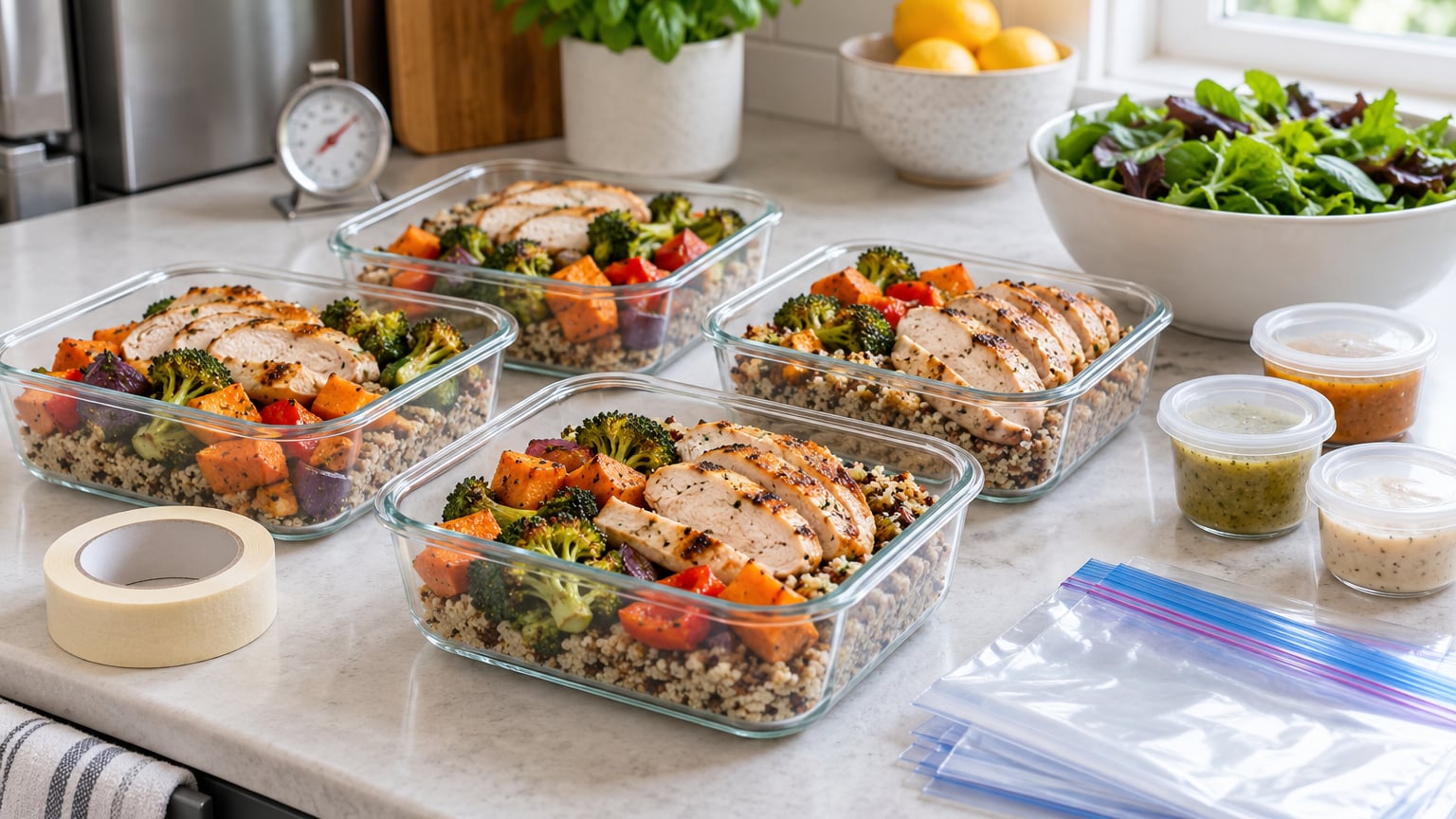
To keep meal prep fresh all week, refrigerate airtight, shallow containers for the first 3 to 4 days, then freeze the remaining portions and thaw them overnight in the fridge. USDA and FDA guidance treats most cooked food as safe for 3 to 4 days at 40°F or below, so days 4 through 7 have to come out of the freezer, not the fridge.
Here is the part nobody tells you. Safety and flavor run on different clocks. A container of chicken and rice is still safe on day 4 if you handled it correctly, and it also tastes noticeably flatter than it did on Sunday. The safety limit is hard. The flavor limit is soft, and it arrives much earlier.
So this guide splits the week in two: fridge for days 1 through 3, freezer for days 4 through 7. The whole system takes about 90 minutes on a Sunday afternoon, plus two minutes each night to move the next portion from freezer to fridge.
Table of Contents
- What You Need
- Step-by-Step
- Common Mistakes
- Frequently Asked Questions
- How long does meal prep last in the refrigerator?
- Can I meal prep on Sunday and eat all week?
- What temperature should my refrigerator be for meal prep?
- Which foods should I freeze for days four through seven?
- How do I keep salad and sandwiches from getting soggy?
- Is it safe to reheat meal prep once or more than once?
- Conclusion
What You Need
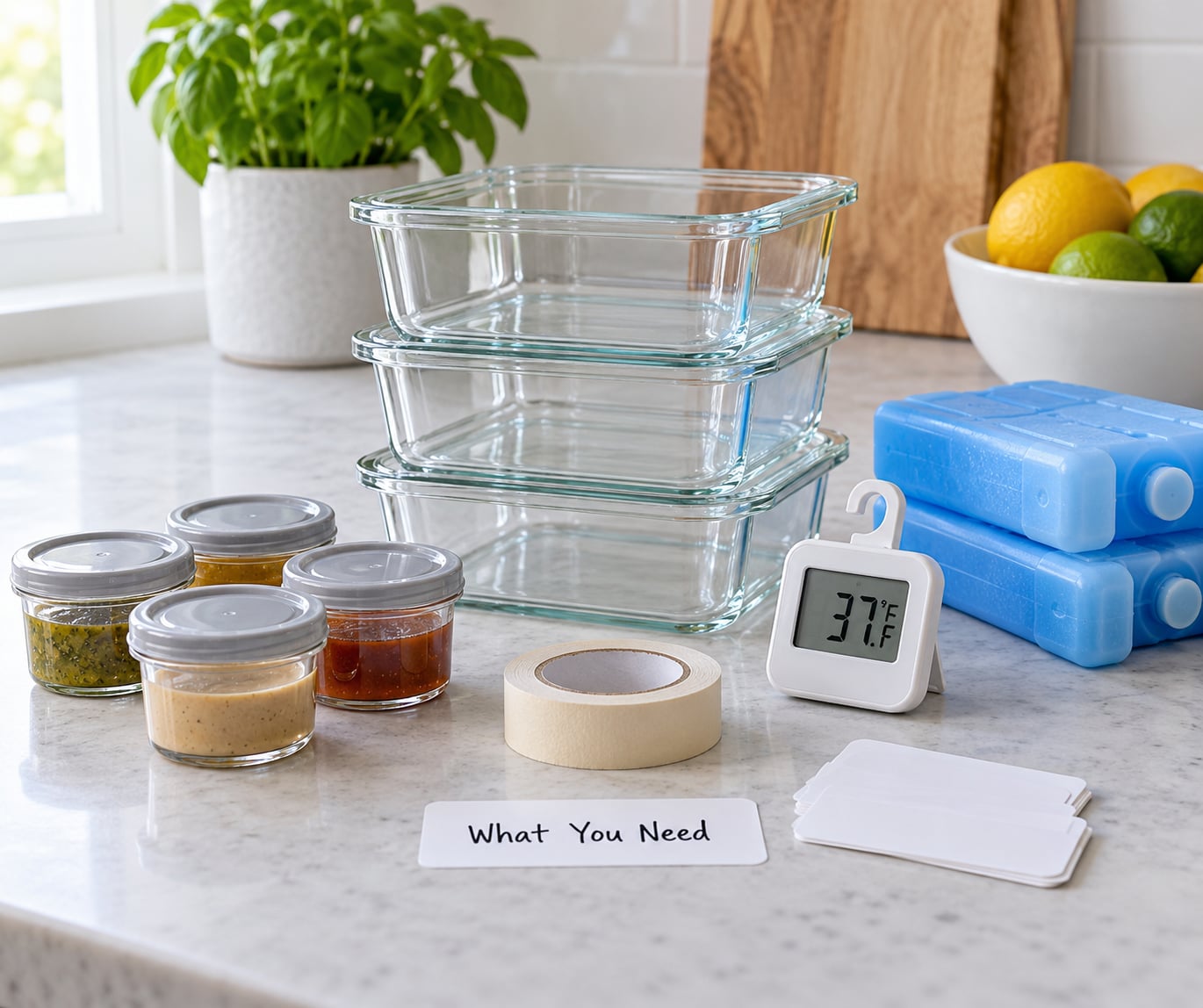
Shallow airtight containers. Depth is the enemy here, because heat has to escape a container before it can cool safely. A 2-inch-deep glass dish cools roughly three times faster than a 4-inch-deep bowl holding the same chicken and rice, and it stacks better in the fridge. Glass also refuses to stain and holds no odors, which is why it is my default for grains and sauces. If you buy only one thing, buy four shallow glass containers with locking lids. Our roundup of meal prep containers that do not leak covers the plastic and silicone options in more detail.
A refrigerator thermometer. Most fridges read warm near the door and cold at the back wall. A cheap stick thermometer in the middle shelf tells you what your food actually experiences, and it takes the guessing out of whether that container is safe on Thursday.
Reusable ice packs. If your lunch box sits in a warm car or a non-climate-controlled office, frozen gel packs are the difference between safe and risky by 2 o’clock. They are also the cheapest fix for the “my food tasted lukewarm” complaint.
Masking tape and a marker, or a stack of label stickers. Every container gets a dish name and a made-on date. This is not fussiness; it is the FIFO rotation system that keeps you from finding a forgotten tub at the back of the fridge after it has turned.
Freezer-safe bags or containers for the back half of the week. Heavy-duty zip bags laid flat in the freezer work well and stack like books. Rigid freezer containers cost more room but protect shapes better.
Small separate containers for wet ingredients. Two-ounce silicone cups or a tiny jar with a lid hold dressing, salsa, and marinated beans so they never touch the dry food.
Step-by-Step
- Choose the right containers. Shallow, airtight, and no deeper than 3 inches for anything that is still warm. Match lids to bases and discard any lid that no longer clicks shut.
- Cook and cool fast. Spread cooked food in a single layer on a baking sheet, or divide a big pot of chili into small containers. Get it from the heat into the fridge within 2 hours, and within 1 hour if your kitchen is above 90°F.
- Portion the week in two halves. Fill three to four containers for Monday through Wednesday. Put everything meant for Thursday and Friday straight into freezer-safe bags or containers, still warm, and freeze them as soon as they are cool enough.
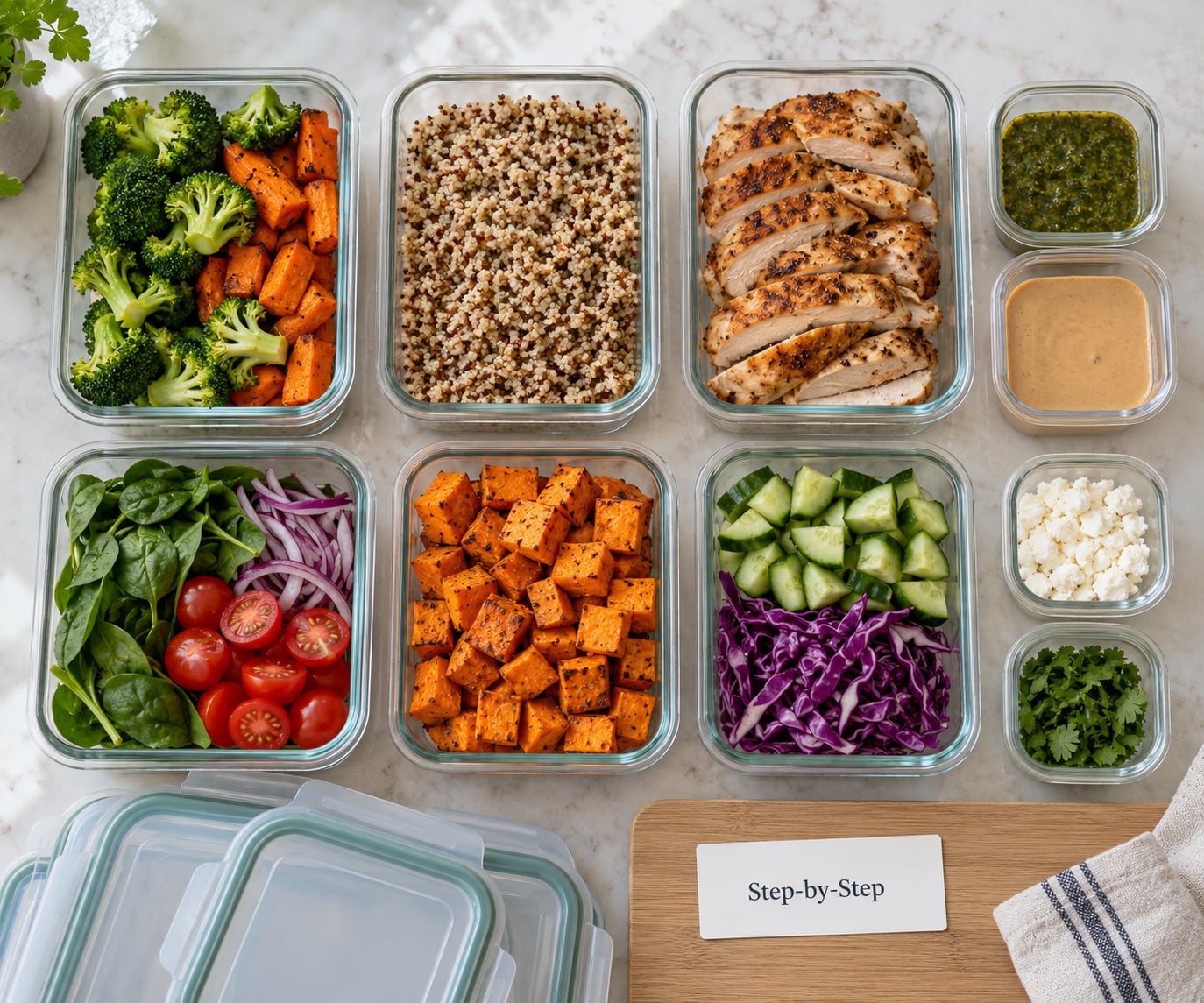
- Store each component separately. Keep grains, protein, and vegetables in their own compartment. Dressings and sauces go in their own small cups. This one habit fixes more soggy lunches than anything else you can buy.
- Label and rotate. Write the dish and the date on the lid. Put Monday’s meals at the front of the shelf and Friday’s at the back, oldest to newest, so you grab the right one without thinking.
- Hold the fridge at or below 40°F and leave room for air. Do not pack the shelf solid. Air circulates between containers and keeps everything cold rather than just the outside of the pile.
How do you know each step worked? The food goes from steaming to fridge-temperature inside two hours, the sealed lid stays taut with no fogging when you open it the next morning, and the frozen portions come out of the bag as solid blocks that slide into a lunchbox intact.
How Long Does Meal Prep Stay Fresh?
Most cooked food, including poultry, ground meat, fish, rice, pasta, and prepared sandwiches, generally stays safe for 3 to 4 days in the refrigerator when kept at 40°F or below. That is the USDA and FDA number, not a conservative guess.
Seafood and shellfish are the shortest window at 1 to 2 days for best quality. Leafy salads are the same: eat them in the first two days if you want them crisp, freeze them if you need them later. Cooked grains hold their texture for about 3 to 4 days refrigerated and freeze well, which makes rice and pasta the easiest thing to plan a whole week around.
| Food type | Fridge days | Freezer months | Best container |
|---|---|---|---|
| Cooked poultry and ground meat | 3-4 | 3-4 | Shallow airtight glass |
| Cooked fish and shellfish | 1-2 | 2-3 | Shallow airtight glass |
| Rice, pasta, quinoa, couscous | 3-4 | 3-4 | Divided airtight container |
| Roasted or steamed vegetables | 3-4 | 2-3 | Airtight with a vent for the first hour |
| Leafy salads and cut fruit | 1-2 | Not recommended | Separate container, paper towel layer |
| Soups, stews, curries | 3-4 | 2-3 | Individual portions |
| Sauces and dressings | 3-4 | 3 | Two-ounce cups or ice cube trays |
| Assembled sandwiches and wraps | 3-4 | 2-3 | Stacked with parchment between layers |
Everything in that table that says 4 months in the freezer is safe well past that mark. Frozen food does not grow bacteria at 0°F. The four-month number is about quality: texture, flavor, and moisture, not safety.
How Should You Store Different Meal-Prep Foods?
Proteins. Cut chicken and sliced deli meat belong in a sealed container, not wrapped loosely in foil, and they go to the back of the shelf where the cold is most reliable. If your chicken turns dry, the fix is not to undercook it. Cook poultry to 165°F, then brine it before cooking or add a splash of stock when reheating. Ground meat goes to 160°F, and whole cuts and fish to 145°F.
Grains. Spread rice on a tray to steam-dry for a few minutes before it goes in, or it clumps into a solid block by Tuesday. A fork through the cooled rice breaks up the clumps. Keep grains in their own container so they never sit under a wet topping.
Vegetables. Roasted vegetables hold up well in an airtight container. Raw greens do not, which is why salads get a paper towel layer and their own box. If you are freezing vegetables, blanch them in boiling water for two to three minutes, cool them in ice water, drain well, and freeze. Skipping the blanch costs you color and texture.
Sauces. Dressing in a small lidded cup, salsa in a separate container, honey and mustard in their own jar. Nothing wet goes directly onto rice or bread.
Salads. Dry the greens thoroughly before they go in the box, line the bottom with a paper towel, and put protein and dressing on top only if you plan to eat it today. Otherwise, pack them apart, with a sturdy leaf between the greens and the protein if you have to stack them. Our guide to meal prepping sandwiches for the week covers the barrier trick in more detail.
Sandwiches and wraps. Build with a sturdy lettuce leaf or a spread of mustard as the moisture barrier, keep wet fillings off the bread, and slip parchment or wax paper between stacked sandwiches so the top slice does not press into the filling. Assembled sandwiches freeze decently for 2 to 3 months as long as the bread is not lettuce-heavy or tomato-heavy. Toast at eating time for bread that still crunches.
How Can You Keep Meals From Getting Soggy or Dry?
Most soggy lunches are a moisture migration problem. Wet food sits at the bottom of the container, and over hours salt and starch pull water into everything above it. A divided container with a separate sauce cup solves this in one move, and it is also the cheapest fix available.
Dry meals are the same problem in reverse. Food left in an unsealed container, or stored in a container larger than the portion, loses moisture to the fridge’s dry air. Airtight lids stop it, and a paper towel layer under fried or crispy items absorbs the oil that would otherwise steam the food soft.
Cooling technique matters as much as packaging. Food sealed while steaming-hot traps condensation, and that warm damp pocket is both soggy and hospitable to bacteria. Spread it out, cool it fast, and seal only when it has stopped steaming.
And do not pack containers so full that you are squeezing the lid shut with a rubber band. Leave a finger’s width of headroom so steam has somewhere to go for the first hour, then press the lid down properly.
Can You Freeze Meal Prep for the End of the Week?
Yes, and it is the only honest way to cover Thursday and Friday. Portion the meals meant for later in the week while they are still slightly warm, lay zip bags flat on a tray to freeze solid, then stack them upright.
Freeze dressing in an ice cube tray and drop one cube into the container at lunchtime. Freeze cut avocado with a splash of lime juice, or just skip it and add a fresh half on Thursday. Tomato slices and cucumbers turn watery in the freezer, so add those at eating time too.
For thawing, move the portion from freezer to fridge the night before, which is what most home cooks find easiest. To reheat from frozen, put the sealed container in cold water for 15 minutes or use the microwave defrost setting, then heat on about 70% power and stir halfway. Chicken and rice get a tablespoon of stock or water before reheating, which restores moisture you would otherwise lose.
One rule: once food has thawed in the fridge, eat it within a day or two. Do not put it back in the freezer, and do not thaw the same portion twice.
Common Mistakes
Leaving food warm too long. A pot of soup that cools on the counter for three hours puts the whole batch in the 40°F to 140°F range where bacteria multiply fastest. Fix: divide into shallow containers and refrigerate within 2 hours.
Sealing food while it is still steaming. You get condensation, a soggy texture, and a warm environment that works against you. Fix: cool fast, then seal.
Overcrowding the fridge. A packed shelf blocks cold air, so the middle containers sit warmer than the thermometer reading suggests. Fix: leave gaps between containers and keep the least-used meals on the warmest shelf.
Mixing wet and dry in one box. Fix: divided containers, separate dressing cups, and deli meat on top of the greens instead of underneath.
Treating every day of the week as fridge time. This is the mistake that makes people nervous about day-4 chicken, and the fear is reasonable. Fix: days 1 to 3 in the fridge, days 4 to 7 from the freezer.
Forgetting to label anything. Fix: dish name and date on every lid, oldest meal in front. It also kills the food-waste pile-up.
Reheating the same portion repeatedly. Warming food, cooling it back to fridge temperature, and warming it again plays into bacterial growth. Fix: reheat a portion once, thoroughly, until it is 165°F and steaming hot throughout, then eat it all.
One more thing worth fixing before Sunday: if five identical lunches sound bad by Wednesday, change the format rather than the ingredients. Rotating grain or switching one lunch to a wrap or prepped lunch that holds up to Thursday keeps the week from tasting like one long lunch.
Frequently Asked Questions
How long does meal prep last in the refrigerator?
Most cooked food, including poultry, ground meat, fish, rice, pasta, and prepared sandwiches, stays safe for 3 to 4 days when kept at 40 degrees F or below, according to USDA and FDA guidance. Quality peaks earlier, usually within the first 24 to 48 hours. Plan to freeze any portion meant for day 4 or later rather than pushing it in the fridge.
Can I meal prep on Sunday and eat all week?
You can cover a full week, but not from the fridge alone. Cook on Sunday, refrigerate three to four containers for Monday through Wednesday, and freeze the rest the same afternoon while the food is still slightly warm. Each night, move the next portion from freezer to fridge so it thaws overnight and is ready to reheat.
What temperature should my refrigerator be for meal prep?
Keep it at or below 40 degrees F, which is the number USDA and FDA guidance uses for storing cooked food safely. Most home fridges run warmer than their dial suggests, especially near the door, so a cheap stick thermometer in the middle shelf is the most useful upgrade you can make for meal prep.
Which foods should I freeze for days four through seven?
Cooked grains, soups, stews, curries, roasted vegetables, proteins, and oil-based sauces all freeze well. Leave out leafy salads, cut cucumber, tomatoes, avocado, and fresh dairy-based dressings, since those turn watery, mushy, or grainy after thawing. Freeze dressings in ice cube trays instead so they stay smooth.
How do I keep salad and sandwiches from getting soggy?
Keep wet ingredients away from bread and greens. Use a sturdy lettuce leaf or a layer of mustard as a moisture barrier, pack dressing in a separate two-ounce cup, dry your greens thoroughly, and line the container with a paper towel. Slip parchment between stacked sandwiches, and toast bread at eating time rather than storing it soft.
Is it safe to reheat meal prep once or more than once?
Reheat once, thoroughly. Warm the portion until steaming hot throughout, which means 165 degrees F for most reheated leftovers, then eat it all. Repeatedly warming a portion and cooling it back down lets bacteria multiply between cycles. If you only need half a portion, split it before reheating rather than saving the rest warm.
Conclusion
If you do one thing differently this week, split the batch in two before it goes in the fridge. Fill three or four shallow airtight containers for days 1 through 3, and put everything for days 4 through 7 straight into the freezer while it is still warm.
Start with a batch of rice and roasted vegetables plus a cooked chicken breast. The grains and vegetables freeze well, the chicken reheats best with a splash of stock, and the divided container keeps everything separate on Thursday. Label both batches with the date, keep your fridge at or below 40°F, and move Thursday’s portion to the fridge on Wednesday night.