
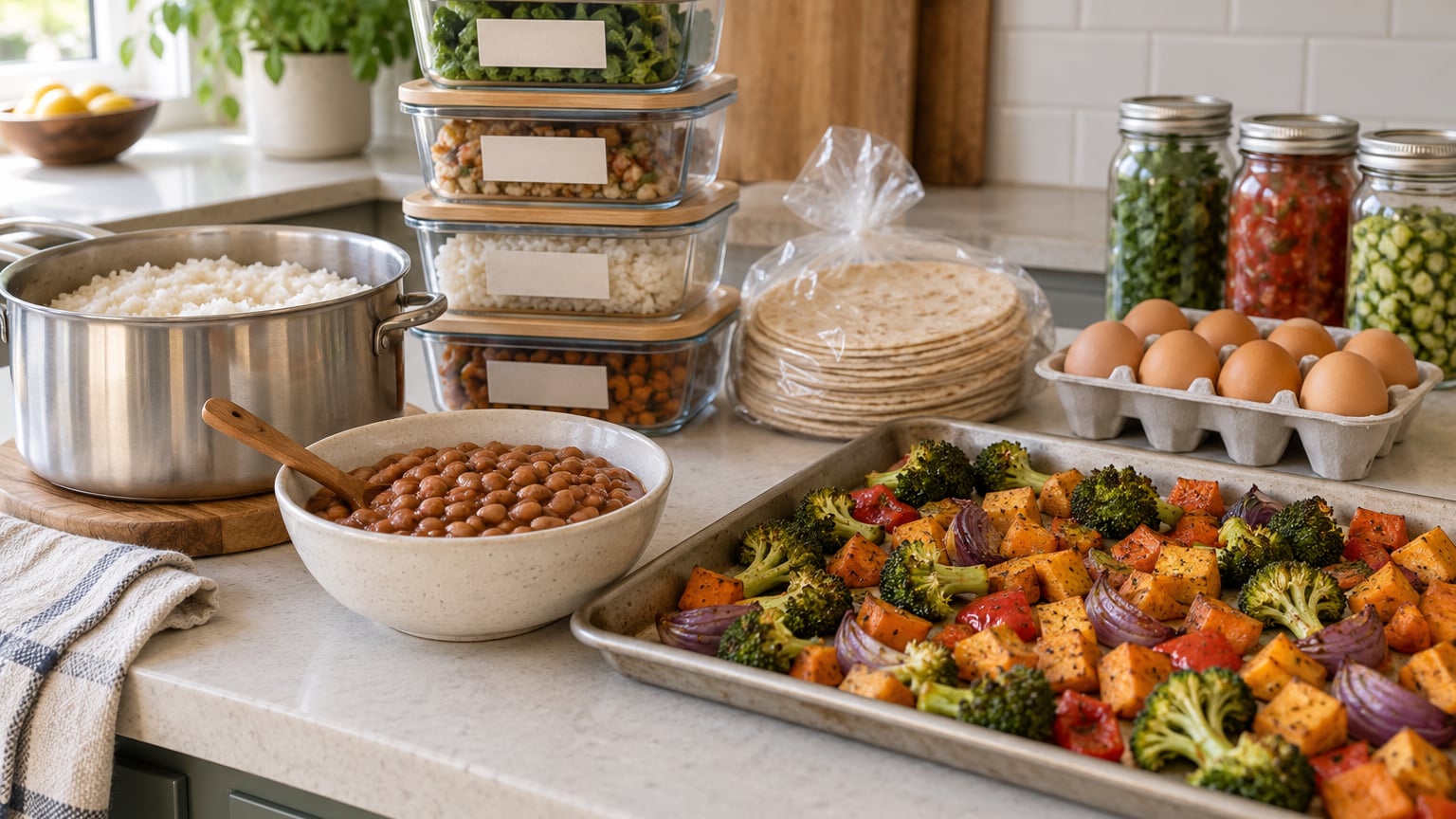
How to meal prep for a family on a budget comes down to three things: plan meals that share the same cheap ingredients, spend one focused block of time cooking them in bulk, then store and reheat them so weeknight cooking takes about ten minutes. Most families can get a full week of lunches and dinners into the fridge and freezer for somewhere around two to three dollars a serving.
You do not need a bigger kitchen, a spreadsheet background, or eight hours on a Sunday. You need a list, five flexible staples, and a system you repeat. Allow about two hours the first time and closer to ninety minutes once the routine settles. Prices cited below are typical US ranges, checked October 2026, and they move around by region and by week.
Table of Contents
- What You Need
- Step-by-Step: How to Meal Prep for a Family on a Budget
- Common Mistakes
- Budget and Planning Tips
- Frequently Asked Questions
- How much does family meal prep cost?
- How many meals should I prep for a family each week?
- How long do meal-prepped lunches and dinners stay safe in the refrigerator?
- Can I meal prep for two and double the recipes for a larger family?
- What foods should I avoid preparing several days ahead?
- How do I stop family meal prep from getting boring?
- Conclusion
What You Need
Start with the planning side, because a plan made on an empty stomach at four o’clock on a Sunday is the reason most people quit by week three.
- A notebook or notes app. One page for a ten-meal rotation, one page for the shopping list. Paper is fine, and paper gets used more often than an app that asks for a subscription.
- A rough sense of your number. Divide last month’s grocery total by the number of people fed. Most families land somewhere between nine and fourteen dollars per person per week for groceries alone, before any takeout.
- Five flexible budget staples. Beans or lentils, rice or pasta, eggs, a cheap protein such as chicken thighs or ground beef, and seasonal or frozen vegetables. These five items turn into far more than five meals.
- Storage that actually seals. Three or four glass or snap-lid containers for the fridge, and a dozen cheap freezer bags or flat trays for the freezer. If you are shopping for containers, our guide to meal-prep containers that do not leak compares the common types.
- Basic equipment. One large pot, one sheet pan, a couple of skillets, a cutting board, and freezer-safe bags or a rimmed tray. A slow cooker helps if someone is home all day, but skip it if your schedule runs opposite hours, since a slow cooker that starts at noon is useless when nobody walks through the door until eight.
Step-by-Step: How to Meal Prep for a Family on a Budget
1. Set a Realistic Family Meal-Prep Goal
Decide how many meals you are actually going to eat, not how many you could theoretically make. For a family of four, ten prepped meals across the week is plenty: five lunches, four dinners, and one deliberately doubled batch that covers both a lunch and a dinner the next day.
Account for three things before you commit. How many people actually eat at home on a given night, how many meals get skipped because someone has practice or a shift change, and how many meals you want left over on purpose for the following day.
How to meal prep for a family on a budget fails fastest when you plan for ideal attendance. Cook for the number of people who reliably show up, then freeze two extra portions as insurance. You will know the goal worked when Friday’s container is gone without anyone negotiating.
2. Plan Around Five Flexible Budget Staples
A ten-meal rotation built on five staples typically uses the same ingredients four or five times each. That repetition is the entire trick, because every second use of an ingredient costs a fraction of the first.
- Beans and lentils. Dried lentils cook in about twenty minutes with no soaking and one of the cheapest proteins per serving you can buy. Canned beans cost more per ounce but save time.
- Rice, pasta, or both. Store-brand pasta is usually the cheapest item in the cart. Cook a big pot of rice and let it cool fast, spread thin, so it reheats without turning gluey.
- Eggs. Hard-boil a dozen; they last four days refrigerated and make a fast breakfast or protein add-on.
- One cheap protein. Chicken thighs are forgiving and usually cheaper per pound than breast meat. Ground beef stretches further when you brown it with onion and drain the fat, which is what a can of beans is already doing.
- Vegetables. Frozen mixed vegetables hold their value, cost less per pound than fresh, and need no prep. Add one fresh item at serving time for texture and color.
Rotating on five staples also keeps the grocery list short. A short list is where the savings quietly come from.
3. Shop With a Planned List and Backup Meals
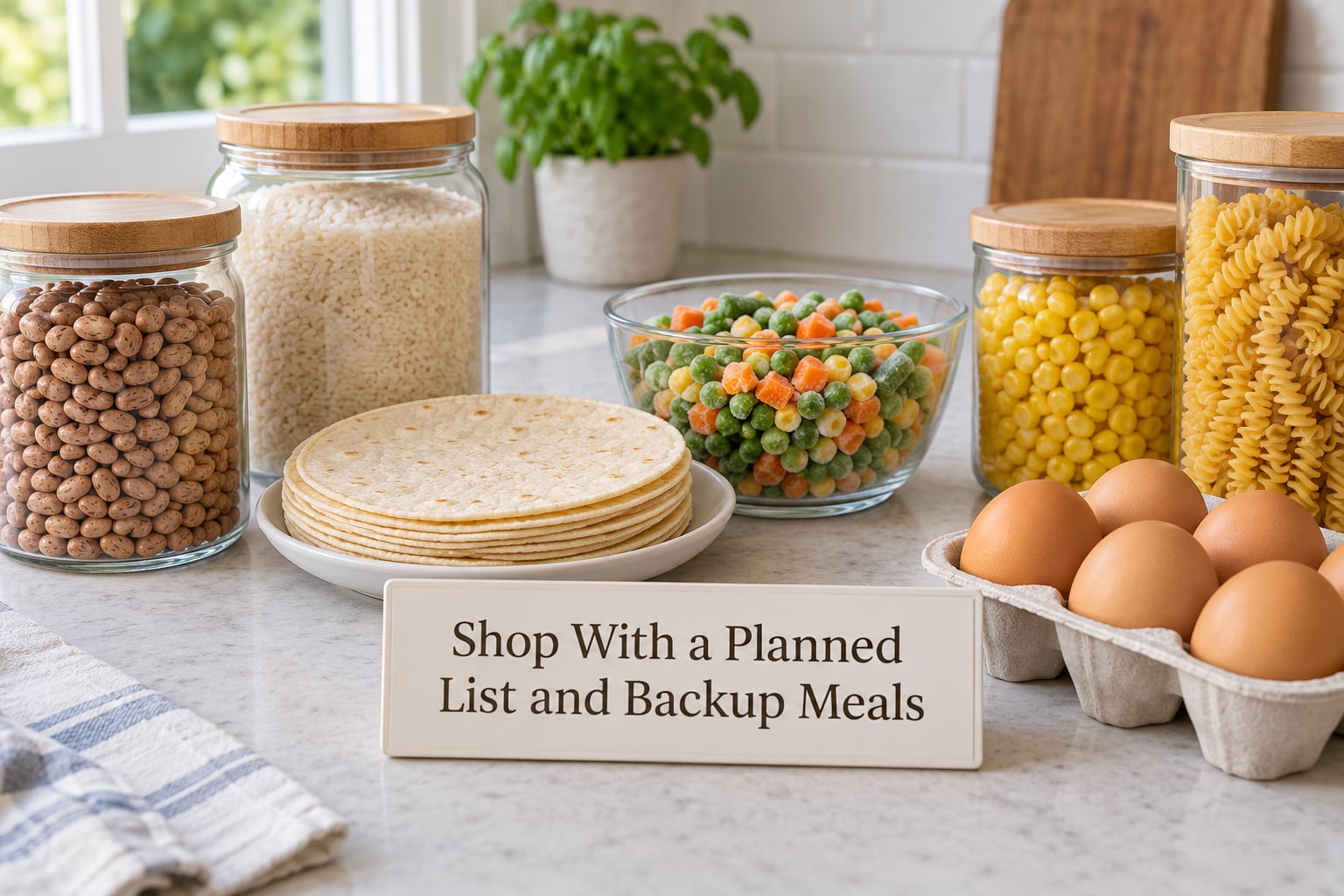
Shopping starts at home, not in the aisle. Check the pantry first and write down what you are low on, then add the fresh items your rotation needs. Buying a second jar of something you already have open in the cabinet is the most common way a careful shopper blows a food budget.
Compare unit prices rather than shelf prices, and let the small package win when the big one is close. Store brands on pantry staples like rice, pasta, canned tomatoes, and broth routinely cost less and taste nearly identical once they are in a pot with nine other ingredients. Buy fresh produce when it is in season and buy frozen when it is not.
Plan two backup meals before you shop, not after. These are the meals that use only pantry items, and they are what you fall back on when the sale meat sells out, when the week fills up, or when the budget has already been squeezed by something else. Sheet pan chicken thighs with frozen vegetables and a can of corn is a reasonable backup. So is pasta with canned beans and jarred sauce.
Write the backup meals on the list itself, in pencil. When a deal shows up, you will have room to add it without blowing the plan.
4. Cook One Big Batch in the Least Amount of Time
Run your oven and stovetop at the same time instead of waiting for one thing to finish before starting the next. Put the sheet pan of vegetables in first, start the rice, brown the meat, and only then do the chopping that has to be done last.
Cook more components than you think for a household of two, because a big batch costs you the same time as a small one. The real limit is how many servings your family will eat before they get bored, and that number is usually lower than a single person would guess.
Cook one batch until you see whether the family actually eats it twice before doubling the recipe. A repeat request is the strongest signal that a meal deserves a permanent slot on the rotation.
5. Turn the Batch Into Several Meals
One cooked batch of rice and beans should not become five identical containers. Change the format and the seasoning and the same food reads as a different meal.
- Bowl. Rice, beans, roasted vegetables, salsa over the top, shredded cheese on the side.
- Wrap. Fill a warm tortilla with rice, beans, and vegetables. Add lettuce and tomato at mealtime so nothing goes soggy.
- Sandwich. Shredded chicken or chopped filling between slices of bread. Our guide to meal prepping sandwiches for the week without soggy bread covers the storage trick that keeps bread dry.
- Casserole. Combine leftovers with a can of condensed soup or a cup of dry pasta and bake. Casseroles freeze well and reheat from frozen in the oven.
- Plate. The cheapest version: the batch components kept separate, so everyone builds their own plate at the table.
Season in layers. Cumin and chili powder on the beans, a different sauce on the wraps, and a fresh dressing at the table give you variety without buying a single extra ingredient.
6. Portion, Label, and Store Everything Safely
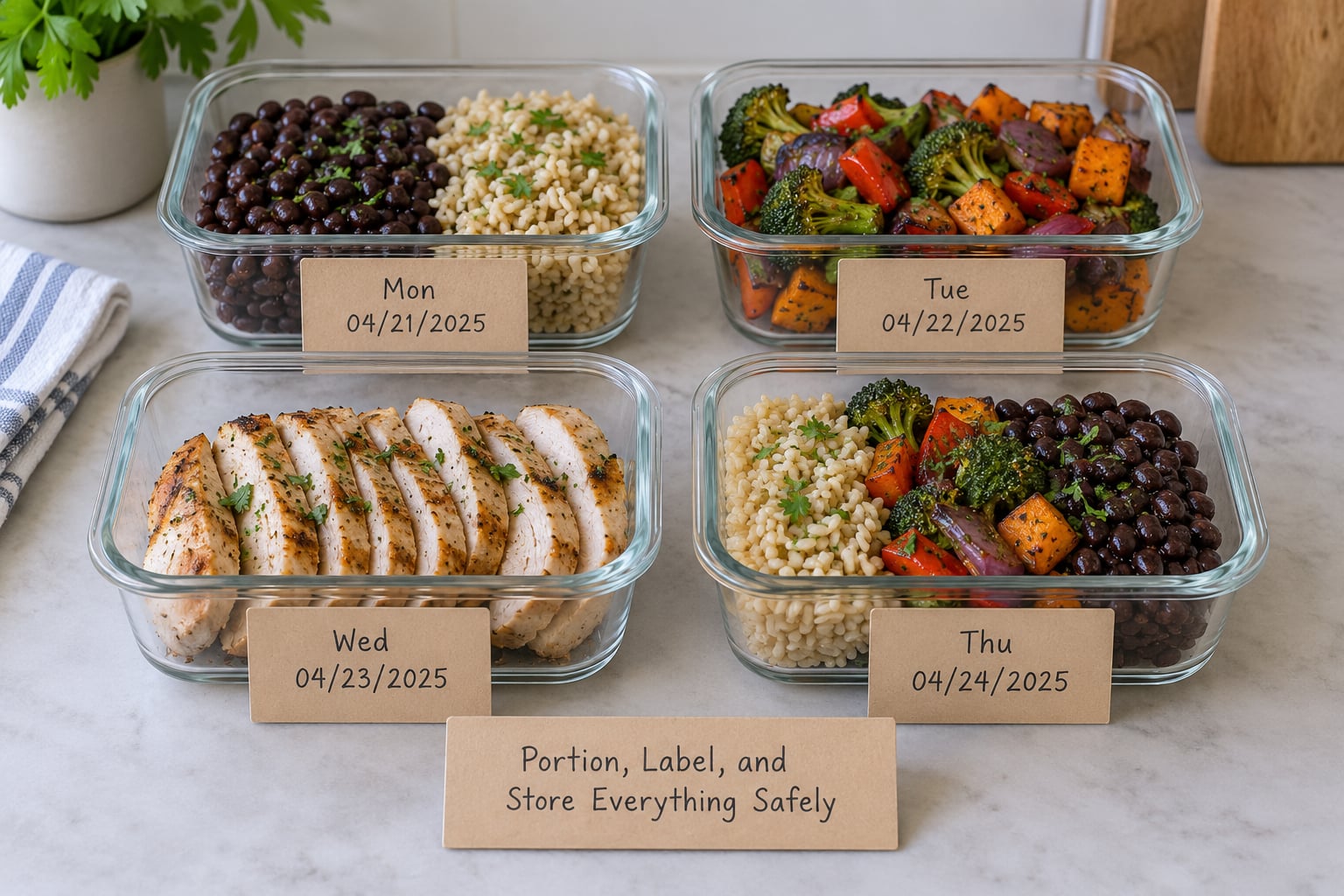
Portion for realistic appetites rather than an adult serving for a small child. Add a child’s portion for the youngest eaters and let bigger portions be an option, not a default.
Divide cool food into shallow containers and refrigerate within two hours of cooking. USDA guidance is three to four days for refrigerated leftovers, so the meals you cook Sunday should be the ones you eat early in the week, and anything later goes in the freezer the same day you portion it.
Cook poultry to 165F, ground meat to 160F, and whole cuts of meat or fish to 145F. Reheat leftovers until they reach 165F, stirring once in the middle, and reheat only the portion you are eating rather than the whole container.
Label every container with the day it was made and the day it should be eaten. A strip of masking tape and a marker work fine. Without a date, leftovers quietly become a fridge archaeology project, and the whole budget exercise falls apart.
7. Finish Each Meal in Under Ten Minutes
Hold back the fresh and crunchy parts. Fruit, salad greens, shredded cheese, salsa, a cooked egg, a quick scoop of tuna, or microwave-steamed vegetables all take under two minutes and keep the meal from tasting like a container that sat for four days.
This step is what keeps people eating the prep instead of ordering dinner on Thursday. Reheat a bowl, add a handful of greens and a dressing, and it reads as a meal rather than a leftover.
Common Mistakes
Prepping too much. Seven containers per person is ambitious and almost always ends in thrown-out food. Prep ten to fourteen meals for a family of four, freeze anything extra, and increase only after two weeks of leftovers nobody complained about.
Cooking meals the family will not eat. Ask for one or two named favorites before you shop, then build the rotation around those instead of around what you find interesting. A picky eater eating the rice and beans while the rest of the plate goes untouched is still a win for the budget.
Prepping the wrong things. Salads, lettuce, cucumbers, cut tomatoes, and raw onion go limp and watery within a day. Add them at mealtime instead. Cooked vegetables such as roasted broccoli, carrots, or peppers travel fine, and frozen peas hold up better than fresh.
Overspending on packaging. You do not need a matching set of glass containers to start. A stack of deli containers and a box of freezer bags run far less than a full organizer system, and they do the same job.
Forgetting labels. Containers without dates turn into guessing games, and guesses waste food. Write the label before the container goes in the fridge, not after.
Cooking in the wrong order. Start long items first and prep cold or delicate items last. Vegetables that sit in a hot pan for twenty extra minutes are the most common cause of a batch nobody wants.
Repeating the same four meals. This happens to everybody. The fix is formatting, not new recipes, and we have a full list of meal-prep lunches that do not get boring by Thursday built around cheap swaps.
Budget and Planning Tips
Cost per serving is the only number that matters when you are comparing meals. Divide the total you paid for the ingredients by the number of servings you actually packaged. A three dollar batch that yields twelve servings costs a quarter a serving, which is usually lower than the beans and rice it came from.
Typical US ranges per serving, checked October 2026:
- Beans and rice with canned vegetables: about one to two dollars a serving.
- Ground beef and pasta with jarred sauce: about two to three dollars a serving.
- Sheet pan chicken thighs with frozen vegetables: about three to four dollars a serving.
- Casserole built from leftovers: well under two dollars a serving.
- Rotisserie or deli meat used twice across a week: about three to five dollars a serving.
Reduce waste by cooking expiring vegetables first, on purpose, at the start of the prep session. A bag of baby carrots that will not survive the week becomes a roasted side dish rather than a compost item.
Reuse cooked ingredients across the week. Extra beans become nachos, extra rice becomes fried rice, extra roasted chicken becomes a wrap filling. Each reuse turns a fixed cost into another meal without another purchase.
Use store-brand versions, frozen vegetables, and your discount store for the staples that will not spoil. Reserve sales and coupons for meat, dairy, and freezer items that you are certain you will use before the quantity spoils. Bulk buying on a tight budget only saves money when the food actually gets eaten, so buy bulk grains and canned goods, not bulk fresh fruit.
A worked example: one pound of thighs, two cans of beans, one bag of frozen mixed vegetables, a pound of pasta, and a jar of sauce makes roughly fourteen servings for a family of four. That is seven lunches and dinners for the cost of one drive-through order, before you count the portion of rice or bread holding it together.
Frequently Asked Questions
How much does family meal prep cost?
Plan on roughly two to three dollars a serving for a family of four, which works out to about eighty to a hundred twenty dollars a week for lunches and dinners. The cost per serving depends on protein: bean and rice meals land near a dollar, ground beef and pasta around two, and chicken thigh sheet pans closer to three or four. Divide your real grocery receipt by the number of containers you packed for the truest figure.
How many meals should I prep for a family each week?
For a family of four, aim for ten to fourteen prepped meals: about five lunches and six to nine dinners, counting one batch you split across both. Prep more only after two weeks of evidence that leftovers get eaten. If your schedule changes midweek, freeze two spare portions rather than cooking more, since unused fridge food is where most of the money disappears.
How long do meal-prepped lunches and dinners stay safe in the refrigerator?
USDA guidance is three to four days in the refrigerator at 40F or below, so cook the meals you want early in the week first and freeze later portions the same day you portion them. Cool food in shallow containers and refrigerate within two hours of cooking. Reheat leftovers to 165F before eating, stirring once so the center heats evenly.
Can I meal prep for two and double the recipes for a larger family?
Yes, and doubling is where the real savings appear because cooking time barely changes. Scale seasonings carefully: spices, salt, and dried herbs need a lighter hand than anything else, so add them in two stages and taste before the second. Increase pot and pan size rather than cooking two separate smaller batches, and expect the cooking time to rise by roughly a quarter to a third.
What foods should I avoid preparing several days ahead?
Skip anything that goes soggy, watery, or smelly: lettuce and leafy greens, cut tomatoes, cucumbers, raw onion, and salad dressing. Cooked vegetables travel better than raw ones, with frozen peas and roasted vegetables holding up particularly well. Also avoid reheating rice directly from the fridge without cooling it quickly and storing it covered, since rice needs fast cooling to stay safe.
How do I stop family meal prep from getting boring?
Change the format, not the food budget. One batch of rice and beans can become bowls, wraps, a hot dog plate, a burrito, a soup by adding broth and greens, or a casserole by adding dry pasta and condensed soup. Keep two or three sauces and dressings on hand, swap seasoning profiles rather than recipes, and let family members build their own plates so the same base reads as different food.
Conclusion
Start smaller than feels productive. Check the pantry tonight, pick two meals everyone already eats, and cook one batch this weekend before adding a third or building out a rotation.
Portion it, label it, and write down what it actually cost per serving. Run that twice with the same meals and the shopping list gets sharper each time. Once it works, add one more meal a week and keep the two backup meals handy for the nights when the plan does not survive contact with a real week.