
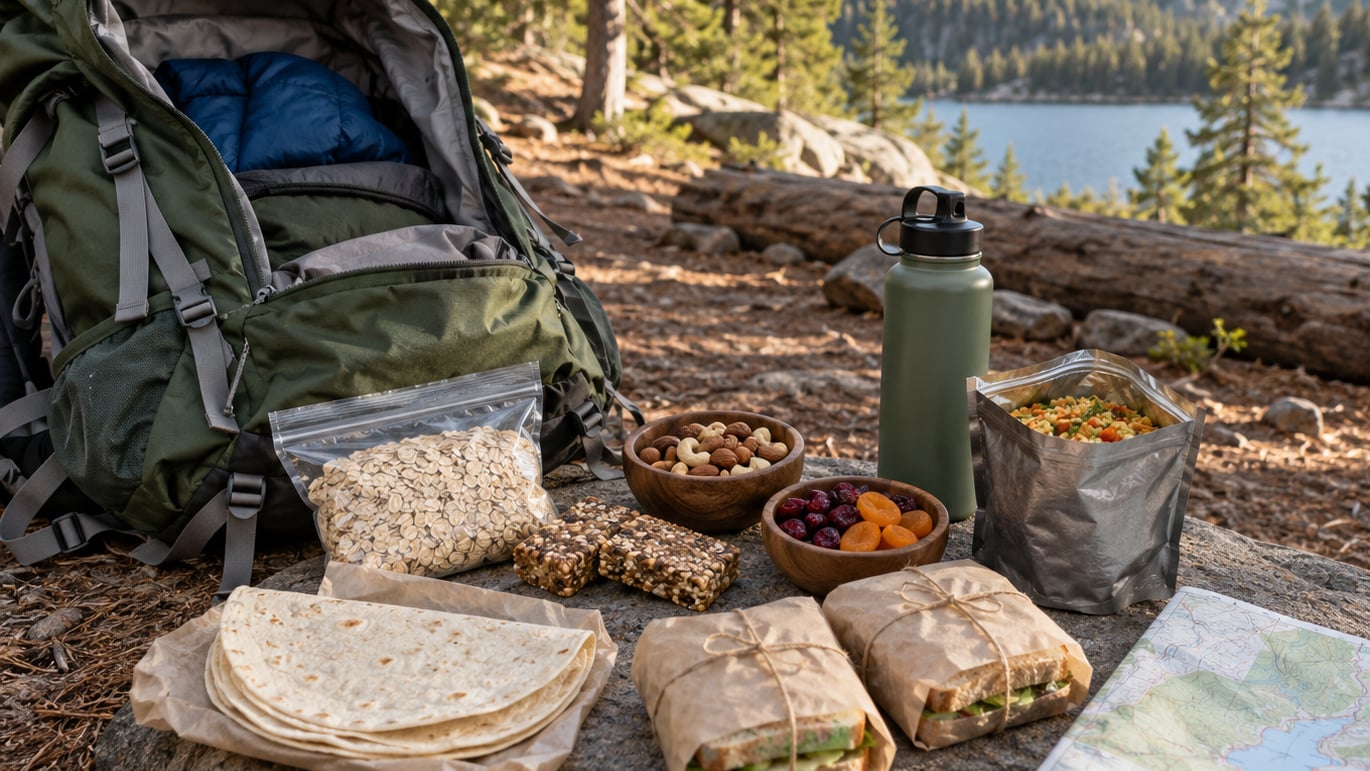
Plan on 1.5 to 2.5 pounds (680 to 1,130 grams) of food per person per day, which works out to roughly 2,500 to 4,500 calories a day. For most hikers, about 2 pounds and 3,000 calories per person per day is the number to start with, then multiply by the number of days on the trail. Here is how that number gets adjusted, what the food actually weighs, and how to build meals people will eat on day four instead of day one.
Every calorie you need on a multi-day hike has to be carried on your back. Bring too little and you risk running out of energy, poor recovery, and bad decisions in bad weather. Bring too much and every step costs more than it needs to, which is exactly how a pack that starts at 35 pounds becomes a 45-pound problem by Thursday.
The figures below come from published calorie guidance and from community rules of thumb that hikers use and argue about constantly. I have separated the two, because they are not the same thing and pretending otherwise is why beginners end up either starving or hauling dead weight.
Table of Contents
- How Much Food to Bring on a Multi-Day Hike: Quick Planning Guide
- How Many Calories Should You Bring for Each Hiking Day?
- How Much Food Weighs for a 3-Day Hike?
- What Food Works Best for Multi-Day Hiking?
- How Should You Plan Meals for a Long Hike?
- How Do You Pack and Store Food Safely on a Hike?
- How Do You Adjust Food for Difficulty, Weather, and Body Size?
- Frequently Asked Questions
- How much food should I bring for a 3-day hike?
- Should I pack an extra day of food for a multi-day hike?
- How much food should I eat per pound of body weight while hiking?
- Is trail mix enough food for a multi-day hike?
- How do I keep sandwiches and other perishable foods safe while hiking?
- Are dehydrated meals a good choice for backpacking?
- Conclusion
How Much Food to Bring on a Multi-Day Hike: Quick Planning Guide
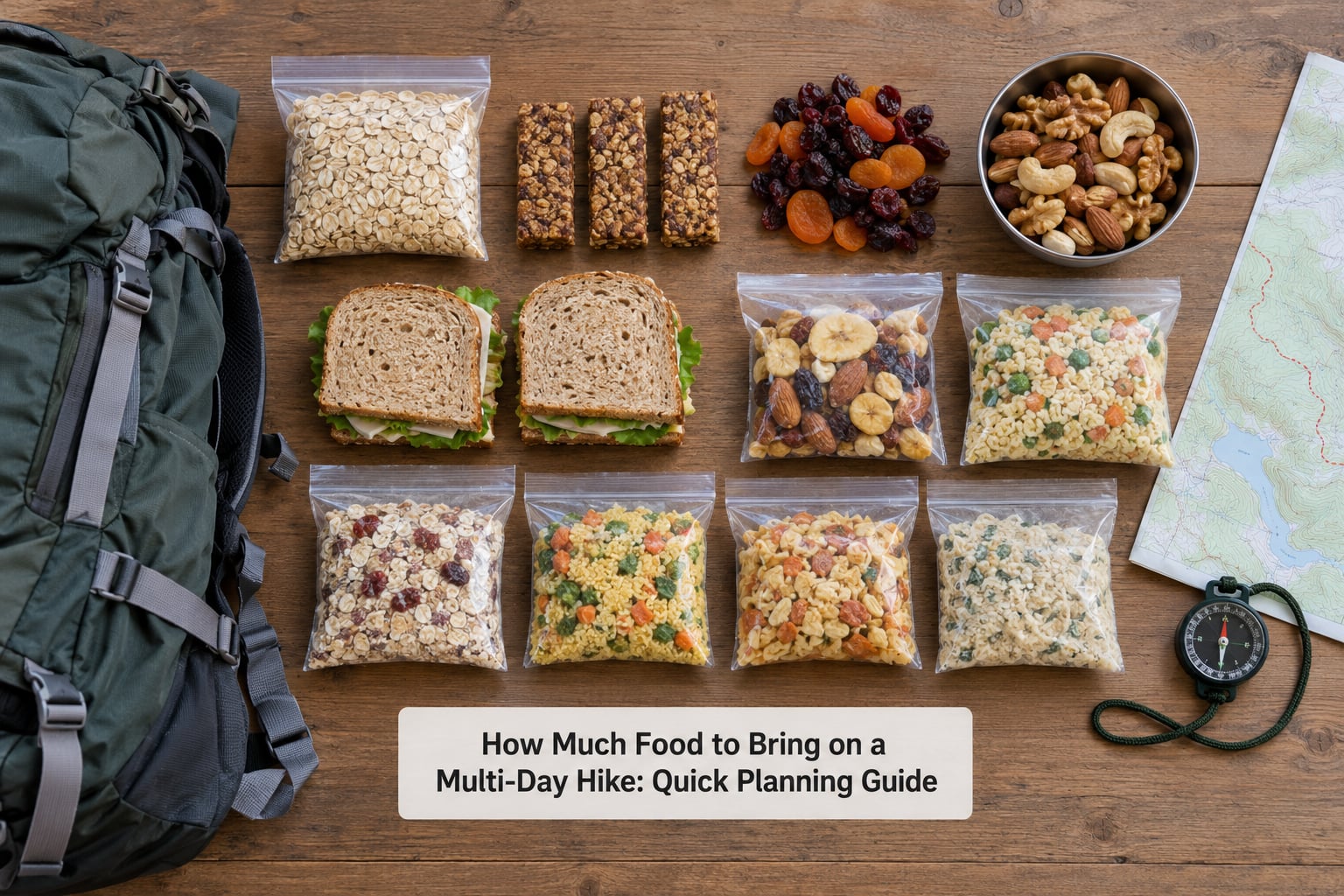
Multiply a daily food weight by the number of days. That is the whole calculation at its simplest.
| Trip length | Calories per person per day | Food weight per person per day | Total food weight, one person |
|---|---|---|---|
| 1 to 2 days | 2,500 to 3,500 | 1.5 to 2 lb (0.7 to 0.9 kg) | 3 to 4 lb (1.4 to 1.8 kg) |
| 3 to 4 days | 2,800 to 3,800 | 1.8 to 2.2 lb (0.8 to 1.0 kg) | 6 to 9 lb (2.7 to 4.1 kg) |
| 5 to 7 days | 3,000 to 4,200 | 2 to 2.5 lb (0.9 to 1.1 kg) | 10 to 18 lb (4.5 to 8.2 kg) |
| 8 days or more | 3,200 to 4,500 | 2.2 to 2.5 lb (1.0 to 1.1 kg) | Resupply every 3 to 5 days |
Those weights assume mixed food with some fat in it. A diet of mostly dried fruit and crackers gets you the calories but eats the weight budget twice over, which is the trap most first-time packers fall into.
For groups, the per-person figure holds, but the packaging does not need to. What one hiker can eat in a single serving, three hikers share from one bigger bag.
| Days of food | One person | Two people | Four people |
|---|---|---|---|
| 2 days | 3 to 4 lb | 6 to 8 lb | 12 to 16 lb |
| 3 days | 5 to 7 lb | 10 to 14 lb | 20 to 28 lb |
| 5 days | 10 to 12 lb | 20 to 24 lb | 40 to 48 lb |
| 7 days | 14 to 18 lb | 28 to 36 lb | Resupply or split up |
These are the variables that move the number. Terrain changes your burn. Temperature changes it. Altitude changes it. Pack weight changes it. Body size changes it. How much you enjoy eating the food you packed changes it more than any of the others, which is why the same formula produces a 1.5-pound day for one person and a 2.5-pound day for another.
How Many Calories Should You Bring for Each Hiking Day?
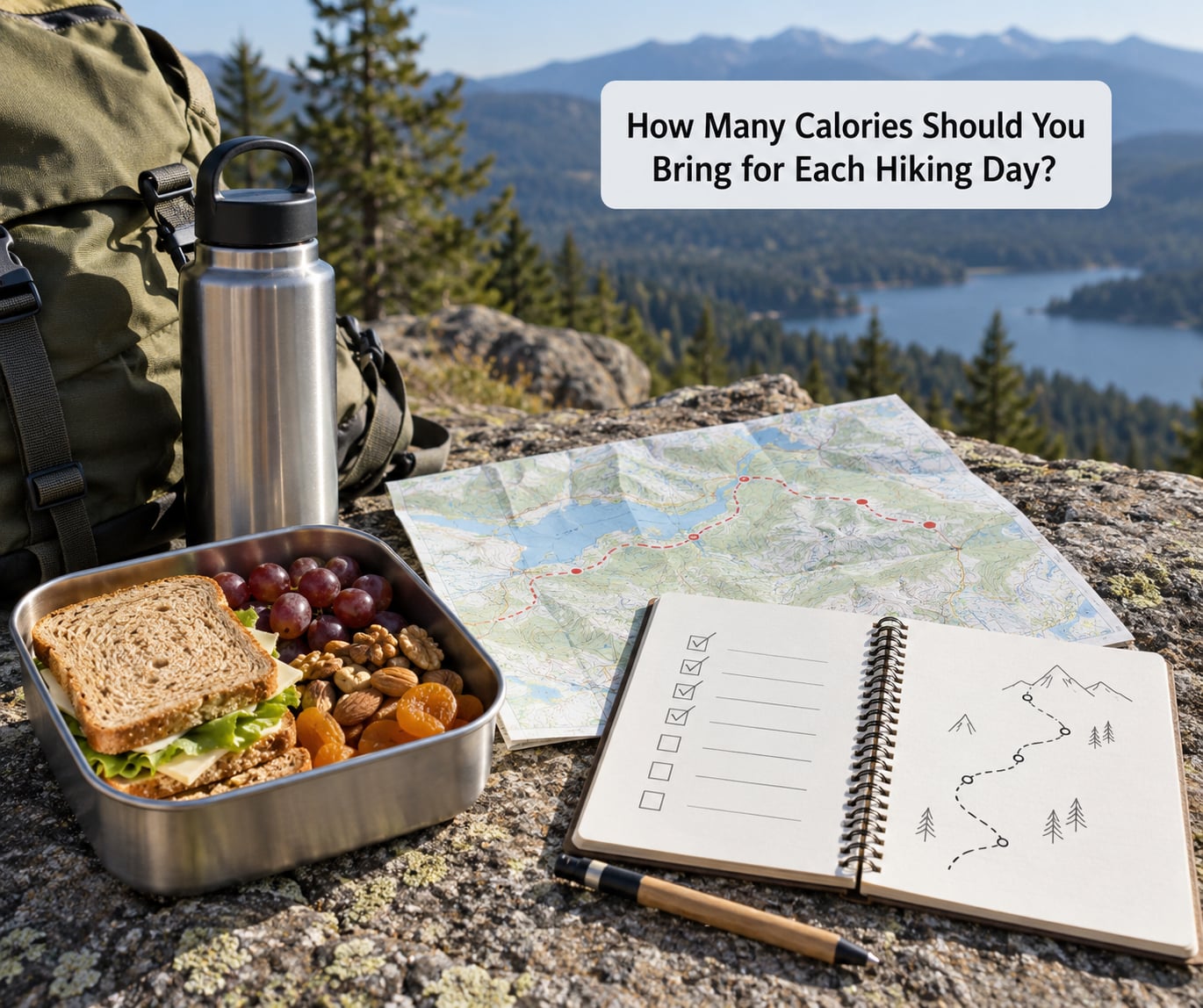
Start with 2,500 to 4,500 calories per day, then narrow it using one of two methods. Both are estimates for planning, not medical guidance.
The walking-hours method assumes 200 to 300 calories for every hour you are actually moving. A hiker walking seven hours on moderate terrain is running 1,400 to 2,100 calories of walking on top of everything else they burn just staying alive. This is the method most useful when you already know your route and its mileage.
The body-weight method assumes 13.5 to 30 calories per pound of body weight depending on activity. At 160 pounds, that works out to about 2,160 calories on a rest day and up to 4,800 on a hard day with a heavy pack.
Both figures sit on top of a baseline. Harvard Medical School puts minimum intake at about 1,200 calories for women and 1,500 for men, and NHS averages land around 2,000 to 2,500 depending on sex and size. Mainstream guidance treats anything above roughly 2,500 calories a day as a discussion to have with a doctor or a registered dietitian rather than a number to plan a menu around.
There is a ceiling here, and it is lower than people expect. Sustained energy intake tops out around two to three times your resting burn no matter how much food you put in front of you. You cannot decide to eat 6,000 calories a day and have it work. That is why a 3,000-calorie target for a moderate day is realistic and a 5,000-calorie target usually just means food you never finish.
Split the daily total into meals and snacks. About 500 calories for breakfast, 600 for lunch, 700 to 900 for dinner, and 300 to 500 spread across snacks adds up to a normal hiking day. Cold-weather dinners push to 800 to 1,000 calories because your body burns more staying warm overnight.
If you want a number you trust more than a formula, calibrate it on a trip you have already done. Track what you actually ate on day two and day three, when appetite is honest, and use that as next year’s starting point. Watch trackers give you a burn number too, but treat it as a rough log rather than a bill.
How Much Food Weighs for a 3-Day Hike?
Six to nine pounds of food for three days for one person, and about half of that on any given morning. The difference is the single most useful thing to understand about backpacking food weight.
You carry the full trip’s food at the trailhead. At any moment you are carrying what is left plus what you have eaten. On a three-day trip at roughly 2 pounds per day, you start with 6 pounds of food and still have 4 pounds on your back at the end of day one.
Water complicates it. A liter of water weighs 2.2 pounds, and on a warm route a hiker might be carrying 2 liters plus 6 pounds of food plus gear. In arid country such as Guadalupe Mountains National Park, where water carries dominate the load, cutting a pound of food saves less than cutting a liter of water. Know which one is actually heavy on your trip.
Volume bites before weight does on a lot of these trips. A large can of soup weighs a pound and a half but fills more bag space than a pound of nuts. Bear canisters add a hard limit of their own, and a standard canister holds far less volume than the same weight of loose food. Plan by what fits, not only by what weighs.
Packaging adds up quietly. A sandwich wrapped in a tortilla weighs about 4 ounces. Do that six times and you have spent nearly a pound and a half on what is really three-quarters of a pound of food.
What Food Works Best for Multi-Day Hiking?
High calorie density. Calories per ounce is the number that decides what goes in the bag, and the table below covers the foods most hikers actually eat.
| Food | Calories per ounce | Typical serving | Calories per serving |
|---|---|---|---|
| Olive oil | 240 to 480 | 1 tbsp | 120 to 130 |
| Nut butter | 185 to 190 | 1 tbsp | 90 to 95 |
| Oats, dry | 380 | 1/2 cup dry | 150 |
| Dry pasta or rice | 360 to 400 | 2 oz dry | 200 to 220 |
| Mixed nuts | 165 to 175 | 1 oz | 170 |
| Peanut butter | 185 to 190 | 2 tbsp | 190 |
| Chocolate bar | 145 to 155 | 1 oz | 150 |
| Flour tortilla | 125 to 135 | 1 large | 150 to 160 |
| Hard cheese | 105 to 115 | 1 oz | 110 |
| Jerky | 100 to 110 | 1 oz | 100 |
| Energy bar | 100 to 120 | 2 oz bar | 200 to 250 |
| Dried fruit | 90 to 100 | 1 oz | 90 to 100 |
| Gummy candy | 95 to 100 | 1.5 oz | 140 to 150 |
| Freeze-dried meal pouch | 165 to 200 | 3 oz pouch | 500 to 600 |
| Tuna in oil, canned | 35 to 40 | 5 oz can | 180 to 190 |
| Fresh orange or apple | 15 to 20 | 1 medium | 60 to 95 |
| Canned soup | 12 to 15 | 15 oz can | 180 to 250 |
That table explains a WalkHighlands forum thread neatly: a bag of mixed nuts from a discount store delivers about 1,000 calories while a single-serve freeze-dried meal lands around 500 to 600. The nuts are lighter per calorie, cheaper, and require no water or stove time. The meal is more dinner-like and has a much better calorie-to-weight ratio than canned soup, but it does not go as far as the nuts do.
Fresh fruit and raw vegetables still belong in the bag. They are not calorie sources, they are morale and water sources, and on a five-day trip morale is not a small thing. Just do not count them toward the calorie total.
Bread, wraps, and sandwiches do better on the trail than most calorie tables suggest. A sandwich built on dense bread with nut butter, cheese, and dried fruit lands around 300 to 400 calories at about 5 to 6 ounces, and it needs no stove. Wraps beat sliced bread because they do not crumble into your liner bag and they double as a cleanup sheet. The trick is moisture: wet bread goes moldy by day two, so heavy wet fillings like tuna salad or tomato are the wrong choice for anything longer than a weekend.
Reliable sandwiches on a multi-day trip: nut butter and honey, cheese and apple, peanut butter and dried fruit, cream cheese with nuts, and hard salami with cheese. Anything that holds at room temperature and survives being sat on is fair game.
How Should You Plan Meals for a Long Hike?
Work backward from your daily calorie number, then assign meals to the hardest part of the day. Hikers eat more at breakfast and dinner than at lunch, and lunch is usually the meal that gets skipped.
One workable daily frame for a moderate day at about 3,000 calories: a 500 to 600 calorie breakfast with a hot drink if you have a stove, three snacks totalling 300 to 400 calories eaten every two to three hours, a 600 to 700 calorie lunch, and a 700 to 900 calorie dinner. Add one more snack block on climbing days.
Snacking steadily beats three big meals. Your body uses food more efficiently when it arrives in small pieces across twelve hours rather than in two large dumps, and you also stop the 4 p.m. bonk that ruins an evening’s mood.
Scale that frame by trip length. A two-night trip needs breakfast, lunch, and dinner on both full days plus snacks, roughly 3 to 4 pounds total. A three-day trip is 5 to 7 pounds. A five-day trip is 10 to 12 pounds, which is the point where carrying everything starts to argue with you. A seven-day trip usually means resupplying, and any trip past about 10 pounds of food should have a resupply or cache plan.
Ask about group organization early, because it is the top question on backpacking forums. Individual day bags are slower to pack and far less likely to end up with two people eating dinner on night one. One bag per person per day, clearly labelled, solves it. Nobody can grab the wrong day if each bag only contains that day.
Now the part that confuses everyone. You will not be hungry on day one and you will be ravenous on day three. Appetite lags two or three days behind your energy need, which is why people underpack deliberately and then run short at the worst possible moment. Plan on eating more than feels right from day two onward, and treat that early disinterest as a signal to eat anyway.
Gummy candy comes up constantly as trail food and it works better than people expect. It is 95 to 100 calories per ounce, it does not crush or melt, it needs no water, and hikers eat it happily on steep climbs when a bar feels like work. The downside is that it disappears fast, so count it as a snack you planned rather than a freebie.
For trips over five days, plan resupply as carefully as you plan the menu. Post-send resupply boxes if the trailhead has postal service, pick up town resupply on loops, and leave a cache only where the rules allow it. Never cache food where wildlife can reach it unless it is inside an approved canister.
How Do You Pack and Store Food Safely on a Hike?
Choose shelf-stable foods you can eat without keeping them cold, and treat anything perishable as a cooler-management problem rather than a hope.
USDA minimum internal temperatures are the standard to plan against. Poultry reaches 165°F, ground meat 160°F, and whole cuts of meat and fish 145°F. Anything you cannot bring to temperature on the trail should not be in the bag.
That rules out a lot of what sounds appealing. Fresh meat, fresh dairy, cut fruit, potato salad, and anything with mayonnaise are not multi-day foods. Cold meals from the grocery cooler are a different story: they are cooked, sealed, and meant to stay refrigerated, so keep them in a cooler below 40°F and use them within the manufacturer’s window rather than guessing at the trail.
The simpler path is cheese, cured meat, jerky, nut butter, dried fruit, bars, crackers, tortillas, and sealed spreads. They travel at any temperature for any length of trip.
Rehydrating meals need boiling water and fuel. A canister stove plus a fuel weighs about a pound and a half, so on short trips where you will not eat three hot dinners, that gear is heavier than the meals are worth. Cold meals or ready-to-eat pouches cost less weight in total when the stove goes home.
Use your bear canister or food bag as designed for your route, and check the volume limit before you pack, not after. In places where food storage is mandatory, that is a legal requirement and not a preference. Keep scented items out of the canister, including wipes and sunscreen.
How Do You Adjust Food for Difficulty, Weather, and Body Size?
Move your number by moving your conditions. The 2-pound default is a starting point for a moderate route, mild temperature, and an adult-sized pack.
Steep routes, big elevation days, and heavy packs push toward 2.5 pounds or 2,500 calories per pound of body weight on hard days. Cold weather pushes dinner calories to 800 to 1,000 and calls for more fat, since fat burns slower and colder. Heat does the opposite: it does not change the calorie need much but it does change what you can stomach, so smaller amounts of food eaten more often works better in hot weather, along with salt and electrolytes.
Altitude raises energy use on top of everything else. High route does not have a published calorie formula, so treat it as an upward adjustment and watch how you feel rather than trusting a number.
Younger hikers and smaller adults generally need less in absolute calories but the same density, so the ounce count drops while the calorie-per-ounce target stays. Kids eat less than parents expect and want different things, so a shared menu needs a separate kid-sized portion rather than an adult portion split in half.
Watch for a pattern across trips: pack 3 pounds a day, eat 2, finish with a week of surplus. That is the overpacker’s problem, and it is common enough to have its own fix. Cut one item, reweigh the bag, and repeat until the total matches your daily figure times your days. Then add back one extra day for trips where a resupply or an exit is not certain.
Hikers often talk about a 40-pound pack as the point where a trip stops being enjoyable, and about carrying no more than roughly a third of your body weight over a long trip. Both are community rules of thumb rather than official limits, and food is only one part of the total. If your gear is doing the heavy lifting, trimming food has less effect than people expect.
None of this is individual nutrition advice. If you have a medical condition, take medication, are pregnant, or have a history of disordered eating, talk to your doctor or a registered dietitian before planning a multi-day hike.
Frequently Asked Questions
How much food should I bring for a 3-day hike?
For one person, budget 6 to 9 pounds of food for three days, which is about 2 pounds or 3,000 calories per day. Two people need roughly 12 to 18 pounds, four people around 24 to 36 pounds. Repackage it into one bag per person per day so nobody eats two dinners on night one. Add one extra day of food only if you have no resupply option and no reliable bail-out route.
Should I pack an extra day of food for a multi-day hike?
It depends on how sure you are of getting out. On a well-marked trail with a bail-out route or a resupply town, a spare day is dead weight. On a remote route with weather windows, river crossings, or no resupply for four days, pack one extra day. That buffer is typically one extra breakfast plus snacks, not a full day of meals.
How much food should I eat per pound of body weight while hiking?
Roughly 13.5 calories per pound on an easy day and up to 30 calories per pound on a hard day with a heavy pack. A 160-pound hiker lands near 2,200 calories on a rest day and around 4,800 on a strenuous day. Treat these as planning figures rather than medical targets, and check with a doctor if you have any health conditions.
Is trail mix enough food for a multi-day hike?
No. Trail mix runs about 165 to 175 calories per ounce, so two pounds of it is a single day at best. It is an excellent snack and a fine addition to a menu, but as the only food for a trip it leaves you short on calories and completely short on variety. Pair it with bars, jerky, dried fruit, a hot meal, and something fresh.
How do I keep sandwiches and other perishable foods safe while hiking?
Use shelf-stable fillings such as nut butter, honey, hard cheese, and dried fruit rather than tuna salad, mayonnaise, or cut vegetables. Keep refrigerated cold meals in a cooler under 40°F and follow the manufacturer’s window. Anything that needs cooking should hit 165°F for poultry, 160°F for ground meat, and 145°F for whole cuts and fish before you eat it.
Are dehydrated meals a good choice for backpacking?
They are light and shelf-stable, and a single 3 ounce pouch runs 500 to 600 calories, so you need three pouches plus snacks to hit a normal day’s target. The catch is equipment: boiling water plus a canister stove and fuel adds about a pound and a half. On trips under four days, cold meals or ready-to-eat pouches often come out lighter once you drop the stove.
Conclusion
Start with one number: about 2 pounds and 3,000 calories per person per day, adjusted for terrain, weather, and how much you weigh. Multiply by your days, aim for 100 to 125 calories per ounce in whatever you pack, and pick foods you will genuinely be excited to eat on day three, because that is the day your appetite catches up.
Then do the unglamorous part. Weigh the food, divide it into day bags, trim anything that does not earn its weight, and add a small buffer if your bail-out options are thin. Last, check the whole load, food and water together, against the capacity of the pack you are actually taking. If the numbers work on paper, how much food to bring on a multi-day hike is settled.