
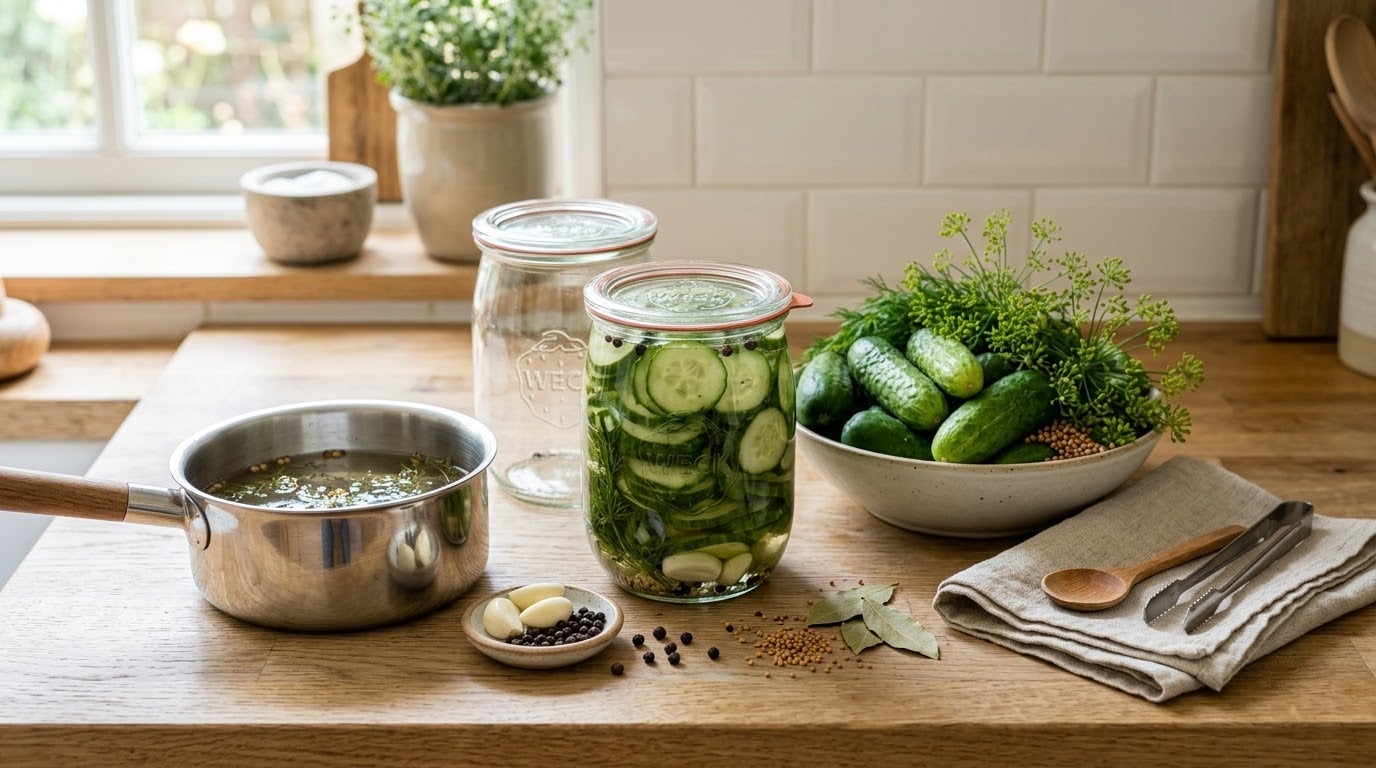
You can make quick refrigerator pickles in about 15 minutes of hands-on time: slice cucumbers, pour over a hot vinegar brine, and let them sit in the fridge for 24 hours. No water bath, no canning jars full of boiling water, no special equipment. The whole thing hinges on one thing that most recipes gloss over, which is how you keep the cucumbers snapping instead of turning limp by day two.
That is where the detail below matters. Pick the right cucumbers, cut them to the thickness you actually want to eat, dissolve the salt fully, and leave proper headspace in the jar.
Here is the base batch for about four pint jars:
- 4 to 5 pickling or Kirby cucumbers, about 2 pounds, sliced into 1/4 inch coins or spears
- 1 cup distilled white vinegar (5% acidity)
- 1 cup water
- 1 to 2 tablespoons pickling or kosher salt, measured by weight if you have a scale
- 3 to 4 smashed garlic cloves, 1 teaspoon whole black peppercorns, 1 teaspoon mustard seed
- Several sprigs of fresh dill, or 1 tablespoon dill seed
Everything else on this page is either a way to make that batch sharper, crisper, or easier to repeat.
Table of Contents
- What You Need
- Step-by-Step: How to Make Quick Refrigerator Pickles
- Common Mistakes
- Frequently Asked Questions
- How long do quick refrigerator pickles need to sit before eating?
- How long do quick refrigerator pickles last in the refrigerator?
- Can I make refrigerator pickles without adding salt?
- Which vegetables are best for quick refrigerator pickles?
- Do refrigerator pickles need to be cooked or heated first?
- Can I use any kind of vinegar for refrigerator pickles?
- Conclusion
What You Need
Vegetables That Pickle Best
Cucumber varieties differ less in flavor than in structure, and structure is what decides whether the pickle stays crunchy. Thin skins, small seeds, and firm flesh win. Anything already soft and seedy on the vine will not recover, no matter how good your brine is.
| Cucumber type | Size and seeds | How it pickles |
|---|---|---|
| Pickling or Kirby cucumbers | 3 to 5 inch, small seeds | The standard choice. Firm, holds up to spears and chips. |
| Persian cucumbers | Small, thin skin, tiny seeds | Excellent, and quick to pickle since they are so thin. |
| English or seedless cucumbers | Long, very thin skin | Works well, no peeling needed. Check for wax first. |
| Standard grocery slicers | Long, wax coated, seedy | Works, but often softer. The wax seals the skin against brine. |
| Large field or garden cucumbers | Big, seedy, thin skinned | Skip these. Seeds and soft flesh go mushy in hours. |
Wax on grocery store cucumbers is not a problem for refrigerator pickles. It is designed to slow moisture loss, which is exactly what you want. Farm market or home garden cucumbers have no wax, so treat them more gently and eat them sooner.
The Brine, Measured Two Ways
The standard safe ratio for refrigerator pickles is 1:1 vinegar to water. That keeps the brine well under pH 4.6, which is the threshold below which the bacteria that cause botulism cannot grow. A 1:2 ratio, meaning one part vinegar to two parts water, is defensible for fridge pickles and gives a milder, more balanced pickle, but 1:1 is the number to start with.
The bigger mistake people make is guessing at quantity. Scale the brine to the jars you are actually filling, plus about a quarter cup of slack so you can top jars up after the vegetables settle.
| Jar size | Vinegar | Water | Pickling salt | Approx. yield |
|---|---|---|---|---|
| 1 pint (16 oz) | 1/2 cup | 1/2 cup | 1 tablespoon | 1 small jar, sliced cucumbers |
| 2 pints (32 oz) | 1 cup | 1 cup | 2 tablespoons | 2 jars, or 1 with spears and aromatics |
| 1 quart (32 oz, wide mouth) | 1 cup | 1 cup | 2 tablespoons | 1 quart jar, or 2 pints |
| 2 quarts (64 oz) | 2 cups | 2 cups | 4 tablespoons | 4 to 5 pint jars |
Sugar is optional and worth a teaspoon or two. It does not make the pickle sweet on its own; it rounds off the sharp edge of the vinegar so the brine tastes rounded instead of harsh.
Which Vinegar and Which Salt to Use
Check the label for acidity before anything else. You need vinegar at 5% acidity or higher, which is standard for anything sold as pickling or distilled white vinegar. Below 5%, you are relying on salt alone to preserve, which is a different method with different rules.
| Vinegar | Typical acidity | Flavor in the pickle | Best for |
|---|---|---|---|
| Distilled white | 5% or 5.6% | Neutral, lets dill and garlic lead | The default dill pickle |
| Apple cider | 5% | Fruity, softens the heat | Bread and butter style |
| White wine | 5% to 6% | Light, clean, a little sharp | Mild jars, cauliflower, peppers |
| Rice vinegar | 4% to 5% | Mild, slightly sweet, less acidic | Use only if the label says 5% or higher |
| Canned pickle vinegar | Usually 5% | Pre-seasoned with pickling spices | Convenient, less control |
Salt matters more than people expect because different salts measure differently by volume. A tablespoon of table salt carries roughly twice the sodium of a tablespoon of Diamond Crystal kosher salt. Use one type for the whole batch and measure it the same way every time.
| Salt | Volume behavior | Notes |
|---|---|---|
| Pickling or canning salt | Fine, dense, sticks to the spoon | Built for this. No anti-caking agents that cloud brine. |
| Kosher salt (Diamond Crystal) | Flaky, about half the density of table salt | Great flavor. Double the volume if you are switching from table. |
| Table salt | Dense and fine | Works, but additives can cloud or discolor the brine. |
| Sea salt | Varies widely by brand | Fine in flavor, unpredictable in a recipe. Fine for brining, not for measuring. |
If you own a kitchen scale, weigh the salt. It removes the whole argument.
How Refrigerator Pickles Differ From Canned and Fermented Ones
All three use salt and acid, and they are genuinely different foods rather than versions of the same thing.
Refrigerator pickles get their acid from vinegar and their texture from salt. They are ready in a day, they stay soft after a few weeks, and they live in the fridge. No heat above a simmer touches the vegetables.
Fermented pickles use salt and water but no vinegar at all. Lacto-fermentation is done by the bacteria on the vegetable itself, which means days or weeks of waiting, a cloudy brine, and live cultures in the jar. The flavor is tangier and softer, and the texture is genuinely different from anything vinegar gives you. Those pickles keep for months in the fridge because the fermentation itself preserves them.
Canned pickles use a hotter, more acidic brine, and then get processed in a boiling water bath so they are shelf stable. That process cooks the vegetables, which is why canned pickles have that cooked texture rather than a raw snap. A refrigerator pickle recipe is not a safe canning recipe, and the ratios are not interchangeable.
Flavor Additions That Actually Work
The base brine is bland enough that it takes additions well. These are the ones that earn their place in a small batch:
- Fresh dill seed for a cleaner, less grassy note than fresh dill. Use about 1 tablespoon per quart of brine.
- Fresh dill fronds packed into the jar, roughly a handful per pint. More pretty, and milder.
- Garlic cloves, smashed rather than sliced. Crushing ruptures the cells and gets more of that flavor into the brine. Four cloves per quart is a solid amount.
- Mustard seed and whole black peppercorns, a teaspoon each. This is the classic profile for pickled herring and mackerel.
- Red pepper flakes or a sliced serrano for heat. The heat mellows noticeably after 48 hours.
- A teaspoon of sugar to round out the acidity without making the pickle sweet.
- Grape, oak, or cherry leaves in the bottom of the jar, if you can find them. The tannins react with calcium in the cucumbers and firm the pectin. A quarter teaspoon of calcium chloride does the same job.
Pick three or four. A jar packed with every spice on the shelf tastes like the shelf.
Equipment and Jars
The required list is short: any clean glass jar with a tight lid, a saucepan, a knife, and a colander or bowl. Standard mason jars work. Weck jars with a rubber gasket are popular among people who keep pickles for months because the seal holds better and the wide mouth makes grabbing spears easy.
Do not sterilize jars or run them through a dishwasher. Refrigerator pickles are not shelf stable, so the canning rules do not apply and the extra heat only risks thermal shock on cold glass.
A mandoline slicer is the one tool worth buying if you make these often, because it gives even 1/4 inch slices in seconds. A small funnel makes packing spears into narrow necks far less frustrating. Everything else on the list is optional.
Step-by-Step: How to Make Quick Refrigerator Pickles
1. Choose and Wash Your Vegetables
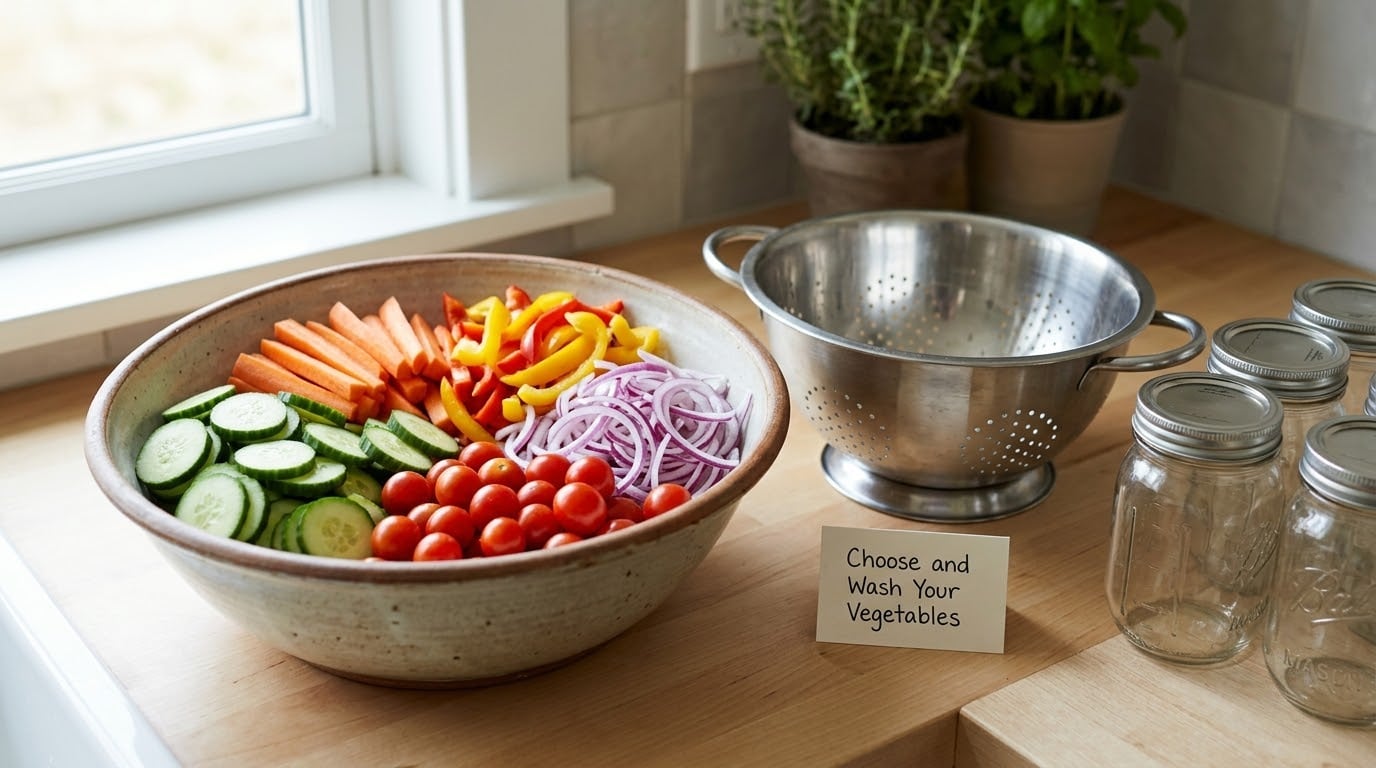
Wash the cucumbers under cold running water and pat them dry. Paper towels, not a dish towel. A damp cucumber carries water into the jar and dilutes your brine.
For the crisper results, soak the whole cucumbers in cold water for 1 to 2 hours before you cut them. The cold soak firms the flesh and gives you a head start on the snap. If you skip it, you skip maybe 10 percent of the crunch, which is more than enough to notice.
Trim about 1/4 inch off the blossom end, the side where the flower was attached. That end carries enzymes that break down pectin and turn the flesh soft. Removing it is the single highest-return trick in this whole method, and it costs five seconds.
Then cut. Coins are the fastest and pick up the most brine. Spears taste better on a sandwich and take longer to soften. Chips are the crispest because they have the most surface area per bite. Whatever you choose, try to keep the thickness even, because pieces of different sizes will be ready at different times.
2. Make the Quick Pickling Brine
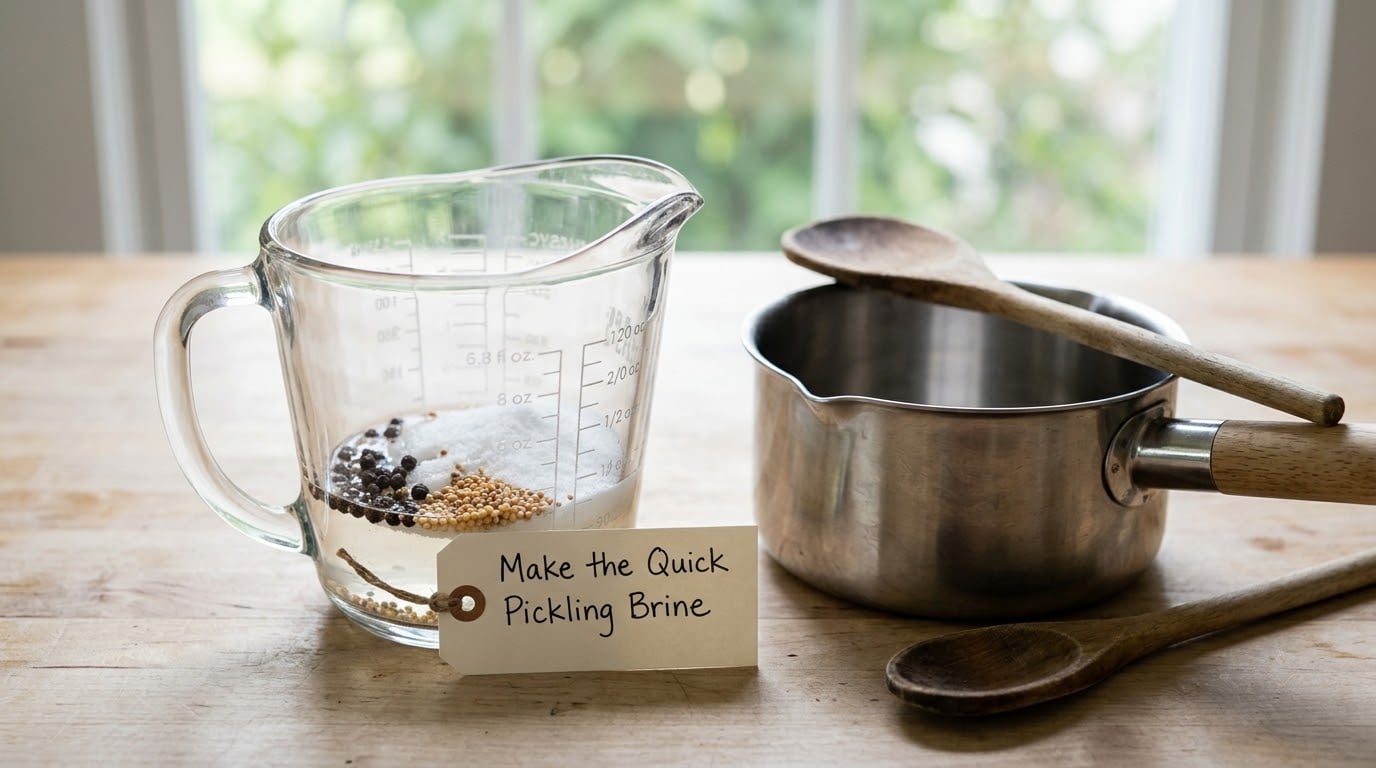
Combine the vinegar, water, salt, sugar and any whole spices in a small saucepan. Bring it just to a boil and stir until the salt has completely dissolved, then take it off the heat.
Dissolving matters more than the temperature. Salt that has not dissolved settles at the bottom of the jar and turns the last few pickles into a brine of seawater. Stir for a full minute after the boil, then let the brine cool until it is warm rather than boiling.
Pouring boiling brine over cold cucumbers cooks them and turns them limp. Warm brine melts the salt and pulls the flavor in while keeping the vegetables raw and crisp. Let it sit 10 to 15 minutes. A cold brine works too and leaves more of the raw cucumber flavor, which some people prefer for onions and peppers.
3. Pack the Jars
Put the aromatics in first: garlic cloves, peppercorns, mustard seed, bay leaves, and the dill. Distributing them jar by jar as you pack means every jar gets an even share instead of one jar holding all the flavor.
Pack the cucumbers on top, standing spears upright or laying coins flat. Pack tighter than feels natural. Crowding is fine as long as the brine can still get between the pieces, which it can with slices and barely with solid spears.
Leave 1/2 inch of headspace at the top of a pint jar, 1/4 inch on a wide mouth jar. Ingredients shift and expand as they absorb brine, and a jar packed to the rim will push its lid up and leak all over your shelf.
4. Pour the Brine and Chill
Pour the warm brine over the packed jars until everything is covered. Weigh the cucumbers down with a small glass weight or a clean lid if they float, which onions and cucumbers often do.
Then look for air pockets. Tilt the jar and swirl it, or run a chopstick down the inside wall to release trapped bubbles. Air pockets mean brine does not reach those spots, and those pickles end up inconsistent.
Wipe the rim clean with a damp paper towel before the lid goes on. Salt on the rim is what turns a sealed jar into a leaking one. Screw the lid on, and put the jars straight into the refrigerator.
They need at least 24 hours to be worth eating. Thin slices are decent at 4 hours, spears want the full 24, and flavor keeps sharpening for about two weeks before it plateaus.
5. Check the Texture and Store Safely
Pull one out after 24 hours and eat it standing up. You are checking three things: the bite, the salt level, and how the dill and garlic have come through.
| Time in the fridge | What to expect | Best use |
|---|---|---|
| 4 to 6 hours | Lightly seasoned, cucumber still tastes fresh | Salad topping, sandwich crunch |
| 24 hours | Classic pickle flavor, still crisp | The standard eating window |
| 3 to 5 days | Dill and garlic fully married, edges softening | Eating straight from the jar |
| 2 to 3 weeks | Flavor plateau, texture noticeably softer | Finishing sauces, marinades |
| 2 to 3 months | Very soft, strongly sour | Cut into relishes, if you like them that way |
Store the jars sealed in the refrigerator, and treat the fridge as the only safe place for them. Refrigerator pickles have not gone through a water bath, so they are not shelf stable and never will be. Refrigeration slows the microbes that can grow in a low-acid vegetable packed in brine.
A cloudy brine is usually calcium and spices, and it settles back to clear if you leave the jar alone. A film of tiny bubbles on the surface is yeast, which is unpleasant but not the same as spoilage. Fuzzy white or green growth, a slimy feel, or an off smell means the whole jar goes in the trash. When in doubt, throw it out.
Common Mistakes
How to Fix a Batch That Went Wrong
Most disappointing pickle batches trace back to one of six things, and four of them take under a minute to prevent.
Leaving off the blossom end. The enzymes concentrated there soften the pickle from the outside in, and no amount of brine saves it. Cut it off next time, about a quarter inch.
Pouring boiling brine over the vegetables. Heat cooks cucumber into a soft, watery texture. Warm the brine only until the salt dissolves.
Not dissolving the salt. Undissolved salt sinks and turns the bottom of the jar far saltier than the top. Stir until clear, then pour.
Skipping headspace. Vegetables expand as they absorb brine and push against the lid. Leave a quarter inch minimum, or a half inch on straight-sided pints.
Crowding jars with whole spears. Brine cannot circulate between tightly packed spears, so they pickle unevenly. Use slices for the tight jars.
Leaving them on the counter. This is a safety problem, not a flavor one. If a jar sat at room temperature for more than two hours, discard it. Fridge pickles are not built to survive that.
Two flavor problems are easy to fix after the fact. Pickles that taste too sour can be rinsed briefly in cold water and served with a pinch of sugar or a drizzle of honey. Pickles that taste too salty can be rinsed, and an unflavored saltwater brine at the same concentration is a quick fix when you have only the brine left.
Tips for Serving and Reusing the Brine
Do not throw away leftover brine. It is a seasoned vinegar ready to go to work.
Use it as a marinade for chicken, pork, or firm fish. A 30 minute soak is enough, and it saves you from measuring a separate acid. Whisk it with a little oil for a dressing, or with mustard and honey for a sharper version on potato salad and slaw.
A splash in a martini or a gin and tonic is the classic move, and a quarter cup of brine with a carbonated mixer makes a decent quick sour. Keep it in a jar in the fridge and use it within a week.
For serving, pickles work as a burger topping, a sandwich layer, or a snack straight from the jar. If you are building sandwiches to eat later in the day, dry them well first and add the pickles just before eating, since moisture is what turns good bread into a soggy one, and that is the same trap described in our guide to sandwiches that stay fresh until lunch. Pickled onions and sliced pickles are also the easiest way to make a plain cheese sandwich taste like it was planned.
For sandwich filling, drain the pickles on a towel for a few minutes first. A spear that has been sitting in brine will soak its bread on contact, and the structural fix is the layering and pressing approach in how to make an overstuffed sandwich hold together.
Pickles also hold up well in a packed lunch. If you are building a week’s worth of sandwiches in one sitting, treat them as a fresh component rather than a prepped one, since they sit better added at eating time than tucked in on Sunday, as covered in 10 best sandwiches to make ahead for the whole week.
Frequently Asked Questions
How long do quick refrigerator pickles need to sit before eating?
They are edible after about 4 hours, but good after a full 24 hours in the refrigerator. Thin coins absorb brine fastest, so they are worth tasting the evening you make them. Spears and thicker cuts want the full 24 hours before the vinegar has penetrated to the center. Flavor keeps developing for roughly two weeks, so jars made last week usually taste noticeably better than jars made this morning.
How long do quick refrigerator pickles last in the refrigerator?
Sealed jars kept continuously refrigerated stay good for two to three months, and many people eat them well past that with no issue. Quality declines before safety does: after a few weeks the pickles turn soft and very sour even though they are still safe. Refrigerator pickles are not shelf stable, so they must stay in the fridge from the moment they are made. Discard any jar showing fuzzy growth, slime, or an off odor.
Can I make refrigerator pickles without adding salt?
You can, but the pickles will taste flat and the texture suffers, because salt is what draws water out of the vegetable cells and firms them. Pickling up some slack with a little sugar and more vinegar will sharpen the flavor, though you lose some of the crunch. If the reason you are skipping salt is sodium, use half the amount and eat a few at a time rather than a whole handful, and remember to skip the salty brine.
Which vegetables are best for quick refrigerator pickles?
Cucumbers lead the list: pickling or Kirby cucumbers, Persian, or seedless English types all work, as long as the flesh is firm and the seeds are small. After that come carrots, radishes, onions, green beans, bell peppers, cauliflower, and banana peppers. Cut dense vegetables like carrots and cauliflower into thinner pieces, roughly a quarter inch, since they take brine more slowly than cucumber. Avoid large seedy field cucumbers, which go soft too fast.
Do refrigerator pickles need to be cooked or heated first?
No. The only heat these need is enough to dissolve the salt, which takes the brine just to a boil on the stove before you pour it over the vegetables. Do not pour boiling brine directly onto cucumbers, because the heat cooks them and they turn soft. Let the brine cool until it is warm, which takes 10 to 15 minutes, then pour. A fully cold brine also works if you prefer a more raw cucumber flavor.
Can I use any kind of vinegar for refrigerator pickles?
Use vinegar labeled 5 percent acidity or higher, which covers most distilled white, apple cider, and white wine vinegars. Rice vinegar is often only 4 percent, so check the label before using it in a fridge pickle. The acidity is what keeps the brine under pH 4.6 and prevents harmful bacterial growth, so this is not a good place to improvise. For flavor, distilled white vinegar is neutral, cider is fruity, and white wine is the mildest of the three.
Conclusion
The fastest path to a crisp jar is short: trim the blossom ends off your cucumbers, boil 1 cup of vinegar with 1 cup of water and 2 tablespoons of pickling salt just until dissolved, let it cool for 10 minutes, and pour it over the packed jars. Wait 24 hours before you open one.
Start with that, then start adjusting. Add more dill for a stronger herbal note, mustard seed and peppercorns for a pickled-fish profile, a sliced jalapeno for heat, or a spoon of sugar for a bread and butter pickle. Once you have a ratio you like, write it on the jar lid so the next batch is faster than the last one.