
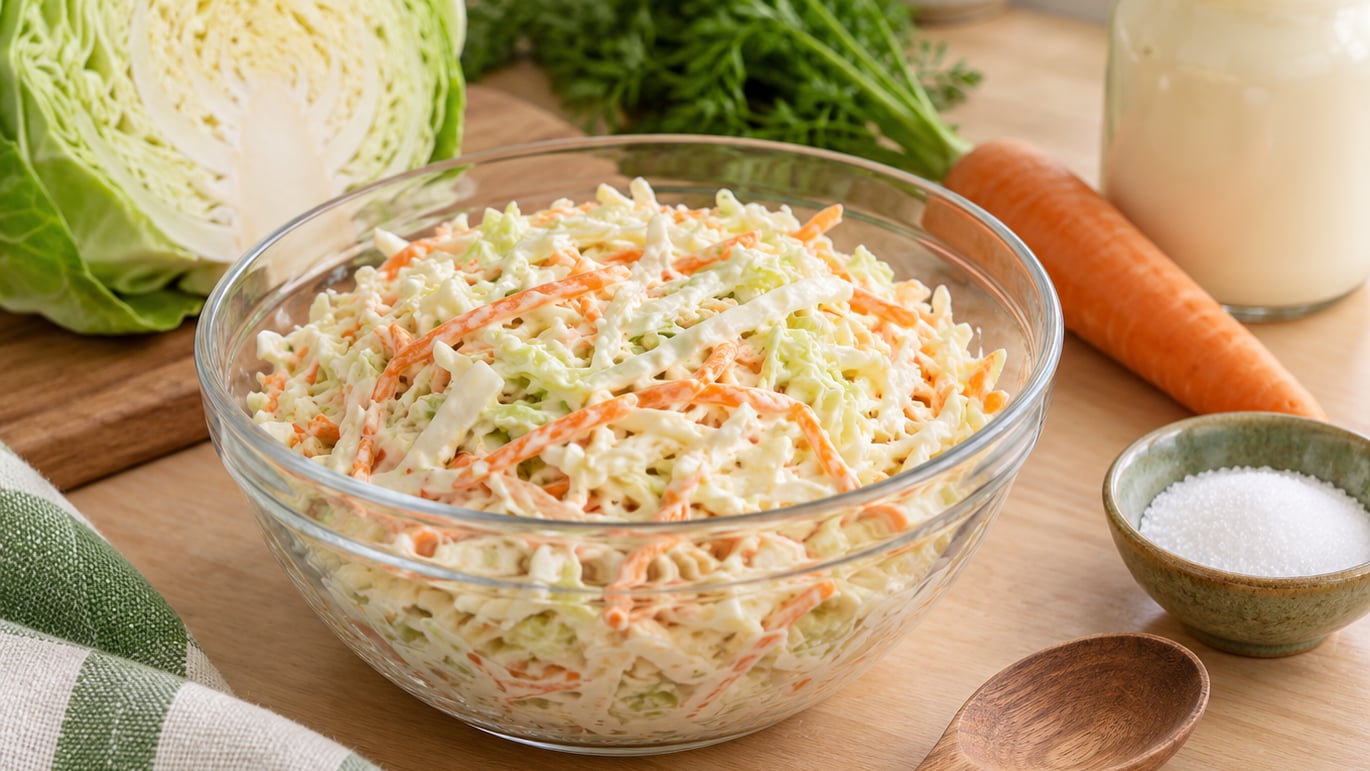
Learning how to make homemade coleslaw comes down to one step people skip: salting the shredded cabbage, letting it sit, then squeezing out the water it releases. About 15 minutes of prep plus an hour in the fridge gives you six servings of creamy, crunchy slaw with a dressing you control.
The cabbage is doing most of the work here, not the dressing. Cut it thin, get the moisture out, and the rest is a whisk and a fold. Get that wrong and no amount of mayonnaise saves it, which is why so many bowls of slaw turn into cabbage soup an hour before dinner.
Table of Contents
What You Need
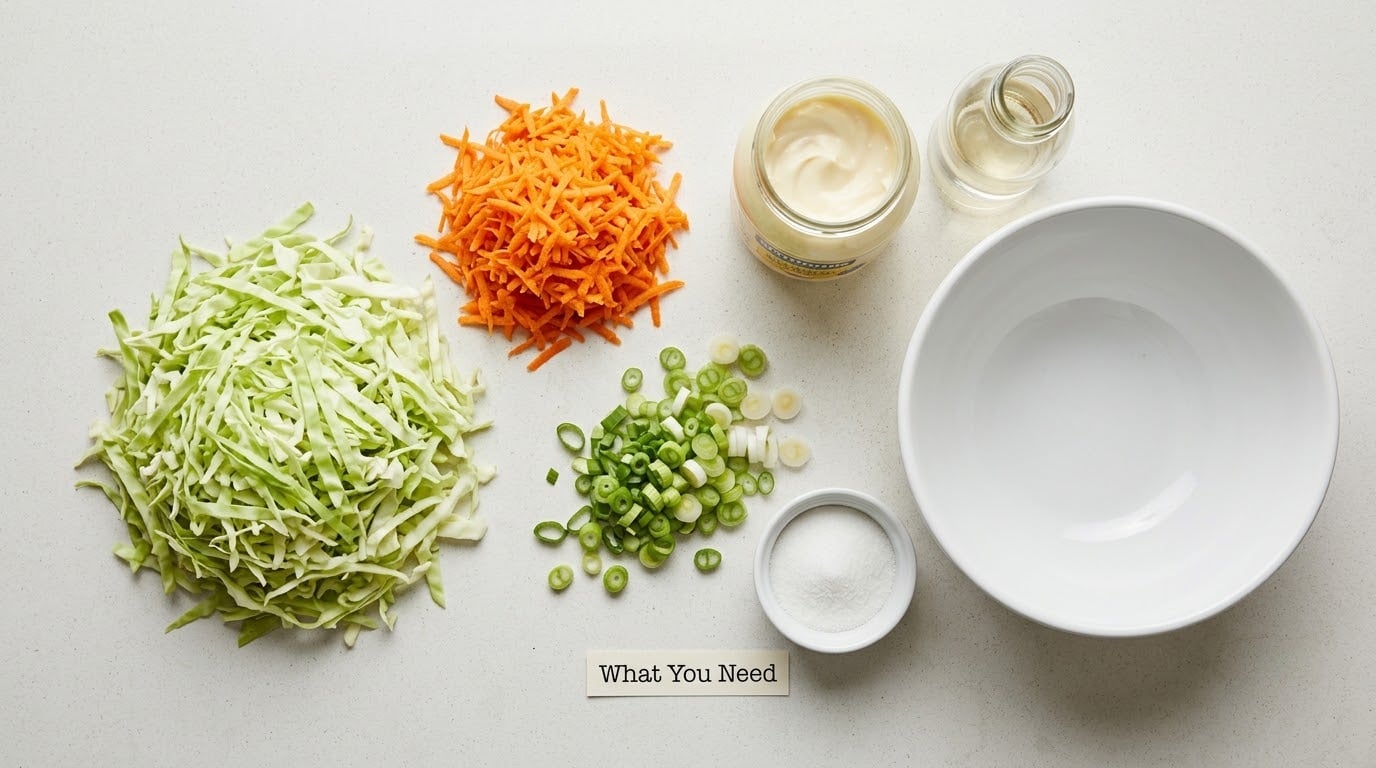
This recipe makes roughly six servings as a side dish. Every quantity below is for a half head of cabbage, so double the cabbage and carrots if you are feeding more without fussing with ratios.
- 1/2 large head green cabbage (about 450 g), core removed, about 6 cups shredded
- 1 large carrot (about 80 g), coarsely grated or julienned
- 2 scallions, thinly sliced
- 1/2 cup mayonnaise (120 ml)
- 1/4 cup sour cream (60 ml)
- 2 tablespoons apple cider vinegar (30 ml)
- 1 tablespoon granulated sugar (12 g)
- 1 teaspoon Dijon mustard
- 1/2 teaspoon kosher salt, plus more for the cabbage
- 1/4 teaspoon black pepper
The sour cream is the quiet ingredient that separates restaurant slaw from homemade. Mayonnaise alone gives you a slick, sweet coating, and sour cream adds body and a little tang so the sugar does not flatten everything out. Use full-fat versions of both if you want the closest match to a deli slaw.
Green cabbage is the standard choice because it shreds into wide, sweet leaves. Purple cabbage works if you like the color, but it is sharper and more assertive, so cut it finer and let it sit a few minutes in the vinegar before it goes into the bowl. Red cabbage is the same idea, turned all the way up.
Tools that actually help
A sharp chef’s knife and a large cutting board get you a fine shred, and they are worth the effort. A box grater is faster and produces a more uniform, softer cut, which some people prefer. A food processor with a shredding disc handles a whole head in under a minute, and the same reasoning about cutting cabbage evenly applies to any big batch of shredded vegetables, such as shredded lettuce for a sub salad.
Beyond that you need a colander set over a bowl, a clean kitchen towel, and a mixing bowl with room to toss without compressing the cabbage.
Simple substitutions
Apple cider vinegar is the classic, but white wine vinegar, rice vinegar, or distilled white vinegar all work. Use less sugar if you prefer a tangier slaw, or swap in honey or maple syrup one for one if you are avoiding refined sugar. Greek yogurt thickens the dressing like sour cream while cutting the fat, and it pairs well with a spoonful of Dijon. If you are skipping mayo entirely, a vinegar dressing is the way to go rather than a thinner mayo-based one.
How to Make Homemade Coleslaw Step by Step
Prep time is about 15 minutes, plus 10 minutes for the salt wilt and at least 1 hour of chilling. Total time is roughly 1 hour 25 minutes, and the finished salad keeps in the fridge for three to four days.
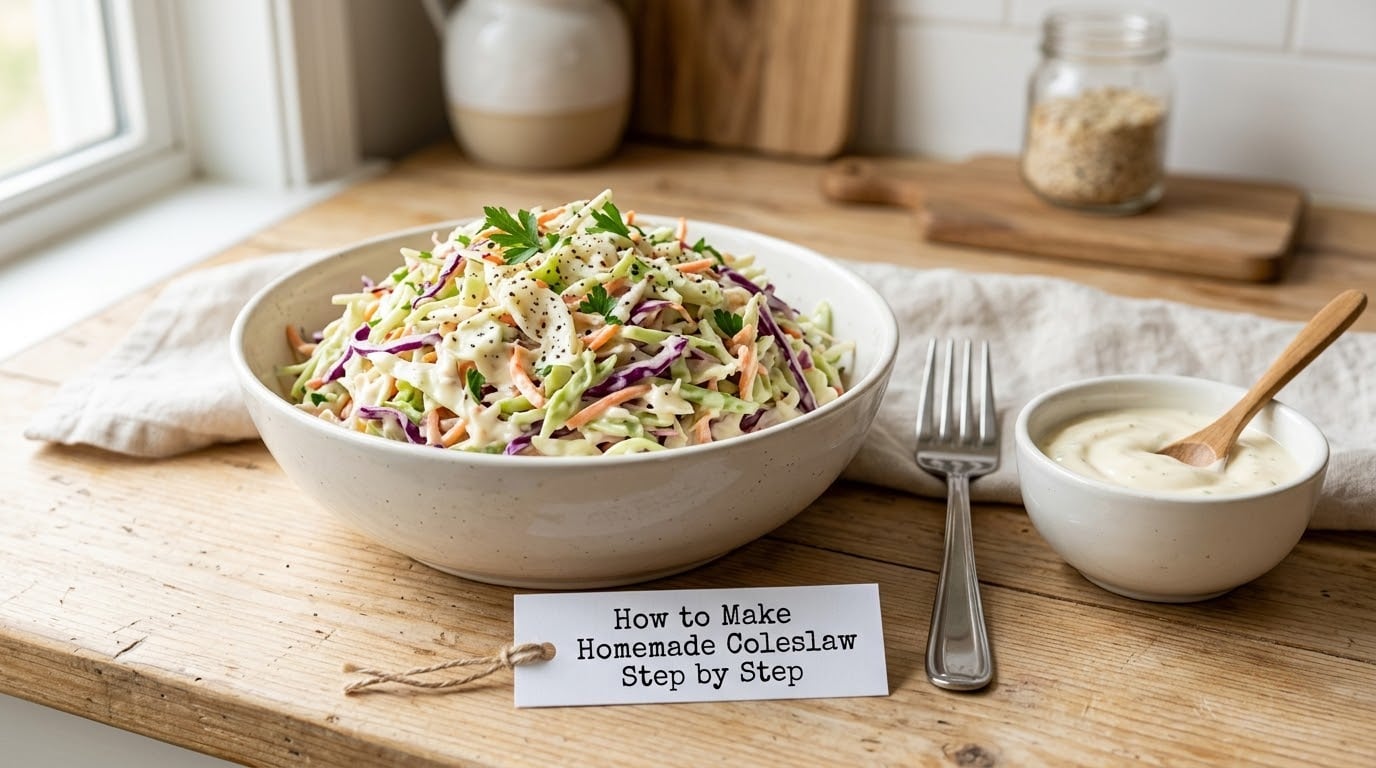
- Break down the cabbage. Cut the half head in quarters, then slice out the hard wedge of core from the center of each piece. Cut against the grain, which on cabbage means cutting from the flat outer leaf toward the core.
- Shred it thin. Slice each quarter into 1/8-inch (3 mm) strips with a sharp knife, then rotate the pile and cut again in the other direction. You want matchstick strips you can see through, not ribbons.
- Salt and wait. Toss the cabbage with 1 teaspoon of the kosher salt and let it sit in a colander set over a bowl for 10 minutes. A layer of salt on top is fine, just toss it once halfway through.
- Squeeze it dry. Grab handfuls, press firmly into the colander, then wring each handful over the sink. Be thorough but not brutal, since crushing the leaves leaves you with limp, half-mushy shreds.
- Whisk the dressing. Combine the mayonnaise, sour cream, vinegar, sugar, Dijon, remaining 1/2 teaspoon salt and the pepper in a small bowl. Whisk until smooth and pourable, about 30 seconds.
- Add the carrot and scallions. Fold them through the dry cabbage first so the shreds stay separated.
- Dress in stages. Pour about two-thirds of the dressing over the cabbage and toss with your hands until every strip is glossy. Add the rest a little at a time until the slaw is evenly coated and nothing pools at the bottom of the bowl.
- Chill, then taste. Cover and refrigerate for at least 1 hour, then taste with a clean spoon before serving and adjust.
You know it is ready when the shreds are coated but still bend without snapping, and there is no milky puddle underneath. If a spoonful of dressing sits at the bottom of the bowl, you went too far and should add a handful of freshly squeezed cabbage or a spoonful of plain shredded carrot to soak it up.
How to Make Homemade Coleslaw With the Right Texture
Crispness comes down to four decisions, and all of them happen before the mayo arrives.
Cut it evenly. Uneven shreds are the quiet reason a bowl of slaw feels raw in places and soft in others. Long strips stay tough through the chill because they take longer to soften, so aim for 1/8 inch on every piece.
Salt it, but do not oversalt it. Salt draws water out of the cabbage cells through osmosis, which is what makes the shreds softer and takes the raw edge off them. Ten minutes is enough. An hour in the salt gives you limp cabbage and a bowl of brine in the colander, and you will need more sugar and vinegar to cover the result.
Drain it completely. Rinsing after salting is optional. Squeezing is not. Every drop you leave behind comes back as watery slaw within the hour.
Add the dressing late and lightly. The more you pour in, the more liquid the cabbage has to drink, and eventually it starts leaking back out. Staged dressing plus a squeeze of extra cabbage if needed gives you the same result with less risk. Many cooks on cooking forums keep a little dressing back in the fridge and drizzle it over at the table for that reason.
Let the finished bowl sit for at least an hour before serving. The sugar dissolves, the vinegar softens, and the cabbage takes on a faint pickle edge. It is noticeably better after two hours, and many regular makers prefer it on day two. Hold the extra dressing back if you are dressing it a day early and add it just before it hits the table.
Common Mistakes and How to Fix Them
The slaw turned watery. The cause is almost always moisture that never left the cabbage, either because it was not salted or because it was not squeezed hard enough. The fix for next time is the salt wilt plus a firm wring. For slaw that is already watery, tip it into a fine colander and let it drain for 10 minutes, then fold in a fresh handful of dry shredded cabbage. If you are out of cabbage, a tablespoon of sour cream thickens the pool without flattening the flavor.
The dressing tastes flat. You almost certainly under-seasoned it because the dressing was tasted on its own. Taste it again after it has been mixed with the cabbage, since a quarter of the batch is diluted by the time you serve it. A pinch of salt and a squeeze of lemon or extra vinegar fix most flat bowls. Blandness also shows up when the sugar was measured loosely, so use a level tablespoon.
It is soupy instead of creamy. People keep pouring mayonnaise in until the slaw looks right, and it never does. Stop at the point where the shreds are glossy and the bowl has no liquid at the bottom, then eat a spoonful. Add thickeners rather than more dressing: a tablespoon of sour cream, a spoonful of the drained liquid from the colander, or more grated carrot.
The cabbage is tough or bitter. That is the core left in, strips cut too thick, or salt wilt skipped entirely. Cut around the core and slice across the grain. If the finished slaw tastes sharp, let it sit another 30 minutes with an extra teaspoon of sugar before serving, since the sweetness and the acid are correcting each other.
The shreds are uneven. A dull knife crushes cells and leaves some pieces thick while others shred to mush. Sharpen it, or use a box grater or food processor disc for consistency. Home cooks who cannot get a knife fine enough often report the grater giving them the best crunch of the three methods.
The dressing separated in the bowl. That happens when it is thinned too fast or sat undressed for hours. Whisk it again with a spoonful of cold water or a drop of vinegar, and add it to the slaw in two or three smaller additions rather than one pour.
The slaw went limp in storage. It was dressed too early and sat for days. For potluck planning, do the shredding and salt wilt a day ahead and store the cabbage dry in a sealed container in the fridge. Whisk the dressing separately and combine two hours before you serve it. Dressed slaw keeps three to four days refrigerated at 40°F (4°C) or below, which is the safe window for cut, dressed vegetables.
Never leave coleslaw sitting at room temperature for more than two hours, or one hour if it is above 90°F (32°C) outdoors. That rule applies at buffets and cookouts, where the bowl sits out longest.
Frequently Asked Questions
How long does homemade coleslaw stay fresh?
Refrigerated at 40°F (4°C) or below, homemade coleslaw stays good for three to four days. It keeps best if you store the shredded cabbage dry and dressed separately, then combine them a couple of hours before serving. If the bowl has been sitting out at a cookout for more than two hours, or one hour in heat above 90°F (32°C), discard it.
Can I make coleslaw the day before serving?
Yes, and it usually tastes better on day two. Shred and salt-wilt the cabbage up to a day ahead, squeeze it dry and refrigerate it covered without dressing. Whisk the dressing separately and toss everything together two hours before you plan to serve, adding a splash of vinegar if the slaw tastes flat.
Should I salt the cabbage before making coleslaw?
Salting the shredded cabbage for about 10 minutes pulls water out of the cells and softens the raw edge, which is what keeps finished slaw from turning watery. Drain it in a colander and squeeze the shreds dry before dressing. Skip the salt if you are making a vinegar slaw for long storage, and season the finished salad instead.
What can I use instead of mayonnaise?
Greek yogurt works well as a thickener in the creamy version, used in place of the sour cream or mixed half and half with mayo for a lighter result. For a slaw with no mayo at all, switch to a vinegar dressing of apple cider vinegar, sugar, mustard and a little neutral oil, which is the Carolina style and holds up longer.
How do I keep coleslaw from getting watery?
Salting is the main lever: toss shredded cabbage with a teaspoon of kosher salt, rest it 10 minutes in a colander over a bowl, then squeeze the handfuls dry. Dress lightly and in stages so no liquid collects underneath, and keep extra dressing out of the bowl until serving time.
Can I use pre-shredded cabbage for coleslaw?
Bagged slaw mix is shredded and treated to stay crisp, so it holds up for days, but the cut is coarse and the flavor is often flat or preservative-tasting. Shredding a fresh half head takes five extra minutes and gives you finer, sweeter pieces you can season yourself. Buy plain shredded cabbage rather than a seasoned mix if you go that route.
The Short Version
Start with the cabbage, not the dressing. Cut it thin, salt it for ten minutes, squeeze the handfuls dry, and only then reach for the mayo.
Whisk mayonnaise, sour cream, vinegar, sugar, Dijon, salt and pepper, add it in stages, and chill the bowl for an hour. Taste it with a clean spoon before it goes to the table, and keep a splash of the leftover dressing back for anyone who wants more. It travels well to a cookout, sits next to a big tray of deli-style platters without any fuss, and stays crisp on the sandwich plate the next day.