
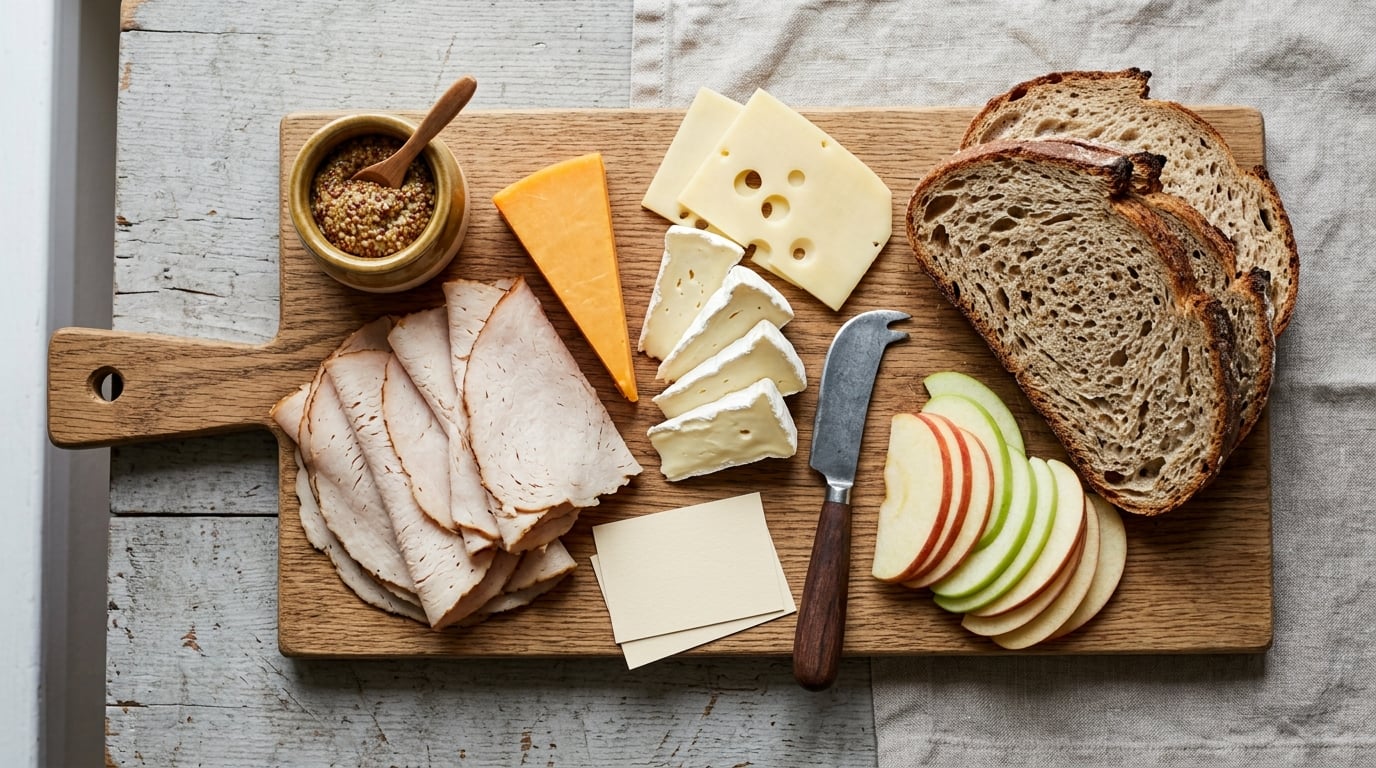
The best cheese for a turkey sandwich is Swiss, Havarti or provolone for a cold deli build, and sharp cheddar, muenster or smoked Gouda once you add heat. Turkey is lean and already salty, so the cheese has two jobs: add the flavor the meat does not have, and hold its own texture from the first bite to the last. Whether the sandwich is cold or hot changes the answer more than anything else.
That cold-versus-grilled question is the one most guides skip, and it is the one that decides your cheese. A cold sandwich needs a firm, sliceable cheese that adds a distinct note to the bite. A hot sandwich needs a low-moisture cheese that melts into the bread without breaking into an oily film or pulling away from it.
I build turkey sandwiches for a small lunch counter, and the mistake I see most often is not a bad cheese choice. It is a good cheese used at the wrong temperature. Provolone dropped onto a cold sandwich is excellent. Provolone left on a panini press too long turns into a rubbery sheet that tastes mostly of salt.
Below are ten cheeses, ordered roughly by how often they earn a spot on my board, with the flavor each one brings, how it behaves under heat, and the filling it pairs with best.
Table of Contents
- Best Cheese for Turkey Sandwiches at a Glance
- 1. Aged Cheddar for a Sharp, Hearty Turkey Sandwich
- 2. Swiss for a Classic Turkey Sandwich
- 3. Muenster for a Soft, Buttery Sandwich
- 4. Smoked Gouda for a Savory Turkey Sandwich
- 5. Fresh Mozzarella for a Creamy Turkey Sandwich
- 6. Fontina for a Rich Melt Without Excessive Sharpness
- 7. Provolone for a Crisp, Mild, Melt-Focused Sandwich
- 8. Pepper Jack for a Spicy Turkey Sandwich
- 9. Havarti for a Creamy, Buttery Sandwich
- 10. Blue Cheese for a Bold Turkey Sandwich
- Frequently Asked Questions
- Why isn’t provolone always the best cheese for a turkey sandwich?
- What is the best cheese for a classic turkey sandwich?
- Which cheese works best with turkey and avocado?
- Should I melt the cheese on a turkey sandwich?
- How can I keep a turkey sandwich from getting soggy?
- How long can a turkey sandwich with deli meat be stored safely?
- Conclusion
Best Cheese for Turkey Sandwiches at a Glance
Here is the short version. Provolone is a strong pick for a mild, sharp, melt-forward deli sandwich, and it is the right call more often than most people admit. It is simply not the most flavorful or the most texture-forward option for every turkey filling, and it has no acid to cut the saltiness that comes with processed deli meat.
| Cheese | Flavor | Melt behavior | Texture | Pairing strengths | Best sandwich style |
|---|---|---|---|---|---|
| Aged cheddar | Sharp, tangy, nutty | Melts to a smooth sauce, can break if pushed | Firm, crumbly when aged | Apple, bacon, mustard, stuffing, hot honey | Grilled, pressed, toasted |
| Swiss | Mild, nutty, slightly sweet | Even melt, minimal oil | Semi-firm with clean snap | Ham, apple, cucumber, Dijon, avocado | Cold deli sandwich or light press |
| Muenster | Buttery, tangy edge, savory | Soft creamy melt, forgiving | Semi-soft, supple | Cranberry, apple, arugula, honey mustard | Cold or gently warmed |
| Smoked Gouda | Deep, smoky, creamy | Good creamy melt | Semi-soft, smooth | Smoked turkey, bacon, caramelized onion | Toasted rye or grilled |
| Fresh mozzarella | Milky, delicate, clean | Softens, does not truly melt | Soft, moist, creamy | Tomato, basil, olive oil, roasted pepper | Cold, pressed panini only |
| Fontina | Mild tang, rich, earthy | Excellent glossy melt | Creamy, semi-soft | Mushrooms, spinach, Dijon, pear | Grilled, panini pressed |
| Provolone | Mild, slightly sharp, salty | Fast, clean melt, rubbery if overdone | Smooth, semi-hard, uniform | Roasted red pepper, tomato, onion, cherry pepper | Classic deli sub, hot sub |
| Pepper jack | Creamy with variable heat | Smooth fast melt | Semi-soft, stretchy | Pepper jelly, barbecue, bacon, apple | Panini, spicy stack, cold |
| Havarti | Buttery, creamy, gently tangy | Silky melt, no rubbery stage | Supple, creamy | Pear, cranberry, honey, mustard, apple | Cold lunchbox, warm melt |
| Blue cheese | Pungent, tangy, savory | Softens quickly | Crumbly with blue veins | Pear, apple, bacon, honey, walnuts | Cold, opened-face, toasted |
Two things this table makes obvious. First, the cheeses at the top of the melt column are the same ones people call best on a turkey sandwich, because melting well is the whole job when the sandwich is hot. Second, the cheeses that do the most for a cold sandwich, like blue or aged cheddar, barely register in the melt column, and that is exactly why they are worth keeping in the rotation.
1. Aged Cheddar for a Sharp, Hearty Turkey Sandwich
Sharp cheddar is the cheese to reach for when the sandwich is too quiet. Deli turkey is lean and faintly sweet, and a mild cheese on top of it leaves you chewing through two bland layers. A two-year cheddar brings the tang and the funk that the meat is missing.
The filling that makes it sing is something acidic and something sweet. Think thin apple slices, crisp bacon, a swipe of yellow or Dijon mustard, and a scatter of turkey dressing from the roasting pan. On a sandwich made from extra roast turkey with the stuffing still on the side, sharp cheddar is the correct answer every time.
The one caution is heat. Aged cheddar is firm, so slice it thin with a sharp knife or grate it loosely, and keep the sandwich under the press just long enough to warm the cheese through. Push it further and the fat separates, and you get the greasy orange puddle that makes people say cheddar does not belong on a sandwich. It belongs on a sandwich. It just needs less time in the pan.
Choose the age deliberately. Mild cheddar is creamy and buttery with a soft edge, which works when the turkey is sweet, like honey-smoked. A very aged cheddar is crumbly and sharp and will fight a delicate sandwich if the rest of the build is quiet. In the middle sits the two-to-three-year cheddar that most sandwich counters sell as sharp, and that is the one I buy by the pound. Colby and Colby Jack sit at the far mild end, and American cheese is the extreme version, salty and smooth enough to make a turkey sandwich taste like the ones from a diner.
2. Swiss for a Classic Turkey Sandwich
Swiss is the most balanced cheese on this list, and the one I reach for when the sandwich has to work cold, in a lunchbox, three hours after assembly. It is mild enough to stay out of the way and nutty enough to be noticed. It also melts with almost no oil, which is why it is a safe pick on a panini press.
Add ham alongside the turkey and it becomes the sandwich people describe as classic. Sharp mustard, thin apple or cucumber, a few sprouts, and the combination reads as a real sub rather than leftovers on bread. Turkey and avocado is the other pairing worth naming, and Swiss is the cheese that lets the avocado stay the star.
The varieties change the result more than you would expect. Baby Swiss is milder, softer and slightly sweet, which is the version to use for a kids’ lunchbox sandwich. Emmental, the cheese most plain Swiss is modeled on, is a little more assertive. Gruyere, aged in the same style as Swiss, brings deeper nuttiness and a firmer texture, and it is the pick when you want a cold turkey sandwich to taste grown-up without going sharp. On the r/Cooking thread about the best cheese in a turkey sandwich, the consensus cluster was Swiss, Monterey Jack and cheddar, with baby Swiss named repeatedly as a personal favorite, and that tracks with what I see at the counter.
3. Muenster for a Soft, Buttery Sandwich
Muenster is the answer when you want creaminess without committing to a heavy flavor. It sits between a mild cheese and a sharp one, with a buttery body, a gentle tang, and enough salt to work with turkey that is already salted.
Roast turkey with cranberry is the pairing to build around it. The cranberry supplies acid and tannin, muenster supplies the fat and the mellow savory note, and the turkey holds it together. Apple, arugula and honey mustard land in the same family, and muenster is the one cheese that will not make a sandwich with all three taste like too much.
Because it is soft, temperature is the thing to manage. Serve it cold from a good deli and it is creamy and clean. Warm it in a skillet and it turns glossy in about a minute. Leave it in a panini press for four minutes and the bread is over-toasted and the cheese has gone slack, so slice thin, use medium bread, and take it out while the center still has structure. Colby is the closest neighbor on a deli board, with a firmer, more neutral profile that holds up better in a wrapped and packed sandwich.
4. Smoked Gouda for a Savory Turkey Sandwich
Smoked Gouda is the cheese to reach for when the turkey already carries a lot of character. Smoked turkey, bacon, pastrami-adjacent deli meat, roast turkey with gravy, all of these want a cheese with depth rather than one that adds more depth from a different direction.
Smoke is a savory flavor, not a hot one, so it stacks with turkey without competing. The failure mode is doubling up, which is why I would not put smoked Gouda on a sandwich that already has smoked bacon and smoked paprika in the mayo. Pick one smoke source. Bacon with plain Gouda works just as well, and caramelized onion with smoked Gouda is a cold-weather favorite that tastes like a deli in Vienna.
Plain young Gouda is milder, sweeter and creamier, and it is the right choice with mild deli turkey where you want more body without any smoke. Smoked Gouda is firmer and more structured, which makes it easier to slice for a sandwich and better in a layer that has to survive a press. On extra roast turkey, smoked Gouda with a thin spread of whole-grain mustard and a few pieces of pickled jalapeno is the build I make when someone asks for something that tastes smoky but not heavy. Serve it warm, not melted through, and the creamy center survives.
5. Fresh Mozzarella for a Creamy Turkey Sandwich
Fresh mozzarella is a legitimate answer to the turkey sandwich question, with one condition: it has a lot more water than any other cheese on this list, so you have to build around that instead of pretending it is not there.
Its flavor is milky and soft, and it does not shred or brown, which means the right use is cold. A turkey and fresh mozzarella sandwich with sliced tomato, basil, a drizzle of olive oil and a little black pepper is a Caprese sandwich that works. The same cheese in a skillet turns watery and the bread goes damp in the center, so if you want it warm, use a panini press with real pressure and a short contact time, which pushes the water out rather than steaming it into the bread.
Two habits fix most of the problems. Drain the slices on a paper towel for ten minutes, and buy the lowest-moisture fresh mozzarella you can find, which is usually the ball packed in brine rather than the log in water. If you want the same creamy character with less liquid, queso fresco does the job better on turkey with avocado and lime. Feta is drier, briny and crumbly, and it works when you want the cheese to stay as distinct pieces in the sandwich rather than a melted layer.
6. Fontina for a Rich Melt Without Excessive Sharpness
Fontina is the compromise cheese, and it is the one most people do not think to buy. It has a mild tang, a creamy body and a melt that turns glossy and even in a hot pan, which is exactly what a turkey melt wants without the sharpness of aged cheddar or the rubbery finish of an over-melted provolone.
Compared with mozzarella, fontina is drier, saltier and holds more flavor, so a fontina melt tastes finished while a mozzarella melt can taste unfinished. Compared with Swiss, fontina is rounder and less nutty but richer in the mouth. That makes it the cheese for a heavier sandwich where Swiss would get lost, like turkey with sautéed mushrooms, wilted spinach and a spread of grain mustard on a thick roll, pressed until the cheese runs and the bread is genuinely crisp.
It also works cold, sliced thick, with roast turkey, apple and a thin layer of pesto. Parmesan belongs in the same family as a finishing move rather than a main slice, because it is too hard and too salty to function as a layer, but a few shavings over a fontina turkey melt add the nutty depth that the cheese itself does not have. Asiago and a mild Alpine-style cheese like Jarlsberg are the same idea with a slightly more savory edge.
7. Provolone for a Crisp, Mild, Melt-Focused Sandwich
Provolone is the default for a reason. It is mild with a slight sharpness, it carries a good amount of salt, it slices thin without breaking, and it melts fast and evenly, which makes it ideal for a hot deli sub or a chopped cold sandwich with olive, roasted red pepper and onion.
It is also the cheese that a hot sub is built around, and the reason is texture as much as flavor. Provolone softens and stretches without needing a long press, so the bread toasts while the cheese is still creamy in the middle. The cherry pepper and provolone combination on the widely-copied turkey sandwich recipe is a proven version of this, and the sweet heat of the peppers is exactly the kind of accent provolone cannot provide on its own.
When provolone is the best cheese for a turkey sandwich
It wins when the sandwich is deli-simple, when you want salt and mild sharpness without adding a distinct flavor note, and when the sandwich gets warm. Roast red pepper, banana pepper, tomato, red onion, olives, sweet pickles and a mayonnaise or mustard spread are its natural partners. Smoked turkey with provolone and a good tomato is the classic cold combination, and on r/Sandwiches that build gets called a good classic for good reason.
Why provolone is not always the answer
Three failure modes show up repeatedly. The first is one-note flavor. Provolone is a single, steady, salty note, and when it is the loudest thing on the bread, the sandwich can taste flat no matter how good the turkey is. There is no acid in it to cut through deli meat, which is already salty from the brine and the added sodium, so the overall impression is salt on salt.
The second is texture. Provolone has a short, uniform melt, and it turns rubbery quickly once it passes the creamy stage. That is fine in a 30-second sub press and disappointing in a panini that sits on the plate for a minute. The third is that it does nothing for texture. Every layer of the sandwich is soft and smooth, turkey, cheese and bread, so the whole thing reads as uniform.
Decoding the label helps here. Provolone is the young, mild, moist cheese. Provoletta is the aged, drier, sharper version, and it behaves more like a semi-hard cheese that still melts cleanly. Provolone con latte, the smoked variety, is a different flavor profile entirely. Smoked provolone with smoked turkey is a lot of smoke in one bite, which is why plain provolone or smoked Gouda usually serves that sandwich better.
8. Pepper Jack for a Spicy Turkey Sandwich
Pepper jack is a creamy, mild-bodied cheese with a variable amount of heat from the cracked pepper in the curd, and the variation is real. Within the same style you will find versions with almost no heat and versions that are genuinely spicy, which means you cannot predict it from the label.
What it does well is pair heat with a sweet or smoky filling. Pepper jack with pepper jelly on turkey is a proven combination, and the jelly is the acid and sugar that the cheese does not have. Barbecue sauce does similar work, as do bacon, apple slices and a smoky tomato. The pressed version that comes out of a panini with roasted red pepper, basil and chili crunch on ciabatta, which shows up repeatedly on sandwich forums, is the strongest argument for this cheese: pepper jack melts smooth and creamy and does not turn rubbery, so it holds up under a press where a low-moisture cheese might dry out.
Heat management is straightforward. Use a mild version for a packed lunchbox, since the heat dulls in a cold sandwich and the cheese loses its point, and put the heat in a condiment instead. Dijon, pepper jelly or a few drops of hot sauce can be scaled per person, which is impossible with pepper jack itself. For a mixed table, sharp cheddar on half the sandwiches and pepper jack on the other half solves the problem, since the cheddar brings intensity without capsaicin. Monterey Jack with no added pepper is the same creamy melt with none of the heat, and Colby Jack is the softer, blander cousin.
9. Havarti for a Creamy, Buttery Sandwich
Havarti is creamy, buttery and gently tangy, and it is the cheese to use when you want richness without weight or sharpness. The texture is soft enough to bend around the turkey and dense enough to stay in one piece in a sandwich, which is a balance most soft cheeses do not achieve.
It is the cheese that quietly handles fruit. Thin pear slices, dried cranberries, apple, a spoonful of honey, a mustard with some grain in it. The pear and Havarti pairing is the one I return to most, and if the sandwich is cold, a slice of Havarti with pear and a roast turkey thigh does the job that a bowl of soup would on a cold day. Someone in the sandwich community described Havarti as secretly luxurious, which is an accurate description of a cheese that looks ordinary and tastes expensive.
Choose by age. Mild Havarti is creamy, buttery and slightly sweet, and it is the right pick for turkey with apple, bacon or mustard, and for a sandwich that will be eaten cold. Aged Havarti, sometimes labeled Danish or extra aged, is firmer and noticeably tangier, and it holds up better when the sandwich is hot or when the filling is sharp. Provolone versus Havarti comes down to this: provolone is saltier and sharper with a fast melt that suits a hot sub, and Havarti is rounder and creamier with a forgiving melt that suits a sandwich you want to eat cold at your desk. Aged Havarti takes heat better than provolone, which is a point in its favor on a toasted sandwich.
10. Blue Cheese for a Bold Turkey Sandwich
Blue cheese is worth choosing when you want the sandwich to taste deliberate, and it is the wrong choice when someone just wants lunch. Turkey is mild enough that blue cheese does not need to fight anything, so a small amount does something out of proportion to its weight in the sandwich.
The pairings that work are sweet, nutty and acidic. Thin pear, apple, bacon, walnuts, honey, a sharp mustard, and a roast turkey that has some color from being properly browned. A cold turkey sandwich with a thin smear of blue cheese dressing, pear slices and arugula is the version I make most often, and an open-face version with a drizzle of honey and a few cracked walnuts is a genuinely good lunch.
Use less than feels right. A thin crumble scattered over the turkey, not a slab pressed into the bread, and let the blue flavor sit in the background where it sharpens everything else. For readers who want depth without the funk, the standard approach is a blend, layering a strong cheese over a mild one. Provolone underneath, a light crumble of blue on top, and the salt and melt of the provolone softens the blue into a savory seasoning. That is the technique that converts a skeptic. Goat cheese is the gentler alternative, creamy and tangy with no blue at all, and brie is the soft-ripened option that works cold with apple and honey on a sandwich that is more assembled than stacked.
Frequently Asked Questions
Why isn’t provolone always the best cheese for a turkey sandwich?
Provolone is mild, salty and melts evenly, which makes it excellent for a hot deli sub. It is not always the best choice because it is a single, steady flavor with no acid to cut the saltiness of processed deli turkey, it turns rubbery quickly if over-melted, and it adds no texture to a sandwich that is already all soft layers. Sharp cheddar, Swiss or smoked Gouda each add a distinct note instead of repeating the turkey’s mildness.
What is the best cheese for a classic turkey sandwich?
Swiss is the best all-around choice for a classic turkey sandwich. It is mild and nutty, holds its structure cold, melts without separating into oil, and works with ham, apple, cucumber and mustard. Provolone is the right pick if the sandwich is served hot and you want salt and mild sharpness rather than flavor. Many sandwich makers layer both, sharp underneath for depth and Swiss on top for the melt.
Which cheese works best with turkey and avocado?
Swiss is the best cheese for turkey and avocado, because its mild nuttiness and clean snap do not compete with the soft richness of the avocado. Havarti also works, and it is the creamier option if you want more body. Provolone is fine but adds salt without much contrast, and aged cheddar is too sharp against avocado. A thin layer of mustard and a squeeze of lemon keep the whole sandwich from going flat.
Should I melt the cheese on a turkey sandwich?
Melting suits a pressed or grilled sandwich, where the cheese needs to become a sauce and glue the bread to the filling. Provolone, Swiss, muenster, fontina and pepper jack all melt well, and a short press of 60 to 90 seconds is usually enough. Sharp cheddar, aged Gruyere and blue cheese are better cold or only lightly warmed, since long heat dries them out or breaks the fat. Very soft cheeses like fresh mozzarella are best left cold.
How can I keep a turkey sandwich from getting soggy?
The most common cause is moisture on the outside of the bread, so toast the slices first and let them cool completely. Put creamy cheese, mayonnaise and wetter vegetables such as tomato or lettuce on one side only, and keep a barrier between the filling and the bread, which means cheese, spinach leaves or a thin spread of butter. Deli turkey releases water as it sits, so wrapping it well and refrigeration for more than a few hours makes the problem worse.
How long can a turkey sandwich with deli meat be stored safely?
A sandwich made with cooked deli meat should stay in the refrigerator at or below 40 F and be eaten within three to four days. Do not leave it at room temperature for more than two hours, or one hour if the temperature is above 90 F. When reheating turkey, heat it to 165 F in the center, and for the best texture press the sandwich in a skillet rather than microwaving it, which makes the bread soft and the cheese rubbery.
Conclusion
Here is the quick decision rule. Sharp cheddar when you want tang and bite. Swiss when you want balance and a sandwich that survives a lunchbox. Muenster or Havarti when you want creaminess. Smoked Gouda when you want savory depth. Fontina when you want a rich, glossy melt. Pepper jack when you want heat. Provolone when you want a mild, salty, deli-style melt that goes fast under a press. Blue cheese when you want the sandwich to taste like a decision was made.
Start with the filling, not the cheese. Decide whether the sandwich is cold or hot, what the turkey tastes like already, and whether the other ingredients are sweet, smoky or sharp. Then pick the cheese that adds the note the rest of the sandwich is missing, instead of one that turns a turkey sandwich into a cheese sandwich. That single step is the whole difference between a good lunch and a boring one.