
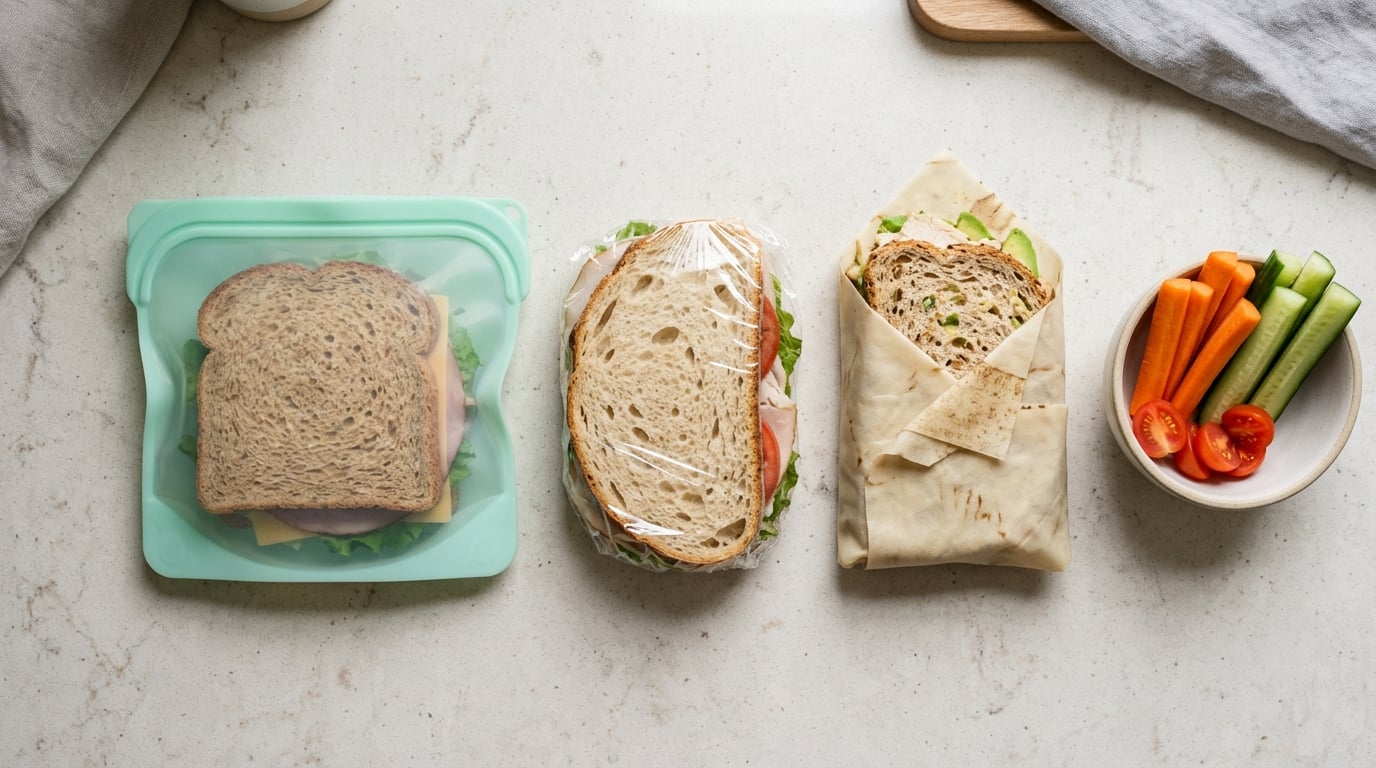
If you pack lunch most days of the week, the sandwich matters less than whatever carries it. Reusable sandwich bags vs. plastic wrap vs. beeswax wraps comes down to moisture and portability: bags win for wet fillings and long commutes, beeswax wraps win for bread, cheese, and low-waste storage, and plastic wrap is still the cheapest way to contain something dripping on the way to the car.
There is no single winner, because these three seal in three different ways. I have used all three in the same house, which is where the differences stop being theoretical and start showing up as a soggy bread slice or a melted zipper track.
Table of Contents
- Reusable Sandwich Bags vs. Plastic Wrap vs. Beeswax Wraps at a Glance
- How Well Does Each Option Keep a Sandwich Fresh?
- Which One Is Best for Wet or Messy Sandwiches?
- Reusable Sandwich Bags: Best for Commutes and Meal Prep
- Plastic Wrap: Best for Flexible, Leakproof Wrapping
- Beeswax Wraps: Best for Breathable, Low-Waste Storage
- Reusable Sandwich Bags vs. Plastic Wrap vs. Beeswax Wraps: Which Has the Lowest Impact?
- Cleanup, Storage, and Food-Safety Differences
- Which Should You Choose?
- Frequently Asked Questions
- Start With the Sandwich You Actually Pack
Reusable Sandwich Bags vs. Plastic Wrap vs. Beeswax Wraps at a Glance
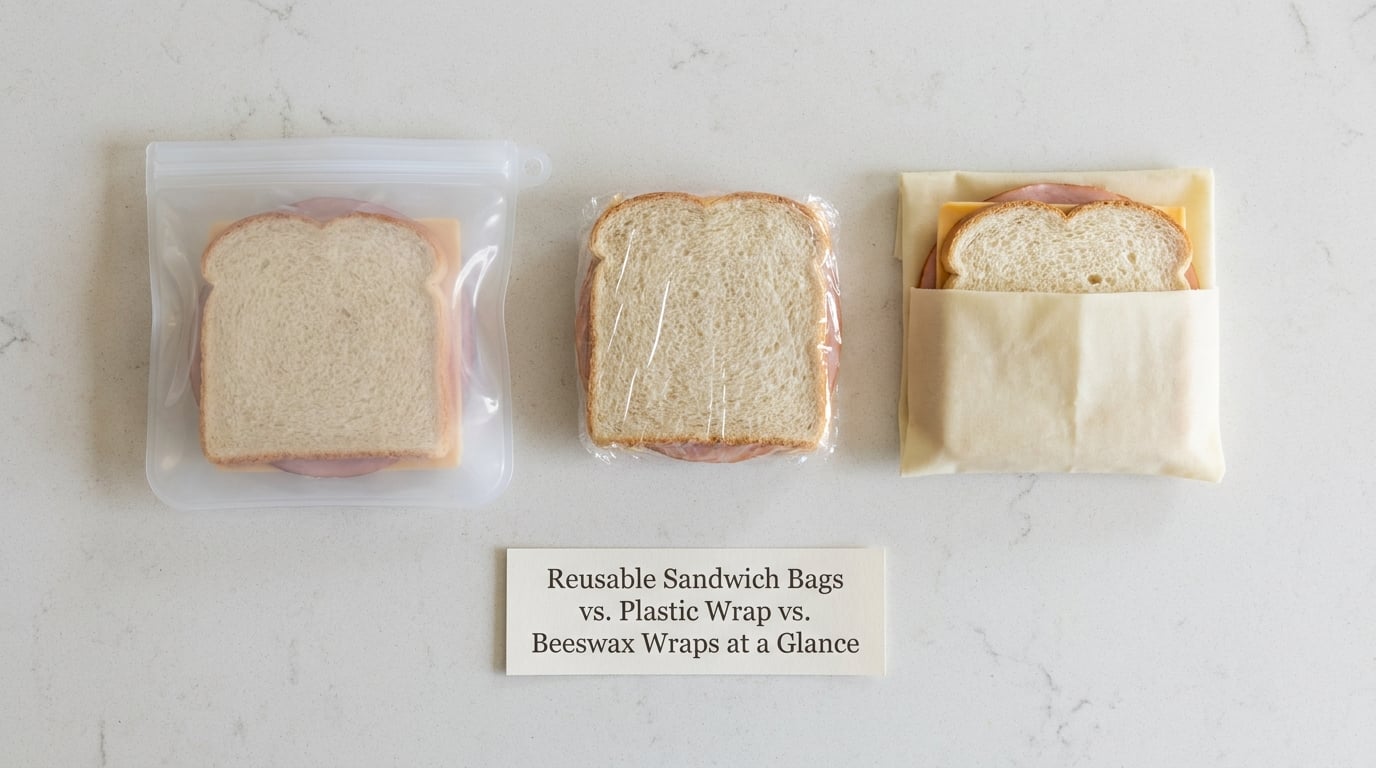
The table below compares the three by the criteria that actually change your day-to-day experience.
| Criterion | Reusable sandwich bag | Plastic wrap | Beeswax wrap |
|---|---|---|---|
| How it seals | Mechanical zip or slider track | Static cling and oil adhesion | Hand warmth softens the wax coating |
| Holds liquid | Yes, if closed properly | Yes | No |
| Moisture handling | Seals moisture in or out | Seals moisture in | Breathable, lets moisture pass |
| Good for raw meat | Only with a separate bag | Yes, then discard | No |
| Heat limits | Varies by material; check the maker | Microwave-safe in short bursts | No microwave, no hot food |
| Dishwasher | Many models yes, some hand wash | No | No, cold water by hand |
| Cleanup | Wash, then air dry fully | None, discard it | Cool water, mild soap, air dry |
| Reuse count | Often a year or more of daily use | One use | Months to a few years |
| Cost direction | Higher up front, low per use | Lowest up front, high per use | Mid-range up front, low per use |
| End of life | Long-lived, hard to recycle | Usually not accepted curbside | Home compostable when worn out |
| Best for | Commutes, wet sandwiches, meal prep | Short-term, messy, high-moisture food | Bread, cheese, cut produce, low waste |
How Well Does Each Option Keep a Sandwich Fresh?
Plastic wrap and reusable bags both seal moisture inside, and beeswax wraps deliberately do not. That single difference explains most of what follows.
Moisture and crispness
A tomato sandwich in a sealed bag or under plastic wrap will steam its own bread within a few hours. The bread goes soft first at the wet edge and then all the way through.
A beeswax wrap lets a little moisture escape, which is closer to how bread was stored before it ever met a sandwich box. Cucumber, tomato, and lettuce hold up noticeably better that way, and a half-eaten sandwich keeps its structure longer.
Odors and how long each actually lasts in the fridge
Beeswax wraps and plastic both pick up smells, but a beeswax wrap is cotton underneath, so onion and ham odors sit in the fabric. Rinse it while the smell is faint, not after a week in the fridge.
Reusable silicone bags hold odor most stubbornly of the three. Prolonged odors usually come from a bag that was not dried properly rather than from the material itself.
As a general rule, a sandwich made fresh and eaten within a few hours is fine in any of the three. A sandwich stored overnight is noticeably better in beeswax wrap or a rigid container than in anything sealed tight.
Which One Is Best for Wet or Messy Sandwiches?
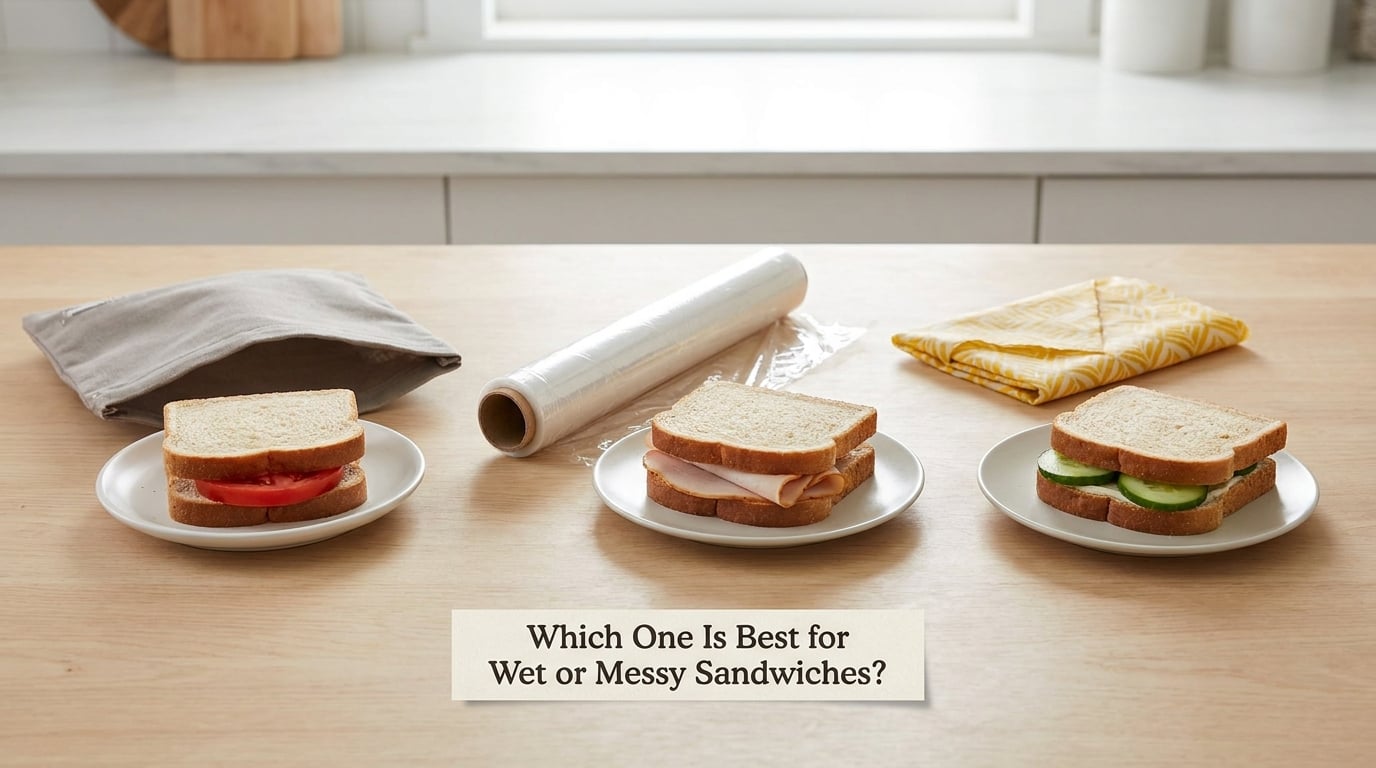
Reusable sandwich bags and plastic wrap are the stronger everyday choices, and a beeswax wrap simply cannot hold a liquid filling. It seals onto a dry bread surface and then gives up.
Reusable sandwich bags vs plastic wrap for wet sandwiches
For grilled vegetable, tuna, and egg salad sandwiches, a bag with a proper double seal wins. The track traps the moisture where a stretched film can slowly creep past a folded edge.
Two details decide whether a bag is actually leakproof. First, run your fingers along the seal to make sure there is no food or liquid bridging the two sides. Second, stand the bag upright in the fridge, because a sealed wet sandwich sitting on its side will press against the closure and eventually find a way out.
Plastic wrap still has one edge on the bag. It conforms to almost any shape, needs no cleaning, and is the right call when you are covering a plate of raw marinated meat that you will not want to wash a bag for.
Reusable Sandwich Bags: Best for Commutes and Meal Prep
A reusable sandwich bag is the option to pick if your lunch spends hours in a backpack or a car. It survives being dropped, it slides into narrow lunchbox compartments, and it does not need any technique to close properly.
Most models are food-grade silicone or PEVA and are BPA-free. Sizes matter more than brand: a true sandwich size plus one smaller snack size covers almost everything. Insulated versions exist, but the insulation is thin and mostly keeps a sandwich from being ice-cold by lunchtime, not warm.
Freezer compatibility is common, which is the quiet superpower of the bag category for batch cooking. Check the maker’s guidance for your specific material before microwaving, since microwave tolerance varies between silicone and PEVA designs.
Are reusable sandwich bags safe?
Yes, when you use them the way you would any food container. Wash them properly, dry them completely, and keep raw poultry or ground meat in a bag you will not use for a sandwich until it has been washed. Heat silicone gradually rather than microwaving a cold, stiff bag straight from the fridge, and replace any bag with a warped or cracked seal.
What are the disadvantages of reusable bags?
- They are useless for raw meat unless you keep a separate bag for it.
- They trap odors more than the other two options, especially if they are not dried right after washing.
- They take up space in a drawer and never compress flat the way a wrap does.
- A mediocre zip track leaks, and cheap bags fail at the seam long before the silicone wears out.
- They are difficult to recycle at end of life, so the case for them rests entirely on how long you keep them.
Plastic Wrap: Best for Flexible, Leakproof Wrapping
Plastic wrap is the cheapest and least fussy option, and for a lot of kitchen jobs it is still the right tool. It stretches around a bowl, a plate, a stalk of celery, or an oddly shaped leftover in a way no other option manages.
It is transparent, so you can see the food without lifting the cover, and it grips a wet surface better than anything else on this list. That is why it remains the default for short-term refrigerator storage of cut fruit, opened packages, and anything still leaking.
Handle raw meat by wrapping it directly, keeping it on a separate plate in the refrigerator, and discarding the film with the tray when the meat is cooked. Do not let it touch a sandwich that will be eaten uncooked.
The drawbacks are steady rather than dramatic. It is a single-use petroleum-derived film that most curbside recycling programs do not accept, so it goes straight to landfill. Run a food supply down to its last corner and you will often use a second sheet for a job the first sheet half-covered.
Beeswax Wraps: Best for Breathable, Low-Waste Storage
A beeswax wrap is cotton coated with beeswax, coconut oil, and tree resin. The seal comes from your own hands. Warm the sheet with your palms, press it over a sandwich, and the coating softens enough to cling to itself.
For bread, cheese, and cut produce, this is the best-behaved option of the three. It breathes, it folds down to almost nothing, and a set of three sizes covers a half sandwich, a full sandwich, and a large bowl or plate.
Keep it away from raw meat, raw fish, and anything dripping. Skip hot food, skip the microwave, and stay away from the dishwasher. A beeswax bag cannot be melted, pressed, or ironed back together, so it is a cold-storage tool only.
What are the drawbacks of using beeswax wraps?
- No microwave, no hot food, no oven, no dishwasher.
- They will not hold a liquid filling, so wet sandwiches are out.
- Grease from certain foods will not wash out of the cotton.
- The wrap slowly loses its stick and eventually stops sealing well.
- Wax and resin are animal-derived, which some people avoid for dietary or religious reasons.
How many times can you reuse a beeswax wrap?
Brands make widely varying claims, and the honest range is months to a few years rather than a fixed wash count. A wrap that survives a year of daily sandwich use is doing well. Wash it in cool water with mild soap, dry it flat, and fold it rather than rolling it, so the wax does not crack along a crease.
When it stops clinging on its own, it is done. You cannot restore the original stick, and a rewaxing kit is a hobby rather than a fix.
Reusable Sandwich Bags vs. Plastic Wrap vs. Beeswax Wraps: Which Has the Lowest Impact?
Reusable options usually win, but not automatically, and the reason is worth understanding. Impact is driven by how many times you use the item and how you dispose of it, not by the material alone.
Plastic wrap is cheap and convenient, and the honesty is that most people use a sheet or two per day and throw all of it away. A wrap that is not accepted by your local curbside recycling has no second life at all.
Beeswax wraps have a genuinely favorable end of life. Cotton, wax, coconut oil, and tree resin are all things that break down in a home compost pile, which is a rare quality in a food-contact product.
Reusable bags have the strongest case only when they stay in rotation for a year or more. A bag that is used twice and then binned has a worse footprint than the film it replaced. Washing them also costs water and energy, and they are not recyclable at end of life.
Do beeswax wraps or silicone bags shed microplastics?
Beeswax wraps do not contain plastic, so the question does not apply to them. Food-grade silicone does not shed microplastics under normal use, including in the dishwasher, but very cheap uncertified silicone can be a different story. Buy bags labeled food-grade or BPA-free, and replace any that tear, craze, or develop a sticky surface.
Cleanup, Storage, and Food-Safety Differences
Cleanup is where the reusable options quietly add work, and the most common complaint from people who give up is drying, not washing.
- Bags: turn inside out, wash with dish soap, rinse, and prop open until completely dry. Trapped moisture is what causes odor and mold.
- Beeswax wraps: cool water and mild soap, no soap on heavy grease, dry flat, and store folded in a drawer or basket.
- Plastic wrap: nothing to clean, but it must be removed from food-contact surfaces before you recycle anything else nearby.
Keep raw poultry and ground meat at or below 40°F and refrigerate perishable sandwiches within two hours, using a shallow container if you are cooling cooked leftovers before packing. Reheat deli meats and cooked leftovers to 165°F before serving.
How long does each option really last?
A roll of plastic wrap lasts exactly one use. A quality bag usually runs a year or more of daily lunches before the seal or the silicone gives out. A beeswax wrap in regular use tends to lose its stick somewhere between several months and a couple of years, and it stops working well rather than falling apart.
Whichever you choose, the lifespan is set by the drying and washing habits, not by the purchase date.
Which Should You Choose?
Choose based on the filling and the trip, not on the category.
- Reusable sandwich bags for work, school, meal prep, and anything wet, saucy, or likely to be sat on in a bag. Buy a true sandwich size plus a snack size.
- Plastic wrap for short-term refrigerator coverage, flexible shapes, and raw meat you want to isolate and discard.
- Beeswax wraps for bread, cheese, and mostly dry sandwiches, for covering bowls and plates, and for cutting single-use plastic from everyday food storage.
If you only buy one thing to start, the answer depends on your lunches. A packed commute every day means a bag. Mostly sandwiches eaten within an hour of packing mean a set of beeswax wraps. Keep a small box of plastic wrap as the backup for raw meat and messy refrigerator storage.
Most low-waste kitchens that I have seen run all three at once, and that is not a failure to commit. It is just a sensible division of labor.
Frequently Asked Questions
Are reusable sandwich bags better than plastic wrap?
For packed lunches, yes. A bag with a working seal survives the trip, goes in the dishwasher, and replaces hundreds of disposable bags over a year. Plastic wrap is still better for raw meat, oddly shaped leftovers, and short refrigerator storage, because it conforms to anything and costs almost nothing to use once. A lot of households keep both.
Can beeswax wraps be used for every kind of sandwich?
No. Beeswax wraps cannot hold liquid, so tomato, tuna, and any drippy filling will end up on the counter. They also cannot go in the microwave, hold hot food, or be washed in the dishwasher. They shine with bread, cheese, deli meat, and cut vegetables stored in the refrigerator or carried for a few hours.
What is the best reusable container for a lunchbox?
For most people, a food-grade silicone or PEVA bag in a true sandwich size, plus a smaller size for snacks. It packs flat, survives being dropped, and fits narrow compartments. An insulated jar only wins if the lunch is mostly chopped fruit or yogurt, since the insulation is thin and designed to slow warming rather than keep food hot.
How long can each option keep a sandwich in the refrigerator?
All three are fine for a same-day lunch, and none of them makes a sandwich last much longer than a day or two. Beeswax wrap preserves crispness best because it breathes, while plastic wrap and sealed bags keep moisture in, which softens bread faster. For anything stored longer, use a rigid airtight container rather than any of the three.
Are plastic sandwich bags recyclable?
Most curbside programs do not accept plastic film, including sandwich bags and cling wrap, because it tangles and jams sorting equipment. Some grocery-store drop-off programs do take it. A reusable bag only helps if you keep using it for years, since the plastic version is buried the moment you throw it away.
Can beeswax wraps go in the dishwasher?
No. Dishwasher heat and detergent strip the wax and resin coating, and the wrap will stop sealing. Wash it by hand in cool water with mild dish soap, rinse, and dry it flat with the waxed side up. Once it no longer clings on its own, the coating is spent and the wrap should go in the compost.
Start With the Sandwich You Actually Pack
Judge each option by the food in front of you. In this reusable sandwich bags vs plastic wrap vs beeswax wraps comparison, the simple split is a bag for routine lunches that travel, plastic wrap for wet or short-term sandwiches, and beeswax wraps for dry fillings and lower-waste storage.
Whichever one you pick first, buy the size you will actually use and wash it the day you unpack it. That habit does more for the life of the product than anything written on the packaging.