
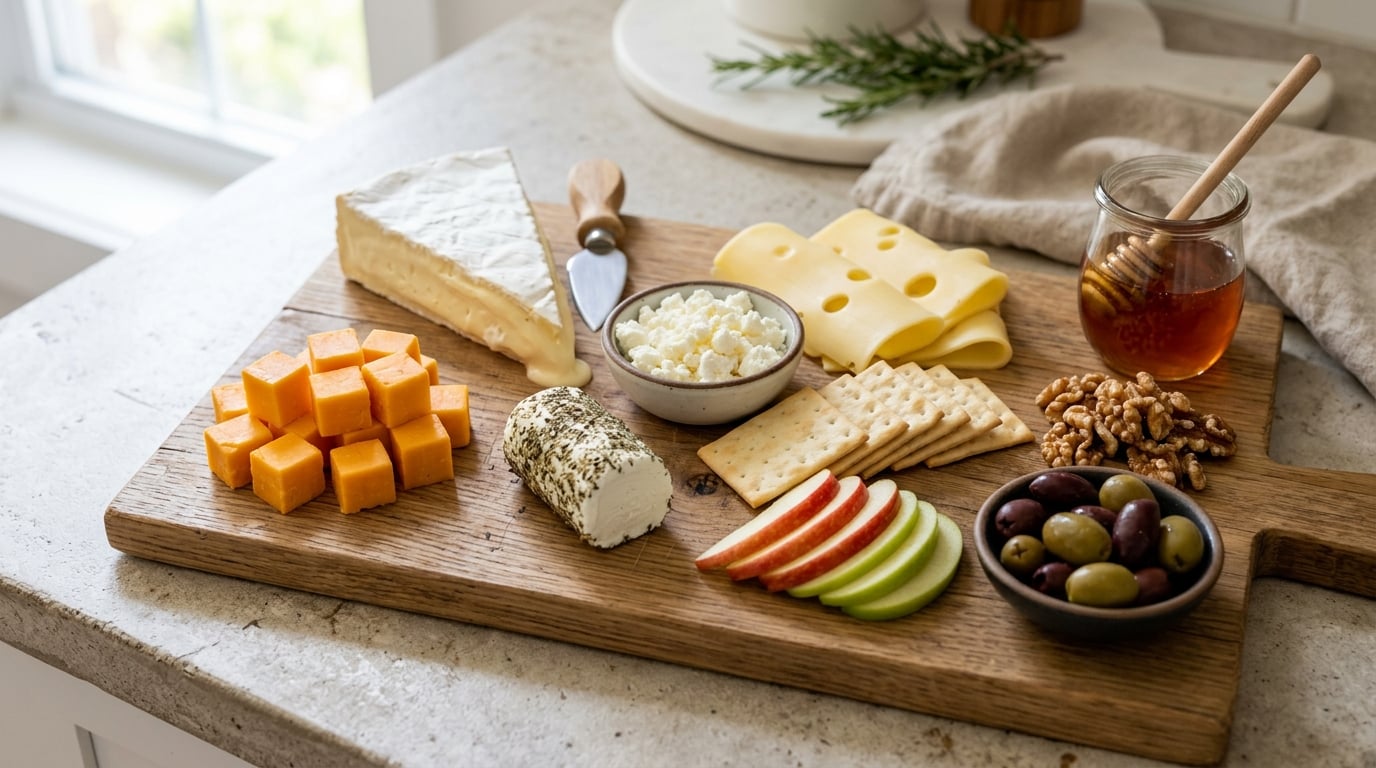
A charcuterie board does not need a specialty cheese shop. The best cheeses for a budget charcuterie board from a regular supermarket are the everyday block cheeses sitting in the refrigerated case: sharp cheddar for savor, mozzarella for creaminess, Swiss for nuttiness, feta for salt, and a wedge of brie as the centerpiece. Pick one cheese from each texture family, add crackers, fruit, and olives, and you get a board that looks generous and tastes layered for a fraction of what a cheese counter charges.
Most people assume budget means dull. It does not, as long as contrast does the work. Three mild cheeses on one board is the real failure, not three inexpensive ones with sharp, tangy, and crumbly notes standing between them.
Below I break down ten supermarket cheeses worth buying, what each one does on the board, and what to put next to it. Prices vary by region and change often, so I have ranked everything by price tier rather than quoting numbers that will be stale by the time you read this.
Table of Contents
- Best Cheeses for a Budget Charcuterie Board from a Regular Supermarket at a Glance</
- 1. Budget-Friendly Sharp Cheddar
- 2. Low-Cost Mozzarella
- 3. Value-Packed Swiss Cheese
- 4. Everyday Parmesan
- 5. Budget Goat Cheese
- 6. Soft Brie or Brie-Style Cheese
- 7. Affordable Feta
- 8. Mild Havarti or Sandwich-Style Cheese
- 9. Inexpensive Blue Cheese
- 10. Budget Colby or Mild American-Style Cheese
- How to Build a Balanced Budget Charcuterie Board
- Frequently Asked Questions
- How many cheeses should I put on a budget charcuterie board?
- What are the cheapest cheeses at a regular supermarket?
- Can I make a charcuterie board without specialty cheese?
- What cheese goes best with crackers, fruit, and cured meats?
- How do I keep a supermarket cheese board affordable?
- How should I store cheese before serving it on a charcuterie board?
Best Cheeses for a Budget Charcuterie Board from a Regular Supermarket at a Glance</
The table below shows how these ten cheeses divide across texture, flavor, and cost, and what each one contributes to a balanced board. Price tier is relative, based on typical per-pound cost in a standard US supermarket, and the board role column tells you what gap the cheese fills.
| Cheese | Texture | Flavor | Price tier | Best pairing | Board role |
|---|---|---|---|---|---|
| Sharp cheddar | Firm, sliceable | Bold, savory, tangy | Low | Apple slices, seeded crackers, salami | The savory anchor |
| Mozzarella | Soft, milky, slightly springy | Mild, fresh | Low | Tomatoes, basil, baguette chips | Creamy mild base |
| Swiss | Semi-firm with small holes | Mild, nutty, slightly sweet | Low | Ham, mustard, crispbread | Everyday neutral |
| Parmesan | Hard, crumbly | Salty, nutty, sharp | Low to mid | Crackers, olives, salami | Texture contrast |
| Goat cheese | Soft, creamy, sometimes logs | Tangy, lemony | Mid | Honey, preserves, walnuts | Tang counterweight |
| Brie-style | Soft-ripened, bloomy rind | Buttery, mild, mushroomy | Mid | Grapes, baguette, prosciutto | Centerpiece |
| Feta | Crumbly, brined | Salty, briny, sharp | Low | Cucumber, olives, pita | Salty brightener |
| Havarti | Semi-soft, buttery, small holes | Mild, creamy | Low to mid | Apples, nuts, cold cuts | Kid-friendly mild |
| Blue cheese | Crumbly with blue veining | Pungent, salty, creamy | Low to mid | Pear, honey, walnuts | Bold finish |
| Colby or mild American | Semi-soft, sliceable | Mild, buttery, neutral | Low | Crackers, pickles, apple | Volume filler |
That last column matters more than people expect. A board works when each cheese has a job, and the job is usually about texture or intensity rather than prestige.
1. Budget-Friendly Sharp Cheddar
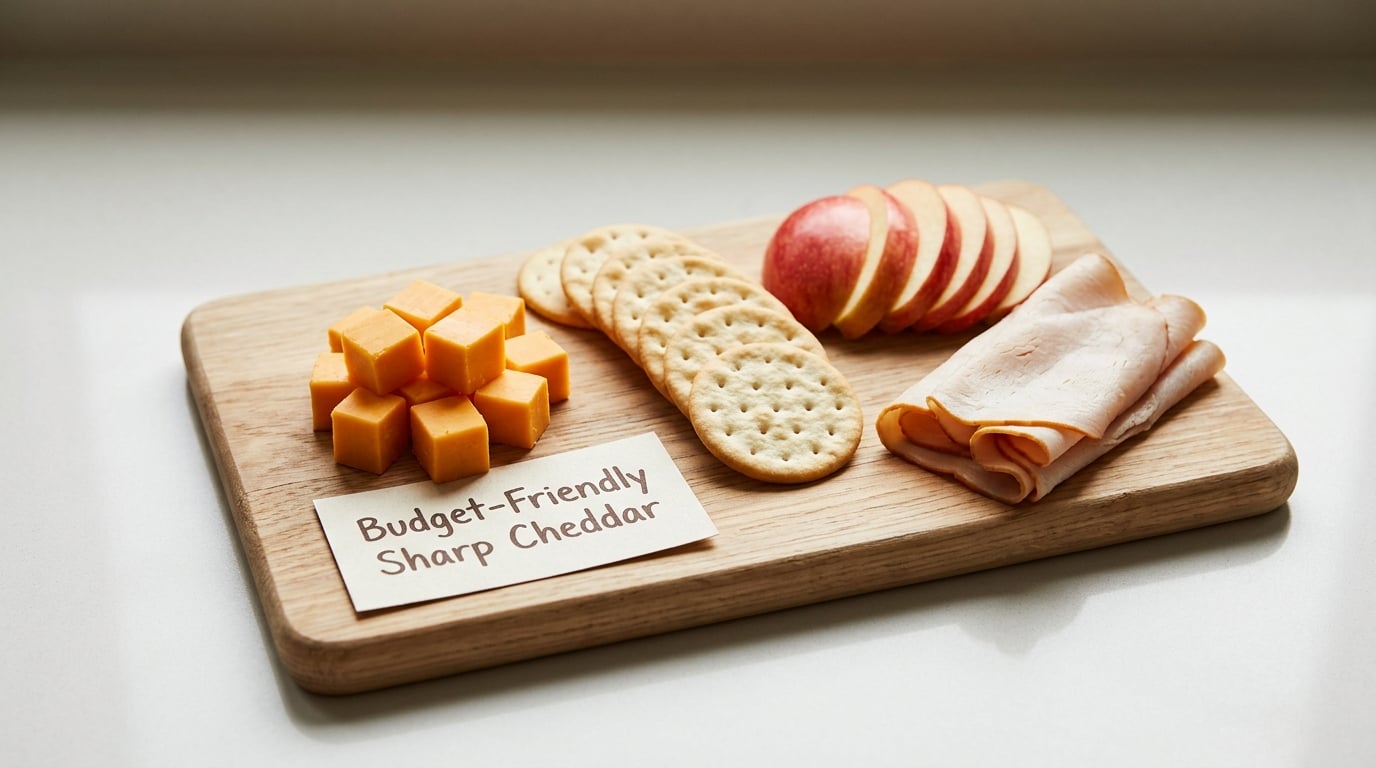
Sharp cheddar is the anchor of a budget board because it carries the most flavor per dollar in the case. Aged cheddar develops a savory, slightly tangy depth that plain mild cheese never reaches, and that depth gives the whole board something to be balanced against.
Which sharp you pick depends on who is eating. Medium sharp works best for mixed crowds, because it has flavor without turning sharp enough to overpower cracker crumbs. Extra sharp is more assertive and works well next to fruit and sweet cured meats, where the acidity and sugar soften it.
Serve it cubed rather than sliced if you want the board to look abundant. A small hand-cut cube of a cheap block reads as more generous than a thin ribbon from the deli case, and cubing gets more cheese onto the board for the same money.
A serving example I keep coming back to: sharp cheddar cubes with seeded crackers, thin apple slices, and folded turkey or salami. The apple cuts the fat, the turkey adds salt, and the crackers add crunch. Nothing there needs a specialty shop.
One practical note. Cheddar bruises and dries faster than most cheeses, so buy it close to the day you plan to serve and keep it in a sealed container in the refrigerator. It will hold its texture for a couple of days without trouble.
2. Low-Cost Mozzarella
Mozzarella is the affordable way to get creamy and mild on a board. It does almost nothing bold, and that is exactly why it earns a spot: it softens the sharp edges of everything else on the board.
Supermarkets carry two useful forms. The low-moisture block, sold near the pizza toppings, is firmer and slices cleanly, which makes it the better board cheese. The fresh tub packed in brine is wetter and softer, better suited to caprese-style plating with tomatoes and basil than to a cracker board.
For a board, tear the low-moisture block into rough pieces instead of slicing it. Torn edges catch light and hold dressing or oil, and the irregular shape looks less like deli counter-cut and more like something you put together yourself.
Pair it with cherry tomatoes, fresh basil leaves, a drizzle of olive oil, and a few crackers. Capable cooks also toast bread rounds and top them with mozzarella and tomato for a two-minute crostini, which reads as effort without the cost.
Watch one thing: fresh mozzarella has a short refrigerated life compared to other cheeses. Check the date and buy the block for anything you are planning more than a day ahead.
3. Value-Packed Swiss Cheese
Swiss-style cheese adds a mild nuttiness and a semi-firm bite that most soft cheeses cannot. It is the quiet workhorse of a budget board, sitting between the sharper cheeses and the soft ones without taking over the plate.
At the supermarket, look for a block rather than a presliced pack. Presliced Swiss is convenient but the per-pound cost is usually higher, and the slices are often thinner than what you want on a board. A block also lets you cut thick half-inch pieces that stand up next to crackers.
Check for even small eyes and a smooth texture, and avoid blocks with an overly wet surface. You do not need aged or imported Swiss. The standard aged or plain variety in the case is the one built for this job.
Serve Swiss folded or layered with thin deli ham, a dab of mustard, and crispbread or water crackers. It also pairs well with apple slices and with a mild red wine, and it holds up on a board that will sit out for a couple of hours better than most soft cheeses.
4. Everyday Parmesan
Cheese boards need at least one hard, crumbly cheese because the soft ones all taste similar by the second bite. Parmesan fills that gap with a salty, nutty punch and a completely different texture from everything else.
Buy the wedge, not the pre-shredded tub. Shredded Parmesan is treated with cellulose to keep it from clumping, which costs more per pound and dries out on a board within an hour or two. A wedge shaves or crumbles cleanly with a fork and stays flavorful for the whole party.
Shave thin with the small hole side of a box grater for crackers, or crumble larger chunks for a more rustic look. The bigger the crumble, the longer the surface stays visible and the better the texture contrast against a soft cheese next to it.
Pair it with olives, salami, and a few plain crackers. It also works with roasted red peppers and with fresh pear slices, and a little shaved parmesan over a bowl of the leftover tomato and mozzarella from earlier turns into a real meal the next day.
5. Budget Goat Cheese
Goat cheese is the answer when a board tastes flat. Its tang is mild enough to be approachable and sharp enough to reset the palate, and it does the same job on a budget board that a specialty chèvre does on an expensive one.
For a board, pick a mild log rather than a heavily aged or peppery version. Logs slice cleanly into coins, hold their shape on a cracker, and spread if guests want to build their own. Plain versions are usually the safest choice for a mixed group.
Serve the coins with honey, fig or apricot preserves, and a small bowl of walnuts. That trio is the classic pairing, and it costs less than the cheese does. Add thin apple slices for crunch and a few unsalted crackers underneath so the softer log has something to sit on.
Goat cheese travels well for a party because it holds up at room temperature better than brie or fresh mozzarella. Leave it in its wrapping until the last minute, then cut the log just before guests arrive so the cut faces stay clean.
6. Soft Brie or Brie-Style Cheese
Brie is the centerpiece. It is the one cheese people expect to see on a board, it photographs well, and a supermarket version gives you the buttery interior and soft bloomy rind for a small fraction of the specialty-counter price.
Choose a wheel or a full-size wedge rather than the small triangles in the snack section. Bigger units cost less per ounce and give you enough to cut a proper centerpiece. Let it sit at room temperature for 20 to 30 minutes before serving so the inside softens without the rind going slimy.
Wrap it and store it in the refrigerator until serving, in the same box or airtight container it came in. Brie is the cheese most often ruined by early unpacking, so resist the urge to leave it out all afternoon while you arrange the rest of the board.
Pair it with grapes or sliced pears, thin baguette rounds or crackers, and prosciutto, ham, or fig jam. For a budget version of the classic, spread a thin layer of apricot preserves on the brie right before serving. It takes ten seconds and makes the cheese look like a deliberate choice.
7. Affordable Feta
Feta contributes salt and crumble, and those are the two things most budget boards are missing. Even a small amount wakes up a spread that is starting to taste one-note.
Block feta is the better buy. It is less expensive per ounce than crumbled feta, it keeps longer in the brine, and you control how fine the crumble is. Pre-crumbled feta has more surface area exposed to air and brine, which makes it dry out and turn dull within a day or two of opening.
Crumble it yourself over the board just before serving, or keep a small sealed tub of brine alongside so guests can keep moistening what they do not use. Feta goes salty fast, so treat it as an accent rather than a main slice.
Serve it with cucumber slices, kalamata or green olives, fresh herbs like mint or oregano, and toasted pita or pita crackers. A tray of baked feta with tomatoes and olives reads as a restaurant dish and costs almost nothing beyond the block you already bought.
8. Mild Havarti or Sandwich-Style Cheese
Havarti is the cheese that keeps a mixed-age group happy. It is mild, buttery, and semi-soft, with small holes and a texture that feels familiar, which makes it the safest pick when there are children or cautious eaters at the table.
Any mild sandwich-style cheese works in the same slot: mild cheddar, colby, Monterey Jack, or a basic Swiss. The point is not the specific variety but the texture, a soft sliceable cheese that sits between the crackers and holds its own without a strong aroma.
Buy a block, not the pre-sliced pack, for the same reason as Swiss. Slice it thin for crackers or cut it into finger-width pieces for people who do not want to assemble their own bites. Its mildness also makes it a good carrier for a topping, so a strip of havarti with a fig slice and a thin piece of prosciutto is a small assembled bite that looks considered.
Pair it with apples, pears, salted nuts, and cold cuts. It is also the cheese most likely to disappear first at a party, so if the group is large, buy more of this one than your math suggests.
9. Inexpensive Blue Cheese
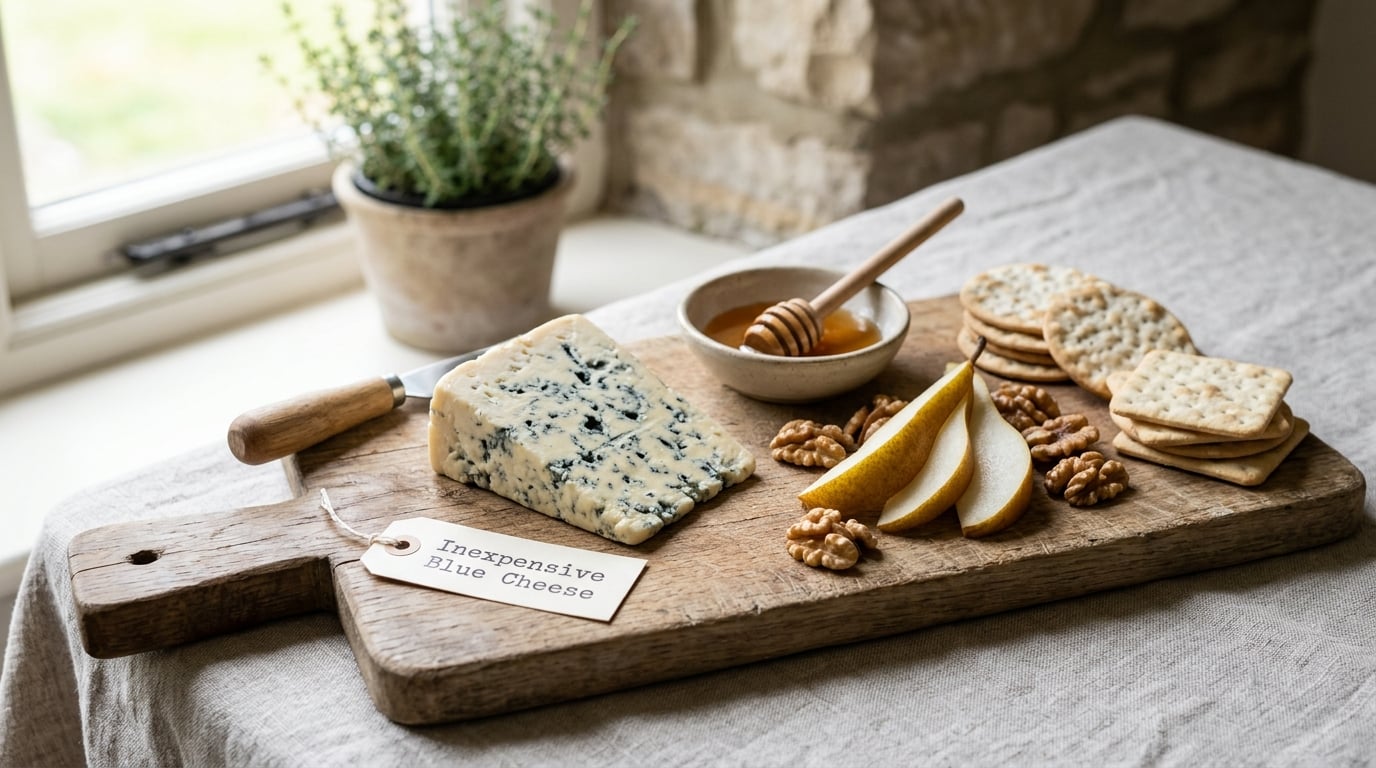
Blue cheese is optional and polarizing, which is exactly why it belongs on a budget board. A small wedge of mild blue adds a depth that nothing cheap else provides, and guests who like it will eat a surprising amount of it.
Choose a mild or moderate variety rather than a sharp, aged, or heavily veined one. The supermarket versions labeled mild blue or gorgonzola are creamy and gentle, with enough blue veining to look like blue cheese but not enough funk to clear a room. Check the ingredient list if you are sensitive to strong flavors, since some versions are much more assertive than the name suggests.
Balance it with sweetness and fat. Thin pear slices, honey, and walnuts are the pairing that works every time, because the sugar and the nut bitterness pull the pungency back to a place most guests can enjoy.
Serve it crumbled rather than sliced. Crumbling also stretches the wedge further, which matters when you are working to a budget, and it lets you use a small amount on a cracker-heavy board without it taking over.
Keep it sealed in the refrigerator. Blue cheese spread around a board transfers smell to everything it touches, so give it its own container and its own corner of the platter if you are serving a mixed group.
10. Budget Colby or Mild American-Style Cheese
Colby and mild American-style cheese solve a specific problem: a large group where some guests will not eat the sharper or tangier options. They are mild, smooth, and inexpensive, and they are the closest thing on a budget board to a neutral filler.
They also carry volume cheaply, which is why they earn their place. When you are feeding fifteen people and need the board to look full, mild American slices folded into rosettes fill space that expensive cheese would cost several times more to cover.
Fold the slices rather than laying them flat. A simple fold into quarters, stacked loosely in a row, or a loose ribbon reads as deliberate, while a flat stack of slices reads as lunch meat. Cut thick squares for a kid-friendly option that is easy to pick up.
Pair it with crackers, pickles, apple slices, and jelly. A small bowl of sweet pickles next to mild American is the combination most children will actually eat, and it costs almost nothing.
How to Build a Balanced Budget Charcuterie Board
Balance comes from texture and intensity, not from price. A board of three mild cheeses tastes the same no matter how little you spent on it, while a board of three cheeses that are sharp, tangy, and crumbly tastes considered even if every item came from the same store brand shelf.
Pick one cheese per texture family
Choose one firm or aged cheese, one soft or creamy cheese, one tangy or brined cheese, and one crumbly cheese if your budget allows. Sharp cheddar, brie, goat cheese, and feta fit that pattern exactly. A hard cheese like Parmesan rounds it out and adds the crumbly slot in a single purchase.
Four to six cheeses is the useful range. Three feels sparse on a board for more than six people, and more than six means most of the cheese sits out until it is wasted. If you want to offer more, add another accompaniment rather than another wedge.
Budget the quantities by serving size
Plan on roughly 2 to 3 ounces of cheese per person, which is a small cube-and-a-half. For eight people, that means about 16 to 24 ounces of cheese total across all varieties. For fifteen people, you are looking at closer to 30 to 45 ounces, and buying one large wedge is usually cheaper than two small ones.
Meats follow the same math at about 1 to 2 ounces per person. Fruit and crackers are less precise, but a quarter to a half pound of fruit and about 10 crackers per person is a reasonable starting point that leaves room for seconds.
Fill the board with cheap volume
Crackers, breadsticks, and pretzel crisps give you height and crunch for very little. Seasonal fruit adds color for the cost of a few dollars, and in-season fruit is cheaper and better tasting than the off-season kind. Olives, cornichons, dried apricots, mixed nuts, and a small bowl of marinated artichoke hearts all look like intentional components rather than filler.
Two or three condiments, mustard, a good olive oil, honey, and fig jam, finish the board and make the same ingredients taste like more food than they are.
Cut for height and let cheese come to temperature
Block cheeses cut into cubes or sticks look more generous than thin slices, and mixing shapes across the board, cubes, wedges, logs, and ribbons, reads as abundance. Take cheeses out of the refrigerator about 30 minutes before serving so they are not rock hard.
Leave hard and semi-hard cheeses out and keep the soft ones in the refrigerator until the last minute. Two hours is the limit for perishable food sitting at room temperature, and one hour if the temperature is above 90°F, so plan the layout late rather than setting the whole board out early.
Buy the biggest unit and use the leftovers
A wedge or a small wheel costs less per ounce than the deli counter or the pre-sliced pack, and it leaves you with cheese for the week ahead. Shred the extra cheddar onto a frittata, melt the leftover havarti onto toast, turn the remaining brie into a baked cheese with fruit, and crumble the rest of the feta over roasted vegetables.
Buy the round things and the long things last. Fresh whole fruit, vegetables, and bread keep for days, so if the board gets called off, you have not thrown away the perishable part.
Frequently Asked Questions
How many cheeses should I put on a budget charcuterie board?
Four to six cheeses is the sweet spot. Three can look sparse on a board serving more than six people, and more than six leaves a lot of cheese sitting out until it is wasted. Pick one from each texture family instead of picking more of the same. One firm and sharp, one soft and creamy, one tangy or brined, and one hard or crumbly gives you a balanced board without overbuying.
What are the cheapest cheeses at a regular supermarket?
The least expensive options are the everyday block cheeses in the refrigerated case: colby, mild American, mild cheddar, low-moisture mozzarella, and standard Swiss. Pre-shredded and pre-sliced versions often cost more per ounce than buying the block and cutting it yourself. Goat cheese, brie, and blue are mid-range, but small amounts stretch further because their flavor is strong.
Can I make a charcuterie board without specialty cheese?
Yes, and most people never notice. Community boards built entirely at discount grocers regularly use cheddar, mozzarella, Swiss, colby, muenster, gouda, and American with store brands and they work fine. What makes a board impressive is the contrast between cheeses and the way they are arranged, not the prestige of what is on it. Skip fancy wedges and spend the money on fruit and crackers instead.
What cheese goes best with crackers, fruit, and cured meats?
Firm and semi-firm cheeses handle crackers best, since they do not crumble or slide. Sharp cheddar and Swiss are the most reliable pairings for salted crackers, salami, and prosciutto. Soft cheeses like brie and goat cheese work better with bread or baguette rounds than with brittle crackers. For fruit, mild cheeses like havarti and mozzarella take sweet notes well, while sharp cheddar and blue cheese cut through the sugar.
How do I keep a supermarket cheese board affordable?
Buy blocks and wedges rather than deli counter cuts or pre-sliced packs, since the per-ounce cost is consistently lower. Shop the reduced shelf and manager specials, where whole wheels of brie and cheddar often show up after a date change. Plan 2 to 3 ounces of cheese per person so you do not overbuy, fill the empty space with crackers, olives, and seasonal fruit, and skip the serving board, which is where budget boards often go wrong.
How should I store cheese before serving it on a charcuterie board?
Keep everything wrapped or in airtight containers in the coldest part of your refrigerator until shortly before serving. Take hard and semi-hard cheeses out about 30 minutes ahead so they are sliceable. Leave soft bloomy cheeses such as brie wrapped until the last minute, since unwrapped early they go from firm to slimy. Once the board is out, keep perishable items under two hours at room temperature, or one hour if it is above 90°F.
Start in the refrigerated case, not the specialty aisle. Pick up a block of sharp cheddar, a low-moisture mozzarella, a wedge of Swiss, a small log of goat cheese, and a wheel of brie, then add crackers, an apple, a few olives, and a jar of honey. That combination covers sharp, creamy, nutty, tangy, and soft, and it will hold up better than a pricier board built around a single impressive cheese. Prices shift with the season and the region, so check what is marked down before you fill the cart.